I was pouring coffee at Mom’s house when I told her I wanted $120,000 of my inheritance early. The coffee was already running over the filter, and I kept talking while she reached for a dish towel. I said it would be better than waiting until she died, that she could watch me enjoy it while she was still here. I know how that sounds. I said it anyway.
I’m Kyle. I was 47 then, and I’d been counting money that wasn’t mine for longer than I like to admit.
Mom was 75. My dad, Frank, had died in 2020 and left her the house, some farm ground he rented out, and about $400,000. I knew the rough number because I’d asked. I kept asking little questions, too, like whether the land was still rented and what the taxes ran. I called it planning. It wasn’t.
I worked maintenance at a quarry outside town. I was used to figuring out how long a job would take, what parts it needed, what could wait until the next shift. I treated Mom’s estate the same way. Something due later. Something I could move up if I made a decent case.
I didn’t think of it as stealing, because I thought I’d get it eventually. That excuse had been working for me for years.
Mom lived by herself in the house where I grew up. The back door still stuck when the air was damp, and she kept a chipped blue mug by the sink that Dad had used every morning. I knew those things. I also knew how much the place was worth. I don’t say that proudly. But I’m trying to tell this straight, and the truth is I could look at my mother’s kitchen and see both her and the value of the house.
By March, Jenna and I had been fighting about money in the ordinary way people fight when bills keep coming. Our roof needed work. My truck wasn’t getting younger. I wanted something that was mine, not another repair or payment. The boat had been on my mind for a while. I told Jenna it would give us something to do as a family. She asked if we could afford it. I said we could, if Mom helped.
Mom didn’t say yes right off. I was sitting at her kitchen table with a bottle of wine I’d brought, trying to sound like I’d come up with the idea for her sake.
I remember the coffee stain under my wrist. It was shaped like a little hook, and I rubbed at it with my thumb while I talked.
“You’re going to leave me everything anyway,” I said. “Why wait?”
Mom looked at me over the rim of her glasses. “How much are you asking for?”
“A hundred and twenty.”
She didn’t answer for a few seconds. I filled the gap with more talking. I said it wasn’t even a third of what Dad had left. I said she could see what the money did for me. I made it sound like I was offering her a gift.
“While you’re alive,” I said. “So you can watch me enjoy it.”
She put her mug down. “You want me to give you $120,000 now.”
“That’s right.”
I expected her to tell me no. Instead she looked tired. That should have made me stop. It didn’t. She said she’d have Mr. Dunne write it up properly, and I said sure before she finished the sentence. I thought the lawyer part was just a hoop to get through.
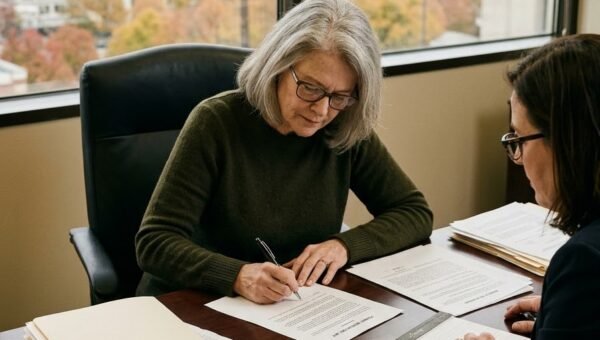
The office was in a low brick building near the courthouse. I’d been there with Dad once, years earlier, when he was setting up his will. Mr. Dunne remembered me. He offered coffee, but I said no because I’d already had two cups at Mom’s. He laid a few pages on the desk and started explaining what I was signing.
I remember hearing “advancement against inheritance.” I remember hearing that the $120,000 would be counted against whatever I received later. Mr. Dunne read the language out loud, then stopped to ask if I understood. I could have asked him to explain it again. I could have taken the papers home. I could have read them. Instead I nodded, because the number in my head was the transfer, not the words on the page.
“That makes sense,” I said.
Mr. Dunne looked at me a little longer than I liked. “It’s important that you understand this is not a separate gift on top of your inheritance.”
“I understand.”
I didn’t. Or I didn’t want to. There’s a difference, but it doesn’t help me much now. I signed where he pointed. Three times, I think. Mom sat in the chair beside me and watched. When it was done, Mr. Dunne handed me a copy. I folded it once and shoved it into the glove box of my truck.
On Wednesday, Mom wired the money. I got a bank alert while I was in the break room at work. I stared at it for a minute, then showed the screen to a guy from the shop. He whistled. I said, “It’s family money.” That made it sound earned.
I bought the boat that Friday. It was bigger than the one I’d originally been looking at, because I had the money and figured I might as well get something we wouldn’t outgrow. I posted pictures online. The first weekend, Jenna and I took the kids out on the water. I remember one of them dropping a cheese cracker between the seats. I remember Jenna laughing when I tried to get the engine started. We had a good afternoon. I’m not going to pretend we didn’t.
After that, I got busy with the boat. There were supplies to buy and a cover to order and things I hadn’t thought about until I owned it. I visited Mom less. I told myself she was fine. When she called, I’d answer if I wasn’t working. If I was on the water, I might call back the next day. She didn’t complain, which made it easier to keep doing it.
There were little things I noticed and decided not to think about. Mom still asked how Jenna was. She’d say, “Bring the kids over when you can.” I’d tell her we would. She’d ask when we were going to use the boat again, and I’d say the next weekend. Sometimes I meant it. Sometimes I was just trying to end the call without hearing her sound disappointed.
Jenna started asking about the house in June. She didn’t ask to take it. Not at first. She asked whether Mom would ever want to move somewhere smaller. She asked what the apartment over the garage was like. It had a bathroom and a little kitchen, and I said Mom could live there if she wanted. Jenna said she was worried about asking. I told her Mom would understand. I was already treating an idea as a plan.
We were sitting at our kitchen table when I said I’d talk to Mom in July. Jenna took a sip of water and set the glass down carefully.
“Did she say you could have the house?”
“Not exactly.”
“Then why are we talking like we’re moving in?”
I got irritated with her for asking. That’s the part I hate admitting. She was asking the one fair question, and I acted like she was slowing things down.
“It’s all coming to me anyway,” I said. “I’m just trying to get ahead of it.”
Jenna didn’t agree. She didn’t tell me I was wrong either. She just looked down at the table. I took that as permission because it was easier than hearing what she was actually saying.
I went to Mom’s in July without wine. I’d decided I should sound practical, not like I was making a second request. I told her Jenna and I wanted to move into the house. I said it was too much space for her and she could use the apartment over the garage. I said there were nice places nearby if she didn’t want to live on the property.
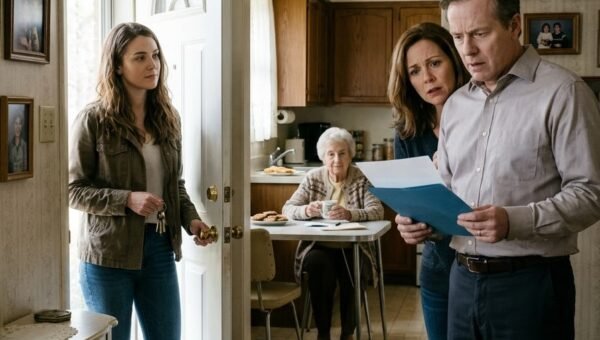
Mom was in the living room. Dad’s chair sat near the window, and I knew not to sit in it. I stood by the table instead. She asked what I meant by “move into the house.” I said we’d take the main house and help her sort through things. She asked where I thought she would sleep.
“The apartment,” I said. “Or we could look at places.”
She stared at me. I heard the refrigerator kick on from the kitchen. There was a little rattle in the ice maker that Dad had never fixed. I was standing there asking Mom to leave the house she’d lived in for decades, and I noticed that stupid noise because I didn’t want to look at her.
“You’re asking me to move out,” she said.
I shifted my feet. “I’m asking you to think about it.”
“By spring?”
“We’d want to get things settled by then.”
She had her hands folded in her lap. “Why do you think you have the right to decide that?”
I gave her the answer I’d been using in my head. I said the house would be mine one day. I said she’d already given me money early, so this was the same kind of thing. I told her that it didn’t make sense to wait.
“Mom, it’s all coming to me anyway.”
She walked over to Dad’s chair and sat down. She didn’t yell. She didn’t cry. I would’ve known what to do with that. Instead she asked if I remembered March, Mr. Dunne’s office, and the paper I’d signed.
“Sure,” I said. “The money thing.”
“Go get the copy.”
I didn’t think it mattered. That’s why I went to the truck without arguing. I opened the glove box and found the paper under an old insurance card and two takeout receipts. I had folded it enough times that the creases had gone soft. I read the first line, then the next. I didn’t have to get far to see the words I’d heard in March.
I stayed out by the truck longer than I needed to. I was trying to remember what Mr. Dunne had said. I remembered his voice, but not the details. I remembered Mom watching me sign. That part was clear. I went back inside with the paper in my hand.
Mom hadn’t moved from Dad’s chair.
“What is this?” I asked.
“You signed it.”
“I know I signed it.”
“Then read it.”
I looked down again. The paper said the money was an advancement against my future inheritance. The amount would be deducted from my share of Mom’s estate. I had understood those words well enough to sign them, if not well enough to admit what they meant.
“That’s just the $120,000,” I said.
“That’s what you asked for.”
“That doesn’t mean I can’t have the house.”
“No. It means you don’t own the house.”
I was embarrassed, and I turned that embarrassment into anger because anger felt better. I said I’d been led to believe we were making an arrangement. Mom said she’d told me to read it. I said I’d trusted her. The sentence came out of my mouth before I could hear how ridiculous it was.
“You trusted the lawyer,” she said. “He read it to you.”
I looked at the page again. There was more text below the part I remembered. I’d signed next to the paragraph. My eyes moved across it slowly. The paper didn’t say the house was promised to me. It didn’t say I could move in, or that Mom had given me control of anything. It said the money was an advance against what I might inherit. The house was still hers.
I wanted to argue over the word “might.” I wanted to say that she couldn’t change things now after giving me the money. I wanted to call Mr. Dunne and ask if the paper could be undone. I also knew I had spent the money. There was no way to put that back into Mom’s account.
“Is there another number here?” I asked.
“Keep reading.”
I read it. The clause said the advance would be counted against my eventual share before anything was distributed. That was all. No secret penalty. No trick. No extra charge. Just the part I’d nodded through because I wanted the money.
I looked at Mom. I thought she might tell me she’d changed her mind, that we could work something out. Instead she said the house wasn’t mine, and she wasn’t moving out. She said she’d spoken to Mr. Dunne after I brought up the move. He’d confirmed what the document meant and told her she had no duty to hand over the house. I didn’t like hearing that from her, but I couldn’t say it was wrong.
“You’re not going to give me the house?”
“No.”
“After the money?”
“The money was an advance. You signed for it.”
That was the sentence. Plain as that. I had no good answer. I said she was making me sound like a thief. Mom said she wasn’t calling me anything. She was telling me what I had done.
I left the paper on the table and went home. Jenna was in the kitchen. I told her Mom had said no. Jenna asked what the paper said, and I gave her the short version. She asked whether I’d read it before I signed. I said Mr. Dunne had read it out loud. She didn’t press me. Somehow that felt worse.
A few days later, Jenna called Mom. I didn’t know she was going to. She told me afterward that she’d asked if Mom was all right and then said she needed to know what I had told her about the house. Mom told her I’d asked her to move out by spring. Jenna told me I’d said we were going to get the house.
I was angry at Jenna for telling me what I’d said. That’s how far gone I was. I tried to explain that I hadn’t meant it like that. I said I’d been talking about the future. Jenna reminded me I’d told her we could start planning the move. She said she’d believed me. I said I believed it too.
That wasn’t true. I believed I was entitled to it. I had never asked Mom if she wanted to leave. I had never asked what she needed. I had just kept saying “anyway” until it sounded like a fact.
Jenna and I had a long talk that night, though I did most of the talking. I said she shouldn’t have called Mom. She said she didn’t want to be part of a plan that made Mom feel pushed out of her own house. I said Mom was making things difficult. Jenna said, “She owns it, Kyle.”
I had no answer that didn’t make me sound worse.
Mom didn’t cut me off. She didn’t block my number or tell the family I was a bad son. She did something harder for me to argue with. She kept her boundaries. She told me to call before I came over. She said the house was not up for discussion. She said the money had been handled and there would be no more early inheritance.
I called Mr. Dunne and asked if there was any way to change the paper. He explained the terms again. I said I hadn’t understood. He asked whether he’d read it to me. I said yes. He asked whether I’d been given a copy. I said yes. I could hear myself saying those words, and it was like answering questions about a job I’d done badly.
“Can Mom still leave the house to me?” I asked.
“She can make her own decisions about her estate,” he said. “You have no claim to the house while she’s alive.”
I wanted him to say something softer. He didn’t. I hung up and sat in my truck for a while. I kept the engine off. The paper was still folded in the glove box, where I’d put it back after the visit. I’d signed it, carried it around, and forgotten it. That is not the same as being tricked.
In August, Mom asked me to come by. I almost didn’t go because I figured she wanted to talk about the house again. She said on the phone she had something she wanted to tell me, and I decided the right thing was to show up. I still wanted to believe there was a way to get back to what I thought I’d been promised.
She had a letter from Dad on the table. I knew his handwriting, though I hadn’t seen it in a while. Mom said she’d found it in his desk while sorting papers. She didn’t ask me to read it. She just said Frank had written it after his last doctor visit, when he was getting things in order.
I asked what it said. Mom told me it was about wanting her to be safe and not letting anyone rush her into a decision. Dad had written that he’d worked all his life so she wouldn’t have to ask permission to stay in her own home. I asked if he’d named me. Mom said he hadn’t. I don’t know why that bothered me. It did.
She put the letter back in its envelope. I didn’t ask to see it. I’d already heard enough to know Dad had thought of the possibility that somebody might pressure her. I wanted to say he meant someone else. I didn’t.
The boat started costing more than I’d expected. Storage, fuel, repairs. The money I’d spent was gone, and what I still owed was my problem. At first I told myself I could sell it in the spring and get most of the money back. Then I got an estimate. It was lower than I expected, and I got mad at the person who gave it to me, as if he’d set the price just to insult me.
Jenna didn’t say I told you so. She didn’t have to. We had already used some of the money on the boat and some on bills. I’d spent the rest on things I couldn’t point to anymore. I didn’t have $120,000 sitting somewhere, waiting to be returned to Mom. I had a boat that I was now trying to sell.
I went back to Mom’s once in September. I called first. She let me in, but she didn’t offer me coffee. I stood by the kitchen counter and asked if she’d thought more about the house. She said no. I said it felt like she was punishing me. She said she was keeping her home.
I told her I was her only son. I had used that line before, though I hadn’t noticed how much it sounded like a bill. She said, “I know who you are, Kyle.”
I wanted to hear that as love. Maybe it was. Maybe it was also a warning. I don’t know. She didn’t say she hated me or that she would never speak to me again. She asked me how Jenna was. I said she was fine. Then I left without asking how Mom was.
I did sell the boat. Not for what I paid. The buyer came on a Saturday, walked around it, asked about the engine, and offered less than the amount I still owed. I took the offer anyway. I needed the payments gone. I signed the transfer papers on the hood of my truck and watched the buyer tow it away.
I’d told Mom she could watch me enjoy the money while she was alive. I didn’t think about that line for months. Then I stood in my driveway watching the boat disappear behind another truck, and I heard myself saying it again. I had made it sound like a kindness. It wasn’t. It was a way to make my wanting something sound like something she should be grateful for.
Mom hasn’t changed her will in front of me. She hasn’t told me what I’ll get, and I haven’t asked again. I know she can make her own choices. I know the $120,000 is already counted against whatever she leaves me. I also know she might leave less than I expected, or nothing. I still catch myself trying to add up the land and the house. Then I remember I’m doing it.
I wish I could say I’ve become the son who visits just to sit with her. Some visits are like that. Some are still me checking whether she’s softened, whether the house is still a subject I can raise. I catch myself before I say it now. Not every time.
The signed copy is still in my glove box. I took it out once to show Jenna. She read the line I had skipped over and handed it back without saying anything. I folded it along the old creases and put it away. I had asked Mom for money so I could enjoy it while she was alive. The paper says exactly what I signed: it was an advance against my inheritance.