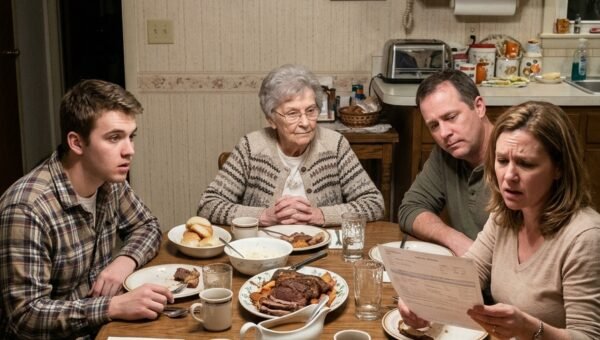
My mother kept the sugar bowl on the kitchen table, right where my father liked to set his coffee. On Tuesday morning, he slid a folded bill beside it and told her she owed him $1,140 a month. Mom read the paper twice, then looked at me because I happened to be there dropping off a jar of peach preserves. I didn’t say anything. I thought I was helping by staying out of it.
I’m June, their daughter. I was fifty-three then, and I lived about fifteen minutes away in the same old South Carolina textile town where Mom had sewn shirt collars for thirty-one years.
Dad, Dewitt, read power meters for thirty-four. They retired the same spring, and I thought they’d be glad to have time together. Mostly they got in each other’s way. I had watched that start happening for months, but I kept calling it an adjustment.
Dad went for coffee at the gas station every morning with his friends. Burl was the loud one, and he liked to complain that his wife spent his pension like water. Mom heard that kind of talk when she went in for gas, too. I remember her saying, “I guess Dewitt thinks I’ve got a secret shopping habit now.” She laughed, but it was the sort of laugh that asked me to tell her it was silly.
I told her it was silly. I didn’t ask if Dad had said anything outright. That’s the part I wish I’d done differently. I’d seen him start looking at grocery receipts, and I’d seen Mom stop telling him what she bought for the house. I was busy with my own life, and it was easier to think their forty-four years together could handle a rough patch without me.
That Tuesday, Dad had come home from coffee and taken the bill from his shirt pocket. He smoothed it out on the table. Electricity, water, groceries, cable, and half the house insurance.
He’d written the total at the bottom and circled it twice. I can still picture a little peach stain on the sugar bowl from the jar I’d brought.
“That’s your half,” he said.
Mom touched the paper with one finger. “My half of what?”
“Of the house. All the bills.”
“I’ve been paying bills here since before you retired.”
Dad rubbed the side of his coffee cup. “I’ve been carrying you for forty-four years, Rosetta. A man gets tired.”
I looked down at the preserves. I had a whole jar in my hand and no useful words in my mouth. Mom looked at me once, then back at him.
“Carrying me?”
“From now on, we each pay our own way.”
Then he held out his cup for more coffee. Mom filled it. I watched her do it because she’d been pouring his coffee for years, even when she was mad at him. Dad drank it and went to the den.
I took the bill home with me, or I thought I did. Actually, Mom had folded it and put it in the drawer with the takeout menus. The thing I took home was the feeling that I should have said something. But the next time I came over, Mom was calm, almost cheerful, and that made me think she had it handled.
She told me Dad had gone shopping by himself for the first time in forty years. He came back with bologna, white bread, and pork rinds. He set the bags on the counter and said, “That’s my half. You get your own.”
Mom made baked chicken that night. She told me she ate it at one end of the table while Dad ate his bologna at the other. When she got to that part, she smiled and said, “He watched every bite I took.” I laughed, too. I know I shouldn’t have. It sounded like a silly story when she told it lightly, and I let it stay silly.
Then Mom showed me the shoebox from the hall closet. It held receipts going back to 1982. She’d kept them in envelopes, sorted by year. I remember one old receipt for a lamp, folded so small it had a crease right through the price. She told me she’d started saving receipts because Dad used to lose his.
“I didn’t think I’d need them to prove I live in my own house,” she said.
I didn’t know what to say to that, either. So I sat down at the kitchen table and helped her sort the newer ones. It felt practical. It also felt good to be on her side in a way I could see and touch.
We found the television receipt first. Mom had paid for it with her factory money in 2019. The recliner was a birthday present she’d bought Dad when he turned sixty-five. The deep freezer was hers, and so was the mower. She’d paid half the bass boat down payment and the last three years of payments. There was a receipt for the truck tires, and one for the grill.
She wasn’t making any of that up. I had watched her bring the television home. I remembered her saying the old one was giving everybody a headache. I just hadn’t kept track of who paid for what. Dad hadn’t, either, as far as I knew.
We counted the receipts and made a list. At first Mom wrote everything in her neat block letters. When her hand got tired, I took over. I was mad by then. I wrote “paid by Rosetta” beside the big things and thought that was fair. I didn’t wonder whether it was fair to turn a private argument into a label on every object they owned.
Mom drove to the store the next morning and bought six packs of yellow sticky notes. She put the bags on the table next to the shoebox. The smell of the adhesive takes me straight back to that kitchen. I can’t smell it now without seeing the bill Dad had slid beside the sugar bowl.
We spent three days marking things. The television got a note that said it was paid for by Rosetta, Christmas 2019. The recliner got one for his sixty-fifth birthday. The freezer, the mower, the grill, and the coffee maker all got notes. Mom put one on the bass boat, right over the part where Dad had named it after his mother. I asked if she wanted to move that one to the window.
“No,” she said. “He’ll see it.”
I helped with the remote, too. That detail is why I can’t pretend I was only watching. Mom wrote “Paid for by Rosetta” on a note and stuck it to the back of it. I thought it was funny. I even said, “That one might be a little much.” But I was smiling when I said it, and she smiled back.
For a few days, Dad didn’t notice. He went to the den, watched television, and came back to the kitchen for coffee. Mom didn’t take any notes down. I figured the quiet meant he’d gotten the message, or at least that he knew she was serious. I didn’t ask what she wanted to happen next.
On Thursday, Dad opened the refrigerator to get a beer and finally saw the yellow note on the door. He read it, shut the door, then opened it again as if the note might have changed.
“What in the world is this?”
Mom was at the sink. “That’s my refrigerator, honey. Paid for in 2016.”
“Your refrigerator?”
“We each pay our own way now. You said so.”
Dad looked at me. I was sitting at the table with a dish towel in my lap. I could have gotten up. I could have said this was getting out of hand, or asked him what he thought the note was supposed to do. Instead, I folded the dish towel into smaller and smaller squares.
He gave a short laugh. “Rosetta, you’ve lost your marbles.”
“Maybe so,” she said. “But I’ve still got my receipts.”
He shook his head and went to the den. He didn’t take the notes down. Mom told me later she thought he was waiting for her to get tired of it. I think she was waiting for him to apologize. Neither of them said that out loud.
The game was Saturday, the same as it was every fall. Dad had Burl and a few other friends over to watch. Mom always made seven-layer dip. She made it that year, too. I offered to bring a salad, but she said she had enough food, so I came early instead.
I found her in the kitchen with the dip bowl and another yellow note. She stuck it to the side of the bowl, then stepped back to read it. I could tell she wanted me to laugh, so I did. It said the dip was paid for by Rosetta. That was the note that finally made me feel uneasy, but by then all the other notes were up.
“June, it’s just a joke,” she said.
“I know.”
I did know. I also knew Dad had invited people into a house with notes on the furniture, the television, and the boat. I could have told Mom I didn’t want any part of it. Instead I carried the dip to the counter and straightened the note so it faced out.
At 2:15, the trucks started coming into the driveway. Burl came in with a sack of ice, talking about the game before he’d even taken off his jacket. Then he saw the notes in the den. He stopped, and the men behind him stopped, too.
“Dewitt, why’s your whole house got yellow stickies on it?”
Dad glanced at the television and then at Mom. “Rosetta’s playing a little game.”
Burl read the note on the recliner. Then he read the one on the freezer. One of the men chuckled when he saw the note on the bass boat.
“Dewitt, I thought you said she spent your money,” he said.
Dad’s mouth tightened. He looked toward me, and I stared at the dip bowl. The bowl had a chip along the rim, the same chip it had when I was a kid. I had no excuse for finding that more interesting than my father’s face.
“Sit down, all of you,” Dad said. “The game’s starting.”
He dropped into the recliner and reached for the remote. There was a yellow note on that, too. He read it and looked at Mom.
“You put one on the remote?”
“Sure did.”
He pointed it at the television and pushed the button. Nothing happened. He pushed it again, harder. The men behind him went quiet. I thought he was going to throw the remote, but he turned it over and worked open the little battery door.
It was empty.
A yellow note was stuck inside.
Dad pinched the paper and pulled it out. He read it once without saying anything, then held it out where Mom could see. The note said, “Batteries paid for by Dewitt, $4.89.”
For a second, nobody moved. Then Burl let out a small laugh and stopped when he saw Dad’s face. Mom looked at the note, then at the remote. I knew she’d taken the batteries out to make sure Dad would find the one she’d put there. That was the plan. I had helped make the plan.
But the note wasn’t hers.
Dad had written his own. He’d bought the batteries, removed them before the game, and put his note in their place. He had seen the labels and answered them with a label of his own. Mom had expected to catch him; he’d been waiting to catch her.
I should have been relieved that the room didn’t laugh at her. I wasn’t. I saw my mother’s hand reach for the remote, then fall back to her side. I saw my father holding up a four-dollar note like it was proof of something. I was the one who’d helped turn their kitchen into a courtroom.
“Did you take them out?” Mom asked.
Dad folded the note once. “You started keeping score.”
“That isn’t an answer.”
“No,” he said. “It’s what happened.”
Mom’s face changed then, not in some big way. She just looked tired. One of Dad’s friends mumbled that he’d check the score on his phone. The others found places to sit. Nobody asked for the dip.
I went into the kitchen and brought the batteries back. I’d put them in my purse earlier, after Mom asked me to keep them somewhere safe. I set them on the table. I didn’t say I was sorry right away, because I didn’t know whether I was apologizing for helping Mom or for not stepping in sooner. It was both, I guess.
Dad put the batteries in the remote. The television came on. The game played. Burl took a scoop of dip, and the men talked about the score as if the note had been a commercial they could skip. Mom sat on the kitchen stool and kept her hands folded. I stayed beside her, but I couldn’t make the house feel normal again.
When the men left, Dad carried the remote back to the table. He laid the note beside the folded bill. Mom didn’t touch either one. I thought she might tell him to keep his $4.89. Instead, she said, “We need to sit down and write out what we actually pay.”
Dad nodded. “All right.”
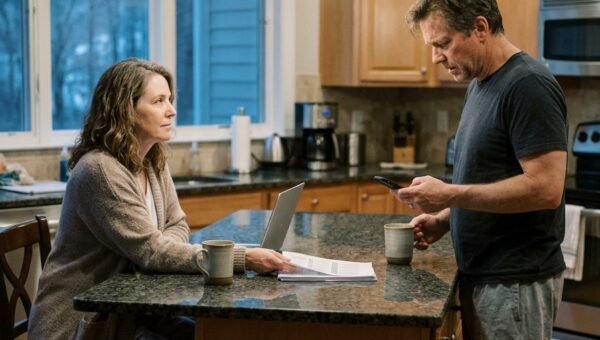
That was the first useful thing they’d said to each other all week. On Sunday, they went through the bills together. They agreed on a monthly amount for the shared costs and opened a separate account for it. Mom didn’t hand over $1,140. Dad didn’t call it carrying her. They made a list that had numbers on it, but neither of them put a note on the refrigerator.
They didn’t fix forty-four years in one afternoon. Dad still went for coffee, and Mom still got quiet when he came home. I kept coming by, though. I stopped telling myself they were fine just because they weren’t asking me to pick a side.
For a while, the yellow notes stayed up. Mom took them down one by one, but not all at once. The one on the television came off first. The note on the recliner came down after a week. The note on the remote stayed in the kitchen drawer, folded around Dad’s little paper.
I asked Mom why she kept it.
She shrugged. “I don’t know. I guess I want to remember how silly we got.”
I didn’t tell her I thought the number on it was the saddest part. The television had cost hundreds. The boat had cost thousands. But the only number Dad wrote in his own hand was $4.89.
The next time I visited, the sugar bowl was back in the middle of the table. Dad set his coffee beside it. Mom poured. I watched them both, and I didn’t laugh when either one reached for something the other had paid for. The folded note was still in the drawer, and I knew exactly how much the batteries cost.