At 5:18 in the morning, Julian texted me that my son could never be part of his life. I was sitting on the bathroom floor with Milo asleep against my shoulder, reading the message again because I thought I had to be misunderstanding it.
“You should have listened to me.”
Then, a minute later: “That child cannot become part of my life.”
I didn’t answer. I took a screenshot. My phone made that little camera sound, which seemed rude at that hour.
Milo stirred, so I put the phone face down and rocked him until he settled. I had no idea that, three months later, another woman would read those exact words and know something I didn’t.
Back up six months. Julian and I worked at the same tech marketing agency in Seattle. I was 34, writing product copy and trying to get promoted without looking like I wanted it too much. Julian was 42 and good at making people feel like they were the only person in a room. He remembered my coffee order and sent a text before work if I’d mentioned a bad meeting the day before.
He told me he was single. He said he lived alone in a condo near Queen Anne, but he never asked me over. Sundays, he said, were for helping his widowed mother, Margaret, with groceries and medication. I believed him because it sounded ordinary, and because I wanted to. That part is embarrassing, but it’s true.
There were things I noticed. His phone was always face down. He didn’t answer FaceTime after nine. He’d cancel a weekend plan, then send flowers to my office on Monday like flowers could cover a whole weekend. I asked once if there was somebody else.
He smiled. “You worry too much.”
I knew that wasn’t an answer. I let it pass anyway. We’d been together about six months when my period was late. I took four tests in my bathroom, one after another, even though the first two had already said what the others said.
Julian came over that night. I’d set the tests on the counter, and I remember one had a little strand of my hair stuck to it. I was trying to say it calmly, like I could make the news easier by using the right tone. He looked at the tests and said, “You can’t keep it.”
I actually asked him to repeat himself. He rubbed his forehead and said, “This pregnancy needs to end.”
“You told me you loved me.”
“I do.”
“Then why are you talking about our baby like an inconvenience?”
He looked tired, not cruel. That made it harder to understand. “Maya, don’t make this more dramatic than it has to be.”
I didn’t tell him to leave right then. I wish I had. Instead, I sat on the edge of my bed while he talked about timing and money and how neither of us was ready. He’d say he loved me, then disappear for two days. He’d send flowers, then miss a call when I needed to talk. I kept trying to turn it into a plan we’d made together. It wasn’t.
Two months later, I heard him laughing at a pharmacy downtown. I was holding prenatal vitamins and trying to compare labels. He came around the aisle with a woman beside him and a little boy holding his hand.
“Daddy, can I get that?”
The woman smiled at him. Julian picked the box up for the boy. I stood behind a display of cough drops until they were gone. I don’t know why I didn’t just walk out. I was scared he’d see me, I guess, though he’d already seen me plenty.
That night I looked him up. His wife was Claire Sterling. They’d been married eleven years. Their son Leo was six. There were holiday pictures, family trips, one anniversary post from a restaurant I recognized because Julian had once said he’d never been there.
I looked at the pictures longer than I should have. Then I called him. He came to my apartment the next evening, and I put my laptop on the counter with his family photos open.
“You weren’t supposed to find out this way,” he said.
“How was I supposed to find out?”
“Maya, ”
“Were you going to tell me after I gave birth?”
He didn’t answer that. He asked me not to contact Claire. He said the marriage was complicated, which is something people say when they want the other person to stop asking for facts.
“She’s your wife,” I said. “I’m carrying your child.”
He set a thick envelope on my counter. There was cash inside. I didn’t count it. I didn’t want to give it that much attention.
“There’s enough here to solve the problem,” he said.
I pointed at the door. “Get out.”
His face changed. “If you contact Claire, you’re going to create problems you don’t understand.”
“Is that a threat?”
“It’s advice.”
I wanted to throw the envelope at him. I didn’t. I left it on the counter until he walked out, then put it in a drawer. I told myself I kept it because I might need proof. I also kept it because rent was due. Both things can be true.
After that, Julian was hard to reach. Sometimes he answered a message with a thumbs-up. Sometimes he didn’t answer at all. I stopped asking him for help because every conversation left me feeling like I’d done something wrong by having needs. I still thought about Claire. I didn’t contact her. I told myself I was sparing her. Maybe I was sparing myself.
Milo was born early on a Thursday morning during a thunderstorm. I named him Milo because I liked how it sounded when I said it out loud. I don’t have a better reason. He had a small crease by his ear and a little crease in his palm that I spent the first day counting with my thumb.
A pediatrician came by several hours later and said Milo had features that could point to Down syndrome. The tests confirmed it. I cried after the doctor left, with my hospital gown sticking to my back. I wasn’t ashamed of my son. I was afraid I wouldn’t know how to take care of him, afraid of the medical appointments, the money, the way strangers might look at him, all of it landing at once.
Then he wrapped his fingers around mine. I remember the nurse’s coffee had gone cold on the counter, and I remember thinking I should tell her. That’s the sort of thing I remember. Not what I said to the doctor.
I sent Julian a picture and wrote, “He’s here. His name is Milo. The doctors confirmed he has Down syndrome.”
He took almost five hours to reply. First came, “Do not contact me again.” Then, “You should have listened to me.” Then the line that brought me back to the bathroom floor: “That child cannot become part of my life.”
I took screenshots because I wanted a record. I didn’t know what I was building one for. I just knew the words sounded like they’d been used before.
For three months, I did the feeding, the appointments, the phone calls, and the late-night searches I’m not proud of. I read too much online and sometimes had to close the screen and go wash a bottle. Milo was Milo, not a list of things I needed to fear. That sounds obvious now. It wasn’t always obvious to me at three in the morning.
I didn’t contact Julian again. I did look up Claire. I’d type her name, close the page, then type it again. I knew what I wanted to tell her, but I didn’t know what I expected her to do with it. I also knew she might decide I was lying. She had every reason to.
One night Milo fell asleep on my chest, and I wrote the message in my notes app first. I changed it a few times. I didn’t want to sound like I was asking her to take my side. I didn’t want to sound like I was asking for money. I didn’t want to be the person who dropped this on her and made her comfort me.
Finally I sent: “My name is Maya Vance. I’m sorry to contact you this way. I didn’t know Julian was married when we became involved. I recently gave birth to his son. His name is Milo, and he has Down syndrome. Julian has told me never to contact him again. I’m not asking you for anything, but I believe you deserve to know the truth.”
I attached Milo’s picture. Then I put my phone on the counter and washed a bottle. I checked it five minutes later, which was pointless. I checked again before bed. No reply.
Nothing the next day either. By the third morning, I’d started telling myself she’d blocked me. At 6:45, somebody knocked on my door.
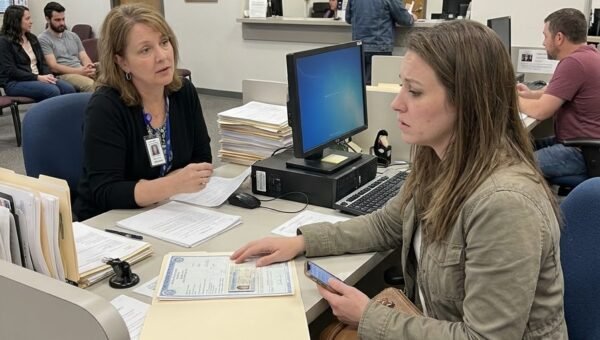
Claire was standing in the hall. Her hair was pulled back, and she had no makeup on. Her eyes looked sore from crying. She was holding a thick folder against her chest with both arms.
I opened the door only a little. “If you came here to yell at me, I understand. Please don’t do it in front of my son.”
She wasn’t looking at me. She was looking at Milo.
Her hand went over her mouth. “Oh my God.”
“What?”
“Can I come in?”
I should say I thought about it. I did, for a second. Then I stepped aside. Claire sat on the couch. I stayed by the doorway, holding Milo and keeping the phone with Julian’s messages close enough to reach.
“Did Julian know Milo had Down syndrome?” she asked.
“Not until he was born.”
“What did he say?”
I showed her the screenshots. She read them without speaking. When she reached the last message, her thumb stopped over the screen.
“I was afraid of this,” she said.
“Afraid of what?”
She looked at the folder in her lap. “Julian did this before.”
I could hear Milo breathing against my shirt. I didn’t ask which part she meant. I was afraid I already knew.
Claire set the folder on the coffee table and opened it. There were clinic papers, a few printed emails, and a small card with a date written on it. She turned the card so I could read it. It was from a pregnancy clinic, dated nine years earlier.
“I was pregnant before Leo,” she said. “Our first baby. We got a prenatal test result that showed Down syndrome.”
She didn’t say it like a confession. More like she’d been saying the same sentence in her head for a long time.
“I didn’t know,” I said.
“Most people didn’t. Julian told our families I miscarried.”
Claire pressed her fingers together, then let them go. “I was scared. I was sick all the time. He kept saying we couldn’t do it, that it would ruin our lives, that the doctors didn’t know what they were talking about. He said he’d stay with me, but he wouldn’t raise a child with a disability.”
She looked down at the folder. “I ended the pregnancy. I told myself it was my choice. Some of it was. I signed the forms. I walked into the clinic. I’ve never blamed him for the part that was mine.”
That wasn’t what I expected her to say. I had pictured her coming to me with a clean story, one where he was the only person who’d made a choice. She wasn’t doing that. She was telling me what she had done and what he had said.
“What’s in the emails?” I asked.
“One I found in an old account. He wrote to his brother before the appointment.” She slid a page toward me, but she didn’t push it into my hands. “I hadn’t seen it before. He’d told me he’d just been scared. He said he’d support me either way.”
The email was short. Julian had written that if the test came back positive, there was no way he was “bringing a child like that into the family.” He’d asked his brother to back him up if Claire changed her mind. The message was dated three days before the appointment.
I read it twice. The first time I saw the words. The second time I saw the date. Three days before, Claire had still believed they were deciding together.
“I found it when I was trying to move old family pictures off that account,” she said. “I wasn’t looking for this. I had to read it a few times before I could tell myself what it said.”
I looked at her. “Why did you come here?”
She wiped her cheek with the side of her hand. “Because when I saw Milo’s picture, I knew what Julian’s message meant. He’d already decided what he’d do if this happened again. And I couldn’t let you think his choice had anything to do with Milo being worth less.”
I sat down then. I didn’t plan to. My knees were sore, and I had been holding the baby too long. I laid Milo across my chest, and he made a small sound.
Claire didn’t reach for him. She asked first. “Can I hold him?”
I looked at her hands. They were shaking a little. I could have said no. I almost did, not because I thought she’d hurt him, but because I was afraid of how it would feel to watch her hold a baby who looked like the one she’d lost.
Then I remembered I’d been looking at her from the outside for months, making her a character in my own story. I handed Milo over.
She held him carefully and made a small sound when he curled his fingers around hers. She cried, but she didn’t make me comfort her. That mattered to me.
“I’m sorry,” she said.
“I’m sorry too.”
She nodded. “I know.”
We didn’t become friends that morning. She left after about an hour, and I watched her carry the folder down the hall. Before she got to the stairs, she turned back.
“I don’t know what I’m going to do about Julian,” she said.
“Neither do I.”
That was the first honest thing we had in common.
For the next week, we traded a few messages. Claire told me she had taken the email to a counselor she’d seen years ago. I told her I’d found a family-law office and had an appointment. I didn’t ask her to help me. She didn’t offer to fix it.
At my appointment, the lawyer told me to save every message, write down dates, and use email if I had to contact Julian. I’d already done most of that without knowing why. The lawyer also said I could ask for a paternity test and child support. I went home with a list of steps that looked plain and tiring. I liked that. Plain and tiring sounded like something I could do.
Julian called me the next evening. I let it go to voicemail. He left a message saying he’d heard from Claire, that this was a private family matter, and I was making it worse by bringing other people in.
I sent one email: “Milo is your son. My lawyer will contact you about paternity and support. Please do not call me again.”
I wanted to add more. I wanted to tell him he’d made me feel foolish and then left me alone with every practical part. I wanted to ask if he remembered the tiny crease by Milo’s ear. I deleted all of that. I sent the plain version.
Claire had a harder time. Julian didn’t shout at her, as far as I know. He called her from work and said she was digging up something they’d already gotten through. She told me he asked why she was punishing him for a decision they’d both made.
“What did you say?” I asked over the phone.
“I said I’d made a decision under pressure, and I wasn’t going to pretend that was the same as making it freely.”
She was quiet after that. “I don’t know if I can stay married to him.”
I didn’t tell her what to do. I knew too well how it felt when Julian explained your choices back to you.
She moved into the guest room that week. A month later, she told me she’d spoken to a lawyer. She was looking at the email, the old clinic records, and what happened with Milo. Nothing was settled, and she didn’t say she was leaving for good. But she stopped letting Julian tell her the past was closed.
Milo’s paternity test came back the next month. Julian was his father. The lawyer handled the next steps. I won’t pretend the money fixed anything. It helped pay for childcare and appointments, and I was relieved to have it. I was also mad that I’d had to prove the obvious.
Claire and I met again at a coffee shop near my apartment. I brought Milo. She brought a picture of Leo, who had lost one front tooth and looked very pleased with himself. We sat at a table by the window and talked for almost two hours. We didn’t talk about Julian the whole time. We talked about school, work, sleep, and how a small child can make every day feel like it has twelve separate mornings.
She told me she didn’t know if she could ever forgive herself for the pregnancy she ended. I told her I didn’t know how to forgive myself for staying with Julian after the first time he told me what he wanted me to do. Neither of us tried to make the other feel better by saying it wasn’t our fault at all. That wouldn’t have been true.
Claire still had to go home to a marriage she was trying to understand. I still had to raise Milo and deal with Julian through lawyers. We didn’t save each other from any of that. We did stop being alone with the story.
A few weeks later, Claire came by again. She asked before she held Milo. I said yes. She sat on the couch and let him grab the seam of her sweater. I noticed she still had the old folder tucked under one arm, but she didn’t open it.
Before she left, she handed me a piece of paper with her new phone number. Under it, she’d written: “Call me if he tells you you’re imagining things.”
I put the paper in the kitchen drawer with the screenshots and the envelope of cash I’d never spent. I didn’t like that the drawer was getting full of Julian’s decisions. But when Milo woke up from his nap, I took Claire’s number out and put it on the fridge, where I could find it without opening anything.