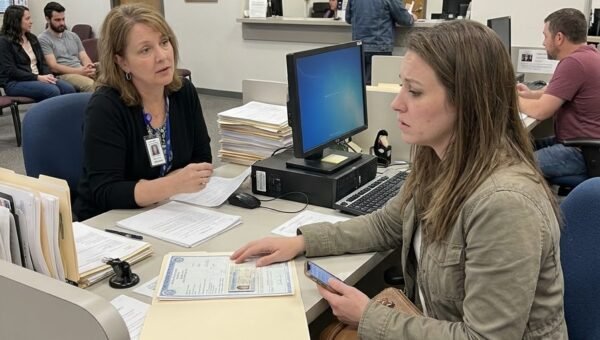
The banker told me my marriage had ended nine months earlier while I was still holding the pen I’d used to sign the inheritance forms.
I kept looking from the court judgment to the statement showing the money my uncle had left me. Fifty million dollars. I’d expected a small amount, maybe enough to pay off a car. Instead, Mr. Henderson was telling me I’d been divorced without knowing it.
“Hannah, did you know a divorce was entered in your name last July?”
I looked at the names again. Mine. Nate’s. My date of birth.
“No,” I said. “I’m still married.”
He turned the folder around so I could read the case number. The judge’s signature looked real. The signature on the agreement looked close to mine, except the bottom of the H was wrong.
“I didn’t sign this.”
Mr. Henderson didn’t argue. He just sat there while I checked the date on the notarized page. June 12. I’d been in the hospital with pneumonia that day. Nate had brought me flowers in a paper sleeve, and I’d asked if the mortgage had cleared.
He’d brushed my hair away from my face and said, “Stop worrying about bills.”
I put my phone facedown on the desk. I’d been about to call him with the inheritance news.
“Don’t add him to anything,” I said. “And I need a copy of every page.”
I was thirty-three and worked as a supply chain manager. At work, a wrong number could hold up a warehouse. At home, I’d spent years finding reasons not to check the numbers too closely.
Nate sold enterprise software. He could make a restaurant server feel like an old friend before the food came. His commissions went up and down, he said, so I covered most of our regular bills. The mortgage, taxes, and insurance on our house outside Chicago came to nearly four thousand dollars a month.
“Your paycheck keeps us steady,” Nate liked to say. “Mine gets us ahead.”
I let that sound like a plan. His mother, Barbara, called him a wonderful provider. Nate never corrected her, and I never did either. I told myself it wasn’t worth making a scene.
That afternoon, the papers said we’d lived in separate homes, disclosed our finances, and settled our property by agreement. My address was listed as Barbara’s house. I’d never lived there. I’d never even had a key.
Mr. Henderson told me he couldn’t fix a court record. I needed my own lawyer.
So I called my phone’s contact list and found an attorney a coworker had once recommended.
The next thing I did was drive home with the papers zipped inside my work bag.
Nate was hosting a backyard party for his colleagues. I’d forgotten. I could hear laughter and chairs scraping before I reached the patio. Barbara saw me first.
“There she is,” she said. “We were beginning to think you’d miss dinner.”
I stepped outside with my bag still on my shoulder. A coworker asked how my day had gone. Before I could answer, Barbara handed me a stack of dirty plates.
“She wears herself out at that warehouse,” she said. “I keep telling her how fortunate she is that Nate can give her all this.”
She gestured toward the house. I’d made the mortgage payment three days earlier.
“Be careful with those,” Barbara said. “They’re not dishwasher safe.”
Nate heard her. He smiled and turned back to his regional director.
The plates were warm against my palms. A steak knife rattled on top. I set the knife and forks on the serving table, walked to the outdoor trash can, and dropped the plates inside.
The crash stopped Nate’s story.
I poured myself a glass of wine and turned toward the group.
“Since Barbara says Nate provides all this, let’s drink to him taking over the bills I’ve been paying. Starting with his Porsche.”
His smile disappeared. He looked at the regional director, then at me.
“Hannah,” he said quietly. “What are you doing?”
“Come inside,” I said.
Barbara started to speak. I picked up my bag instead and walked into the kitchen. Nate followed, shutting the back door behind him. I could still hear people outside trying not to talk too loudly.
He looked at the bag.
“What’s in there?”
“Court papers.”
His mouth tightened. That was the first thing I noticed. Not surprise. Not confusion. His mouth tightened like I’d said a word he’d hoped not to hear.
I took out the judgment and set it on the counter.
“Tell me why there’s a divorce in my name.”
Nate read the first page. He didn’t ask what I meant. He didn’t ask if it was a mistake.
“I can explain.”
“Then explain.”
He rubbed his thumb over the corner of the page. “I didn’t think it would go through like that.”
I waited. The refrigerator hummed behind me.
“You filed it?”
“I was trying to handle some things.”
“Some things like divorcing me without telling me?”
“I thought we’d talk about it.”
“After you filed?”
He looked toward the window, where the patio heaters made a soft orange glow on the glass. “I needed the house and my money separated.”
“The house I pay for?”
“I know what you pay.”
That was the first time he’d said it plainly. I wish I could tell you I felt brave. I mostly felt stupid for how long I’d kept my own receipts and thrown away the ones he handed me.
I tapped the address on the page. “Why is Barbara’s house listed as mine?”
He said nothing.
“Nate.”
“She agreed to let me use it for the filing.”
“Did she know I wasn’t living there?”
His pause answered me before he did.
“She knew.”
The papers showed a notarized acknowledgment from the day I’d been in the hospital. I pushed that page toward him.
“I was in a hospital bed.”
“I know.”
I felt the counter edge against my hand. I kept my voice low because I didn’t want the people outside to hear me through the glass.
“Did you sign my name?”
He looked down. “I signed the agreement.”
“You signed my name.”
“I was going to make it right.”
That line, I think, was the last time I let him use the word “right” without asking what he meant.
I picked the papers back up. Nate tried to touch my arm, but I stepped away.
“Don’t.”
“I didn’t do this because of the inheritance.”
I hadn’t told him about the inheritance. Mr. Henderson had called me at the bank. I hadn’t called Nate. I hadn’t even sent a text.
Nate watched my face. Then he looked at the page again.
“Your uncle’s money,” he said. “That’s what this is about.”
“No. This started before I knew there was money.”
I walked out before he could give me another explanation. I left the wine bottle on the counter. Outside, his regional director was standing by the serving table, and Barbara had gone quiet.
I didn’t tell the group what was in the papers. I didn’t have to. They’d heard enough to know I wasn’t making a joke about the bills.
One of Nate’s coworkers asked, “Are you okay?”
“No,” I said. “But I’m handling it.”
Then I went home to my sister’s place for the night. I slept badly on her couch, with my phone on the floor beside me because I couldn’t stand seeing Nate’s name light up again.
By morning, he’d called eleven times and left four messages. The first said he was sorry. The second said I was making it worse by involving lawyers. The third said we needed to protect our marriage.
I listened to that one twice.
He still hadn’t said he was sorry for signing my name.
My attorney, Ms. Patel, read the court file in her office two days later. She didn’t make a big show of it. She checked the dates, asked me for the hospital discharge papers, and wrote down the name of the notary.
“Don’t confront anyone else until we know what’s in the file,” she said.
“I already confronted Nate.”
“I figured.”
She explained that we’d have to ask the court to set the judgment aside. The forged signature and false address mattered, but the process wouldn’t be finished just because I was sure. We’d need records, declarations, and a judge’s decision.
I brought her the hospital records. The admission date and discharge date covered June 12. The papers also showed that the court had mailed notice to Barbara’s address, not mine.
Ms. Patel looked at me over the file.
“You never received this?”
“No.”
“Did you ever agree to live at Barbara’s?”
“No.”
She nodded and asked me to make a list of every bill I paid. I had plenty. Mortgage statements, insurance notices, tax payments, all in a folder I’d kept because I like things in order. I had never thought that folder would help prove I was still living in my own house.
Nate came to the attorney’s office once, but Ms. Patel wouldn’t meet with him without his own lawyer. He waited outside and asked if I’d talk in the parking lot.
“I don’t want this to be a fight,” he said.
“It already is.”
“I thought I could get the paperwork handled, then talk to you.”
“Why did you sign my name?”
He looked down at the asphalt. “I was scared.”
“Of what?”
“Losing the house. Losing everything.”
I didn’t know what to say to that. He had let me pay most of the bills, then acted like the house and the life inside it were his to protect from me.
“You should’ve talked to me,” I said.
“I know.”
I left. It wasn’t a good answer, but it was the first one he’d given that sounded like the truth.
Barbara called the next day. I let it go to voicemail. She left a message saying she wanted to explain the address.
When I called back, she said she’d thought Nate was “just making things official.” She said he’d told her we were separating and that I knew.
“I didn’t know,” I said.
“I understand that now.”
“Did you tell the court I lived with you?”
“I let him use my address.”
“Why?”
“He said it was only for mail.”
“The papers say I lived there.”
She was quiet.
“I didn’t read every page,” she said.
I wanted to believe that. I also remembered her handing me dirty plates in front of Nate’s coworkers while she praised him for paying for a house he didn’t pay for.
“Did you sign anything?”
“No.”
“Did you know Nate signed my name?”
“I didn’t know that part.”
I asked her to send anything she had about the address to my attorney. A week later, she sent Ms. Patel a short email. In it, Barbara said Nate had asked to use her address because “Hannah wouldn’t need to be involved.” That phrase sat in my mind for a long time.
She wouldn’t need to be involved.
I had been paying the mortgage. I had been in the hospital. I had been his wife. In every way that mattered to me, I had been involved.
Nate’s colleagues didn’t all know what happened. I didn’t want them to. But several had been at the party, and the regional director called me after Ms. Patel filed the court papers.
“I’m sorry about what happened at dinner,” he said.
“You don’t have to apologize.”
“I saw how you were treated.”
That was all. He didn’t promise consequences or tell me what Nate had said at work. I didn’t ask. I didn’t want to turn my marriage into a story for his office.
Still, the party changed something. Nate couldn’t act as though I’d made the whole thing up in a private room. People had watched Barbara hand me her dirty plates. They’d heard me say I paid the bills. They’d seen Nate go quiet.
For a few weeks, everything moved through lawyers. Nate’s attorney sent a response claiming Nate believed I had agreed to the filing. My lawyer asked for the original records and the notary’s information. The notary confirmed that I had not appeared in person on the date listed.
That did not settle the case by itself. It did, however, make Nate’s claim harder to stand behind.
The court hearing came months later. I sat beside Ms. Patel with my hands folded over a notepad. Nate sat across the room with his attorney. Barbara was behind him, holding her purse in her lap.
The judge asked whether I had signed the agreement.
“No,” I said.
“Were you served notice of the divorce?”
“No.”
“Did you live at the address listed?”
“No.”
Nate’s attorney spoke for a while. He said Nate had believed I knew about the filing and that there had been confusion over where I lived. Ms. Patel showed the hospital record, the mortgage payments, and Barbara’s email.
Then the judge asked Nate whether he had signed my name.
He leaned toward his attorney first. They spoke quietly. Nate looked at the papers in front of him.
“Yes,” he said.
The judge asked if I had given him permission.
“No,” Nate said.
Barbara shifted behind him. She didn’t interrupt.
The judge set the divorce judgment aside because I’d never received notice and the agreement had been signed without my consent. My lawyer explained the ruling afterward in plain terms. The judgment was no longer valid. My inheritance was in my name alone, and no joint account had been opened.
I was still legally married to Nate.
That sentence didn’t feel like a win. It felt like walking back into a room where I knew someone had moved the furniture while I was gone.
Nate waited outside the courthouse. He said, “We can start over now.”
I looked at him. He’d worn the tie I gave him for a work award dinner. I used to think it made him look dependable.
“We can’t start over,” I said. “You need to move out.”
He nodded once. He didn’t ask me to reconsider there. Maybe he understood that the papers had answered the question he’d avoided for months.
I kept my inheritance separate. I kept paying the bills that were mine, and I stopped paying the ones that belonged to Nate. He arranged to take over the lease on the Porsche. I didn’t have to threaten him again.
Barbara sent one more message. She said she was sorry she’d helped with the address. I read it, then put my phone down. I wasn’t ready to answer.
Nate moved out before the next mortgage payment was due. We have lawyers handling the next steps in our marriage, and I’m not pretending I know how I’ll feel when those papers come.
The court fixed the record. It couldn’t put back the trust I’d handed over a little at a time.
I still have the work bag I carried into that party. The court papers aren’t in it now. On the first night I was alone in the house, I poured one glass of wine, set it on the counter, and left the dirty plates where Barbara had handed them to me in my mind.
For once, I didn’t clean up after either of them.