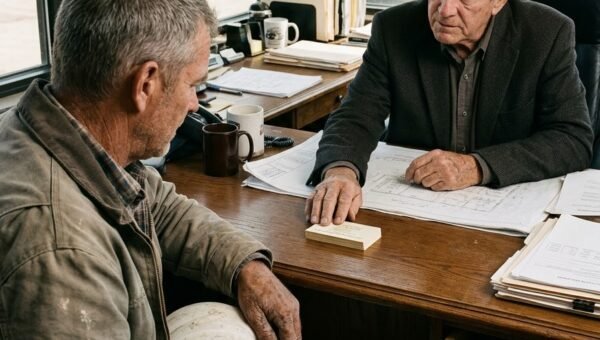
The last ordinary thing Vanessa said before I got home was that she’d left the porch light on. I was still wiping road salt off my boots when I saw my mother’s company papers spread across our kitchen table. I’d been gone ten weeks hauling equipment around the Midwest, and I knew the shape of our place by the sound of the fridge kicking on. The papers didn’t belong there. Vanessa said her father had dropped them off.
I asked what they were. She said, “Old company stuff. It’s nothing.” Then she pushed a glass of water toward me like I’d come in from mowing the lawn instead of driving eleven hours.
I was tired enough to accept that answer, which is something I’ve had to admit to myself since.
I’m Daniel Collins, thirty-nine, a truck driver, and I was engaged to Vanessa Whitmore. My mother, Margaret, was a widow who lived in a modest two-bedroom cottage and drove a Toyota old enough to have a tape deck. I knew she’d started Collins Industrial Holdings with my dad, but she’d always told me she’d sold her stake years ago. I never asked for paperwork. I thought that was her business.
Vanessa had met my mother a few times, but they weren’t close.
My mom was polite, even when Vanessa talked over her. I told myself that was just how Vanessa was around older people. That sounds weak now. It was weak then, too.
The papers stayed on the table after I unpacked. A copy of a company chart, some pages with signatures, and a printout with my mother’s name on it. I picked up the top page, but Vanessa took it from my hand and said her dad needed it back. I asked why he had my mother’s records. She said he was doing a routine review at work and that Mom had probably given him copies years ago.
That was the first small thing I let pass. The next was Vanessa asking when Mom would be home from her volunteer shift, though she’d never shown much interest in Mom’s schedule before. I said I didn’t know. Vanessa said her dad wanted to invite us both to dinner Friday, to “make things official” before we set a wedding date. I thought she meant a toast. I said yes.
I went back on the road Monday. The miles were familiar, and I could usually tell what time it was by how many fuel stops I’d made. Vanessa called most nights, but that week she kept asking about my mother.
Had Mom ever mentioned a trust? Did she still keep her old files? Did I know who had signed the company’s original ownership papers? I told her I didn’t know. She said I should ask.
I didn’t. I was hauling a load through Iowa, and I didn’t want to turn every call into a cross-examination. That’s the excuse I used. The truth is, I didn’t want to hear what those questions might mean.
When I got home Friday afternoon, Vanessa had laid out the blue dress Mom planned to wear to dinner. She said Mom had left it at our place the week before. I asked if she’d talked to Mom about the dress. Vanessa said she had, and that my mother knew what the dinner was for. I called Mom to check. She said, “I know what it’s for, Danny.”
Her voice sounded tired, but she didn’t say no. I knew she could handle herself. I also knew that wasn’t the same thing as not needing me there. We drove to Richard Whitmore’s house together.
Richard was the senior manager of a major Collins Industrial division. I’d heard his name for years, mostly when Mom talked about how well one plant was doing. I hadn’t met him. He had a big house outside town and the kind of relaxed manner some men get when nobody has told them no in a long time.
He greeted Vanessa first, then shook my hand, then looked at Mom’s dress and her old handbag. There was a tiny loose thread near the cuff. I noticed it because I’d fixed it once with a needle from the truck. Richard didn’t say anything about it. Not right away.
At dinner, he talked about the division’s profits and the new warehouse. He said he’d practically built the place himself. Vanessa laughed at his stories, and her mother kept asking if anyone wanted more potatoes. My mother listened without much to say. I had a sense something was off, but I couldn’t have named it yet.
When Mom mentioned she still liked to clean her own house, Richard looked down the table at her. “We need someone to scrub the company toilets. Interested?” His wife laughed. Vanessa covered her mouth and laughed too.
I felt my hands tighten under the table. Mom laid her fork down. She didn’t look at me, but she must have heard my chair scrape because she touched my wrist. I was ready to stand up. She gave me one small shake of her head.
Richard raised his wineglass and said it was only a joke. I said it wasn’t funny. He turned to me and told me to relax, that he was offering Mom a job. I wanted to say more than I did. I also knew Mom would hate me making a scene for her.
She asked Richard what company he managed. He answered proudly, Collins Industrial Holdings. Mom nodded once. Then she set her napkin beside her plate and said she’d see him Monday. Richard laughed and told her to bring her cleaning supplies.
In the car, I apologized for not stopping him sooner. Mom said I hadn’t caused it. I told her I should’ve said something anyway. She looked out the window and said, “You can’t do the talking for me every time.” She was right, which didn’t make me feel any better.
At the cottage, she called Rebecca, the company’s chief legal officer. I was standing in the entryway with my coat on, and I heard Mom say she needed an emergency executive meeting Monday morning. I asked if Richard had done something at work. She told me not to worry about it.
I asked why she’d let him talk to her like that. She said she hadn’t let him do anything. She was choosing what to do next. I didn’t like the answer, mostly because I wanted to be useful. I have spent too much of my life mistaking worry for help.
Mom said she’d explain in the morning. I went home and found the company papers still on our kitchen table. Vanessa was in bed, facing the wall. I didn’t wake her. I took a photo of the top page with my phone, then put the papers back exactly where they’d been.
I’m not proud of that. I told myself I was checking something that belonged to my mother. Really, I was checking up on my fiancée. By then I had enough reason to be worried, but I didn’t want to call it what it was.
The printout showed a holding company I’d never heard of. Mom’s name was listed beside a hundred percent voting interest. I read that line twice. Then I searched the company name on my phone, got a page full of business filings, and understood even less than before.
At 6:40 Saturday morning, Mom called me over. She had coffee on the counter and a stack of old folders on the table. I don’t remember the brand of coffee. I remember the spoon she used had a bent handle, the one Dad had never let her throw out.
She told me she hadn’t sold her shares. She’d moved them into a private trust after Dad died, then kept control through a holding company. She’d wanted a quiet life, and she’d figured the company could run without her showing up in every room. So she let people think she’d retired for good.
I asked if Richard knew. She said he knew she’d founded the company, but he didn’t know she still held the voting shares. She thought he believed the trust was spread among several old investors. That explained the papers on my table. It didn’t explain why Vanessa had them.
Mom said Richard had been trying to get her to sign a transfer of voting rights. He’d told her it was routine paperwork for a planned reorganization. Rebecca had checked the documents and found that the transfer would give Richard’s division control over a large block of company shares. Mom had never signed.
I asked if Vanessa had helped him get the forms. Mom said she didn’t know. She didn’t want to accuse her without proof. That was the first time I saw the sadness she’d been holding back. Not fear. Just a tired kind of hurt.
I went home and asked Vanessa about the papers. She said her dad had asked her to bring them over because he thought Mom might still have an old copy. I asked why she’d told me they were nothing. She said she didn’t want to make a big deal out of work. I asked why she’d laughed at dinner.
She looked away and said, “It was a stupid joke.” I asked if she knew what the papers were. She said no. I didn’t believe her. She saw that I didn’t believe her, and she got angry with me for looking at her phone while she was in the shower. I admitted I’d taken a photo of the papers. That was my part in making the conversation worse.
She said I’d been gone too long to come home and start acting like a detective. She had a point about the way I’d handled it. She didn’t have a point about the papers. We went in circles until she went to stay at her parents’ house.
I spent Sunday gathering what I could without making another mess. I called Rebecca and told her what I’d seen. She said she’d already found that Richard had sent my mother a draft transfer form, plus a memo describing her as “an inactive former founder.” She said the wording was wrong, and the form was not routine.
She told me not to confront Richard or try to get anything out of Vanessa. I said I wasn’t planning to. I meant it at the time. Then I called Vanessa and asked if she’d be at the meeting Monday. She said she didn’t know what I was talking about. I told her I’d be there.
Mom didn’t want me in the room. She said I had no company role and that I didn’t need to make this about me. I said it already was about me, because Vanessa was my fiancée and had brought those papers into our home. Mom looked at me a long time, then said I could sit in if I kept quiet.
Monday morning, I left my truck at the yard and drove to the company headquarters. The boardroom was on the third floor. Mom was there with Rebecca and five board members. Richard came in a few minutes later, carrying a folder. Vanessa walked in behind him.
I hadn’t expected to see her. She looked at me, then at the papers in front of Mom. Richard took his seat like he was there to lead the meeting. He began talking about a reorganization and said the company needed decisive leadership. Mom let him finish.
Then she slid a document across the table. It showed the holding company and her controlling interest. Richard looked at the page, then at her. He said he’d been told she no longer owned the company. Mom said, “You were told I had stepped away. That isn’t the same thing.”
Rebecca laid out the draft transfer, the false description of Mom’s status, and the messages Richard had sent asking for a signature before the review. Richard said he’d only been trying to protect the division. He said he was worried about the company’s future. He sounded less like a bully then and more like a man who’d been sure nobody would check his work.
Mom told him the division would be reviewed by outside counsel. He was suspended from his job while that review went on. He didn’t shout or throw anything. He asked if they could talk privately. Mom said no.
That was when Vanessa started to cry. She said she hadn’t known about the transfer. Mom asked why she’d brought the papers into my home. Vanessa said her father had asked her to. She said she thought it was just old paperwork and that he wanted her to get Mom to look at it. I believed part of that. I didn’t believe all of it.
Richard stood up and told Vanessa they were leaving. She didn’t move. She kept staring at Mom, and then at me. I wanted to walk over and take her hand. I wanted to ask if she was okay. I also wanted to know why she’d laughed.
The board meeting ended. Richard’s access to the company was shut off while the review started. Mom had made the decision she came to make. The business part was clear. The rest wasn’t.
I drove Vanessa to her parents’ house because she was crying too hard to drive. I didn’t touch her. She said her father had been under pressure for months, and he kept telling her this transfer would keep his division safe. She said she’d wanted him to stop calling her useless. Then she said she knew I wouldn’t understand.
I told her I might understand more than she thought, but I couldn’t marry someone who hid this from me. She said she’d never meant for my mother to get hurt. I said she’d still laughed. She nodded, like there wasn’t a clean answer to that.
I gave her the ring back in the driveway. She held it in her palm and asked if I was sure. I said I was. I wasn’t sure about anything else, but I was sure we couldn’t go ahead with the wedding.
For a while, I thought that was the whole story. Richard was suspended, then fired after the review found he’d tried to push the transfer through without approval. The company kept running. Mom went back to her cottage and her volunteer shift. Vanessa stopped calling me.
Then, about three weeks later, she left a padded envelope at my door. Inside was a folded printout and the company chart I’d first seen on our kitchen table. There was a short note in her handwriting. She said she was sorry, and that she’d had the printout before my return.
I read the email chain attached to it. Richard had sent her the ownership chart and asked her to find out whether Mom still controlled the shares. Vanessa had answered that she already knew. She’d seen the papers at her father’s house months before. She knew my mother still owned the company before she ever came to dinner.
The last page was Vanessa’s message to Richard. It said she’d bring the documents to our house and keep me from asking questions until after the Monday meeting. She’d laughed at dinner because Richard told her it would make Mom feel too embarrassed to challenge him. It was supposed to be a joke that kept the whole thing looking harmless.
Mom read it at my kitchen table. She didn’t say anything for a while. I asked if she wanted me to call Vanessa. Mom said no. Then she folded the page along the old crease and put it back in the envelope.
I’d spent all those days trying to decide whether Richard had used his daughter. He had. But Vanessa had known who owned the company, and she’d helped him anyway. I still feel sorry for the girl who learned to call that love.
Her note had one last line at the bottom: “I knew who your mother was before I laughed.”