I got one thing badly wrong: I thought Keith was the only person in that house who knew I existed. When Tawnya opened the red door, I saw my husband behind her, near a table full of paper plates, and she reached back to keep him from coming outside. I still had the cherry pie in both hands. Keith looked at me and said, “Gail, what are you doing here?” Tawnya looked at him, then at me. “You said she was in memory care.”
I didn’t drop the pie. I remember that because I’d put it on a towel in the car so it wouldn’t slide around. My hands were shaking, but the pie stayed level. Behind Tawnya, somebody had tied balloons to a chair, and a man I didn’t know was asking where the bottle opener was. I had driven there thinking I’d catch Keith in a lie. I hadn’t thought he’d already given me a part in one.
I only went to the bank that first day to cash my birthday check from my sister Patrice. Fifty dollars, every year since 1981.
I’m Gail Ostby. I kept books at a lumberyard in Mattoon for thirty-four years, and I still balance our checkbook on Sunday nights. Keith used to joke that I could find a missing penny in a snowbank. He never touched the books because he said numbers gave him a headache.
Haylee, the teller, had been a little girl when I babysat her. She counted out my cash, then glanced over toward the manager. “Mrs. Ostby, can I ask you something?” I said sure. She asked if Keith and I had bought a house. I laughed because we’d lived in the same place for forty-four years.
Then she said he’d moved $86,000 out of our savings on Tuesday.
“He said it was for his retirement, ma’am,” she whispered.
“Keith retired two years ago,” I said.
Haylee turned her screen away from the line behind me. She printed a wire transfer record and slid it under the glass. It showed the money going to a title company in Charleston. There was an address on Birch Lane, and under buyer it said Tawnya Lusk. I had never heard the name.
Haylee looked scared. “I could get in trouble for this.”
“You didn’t show me anything,” I said. I folded the paper and put it next to my Medicare card in my purse.
I should tell you I didn’t ask whether the bank could stop the transfer. I didn’t ask if the account was joint or what steps I could take. I walked out with the paper and my fifty dollars, because I needed a little time to decide whether what I’d seen was as bad as it looked.
Keith was in his recliner when I got home, watching a ballgame. He asked how his birthday girl was. I told him I was fine and said I’d make pork chops. I fried them with peppers, the way he liked, and asked how his knee was doing. He said it was better, and he’d been walking more.
I thought, I bet you have.
At supper he chewed for a while, then said he’d been thinking about our money. “Maybe you don’t need to do the checkbook anymore.”
“Why’s that?”
“You’re getting forgetful, babe. I’ll handle it from now on.”
I set down my fork. I hadn’t missed a bill in forty-four years. “We’ll see,” I said. Then I got up and cleared his plate. I didn’t want him to hear anything in my voice, and I’m not proud of how easy it was to act normal. But if I’d asked him about that wire right then, he’d have had time to change whatever he needed to change.
That night I took our old bank statements to the kitchen table. I went back five years, though I don’t know why I thought five was enough. Small amounts kept showing up. Two hundred here, three hundred there. A furniture store in Charleston. A florist, every February. I checked the calendar. Keith had been visiting a friend in Charleston around Valentine’s Day for years. That was what he told me, anyway.
I didn’t get flowers. Not once.
I sat there with my reading glasses slipping down my nose and added up the transfers. Some of them had come from our joint checking. Some had gone through accounts I didn’t know about. I found a withdrawal for $1,940 and another for $3,275, both described as household expenses. I had no idea what the household was.
I’d been sure of him. That was the part that got me. Not the money, not at first. I’d been so sure I never checked the places I thought I knew by heart. I cried a little, wiped my face on a dish towel, and kept going through the statements until Keith got up for water. I closed the folder before he reached the kitchen.
In the morning, I went to the library and looked up Tawnya Lusk. She was fifty-eight and sold cosmetics. Her page had pictures of a small brick house with a red door. One said, “New beginnings!!” with a row of heart shapes. People had written congratulations. One comment said, “So happy for you and Keith!”
I printed the page. Then I called Patrice in Effingham.
“What would you do?” I asked.
“About what?”
I told her about the money and the house, but not every detail. I didn’t want to say the florist out loud. It sounded worse that way.
Patrice was quiet for a bit. Then she said, “Honey, I’d bake a pie.”
“A pie?”
“Something to carry. So your hands don’t shake.”
I thought she was being funny. She wasn’t. So I baked a cherry pie on Saturday morning and told Keith I was going to see Patrice. He said to tell her hello, then turned the TV up. I put the bank slip and the printout in my purse. The pie sat on the passenger seat, tucked into an old dish towel.
The house was on a quiet street with new sod and balloons tied to the mailbox. I could hear music through the front windows. I sat in the car for ten minutes. I thought about backing out, and I thought about going home and letting the money sit where it was. Forty-four years is a lot to walk away from. I was almost seventy. I had a husband with a bad knee and a house I could pay for. I was not looking for a new life.
I was looking for the truth. Those aren’t always the same thing.
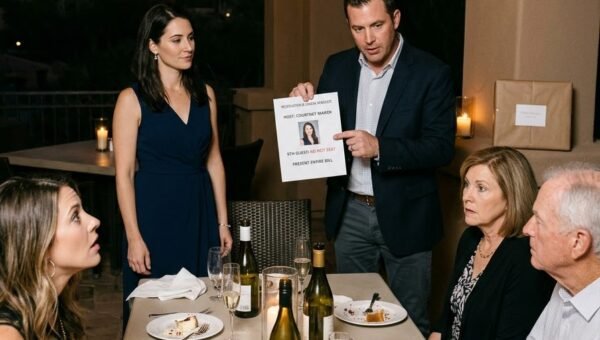
I rang the bell. A woman called, “I’ll get it!” Then Tawnya opened the door in a sparkly sweater, holding a glass of wine. She looked at the pie first, then at me. I saw Keith over her shoulder. He had come up behind her, and he stopped when he saw my face.
“What are you doing here?” he said.
Tawnya’s fingers tightened around the glass. “You told me she was in memory care.”
The whole front room seemed to go quiet, though I could still hear a radio playing somewhere. Keith moved toward the door. Tawnya reached behind her and put a hand against his chest.
“Gail, let’s go home,” he said.
“Which home?” I asked.
He glanced toward the people inside. “Not here.”
Tawnya looked at him. “You said she couldn’t live alone.”
I set the pie down on the low table by the door. “I can live alone just fine.”
Keith lowered his voice. “You’re making this worse.”
“How much worse can it get?”
He looked past me at the street, like he was checking who might hear. That old habit annoyed me. I’d spent decades watching him keep a calm face in public, then tell me what I’d supposedly misunderstood when we got home.
Tawnya stepped outside and pulled the door nearly shut behind her. “I don’t know what’s going on,” she said. Her voice was low. “He told me you had dementia. He said you were in a care place, and that your marriage had been over for years.”
I said, “I still live with him.”
“I know that now.”
Keith said her name, sharp and quiet. “Tawnya.”
She turned to him. “You said she didn’t know who you were.”
I remember the little gold latch on the door. I remember thinking that if I let him take the conversation back inside, it would all become a private misunderstanding. So I took the wire transfer out of my purse and held it out to her.
“This came from our savings,” I said. “Eighty-six thousand dollars.”
Keith looked at the paper. “That’s my money.”
“It was in our account.”
“I earned most of it.”
“I worked thirty-four years.”
“You know what I mean.”
I did know what he meant. He meant he wanted that money to count as his without having to say why. That was his way. A sentence that sounded almost reasonable if I didn’t follow it all the way to the end.
Tawnya didn’t take the paper. “You told me this was your retirement account.”
“It is,” Keith said.
“Then why did you tell me Gail was in memory care?”
He didn’t answer. His jaw moved once, like he was trying to find a version that would fit both of us.
I asked Tawnya how long she’d known him. She said about five years. They’d met at a cosmetics event in Charleston. Keith had told her he and I were separated, but that he stayed at the old house because of the bills and because I wasn’t doing well. He said the divorce was handled, just not public. She’d never met me. He’d shown her a photo once, from years back, and told her I didn’t remember much.
That part hurt more than I expected. He hadn’t just lied about being free. He’d made me sound like a person who couldn’t be trusted to tell the truth.
“I believed him,” she said. “I’m sorry.”
I said, “I don’t know you.”
“I know.”
She didn’t ask me to forgive her. I was grateful for that. I didn’t want to make her the villain just because she was standing in the house my money had helped buy.
Keith reached for my arm, but I moved back. “Don’t.”
He put his hand down. “We can talk at home.”
“No. We’ve been talking at home for years. I just didn’t know what the subject was.”
Someone inside called Tawnya’s name. She didn’t turn around. She asked Keith if he’d told her the truth about the money. He said yes, it was his retirement money. She asked if he’d used our savings. He said he had moved funds, but he planned to pay them back.
“When?” I asked.
He looked at me. “I was going to work it out.”
“You bought a house.”
“I was trying to make sure I had somewhere to live.”
“You have somewhere to live.”
His eyes went to Tawnya, then back to me. “I couldn’t stay in that house forever.”
That was the first thing he said that sounded honest.
He’d been afraid of getting old and being left with nothing. He’d watched his older brother lose his home after a bad business deal, and for years Keith had talked about how foolish it was not to have something put away. He thought the house was safety. Maybe he thought the money was his because he’d earned it. Maybe he thought the marriage was already over, even though he hadn’t said so to me. None of that made the wire transfer less real.
I said, “You could have told me you wanted to leave.”
“I didn’t know how.”
“You knew how to move eighty-six thousand dollars.”
He looked down. Tawnya wiped one hand on her sweater. The glass of wine was still in her other hand, though she hadn’t taken a drink.
I didn’t make a scene at the party. I left the pie on the table and walked to my car. Keith followed me as far as the edge of the front walk, then stopped when Tawnya said, “Don’t.”
The drive home was fifteen minutes. I took the bank slip out at a red light and checked it again, though I already knew what it said. At home, Keith was in the driveway before I got out of the car.
“Can we please talk?”
“No,” I said. “I’m going to call the bank.”
He rubbed his hands together. “Gail, don’t make a mess over this.”
I opened the door. “I didn’t move the money.”
He came into the kitchen behind me and asked if I was really going to call Patrice. I said I didn’t know. He said Patrice had always hated him. That wasn’t true, or it hadn’t been true before Saturday. I almost asked him how long he expected me to keep each version of our marriage in a separate box. I didn’t. I called the bank instead.
They told me they couldn’t reverse a completed wire, but they could secure what was left in the account and start a review. I asked for the forms. The next morning I called a lawyer in Mattoon, a woman named Denise who had helped a woman at the lumberyard with a divorce years earlier. I gave her the facts. I didn’t tell her what I hoped the facts meant.
Denise asked me to bring every statement I could find. “Don’t sign anything Keith gives you,” she said. “And don’t move money just to punish him.”
“I’m not trying to punish him.”
“I know. I’m telling you because people get scared and do things they regret.”
She was right to say it. I was angry enough to have done something foolish. Instead I took my folders to her office. She found transfers I’d missed, going back more than five years. She helped me put a hold on new withdrawals from the joint savings and sent Keith a letter asking him not to sell or transfer anything while we sorted out the accounts. It wasn’t a magic fix. It was a start.
Keith slept in the recliner for a few nights, then went to stay with his brother. He said he needed space. I said fine. He called twice to ask about mail and once to ask if I’d seen his blood pressure pills. I answered those calls because I’m not proud enough to pretend I became a different person in one weekend.
He said he loved me. He said he’d made a mistake. He said he was scared. Then he said he couldn’t understand why I was acting like he’d stolen from me.
I told him, “You don’t get to call it ours when it’s time to take it, then yours when it’s time to explain it.”
He said, “I never wanted you to be hurt.”
I said, “You just wanted me not to know.”
He went quiet. I hung up.
The next week, Tawnya called me. I almost let it go to voicemail, but I picked up. She said she’d found a folder in a desk drawer after Keith came back to collect some of his things. He’d told her he was going to stay with his brother for a while. She said she wasn’t calling to defend him.
“I found papers with your name on them,” she said. “I thought you should see them.”
We met at a coffee shop, not the house. I didn’t want to go back there. Tawnya brought photocopies in a manila folder. There were printouts of bank transfers, a page from the county property records, and a handwritten list of dates. She’d made the list herself because she was trying to figure out what Keith had told her and when.
The last page was a note Keith had left in the desk. It wasn’t a letter to me. It was a list of things he planned to handle after the house purchase. Sell his car. Move his clothes. Change the mailing address. Tell Gail the bank was reviewing the accounts because of “confusion.” Tell Tawnya the divorce was final.
I read that last line twice. It wasn’t proof of a crime. It was proof that he had a plan, and that I was meant to be the confused one in it.
Tawnya had found the note because she was looking for the title papers. She said she’d thought the house was a gift from Keith, paid for with his retirement money. When she saw the account numbers, she knew something was wrong. She could have kept quiet. The house was in her name, and the money had already gone. Instead she gave Denise a statement and agreed to answer questions from the bank.
“I don’t expect you to like me,” she said.
“I don’t know what I feel about you,” I said.
That was the truth. I still don’t know. She’d let him come into her life without asking enough questions. So had I. But I had never been told I had dementia by the man I loved. I had never been made to believe that another woman’s husband was free to start over.
The bank’s review took months. The title company had already sent the money on to close the sale, so getting it back wasn’t simple. Denise handled the calls. She got a court order stopping Keith from selling any other shared property while our case was pending. Tawnya agreed to sell the house rather than keep a home bought with disputed money. She didn’t have to do that, and I won’t say I would’ve done the same thing in her place.
The sale covered part of what Keith had taken. The rest came out of the other accounts and the final split of our savings. I didn’t get every dollar back. I didn’t get forty-four years back either, but that wasn’t something Denise could put in a letter.
Keith and I separated. The house stayed mine for now, while the last papers were being handled. He didn’t fight me for it after the records were laid out. He said he was tired of lawyers. I think he was tired of being asked the same question in different ways and having no answer that worked.
I still balance the checkbook on Sunday nights. It takes less time now. There are fewer bills, and no one sitting across from me telling me numbers give him a headache. I kept Patrice’s birthday check in the drawer beside my Medicare card. I don’t know why I kept the old bank slip too. Maybe because I need to remember that I did see it, and I didn’t talk myself out of what it said.
Tawnya called once, after the sale. She told me the house was empty, and that Keith had left a small box of things behind. She had found one more note tucked under a drawer liner. It was a short message from Keith, dated the day he first showed her the house.
She read it to me over the phone.
“He said you were in memory care, Gail. He said you’d been there for years.”