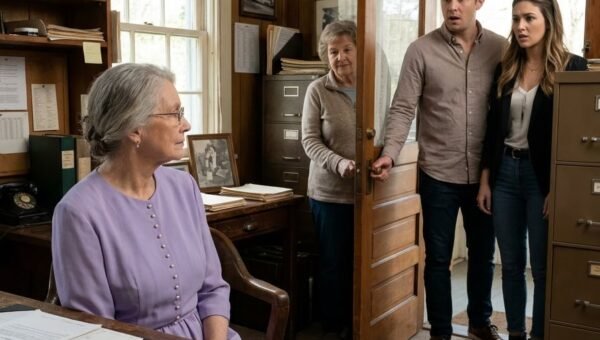
At 8:55, I was standing beside a table covered in empty plates, holding my parents’ restored wedding photo. My sister Courtney pushed a leather check folder toward me.
“You weren’t invited to dinner,” she said. “You were invited to pay.”
My mother laughed. Not a big laugh. Just one short sound, like Courtney had made a joke that was a little too close to the truth. I opened the folder. The bill was $5,300. Dad looked at me across the table like he was still trying to work out why I’d arrived after everyone had eaten.
I didn’t answer Courtney. I turned toward the manager and said, “Nate, remember what I asked you earlier?”
He came over with a sheet of paper in his hand. Courtney’s face changed before he said a word.
A month earlier, I would have told you I was going to that dinner because my family had finally asked me to come. That was the version I wanted to believe. My dad, Tom, called on a Tuesday night while I was at my kitchen table in Tucson, grading junior essays and eating crackers from the sleeve because I hadn’t made dinner. We hadn’t talked properly in weeks, so I watched the phone ring twice before I picked up.
“Rosie girl,” he said.
Nobody else called me that. I sat back down.
“Your mom and I hit forty years next month,” he said. “We’re having dinner. It’d mean a lot if you were there.”
Then he said, “It wouldn’t feel like forty years without you in the room.”
I said yes too quickly. I know that now. At the time, I was glad enough to hear it that I didn’t ask who else would be there or what had changed. I just told him I’d check my school calendar and call him back. He said he’d let Mom know.
Then we talked about the weather for maybe two minutes, as if the important part hadn’t happened.
A week later, Mom, Elaine, called with the details. The dinner was at La Vista del Sol, a resort restaurant in the Catalina foothills. She said there was a private terrace room and the time was nine.
“Nine?” I said. “You and Dad are usually in your pajamas by then.”
“That’s when the room is available,” she said. “Everything’s arranged.”
The next morning she texted me: Dinner starts at 9:00. Terrace room. Don’t be late. She added a red heart. I saved it, which is embarrassing to admit.
I had the feeling that a heart meant something, even though it was just a little picture on a phone.
I bought a blue dress. I got an anniversary card. I also took the only good photograph of my parents’ 1986 wedding to a restoration shop near the university. In the photo, Mom was twenty-four and laughing outside the church with her eyes shut. Water had crept into one corner of the print, and the stain had been getting wider for years. The woman at the shop said she could fix it for sixty dollars.
When I picked it up, I rubbed my thumb along the clean edge of the frame. I still remember that the shop smelled like warm paper and the cinnamon gum the woman kept chewing. It was a small thing, but I was pleased with it. I wrapped the photo in brown paper and set it on my kitchen table so I wouldn’t forget it.
I’m thirty-six. I teach high school English, drive an old Corolla, and spend more weekends grading papers than I like to admit. My sister Courtney lives in Scottsdale with her husband, Preston. They have a big house and a pool. They go to expensive restaurants and take trips I hear about after they get back. I never minded that they had more money than I did. I minded how often my money seemed to end up in the middle of our family.
At dinners, Courtney would reach for her purse and stop.
“Oh, Preston has the cards.”
Or, “I switched purses. I forgot.”
Then the check would sit in the middle of the table. Nobody asked me directly. Mom would smile at the server and say, “Rosie’s got it. She always does.”
And I did. Birthdays, Mother’s Day, holiday brunches, regular family dinners. I didn’t want to be the person who made everyone sit there while people figured out who owed what. So I’d put down my card and let myself be annoyed later, privately, where nobody had to deal with it.
That’s how I got to be the strong one. I was twelve when I fell off the bleachers during P.E. and broke my arm. I sat in a clinic with a bright blue cast while Dad filled out a form. Mom was busy helping Courtney get ready for a piano recital. When Mom finally arrived, she looked at me and smiled.
“See? You’re the strong one,” she said. “You don’t need all the fuss.”
I took it as praise. I liked being told I was easy. A grown-up could tell me I was convenient, and I’d hear that I was special.
A few years ago, Dad had to slow down his small HVAC business. Mom said they needed help with household expenses, just for a while.
“Four hundred a month,” she said. “Send it to Courtney. She handles the bills online.”
I sent the money on the first of every month. I put “For Mom and Dad” in the transfer note, so I’d know what it was for when I looked later. I never asked to see a bill. I trusted Mom, and I trusted that Courtney was passing the money along. It seemed like a family thing, not a loan or a business arrangement.
Then one afternoon I was fixing Dad’s laptop and saw his little spiral notebook on the table. He carried it everywhere. He wrote down dates, amounts, and favors people had done for him.
“A man should know what he owes,” he told me once.
That day, he flipped to a page and tapped an entry with his finger.
“Water heater,” he said. “Eleven hundred. Courtney.”
I looked at her name. I’d already sent thousands of dollars through her account, but Dad had no idea I was doing it.
I asked, “Dad, does Mom ever mention the four hundred I send every month?”
He frowned. “Four hundred?”
I didn’t say anything for a second. Then I went into the kitchen, where Mom was drying dishes.
“Dad thinks I give you fifty dollars here and there.”
Her towel kept moving. She didn’t ask what I meant. That was the part I remembered later. She already knew what I was talking about.
“Your sister has pressures you don’t understand,” she said.
“The money is mine.”
“It goes toward family expenses.”
“Then why does Dad think Courtney paid them?”
Mom turned around, but she didn’t answer that part. She said, “Don’t make this about money, Rosemary.”
I went home and canceled the recurring transfer. I didn’t call her back. I didn’t make a speech. I saw the gray confirmation on my banking app and sat there staring at it for a minute: Recurring transfer canceled. That was all.
The family got cooler after that. Not all at once. There were still texts and holiday plans, but I started getting fewer details. If I asked a question, Mom answered with a sentence instead of a whole conversation. Courtney sent a thumbs-up where she used to send a heart. I told myself I was reading too much into it. I’d spent years trying to keep things smooth, and I didn’t want one canceled transfer to become the reason everybody was mad at me.
At Christmas, Mom texted that dinner started at six. I got there at 5:50, carrying a pie. The meal was over. My plate was covered in plastic wrap, with ROSIE written on a strip of tape. I checked the message again in the driveway. Six o’clock. It said six.
Mom told me she’d sent the wrong time by accident.
“Courtney must have changed the plan,” she said.
Courtney said, “I thought you knew we were eating early.”
I didn’t argue. I was too embarrassed to explain that I’d been reading the same text over and over like there might be a second meaning hidden in it. I took my plate home and ate it at the kitchen counter. That evening, I decided not to make a family case out of it.
Then the anniversary dinner came around.
On the afternoon of the dinner, I was sitting at my table with the restored photo beside me. For some reason, I couldn’t get the time out of my head. Nine didn’t fit with my parents. Neither did the private terrace room, or Mom’s text telling me not to be late. The teacher in me decided to check the facts before I drove all the way up there.
I called the restaurant at 2:15.
“I’m with the Collier anniversary party tonight,” I told the hostess. “Could I sit next to Tom Collier? I’m his daughter.”
I heard typing.
“Collier-Marsh,” she said. “Party of eight at seven.”
I stopped moving my pen.
“Seven?”
“Yes, ma’am.”
“I was told nine.”
The typing stopped. Her voice changed.
“Oh,” she said. “Wait. Are you the guest arriving at nine?”
I stared at the wrapped photograph on my table.
“Yes.”
“Could you hold, please?”
The general manager came on a minute later. His name was Nate Sullivan. He spoke carefully, like he was trying not to make things worse.
“Ms. Collier, the reservation is for eight guests at seven o’clock,” he said. “There’s an instruction sheet at the host desk.”
“What kind of instructions?”
There was a pause.
“The party asked that the full check be presented to a ninth guest arriving at approximately nine.”
I sat down.
“That guest is me?”
“Yes, ma’am.”
“How would your staff know who I am?”
“They provided a photograph.”
I looked at Mom’s text again. Dinner starts at 9:00. Don’t be late. My hands were flat on the table. I could see a tiny ink mark on my right thumb from grading papers. I kept rubbing it with my other thumb, as if I could rub away the rest of what he’d said.
“Who brought the instructions in?” I asked.
“I received them from Courtney Marsh.”
My sister.
I could have stayed home. I actually almost put the frame back in the closet. But then I thought about the years of family checks, and Dad’s notebook, and Mom not asking what I meant in the kitchen. I didn’t want to give them another chance to tell me I’d misunderstood.
“Don’t change anything,” I said.
“Ms. Collier?”
“Don’t warn them. Don’t cancel the reservation. Let it happen the way they planned.”
I asked Nate to keep the instruction sheet and make a copy. I asked him to tell the truth if I asked what it said. He said he would. Then I made one more request. The reservation form had Courtney’s card on file, he told me. I asked him to leave that card attached to the reservation and not move the bill to mine just because my family asked him to.
“I can do that,” he said.
I wrote down his name and the time of our call. I also saved the message from Mom. That’s a teacher habit. Write it down while the facts are still there. I’m not proud of the fact that I’d started keeping records about my own family, but I was done arguing from memory with people who knew exactly what they’d said.
I got dressed, put the wrapped wedding photo on the passenger seat, and drove to the restaurant. The road up into the foothills had the usual patches where the pavement changed color. I remember tapping the steering wheel at a stoplight and thinking I could still turn around. I didn’t.
At 8:55, I walked into the terrace room.
The dinner was finished. The wine bottles were empty. The champagne flutes had a little left in the bottom, and the cake was gone. Eight chairs sat around the table. There was no ninth chair.
Dad looked up when I came in.
“Rosie? I thought you couldn’t make dinner.”
I said, “I was told nine.”
Mom touched his wrist. “Let her settle in.”
There was nowhere to sit. I set the photo on a side table and stayed near the end of the room. I wanted to put the frame down gently. I wanted to take it right back to the car. I did neither.
For ten minutes, I stood there while Mom praised Courtney for arranging everything.
“It was so nice to have everybody together,” she said.
Courtney nodded. “I wanted it to feel special.”
Dad said, “You did a good job.”
I was holding my purse strap so tightly that it was cutting into my hand. I kept telling myself to stay calm. I’d come to find out what was true, not to win an argument. Though, if I’m honest, a small part of me wanted them to feel as uncomfortable as I had felt at Christmas.
Then Courtney gave the server a little nod.
The server walked over with the leather folder. Eleven seconds, I think. I remember because I glanced at the clock on the wall when the folder was set in front of me.
Courtney slid it across the table.
“You weren’t invited to dinner,” she said. “You were invited to pay.”
Mom laughed.
I opened the folder. The total was $5,300. At the top, in small print, was a line about an additional guest arriving later. I couldn’t read the rest without taking the sheet out. Courtney leaned back like the point had been made.
I looked at Nate, who’d come over from the host stand. I’d met him on the phone but hadn’t seen him in person before.
“Nate,” I said, “remember what I asked you earlier?”
He nodded. He had the copied instruction sheet in his hand.
Courtney’s mouth tightened. Mom stopped smiling.
Nate set the copy beside the check. “I was asked to present the full bill to the ninth guest,” he said. “I was also told not to seat her for dinner service.”
Dad’s chair scraped the floor.
“What does that mean?” he asked.
Nate didn’t look at me. He looked at the page. “Those were the instructions I received.”
Courtney said, “That’s not what I said.”
Nate turned the sheet toward her. “This is the copy I made before service.”
My mother reached for the page, but I put my hand on it first. I didn’t snatch it. I just held it down.
“Please read it,” I said.
Nate read the note out loud. His voice was even. That helped. I could hear the ice machine working somewhere in the hall.
“Party of eight at seven. Ninth guest to arrive at nine. Present full check. Do not seat.”
Dad looked at the empty chairs around the table.
“You told me Rosie couldn’t come,” he said to Mom.
Mom looked at him. “I didn’t say that.”
“You said she had a school thing.”
“I said I didn’t know if she’d make it.”
I had to keep my eyes on the paper. I knew if I looked at her, I might start arguing about the exact words, which was the kind of argument I always lost because everybody else got to change the story after the fact.
Courtney folded her arms. “It was a way to include her.”
“By not giving me a chair?” I asked.
“You know how expensive this was,” she said. “Somebody had to cover it.”
“Why did you tell Dad you paid for the water heater?”
Courtney’s face shifted. She looked at Dad, then at Mom.
“That’s not the same thing.”
“No,” I said. “It isn’t.”
Dad said, “You paid for the water heater?”
Courtney looked down at the table. “I handled it.”
“That isn’t what I asked,” Dad said.
Mom tried to step in. “We can talk about all this later.”
I said, “We’ve been talking about it later for years.”
That was the sharpest thing I said all night. I could have said less. I could have left. But I’d spent too long swallowing words just to keep the evening easy for everybody else.
Nate asked who was paying the bill. Courtney said, “She is,” and pointed at me.
I slid the check folder back toward the center of the table.
“No. The reservation is in your name.”
“You can afford it,” Courtney said. “You always pay.”
“I did. I canceled the transfers.”
“Over four hundred dollars?”
I looked at Dad. He was still staring at the note.
“Four hundred dollars every month,” I said. “For years.”
Dad shook his head once. “I didn’t know.”
That was the part that hurt the most, though I didn’t say so. It would have been easier if he’d known and chosen to let it happen. Instead, I’d been giving money to people who let him praise someone else for paying the bills.
Nate said the restaurant had Courtney’s card attached to the reservation. The card was still there, he confirmed. He could charge the event balance to the card on file. He wasn’t threatening anybody or taking sides. He was telling us how the reservation had been set up.
Courtney said, “I didn’t agree to pay all of it myself.”
Nate glanced at the signed event form. “The host signed for the full balance.”
Mom said, “Courtney, we’ll sort it out at home.”
Courtney’s hand went to her purse. For the first time all evening, she seemed to be looking for a card.
Dad turned to me. “Rosie, I’m sorry.”
I believed that he was sorry. I also knew sorry didn’t put the money back or give me back all the dinners I’d paid for while everyone let me think that was just what I did.
“I know,” I said.
He asked, “Can we talk tomorrow?”
I looked at the wrapped photograph on the side table. It was supposed to be a gift. I’d brought a picture of my parents when they were young and happy, before forty years of keeping score and keeping things from each other. I couldn’t bring myself to hand it over.
“Not tomorrow,” I said. “I need a little time.”
Nobody argued with that. Maybe because Nate was still standing beside the check. Maybe because the paper was out in the open now, where no one could say they’d forgotten what it said.
Courtney’s card went through. I heard the machine beep once. She stared at the receipt and said, “This is ridiculous.”
No one answered her.
I picked up the wedding photo and took it home. I didn’t take the anniversary card out of the envelope. For a while, the frame sat on my kitchen counter, still wrapped in brown paper. I could see the clean corner through the glass. I’d paid sixty dollars to restore the part of the picture that had been damaged, and I couldn’t bring myself to unwrap it.
Dad called the next afternoon. He said Mom had told him about the monthly transfers, but he hadn’t known the amount or how long I’d been sending them. He asked me to tell him everything. I told him what I knew. I didn’t tell him what I guessed. I’ve learned the hard way that those aren’t the same thing.
He said, “I should’ve asked.”
“Yes,” I said.
He didn’t argue. That mattered, but it didn’t fix us. He asked if I could meet for coffee sometime. I said maybe, after I’d had a few weeks without family plans. I meant it. I also meant that I wasn’t ready to sit across from him and pretend we could get through it in one conversation.
Mom texted two days later. She wrote, I wish you hadn’t made a scene. I read it twice. I didn’t answer. Courtney didn’t contact me for a while. When she finally did, she wrote that the dinner had been expensive and everyone had gotten carried away. She didn’t say she was sorry for the note or for the money Dad thought she’d paid. I didn’t reply to that either.
The family dinner didn’t happen again the next month. Nobody asked me to cover it. I turned off the old transfer for good, and I stopped volunteering my card when the check came. I still have a hard time with that part. Sometimes I feel cheap for noticing who pays. Then I remember the line Nate read out loud, and I stop calling it a mistake.
I never gave my parents the restored photo. It’s in my closet now, still wrapped, with the anniversary card tucked under it. I saved Mom’s nine o’clock text, too. The heart is still there beside the words.
On Courtney’s instruction sheet, the last line read: “Do not seat the ninth guest.”