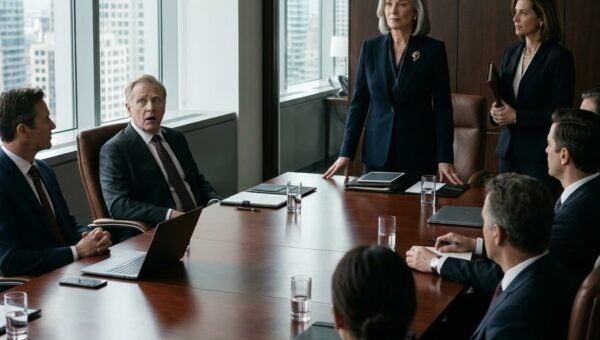
I told Richard to keep quiet when Jessica started taking his name off the work he’d spent 12 years building, and by the time I tried to speak up, he was being walked out of the company.
I’m his wife, Denise. I worked at MedTech Dynamics too, in quality records, so I saw enough to know what was happening. I’d been there 17 years. Richard had been there 22. We weren’t the sort of couple who talked shop over dinner every night, but we knew each other’s habits. I knew how he rubbed his thumb over the paper cup when the coffee was too hot. I knew what it meant when he stopped bringing home his work jacket.
The first time Jessica Caldwell came into the research lab, I was at the far end checking a stack of test reports. Richard had a CardioWatch prototype open on the bench. Jessica glanced at it, then at him.
“We need to think like businesspeople now,” she said.
Richard told her CardioWatch was meant to help doctors catch dangerous changes in a patient’s rhythm. She smiled like he’d said something sweet but old-fashioned.
“That’s exactly the thinking we need to move beyond.”
I watched Richard lower his eyes to the device. I wanted to say something. I didn’t. I told myself he had more standing in that room than I did, and that if I jumped in, I’d make things worse for him. That was my first bad choice. It wasn’t the last.
The company was being prepared for a $350 million sale. People started talking about the deal in the hallways, in meetings, even by the coffee machine. Jessica had arrived with a team that used words like “streamline” and “modernize.” Richard didn’t object to change just because it was change. He’d spent years fixing parts of that monitor that didn’t work. He knew how much better it could be. But he also knew what the buyers wanted to hear, and it wasn’t a story about the engineers who’d made it reliable.
Twelve years earlier, the first working CardioWatch reading came in around 1:00 in the morning. Richard told me about it later, sitting at our kitchen table in his socks, with a ring of dried coffee on his cuff. The first reading wasn’t perfect, he said, but it was steady enough to make him call the hospital team. The next morning, he went back to work before I’d finished my toast.
He never talked about it like he’d done something grand. He talked about the sensor that kept drifting and the code that took weeks to fix. Still, there was one photo of the first prototype in our house, stuck under a magnet on the fridge. His name was written on the back in black marker. He’d never taken it down.
I told him the new CEO might just be trying to make a good impression on the buyers.
“Maybe,” he said.
He didn’t sound convinced. But I wanted that to be true.
The changes came slowly enough that I could pretend they were routine. Richard’s name was missing from one report. Then a meeting he’d led for years was moved to a time when he was on the manufacturing floor. He saw a presentation on the CardioWatch algorithm through the glass wall of a conference room. Jessica was pointing at one of his slides.
I heard about it at dinner.
“They didn’t invite me,” he said.
“Maybe it was a smaller planning meeting,” I said.
He looked up from his plate. “It was my work.”
I had an answer ready, something about the sale and people getting nervous. I swallowed it. I’d already made a habit of trying to calm him down before I even knew what had happened. I think I was afraid that if he got angry, the company would decide he was hard to work with.
That sounds small now. It didn’t feel small then.
A few days later, Richard lost access to the development servers. Stephen in IT told him it was part of a new security structure. He said it with his shoulders rounded, like he was apologizing without being allowed to apologize.
Richard called me from the lab.
“They took me out of the files,” he said.
“Can Stephen fix it?”
“He said Jessica requested it.”
I stood by our kitchen counter holding a dish towel. There was a little dried pasta sauce on the edge. I remember that because I was rubbing at it while Richard talked, like that could solve something. I told him not to go straight to Jessica. Wait until the next day. Let things cool off.
He did wait. Nothing changed.
Then Jessica’s nephew Paul came by his desk with a tablet. He had an impressive-sounding title in the innovation group, though most of his experience came from helping with presentations. He was handling the technology ownership slides for the buyers.
“Jessica wants the references cleaned up,” Paul told Richard.
“What references?”
“The individual inventor names. She wants the materials to show the company owns it outright.”
Richard asked Paul to send him a copy so he could check the technical details. Paul said sure and walked away.
Richard told me this that night. He was careful with his words. He didn’t call Paul a liar. He said the slide was wrong, and he wanted to see if it was a mistake or something more.
I said, “Don’t accuse anybody until you know.”
He gave me a tired look. “I said I wanted a copy.”
“I know. I’m just saying.”
“You always say that.”
I hated that he was right. I had started acting like calm was the same thing as fair. It wasn’t.
That same week, I found a copy of Richard’s employment agreement in the bottom drawer of our filing cabinet. I hadn’t been looking for it. I was putting away the gas bill and had to move a stack of old paperwork. His agreement was folded inside a plain envelope, with a tab clipped to one page.
I recognized the page. I’d seen it years before, when Richard was deciding whether to leave for another job. The company had made him an offer to stay. One clause gave him a $1.2 million transaction payment if MedTech sold the CardioWatch business while he was still employed or within 90 days after he was fired without cause. The deal had to include CardioWatch. His name had to be listed as an inventor on the filings, too.
At the time, I’d thought the clause was a way to keep him from leaving. He’d said it wasn’t something he was counting on. He had signed it, then put the papers away. I’d forgotten how exact it was.
I was standing with that page in my hand when Richard came in. He looked at it, then at me.
“You still have this?”
“I found it.”
“Don’t lose it.”
“I won’t.”
He took it from me and put it back in the envelope. That might have been the moment I should’ve told him to make a copy and call a lawyer. I didn’t. I thought the company would have its own copy, and that the whole thing would be handled properly. I’d spent enough years believing the people in charge would do the right thing if they were given time.
By Thursday, Jessica called Richard to her office. I was on the same floor, closing out a batch of inspection records. I saw him come back to his desk with a separation agreement in his hand.
He didn’t say anything until he got home.
“She wants me out,” he said.
I asked how much severance. Six months, he said, if he signed away any claims related to his work.
“Did you tell her about the other agreement?”
“No.”
“Why not?”
“Because she should know what’s in her own files.”
That was Richard. When he was hurt, he could get stubborn in a way that looked like patience from across the room.
He told me Jessica said his salary was high for someone at his career stage. I kept thinking about those words. They weren’t the sort of thing you say by accident. Still, I told him to wait and get advice before he signed anything.
The next morning, the company held an all-staff meeting in the glass-walled conference room. Board members had flown in from New York. I sat near the back with the quality team. Richard was at the end of the table, holding his hands together. I could see his thumb moving over the side of his finger.
Jessica talked about efficiency and the sale. She praised the company’s growth. Then she turned toward Richard.
“Richard has contributed a great deal,” she said. “But contributions from the past don’t give anyone the right to hold back our future.”
I looked around the table. Some of the people there had learned from Richard. One of them had sat at our kitchen table on a Sunday afternoon while Richard helped him fix a test rig. Nobody spoke.
Jessica said his employment was terminated, effective immediately. Two security guards waited by the door.
Richard stood. He picked up his bag. I was still sitting down.
That’s the part I keep going back to. I knew what he had been asked to sign. I knew there was a second agreement in our drawer. I knew Jessica was talking about his work as if his name were an inconvenience. And I stayed in my chair because I didn’t want to make a scene.
Richard said, “You’re making a mistake.”
Jessica folded her arms. “Read your contract, Richard.”
He walked out between the guards. I could see his face as he passed the glass. He wasn’t asking me to help. I don’t know if he expected me to. I didn’t get up until the doors had closed behind him.
The elevator took him down. I gathered my folder and left through the side hall, then found him in the lobby. His work badge was in his hand. He had taken it off but hadn’t put it in his pocket.
“Did you bring the agreement?” I asked.
“It’s at home.”
“Let’s call a lawyer.”
He shook his head. “I don’t want to spend the rest of my life fighting them.”
“I know.”
But I also knew that leaving without a word was how Jessica wanted it to end. Richard had spent 22 years giving the company more than was in his job description. I didn’t want them to keep the work and take the one payment they’d promised him, too.
That night, we sat at the kitchen table with the agreement between us. The fridge magnet holding the old prototype photo had started to slip. I pressed it back into place before I sat down. I don’t know why I remember that.
Richard read the clause twice. I read it once, then read it again more slowly. The sale was still pending, and CardioWatch was named in the buyer materials. His termination was effective that morning. The timing was right there in black and white.
The next day, Richard called an employment lawyer named Martin. He gave Martin the agreement and the separation papers. Martin asked why Richard hadn’t signed the severance offer.
“Because I didn’t know what I was giving up,” Richard said.
“That’s the right answer,” Martin told him.
I sat beside Richard during the call. I didn’t say much. When Martin asked if we had a copy of the signed agreement, Richard said we did. I handed it over to him, and my hand shook just enough to make the pages tap against the table.
Martin found that MedTech had also filed a patent application listing Richard as one of the inventors. That didn’t give Richard ownership of the company or the device. The company owned the technology. But the contract promised a transaction payment if CardioWatch was part of a sale and Richard was pushed out without cause inside the 90-day window.
The buyers were already checking the company’s records. The missing inventor names in Jessica’s sales deck didn’t change the patent filing. They did make the buyer’s lawyers ask for the original agreement.
A week later, Martin called us at 4:18 in the afternoon. He said the company had agreed to honor the transaction clause. Richard would get the $1.2 million payment when the acquisition closed, minus the taxes and deductions written into the agreement. The company also agreed to correct the buyer materials and list him properly as an inventor.
I felt relieved. Then I felt ashamed of being relieved.
Richard had lost his job. His team had watched him get escorted out. The payment wasn’t a prize. It was what the company had promised him years earlier, before Jessica decided he was too expensive to keep.
He didn’t go back to the office. He didn’t ask for a farewell lunch. Some of the younger engineers reached out in private. One said he was sorry he hadn’t spoken during the meeting. Richard told him he understood. I didn’t. I wanted to tell that young man he could have said one sentence. But I let it go, partly because Richard asked me to.
The sale closed 63 days later. Richard got the payment. He used some of it to pay off the mortgage and kept the rest where Martin suggested until the tax bill was settled. He never bought a new car or a boat. He bought a decent desk for the room where he now consults part time, and he still uses his old coffee cup, the one with the chipped handle.
When people ask how he’s doing, he says, “I’m fine. I’ve got work.”
Sometimes I believe him. Sometimes I don’t.
The company corrected the ownership presentation. They did not put his name back on the slides Jessica had shown that morning, not the way it had been before. They issued a revised set for the buyers. That was enough for the deal. It wasn’t enough to make the room full of people who’d watched him leave suddenly speak up.
I still work there. I thought about quitting. Richard told me not to make that decision for him, and not to punish myself by giving Jessica another person’s job. I stayed, though there are days I wish I’d stood up in that room. I can’t fix it now by saying I would have.
The prototype photo is still on our fridge. The corner is bent from the magnet slipping. Richard’s name is on the back, in his own handwriting. The contract got him the money. The photo is what he kept.