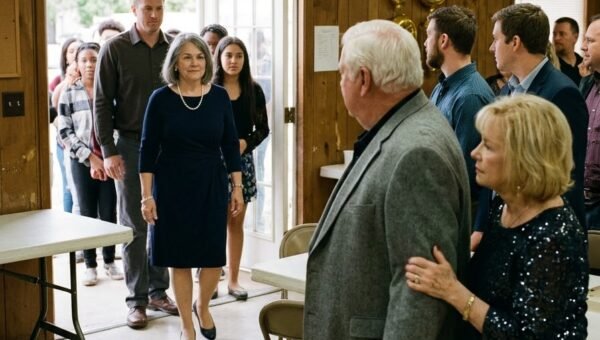
The back row of the Concord auction hall is where my family decided I had no business bidding on our own history.
Brooke had turned in her chair so people around her could hear the joke. I was three rows from the back, holding paddle 52 in my lap. The dress I wore was navy and came from a department store sale. I’d bought it for a work dinner, and one sleeve still pulled a little at the wrist. Brooke asked what I planned to bid on, a commemorative spoon. A couple of people laughed.
I didn’t answer. Uncle Curtis said the auction wasn’t a church raffle and they didn’t take coupons at the door. I looked down at my paddle and ran my thumb over its paper edge. It was the same thing I’d been doing for most of the morning, even when there was no reason to touch it.
That little paddle took me back to my parents’ kitchen, where I used to sit with a stack of bills and sort them by due date. I was twenty-nine when they died in a highway crash outside Boston. There wasn’t a life insurance check big enough to fix what came after. There were medical bills, a rented studio, and family members who seemed to think being short on money made me fair game.
The first months are patchy in my memory. I remember the smell of burnt coffee in the funeral home, and my mother’s old cardigan folded over the back of a chair. I remember Brooke asking if I could cover my part of dinner at a family gathering. I remember not being able to, then pretending I wasn’t hungry while everyone else ordered dessert.
Back then, I didn’t tell anyone how bad it was. I hated being the poor cousin, so I got very good at looking like I didn’t care. That helped me get through some things. It also made it easy for people to assume there was nothing going on with me at all.
The paddle came back into my hands in the auction hall. I lifted my eyes toward the front, where Brooke sat with her husband, Trevor, and her parents. Aunt Evelyn’s tennis bracelet caught the overhead light when she reached for Uncle Curtis’s sleeve. The four of them looked comfortable there, like the room had been set up for them.
They’d been talking about Aldridge Manor for weeks. Our great-great-grandfather built it in 1887, and the family had owned it for generations, though by the time I was old enough to visit, the property had changed hands more than once. It sat on forty-seven acres in Concord, with a stone main house, a carriage guesthouse, stables, and a spring-fed lake. The distant cousins who owned it now had decided to sell.
Brooke’s posts made it sound like the sale was a formality. She’d shared pictures from two private previews, including one of her holding a champagne glass beside the old front steps. The caption said she was finally bringing home the estate we deserved. Relatives filled the comments with congratulations, as if the deed were already in her bag.
Three months before the auction, Brooke posted a candid picture of me at a family dinner. I had on my wool coat, which I’d bought secondhand, and I was looking down at my phone. Brooke wrote that her broke cousin had come to family dinner for a free meal. Twenty-seven relatives liked the post. Aunt Evelyn left laughing emojis.
I saw it while sitting on the subway after work. I read the caption twice, then stared at the little row of reactions. I could’ve called Brooke. I could’ve asked her to take it down. Instead I turned my phone off and spent the ride home thinking up replies I never sent. I’m not proud of that. I wanted to make them feel stupid, and I also wanted them to like me. Those two things kept getting in each other’s way.
At the time, I was a corporate financial analyst. I took the subway to work, bought clearance clothes, and lived in a studio where the radiator clanged whenever the heat came on. That was the version of my life they knew, mostly because I showed it to them. I didn’t tell them about the consulting work I’d started doing on the side, or about the clients who came through Nathaniel Vance, an attorney I met during a company restructuring.
Nathaniel had asked me to help him sort through the numbers on a complicated deal. I’d stayed up late to do it, because I was curious and because the extra money mattered. He paid me well. Then he sent another client my way, and another. I kept my regular job for years. I liked having a salary land every other Friday, even after I didn’t need to count on it.
The money didn’t come all at once. It built over time, one long work night and one careful investment at a time. I didn’t move into a bigger apartment. I didn’t buy a car. I kept telling myself I’d make changes later, once everything felt settled. I’m not sure it ever did. To this day, I notice the price on a grocery receipt before I notice what I bought.
When the auction house announced Aldridge Manor, I got in touch with Nathaniel. I knew from the listing that the property would sell as one lot, and I knew what it had meant to my parents. My mother used to talk about the lake from her childhood visits. My father remembered the old carriage house, where his cousins would hide during family gatherings. I wanted the place to stay out of the hands of someone who thought a few family photos made it theirs.
I also knew my reasons weren’t all noble. The post about my coat still bothered me. I’d be lying if I said the thought of Brooke seeing my paddle didn’t cross my mind. I told myself that was a small part of it. Maybe I needed that to be true.
Two weeks before the auction, I sent in the proof the auction house required to register. Nathaniel checked the paperwork and arranged for the wire transfer to be ready if I won. I remember the exact question I asked him on the phone: whether I had to tell my relatives. He said I didn’t. I took that as permission to keep quiet, though really it suited me.
On the morning of the sale, I found the registration desk, signed the forms, and got paddle 52. The woman behind the desk checked my identification and handed it over without asking anything else. I tucked it into my bag and went to the back of the hall. I wanted to hear the opening bids before I decided how much I could stand to spend.
The early lots passed quickly. A mahogany settee went to a man in the second row. A landscape painting sold to a woman with a red scarf. Brooke won a sterling silver tea service for $7,000, then glanced back at her parents. Aunt Evelyn smiled and called it the first treasure for the new house.
Brooke turned toward me again. She offered to explain how live auctions worked, just in case I accidentally raised my hand on something outside my league. I said I appreciated the concern and had it handled. Trevor gave a short snort beside her. He said I was probably there to see how the other half lived.
I looked back at the front and checked my phone. Nathaniel had sent a message. The funds were verified, and the wire was staged. I put the phone away before I answered. No reply was needed.
Uncle Curtis leaned toward Aunt Evelyn as the auctioneer moved through a few more lots. I heard him say they had approval up to $12.5 million. He told her that serious interest was thin. I don’t know whether he was trying to reassure her or himself. Either way, I heard him.
For a while, I wondered if I’d misunderstood the point of going. I could have left. I could have waited for the auction to end and called Nathaniel to say I’d changed my mind. The thought sat there while a pair of antique lamps sold. Then Brooke raised her paddle for a small painting. She won it, and I watched her smile at her mother.
That smile took me back to the dinner where she’d posted my coat. I could still see the corner of the phone in her hand, the screen facing down after she showed the picture around. I’d gone to the bathroom and stayed there longer than I needed to. When I came out, nobody mentioned the post. I didn’t either. I just sat down and let the night go on.
I was still thinking about it when the auctioneer announced Lot 93. Aldridge Manor. A few chairs shifted. My fingers pressed hard against the edge of paddle 52.
The auctioneer went over the land, the buildings, and the lake. He opened at $8 million. Brooke’s paddle went up before he’d finished the sentence. A man near the front joined her, then a woman in a crimson blazer.
The numbers moved fast. Nine million. Nine and a half. Ten. Brooke stayed in. Trevor leaned close to her and said something I couldn’t hear. Her parents sat straight, hands folded. I knew the scene they’d pictured. Brooke with the keys, the family gathered behind her, the estate back where it belonged.
At $11 million, the woman in crimson stopped bidding. The man near the front offered $11.2 million. Brooke answered with $11.4 million. The man looked down at his catalog, waited a beat, then lowered it.
The auctioneer called $11.4 million and started counting. Brooke’s cousin Megan leaned over to hug her. Aunt Evelyn dabbed at her eyes. Uncle Curtis took out his phone to record the moment. I’d seen that phone at plenty of family dinners. He liked collecting the parts he could show people afterward.
I raised paddle 52.
The auctioneer saw me. He called $11.6 million from the back. A dozen heads turned, then more. Brooke’s smile was gone. Trevor’s arm slid off her shoulders. Uncle Curtis lowered his phone.
Brooke said my name, then asked what I thought I was doing. I didn’t answer. The auctioneer looked toward her and waited for a new bid.
Brooke turned to Uncle Curtis. She looked young for a second, not in age but in the way someone looks when the plan they’ve been repeating starts to fail. Curtis glanced from her to me. He didn’t say anything.
The auctioneer called $11.6 million once. Brooke lifted her paddle to $11.8 million. Her hand was steady. I had expected her to stop sooner, and that surprised me. I knew she wanted the house. I hadn’t thought about what it meant to have people watching her want it.
I bid $12 million.
The number sat in the room. Aunt Evelyn’s hands came apart in her lap. Trevor looked at Brooke, then toward her father. I kept my eyes on the auctioneer. I was trying not to look at my relatives, which was harder than I’d expected.
Brooke went to $12.1 million. Her voice didn’t carry, but her paddle did. I heard the paper scrape against her sleeve as she lowered it.
I had set my limit at $12.4 million. It was a number Nathaniel and I had talked through, based on the property’s condition, the money I could keep liquid, and what I was willing to give up. I didn’t want to win just to prove I could. I kept telling myself that while the auctioneer waited.
I raised to $12.2 million.
Brooke looked down at her phone. I could see her scrolling, but not what was on the screen. She said something to her father. Curtis shook his head once. Not angry. Not exactly. More like he’d found the edge of a promise he couldn’t keep.
Brooke raised to $12.3 million.
My throat felt dry, so I swallowed. The auctioneer waited again. I knew the people watching couldn’t see the numbers in my head, only the paddle in my hand. I had spent years keeping the two sides of my life apart. Now they were sitting in the same room.
I bid $12.4 million.
Brooke’s fingers tightened around her paddle. She looked at Curtis. I saw him lean toward her and say, “That’s our ceiling.”
I can still hear that line because it was the first honest thing anyone in my family had said about money all morning. They had a limit. So did I. The difference was nobody had made mine into a joke yet.
Brooke lowered her paddle.
The auctioneer called $12.4 million once. Then twice. The gavel came down. I had won Aldridge Manor.
The room didn’t erupt. There was some shuffling and a few low voices. My hands were still on the paddle. The skin at my thumb was sore from pressing it against the edge. I waited for the feeling I thought I might have, anger or triumph, but all I could think was that I’d just bought a house with a lake in Massachusetts.
Nathaniel came up from the side aisle. He had been sitting near the registration desk, where he could see the auctioneer and me. He didn’t smile or clap. He asked if I was ready to sign the sale papers. I nodded.
A staff member led us to a small table behind the front row. Brooke stayed in her seat. I could feel her looking at me, though I didn’t turn around. I signed the paperwork, checked the amount, and initialed the terms. My hand shook once while I was writing my address. I crossed the last number and wrote it again.
The deposit was sent that afternoon. The rest of the closing took longer, as it always does with a property like that. There were inspections, old permits, a list of repairs, and more calls with Nathaniel than I can count. I didn’t move into the main house. I didn’t have a plan to make it my home.
I formed a small holding company for the property and started talking with a local preservation group about keeping the grounds open for tours and family history days. That part mattered to me. So did the lake, which had been the one detail my mother always brought up. She used to say the water looked dark even in summer. I couldn’t tell you why she remembered that. Maybe because she’d once dropped her glasses off the dock and watched them sink.
I did not call Brooke to explain what I planned to do. I told myself she could ask if she wanted to know. That was partly fair and partly me making her do the work I’d never made her do before. She didn’t call.
Aunt Evelyn did. She said I’d embarrassed the family by making a scene. I told her I’d gone to a public auction and bid on a property I could afford. She said I knew what she meant. I said I did, and ended the call.
For a couple of weeks I replayed the auction in my head. Not the gavel. Not the money. The way Brooke turned around to make sure I heard her joke. I kept thinking maybe I should have said something then, before all the bidding started. Maybe I should have corrected her when she posted that picture. I had plenty of chances. I let them pass because I was afraid of being laughed at, then I let the fear harden into silence.
The first time I went back to Aldridge Manor after the sale, the auction staff had already taken down the lot sign. I stood near the front steps with Nathaniel and the property manager. The house needed more work than I’d expected. I remember the smell of old wood and a thin strip of blue paint flaking beside the door. That was all I noticed at first.
The property manager asked whether I wanted the original furniture removed. I said I needed to see the inventory before deciding. Nathaniel had a folder with the sale papers under his arm. I asked him to leave it with me for a minute.
I walked to the edge of the drive and looked toward the grounds. I couldn’t see the lake from there. I had spent $12.4 million, and the first thing I felt was how little of the place I could see at once. The house, the guesthouse, the stables, all of it needed people who knew what they were doing. Buying it had settled the auction. It hadn’t settled anything else.
I thought about the old picture of my mother at the lake that I kept in a drawer. I thought about the family dinner, too, because I’m bad at letting things stay in their own boxes. I had the money to buy the house. I hadn’t found a way to make them see me without it.
Nathaniel came over and asked if I was ready to go. I looked back at the door. I’d kept quiet at the auction because I thought silence would keep me in control. It had, for a while. I was tired of giving it that job.
“I didn’t buy it to prove I had money,” I said. “I bought it because you all thought I had no place in our family unless I could pay for one.”
Nobody answered. I had the keys in my hand, and my thumb went over the paper tag just like it had over paddle 52.