The brown jacket was the detail that didn’t fit. Dad had worn it to the crematorium, and nine days later the director called to tell me something had been left in its inside pocket. Ray had already told me there was nothing left to find. He’d said it while handing me a cardboard box with half of Dad’s ashes.
I’m Janet. I was fifty-eight, living six hours from Dad’s house, and I’d spent most of my adult life telling myself that being the daughter who lived farther away didn’t mean I loved him less. It did mean I wasn’t there for the small things. I knew Ray was there for those. I also knew I’d let that fact do too much work for me.
Dad died on a Monday morning. He was eighty-one. A stroke, the kind that came on fast, according to Ray. Ray called at seven, and I asked if Dad was awake, because sometimes he was groggy in the morning and I thought there might be a chance to talk to him.
“Dad’s gone,” Ray said.
I sat on the edge of my bed with the phone still at my ear. I don’t remember what I said after that. I remember looking at the socks I’d put out the night before. They were a pair with one blue stripe near the ankle. Somehow that stupid stripe stayed with me.
I told Ray I’d be in town by dinner. It takes six hours if the traffic isn’t bad, and I didn’t stop except for gas and a bathroom. I kept calling him from the car. He finally answered once, around noon, and said I didn’t need to hurry because there was nothing to do.
I hurried anyway.
Dad had wanted to be buried beside Mom. They were married forty-seven years, and he’d bought the plot under the old oak in 1998. It was one of those facts I assumed would be handled when the time came. I didn’t know the plot number. Ray did. He’d gone with Dad to the cemetery years earlier, and I’d told myself I’d ask Dad about it next time I visited.
There hadn’t been a next time.
When I pulled up at six, Ray came out of the house with his hands in his pockets. He looked like he hadn’t slept. His shirt was wrinkled, and there was a white line of something on one sleeve, maybe paint. I started to ask where Dad was, then saw Ray’s face and understood the answer before he gave it.
“He’s at the crematorium,” Ray said.
I asked him when. He said he’d signed the papers at noon.
There was a little pause. A car went by on the road, slow, then faster.
“I thought we’d talk first,” I said.
“Dad wanted it simple. No fuss.”
Dad had said a hundred times that he wanted to be buried by Mom. I said that. Ray rubbed his forehead, and I could see the tired look underneath the way he’d been talking to me.
“He changed his mind,” he said. “He told me.”
I wanted to ask when. I wanted to ask why that had never come up on any of our calls. I wanted to ask why he hadn’t waited until I arrived. Instead, I looked down at the porch step. One corner had chipped away, and I’d been meaning to fix it the last three visits.
I did not fix it.
The cremation happened the next morning. Ray said I couldn’t see Dad because the crematorium had already prepared him. I didn’t ask what that meant. I don’t know if I was being polite or if I was just tired of hearing that it was already done.
On Wednesday, Ray handed me a plain cardboard box. Half the ashes were inside. Half were staying with him.
I held the box with both hands. It was lighter than I expected, which is a stupid thing to say. I’d never held ashes before. I’d thought there would be more weight to them. Like I’d feel Dad in it somehow. I felt cardboard and a little grit shifting inside.
Ray said he had some things to tell me. He stood by the kitchen counter while I sat at the table. There was a coffee ring near my elbow. Dad used to put his mug right there every morning, even though he owned coasters.
Ray told me there was no will. Dad didn’t believe in them, he said, and he was handling the house, the accounts, all of it. He said he had power of attorney from the time Dad had his hip done.
“Power of attorney ends when Dad dies,” I said.
Ray shrugged. “Then I’m the executor. Same difference.”
I looked at him. “No, it isn’t.”
“I’m the one who’s here, Jan.”
That was true. It was also being used like a door he could shut in my face. I wanted to say so. I didn’t. I was afraid if I pushed, he’d tell me I’d been gone too long to have an opinion. I was also afraid he’d be right.
Dad’s house was quiet in that way a house gets when someone has stopped moving through it. His slippers were beside the back door. There was a glass of water on the end table, with one of those thin brown rings around the bottom. I picked it up and took it to the sink because I couldn’t think of anything else to do.
I left Thursday with the box on the passenger seat and the seat belt buckled around it. I kept glancing over while I drove. It was ridiculous. I knew it wasn’t going anywhere. I was checking anyway.
For the next nine days I did what I do when something hurts and I can’t fix it. I went to work. I answered emails. I made pasta and forgot to eat half of it. I called Ray once and let it ring until voicemail picked up. He didn’t call back. I didn’t try again.
I wasn’t proud of that. I was mad, but I was also scared that there would be another fight, and I couldn’t stand the idea of losing my brother while we were both still alive. So I did the thing I’ve done too often with Ray. I went quiet and called it keeping the peace.
Nine days after Dad died, an unknown number came up on my phone. A man asked if I was Janet Morrow. He said his name was Pete Dawson, and he ran the crematorium.
He apologized first. His assistant had put something in the wrong file, he said. Before a cremation, they checked the clothing. Dad had arrived wearing his brown corduroy jacket. There was a sealed envelope in the inside pocket.
I didn’t answer for a few seconds. I could hear paper moving at Pete’s end of the line.
“Your name is on it,” he said. “Only yours.”
I asked if Ray had known.
“No, ma’am. He signed the papers and left. He never asked about the clothes.”
I sat down on the kitchen floor. I don’t know why. My legs were fine. I just didn’t trust myself to keep standing while I tried to understand how Dad could have carried a letter addressed to me into the last place he went and nobody had thought to tell me.
Pete said the envelope was thick, sealed on all four sides with tape. He could mail it, but I asked him to hold it. I wanted to come get it myself.
I drove back before sunrise the next morning. I’d spent the night thinking I might turn around. I nearly did, at the first rest stop. I bought coffee and let it go cold in the cup holder, then got back on the road.
Pete met me in a small office at the crematorium. He set the envelope on the desk between us. A bit of brown lint clung to one edge. Dad’s block letters were on the front.
My name. Only mine.
I brought a letter opener with me. I had no idea why. I’d found it in a drawer after Dad died and shoved it into my purse. The handle had a nick in it from when I’d dropped it on his kitchen floor years ago. Dad had picked it up, handed it back, and said, “That’s why we don’t run with sharp things.”
I opened the envelope carefully. Inside was a folded paper with a county seal, a smaller envelope addressed to Ray, and a letter from Dad. Four pages, written in the small, cramped writing he used when he didn’t want to waste paper.
The county paper was a deed. The first line of Dad’s letter was dated eleven days before he died. I read it twice before I could make my eyes go on.
He wrote that the day before, Ray had taken him to the bank. Dad had been told they were going to sort out a payment on Ray’s business loan. Ray’s shop had been struggling. Dad had lent him money twice before, and Ray had paid some back but not all of it. Dad wrote that he knew Ray was scared. He also wrote that Ray had asked him to sign a form he hadn’t read carefully enough.
Dad had asked the bank clerk to stop the process and print him a copy. He found out that the form would have given Ray access to an account Dad used for his bills. Dad didn’t accuse Ray of stealing. He said Ray told him it was the easiest way to keep the business from falling behind. The clerk stopped it before anything changed.
I had to set the letter down. Pete asked if I wanted water. I said no, then took the glass anyway.
Dad wrote that Ray was not a bad person. He was afraid of losing the shop and the house he lived in, and Dad understood that fear because he’d spent his own life trying not to be a burden. Then Dad wrote that fear didn’t make it all right to hand him papers and tell him to sign.
I read that part sitting in Pete’s office, with the letter opener still in my hand. Dad had known Ray was in trouble. He’d known I was far away. He’d also known I’d ask questions if he called me, and he didn’t want to answer them while he was still deciding what to do.
That hurt in a quieter way than Ray’s lies. Dad could have told me. He could have called and said he was worried. Instead, he made a plan with a lawyer and kept it in his jacket. I was grateful he’d thought of me. I was angry he hadn’t trusted me enough to let me stand beside him while he did it.
The deed transferred Dad’s house to me. It had been signed, witnessed, notarized, and recorded eleven days before he died. Dad had gone to a lawyer after the bank visit. He wrote that he wanted the house to go to the person who had not asked him for it.
I reread that sentence.
I had never asked for his house. I’d never asked for money. But I’d also never been the one sitting with him at the bank, or driving him to appointments, or replacing the porch light when it burned out. I wasn’t sure I deserved what he’d done. I was sure I didn’t want the deed to become another reason Ray hated me.
Dad’s letter went on. He said he’d planned to tell us both after he got the deed filed. He wanted to sit us down, explain what he’d done, and make sure Ray understood the house was not being taken from him. He wrote that the small envelope was for Ray, to be opened with a lawyer. He asked me not to give Ray the deed before I’d talked to one.
The letter ended with a plain apology for keeping this from me. Dad said he was sorry he’d made me find out from a stranger in a crematorium office. He wrote that he wasn’t sorry about the deed. Then he said he loved me, and asked me not to let the house turn me into the kind of person who kept score.
I was not sure what to do with that. I had spent nine days keeping score already.
Three weeks later.
I met with Dad’s lawyer, Denise, in her office. She confirmed the deed was valid and had been recorded. She also explained that Ray was not the executor. Dad had left no will, so an administrator would need to be appointed for the rest of the estate. Ray could apply, but he couldn’t simply announce it and take charge.
The accounts and the house were separate matters. The house was mine. Dad’s other assets would go through the estate process. Denise said the little envelope should be opened with Ray present, like Dad had asked.
I called Ray and told him I had the letter and the deed. He went quiet. I told him the house had been transferred to me before Dad died. He said I was making it sound like he’d tried to steal from Dad.
“I’m not saying that,” I said.
“You think it, though.”
I didn’t answer quickly enough.
He said Dad had asked him to go to the bank because he knew the accounts and could help. Ray had been trying to keep the shop open. He said he’d told Dad the paperwork was for getting the loan payments caught up, not for taking money. He said he should have slowed down and explained it better.
I believed some of that. I didn’t know if I believed all of it. That was the trouble. I wanted a clean answer, and there wasn’t one.
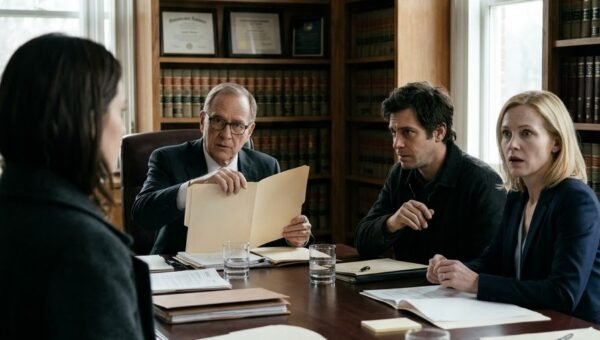
We met at Denise’s office the next week. Ray came in wearing the same work boots he’d worn when he gave me the ashes. He kept rubbing his thumb over a small scrape on one knuckle. Denise laid the sealed envelope on the table and asked him if he wanted to open it himself.
Ray nodded.
Inside was a short note, a bank statement, and a list Dad had written by hand. The note said Dad had lent Ray $27,460 over four years. Some had been paid back. The remaining balance wasn’t a bill. Dad had written that he was not asking for repayment, but he wanted the amount written down so neither of us could pretend things had been divided evenly.
Ray read the note with his mouth pressed flat. He didn’t look at me.
Then Denise showed us the statement from the day at the bank. There had been no transfer. The form Ray had brought in would have added him as a joint owner on one of Dad’s accounts. Ray didn’t deny it. He said he thought it was the only way to make payments quickly if Dad got sick again.
“I thought I was helping,” he said. “I was also scared.”
That was the first time he’d said anything about being scared. He rubbed the scrape on his knuckle until it looked red.
I wanted to tell him he could have asked Dad for help without putting a form in front of him. I wanted to tell him he could have waited for me. I also wanted to tell him that I knew I’d made it easy for him to become the one who handled everything. I’d been happy to let him be responsible, right up until he started deciding things I cared about.
I said, “You didn’t even let me say goodbye.”
Ray looked at the table. “I know.”
That was all he said. Not an excuse. Not an apology that could fix it. Just those two words.
We talked for another hour. Not well. There were awkward pauses, and I got sharp with him more than once. Denise explained that Ray could apply to administer the estate and that I’d need to provide the deed paperwork. We agreed he would handle the account paperwork with her, and I would take over the house. Neither of us was happy with the arrangement, which made it feel more honest than a quick agreement would have.
Afterward, Ray asked if he could go to the house with me. I said yes, but only if we didn’t pretend everything was fine. He said he didn’t know how to do that. I told him neither did I.
At Dad’s house, he went straight to the kitchen and stood by the counter. The coffee ring I’d noticed the day I left was still there. I took a sponge from under the sink and wiped it up. It came off in three passes.
Ray watched me, then pulled the old mug from the cabinet. He said Dad had always used that one, even after the handle got loose. I remembered Dad keeping a spoon beside it because the mug was too narrow for the drawer. I didn’t know why that detail stayed with me.
Ray asked if I was keeping the house. I said yes. He nodded like he’d expected that, but his eyes went to the back door and the slippers still beside it.
“I thought Dad chose you over me,” he said.
I wanted to say he had. I wanted to say he hadn’t. Both seemed cruel in different ways.
“He chose what he thought was right,” I said.
Ray gave a small, tired laugh. “That sounds like him.”
We didn’t hug. We didn’t make a plan to call more. Ray left with the old mug, after I asked him if he wanted it. I watched him carry it out to his truck with both hands, careful not to knock it against the door.
The next morning, I called the cemetery. Dad’s plot was still there beside Mom’s, under the oak he’d picked. I asked about placing a small marker with his name. They said I could, even though he’d been cremated.
I took half his ashes to the cemetery in the cardboard box Ray had given me. I poured them into the ground beside Mom’s marker. The box shook in my hands because the edge had softened from sitting in my trunk. I didn’t say anything out loud. I’m not sure Dad would have wanted me to.
I still have the deed in Denise’s file. I still have the letter in my desk drawer. Ray and I talk, but we don’t talk about the bank unless we have to. He hasn’t asked for the house, and I haven’t offered it.
The old oak shades both names now. I go there sometimes with no flowers, which feels rude, but I go anyway.
Ray kept Dad’s mug. I kept the house. Neither of us got the goodbye we wanted.