“Do we have any more peach jam?” Ethan asked me that Saturday morning.
I was putting the last of our wedding cake in the fridge, so I told him I thought there was a jar behind the pickles. Ordinary stuff. A week into marriage and already arguing about where we put the jam. I was still smiling when the doorbell rang.
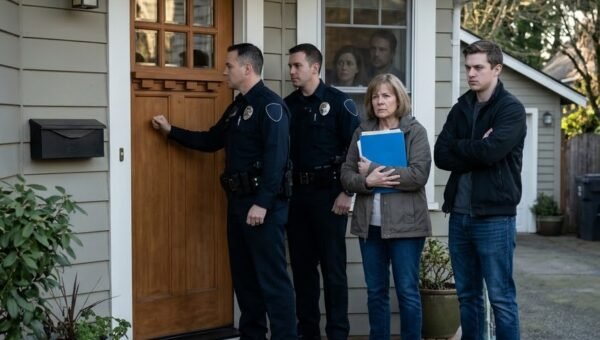
At 8:17, two uniformed officers stood on our porch. My mother, Diane, was behind them with a thick blue folder hugged to her chest.
My younger brother, Ryan, stood beside her, arms crossed. Ethan looked out the front window and stopped moving.
I knew those faces. I’d looked for them at my wedding.
There were four empty chairs in the second row, saved for Diane, my stepfather Paul, Ryan, and Ryan’s girlfriend, Brooke. I had kept checking the entrance while our guests found their seats. At 3:45, I told myself they were running late. At 3:52, I checked again. By 3:59, the coordinator asked if I wanted to wait.
“No,” I said. “Let’s start.”
So I walked toward Ethan with my hands shaking, and my family didn’t come.
I didn’t know why Diane was at our door with police. I did know what was in the blue folder had something to do with Ryan’s $9,400. And I knew I hadn’t agreed to give him that money.
Ethan leaned close to me. “Grace, don’t open it yet.”
I didn’t. I went to the door and kept the chain on.
One officer introduced himself as Officer Bell. The other was a woman named Officer Ruiz. They told me Ryan had called about a financial dispute and asked them to come along while he showed me some paperwork. Nobody was there to arrest me, Officer Bell said. It was a civil matter, as far as they could tell.
Diane held the folder out as if the officers had brought her to deliver it.
“Grace, you need to explain why you’re refusing to pay what you promised.”
I looked at the paper edges sticking out of the folder. “I didn’t promise him anything.”
Ryan made a little sound through his nose. That was how he showed he thought somebody was being ridiculous. He’d been doing it since we were kids.
“I have the invoice,” he said. “You sent the first dollar.”
That was the first time I understood why my dollar mattered to them.
I told the officers I’d get my records. Then I shut the door, took off the chain, and went to the kitchen for the folder I’d made the night before. Ethan followed me. The peach jam sat on the counter, still unopened.
I work in acoustic restoration. I help bring old theaters and halls back to the way they’re supposed to sound. Most days, that means looking at plans, taking readings, and listening to problems other people can barely hear.
I’m good at the quiet details. I’m less good at noticing when my own family has been telling me the same thing for years.
Diane has always cared about what my work pays more than what I do for a living. I’ve tried to tell her about restoring a theater’s sound, about how a room can look perfect and still be wrong when you speak in it. She’d nod and ask whether the job paid well.
I was the dependable daughter. That was the family word for me. When Ryan was short on rent, I sent money. When Diane needed repairs on her house, I paid the contractor. When Ryan started a new business idea, I covered a training course because he said it would get him on his feet.
I didn’t keep a list at the time. I told myself that keeping a list meant I didn’t love them enough. Later, when I finally added it all up, the amount was $21,730. It didn’t include birthday gifts or the Christmases when I bought groceries for Diane’s house because she said things were tight.
I have to be fair. Diane did help me when I was younger. She packed lunches, drove me to work when my car broke down, and sat up with me after I had my wisdom teeth out. I don’t want to make her sound like a stranger. That would make this easier than it was.
But help in our family only seemed to go one way once I started earning more than Ryan.
Ethan was the first person who asked whether I wanted to help.
Two months before the wedding, Ryan asked me to look at his business plan for a mobile architectural scanning company. He wanted to buy equipment and scan building interiors for contractors. The idea wasn’t foolish. I work around old buildings, and I could see how it might be useful. But the numbers he showed me were built on customers he hadn’t spoken to yet.
I told him that gently. I even went through the estimates with him at Diane’s kitchen table. His first-year income depended on several jobs a week, though he had no contracts and no customers. He asked if I’d invest.
“No,” I said. “I can’t put money into this.”
He rubbed at a spot on the table with his thumb. “I thought you’d understand.”
I did understand. I understood enough to say no.
Diane was in the next room. She didn’t say anything then. I thought she was staying out of it. I was wrong.
Our wedding was small, at a restored glass conservatory in Milwaukee. Sixty-four people came. Ethan’s parents had driven in from Indiana. My old professor came up from Madison. Friends brought food and argued over whether the cake was too sweet, which it was, honestly.
I’d kept four chairs for my family. I chose the second row because I thought it would feel less noticeable if they arrived late. That was the kind of thought I had. I was trying to protect them from looking bad, while they were the ones leaving me standing there.
At 3:45, the chairs were empty. At 3:52, I looked at the door again. At 3:59, I said we should start.
Ethan held my hands. “Look at me,” he whispered.
So I did.
We said our vows. People clapped. I smiled for the pictures because I didn’t want to make my friends feel they had to comfort me at my own wedding. That part worked until the drive home, when I started wondering if Diane had been sick, or if Paul’s car had broken down, or if I’d somehow missed a text.
At 10:41 that night, I checked my phone again. Nothing from Diane. No apology. No congratulations. Ryan had posted a picture from a sports bar about forty minutes away. Diane had liked it.
I stared at the little heart under his photo longer than I want to admit.
The next morning, while Ethan was asleep, my phone buzzed on the kitchen counter. Diane’s message said Ryan needed $9,400 by Friday for equipment he’d committed to buying. She said he would lose the deal if I didn’t send the money. She added that I was the only one who could help.
I read it twice. Then I read it a third time, because it was so strange to be asked for that much money the morning after my wedding and not even get a “congratulations” first.
Ethan came into the kitchen while I was still holding the phone.
“She finally contacted you?” he asked.
I nodded.
He set the phone down. “I’m sorry, Grace.”
I opened my banking app and entered $1. In the memo line, I wrote, “For the wedding card you forgot.”
I didn’t think it through. I wasn’t trying to make a joke, exactly. I wanted the transfer to be small and unmistakable. I wanted her to feel, for one second, how insulting it was to be treated like a source of funds and nothing else.
I pressed send.
Diane called twice. Ryan called once. Then the messages started. “What is this supposed to mean?” “This isn’t funny.” “Ryan could lose everything because of you.”
I put the phone face down and finished breakfast. It was eggs and toast. I remember that because the toast burned on one side while I was reading the messages.
That afternoon I opened the old spreadsheet where I’d started tracking family expenses. I added the $1 and saw the total change to $21,731. The number felt less like proof and more like a thing I’d done to myself. I’d kept saying yes because I hated what happened after I said no.
Ethan sat beside me at the table. “What do you want to do now?”
“I want them to stop treating my money like it already belongs to them.”
I called Diane that evening. I was careful not to raise my voice. I’d learned that if I got upset, the whole conversation became about my tone.
“I’m not giving Ryan the $9,400,” I said.
She sighed. “He’s already committed to the purchase.”
“Then he committed money he doesn’t have.”
“I told him you wouldn’t let him lose the deposit.”
I closed my eyes and pressed my fingers into the table. “I never agreed to finance his business.”
“After everything I’ve done for you, ”
“If you told the supplier I was paying, you need to correct that.”
She hung up.
I did not call back. I wanted to. I wanted to ask how she could miss my wedding and still expect to borrow from me the next morning. But I knew she’d turn that into a fight about whether I was being selfish. I had no good answer for that accusation anymore.
Three days after the wedding, Ryan emailed me with “Documentation” in the subject line. He attached an invoice for $9,400. Under it he wrote, “Since you already sent the first payment, just send the remainder.”
I read the message, then opened a reply and said clearly that the dollar was not a payment toward the equipment. I’d never agreed to fund the purchase. I asked him to stop telling people I had.
He didn’t answer.
So I saved the email. I saved my earlier message declining to invest, Diane’s text asking for money, the transfer receipt with its memo, and my reply to Ryan. I put them all in a folder on my laptop. I printed copies too, because there was something about the way Ryan had written “first payment” that made me uneasy.
On Friday morning, Diane sent one more message: “You have until tonight to make this right.”
I didn’t respond. The deadline passed.
I thought that was the end of it. Not a good end, obviously. But I thought Ryan would have to deal with the supplier himself, and Diane would stop trying to make his bad decision my problem.
Instead, a week after my wedding, I stood behind my front door with two officers waiting on the porch.
Ethan came back from the kitchen with my printed records. I checked that I had the transfer, the messages, and Ryan’s email. Then I opened the door.
The officers stepped aside while Diane pushed the folder toward me. Ryan held out one hand, palm up, as if I’d misplaced something that belonged to him.
“You signed the agreement,” Diane said.
“I did not.”
“You know what this is about,” Ryan said. “You can’t send me a dollar and pretend the rest isn’t yours.”
Officer Ruiz looked at him. “A transfer by itself doesn’t establish a loan.”
Ryan shook his head. “She agreed. Mom knows.”
Diane’s mouth tightened. “I saw her sign.”
That made me look at her. She didn’t blink or look away. She seemed sure of herself. That was when I understood she wasn’t just repeating what Ryan had told her. She believed she could make this true by saying it firmly enough.
I handed Officer Bell the printed messages. He glanced through them, then asked to see the papers in Diane’s folder. Diane turned the folder around and pulled out a page with a line of signatures near the bottom.
Ryan stood closer to her. “There. That’s her signature.”
I looked at the page.
It was a purchase agreement for the equipment. The buyer was Ryan’s company. Near the bottom, a line said I would personally guarantee the $9,400. My name was written there in blue ink.
For a few seconds, all I could do was look at it. It was close enough that I could see how somebody had copied the shape of my capital G. It was not my handwriting.
Then I saw the middle initial.
I haven’t used that initial since I was a teenager. It belonged to the version of me who signed school permission slips in Diane’s car. Whoever filled out the agreement had written it from memory, not from my current paperwork. They’d used the name my mother still called me by when she was angry.
I felt my face get hot. I kept my voice level.
“I didn’t sign this.”
Diane reached for the page. Officer Ruiz held out her hand, not grabbing it, just stopping her. “Please leave it where it is.”
Ryan looked at our mother. “You said she signed it.”
“I thought she did,” Diane said.
“You said you saw me sign,” I replied.
She looked at the paper. She didn’t answer.
Officer Bell asked if I wanted to make a report. I said yes. My voice sounded normal, which surprised me. They told me they couldn’t decide who had signed the agreement, and they couldn’t make me pay a private debt. They could take a report and keep a record of what I’d shown them.
Ryan said it was a family misunderstanding. Diane said nobody wanted to make things worse. I nearly said, “You brought the police to my house.” I didn’t. The folder was on the porch rail now, and the signature was still there in plain view.
I handed over copies of my messages and the transfer receipt. Officer Ruiz wrote down the invoice number and said I should keep the originals. Then she asked Diane where she got the agreement.
“Ryan brought it to me,” Diane said.
Ryan shifted his weight. “I didn’t forge anything.”
Nobody had accused him out loud yet. Still, the words came fast.
Officer Bell told him the report would include that statement. Ryan’s jaw moved, but he stopped talking.
The officers left after taking my information. Diane and Ryan stayed on the porch for another minute. She looked at me as though I might still fix things for her if she waited long enough.
I didn’t.
When I shut the door, Ethan was behind me. He put one hand on my back. I leaned into it for half a second, then pulled away because I was embarrassed to need comfort after I’d been so calm in front of them.
That night I called the supplier listed on the invoice. I didn’t accuse anyone. I said my name had been placed on a personal guarantee without my permission and asked them to hold the account while I sent copies of the police report and my written refusal.
The person on the phone was quiet for a moment. Then she said they would check the file.
On Monday, a manager called me back. He said their records showed Ryan had submitted the agreement, and the company would not pursue me without a valid signature. I sent the report number and the emails. They froze the order and told Ryan he would need to pay the balance himself or cancel it.
That was the part I could prove. The company didn’t tell me who wrote my name. Ryan never admitted it. Diane never called to say she was sorry.
Paul did call, two days later. He said he should have come to the wedding and that he was sorry. He hadn’t known about the paperwork, he said. I wanted to believe him. I also knew he had been in the same house when Diane liked Ryan’s bar photo, and I didn’t ask whether he’d seen it.
“I should’ve asked more questions,” he said.
“Yeah,” I told him. “You should have.”
We haven’t talked much since.
The equipment order was canceled. Ryan still owed the supplier for a deposit, but it wasn’t my deposit and it wasn’t my debt. He sent one last email saying he hoped I was happy. I didn’t answer. I’ve stopped covering the family expenses, even the small ones that used to feel easier to pay than to argue about.
I wish I could say that boundary made me feel strong. Mostly it made me feel tired. Sometimes I still look at my banking app before I send money to anybody, just to make sure I haven’t slipped into the old habit.
Ethan and I ate the leftover cake the following Sunday. It was dry by then. He found the peach jam behind the pickles and put a little on his slice, which was a bad idea. He laughed at himself, and I laughed too.
The wedding photo is still in the hallway. I haven’t taken it down, and I haven’t cropped out the empty chairs.
In the picture, Ethan is holding my hands. I’m looking at him. The chairs behind us are empty, and for once I’m not trying to fill them.