Why did I keep putting plates on the table after my father told my mother he wanted a divorce?
I was thirty-one, old enough to know better, and I was standing beside the dining room table with a stack of wedding china in my hands. Mom had the turkey in the oven. Dad had just said he wanted out of their marriage. His mother, Eleanor, already knew. His sister knew too. I was the only one there who hadn’t been told.
For years, I’ve come back to that plate in my hands. It had a tiny blue flower around the rim. I set it down because I couldn’t think of anything else to do.
I know how the story ended. Mom didn’t go back to Dad. She didn’t sign the loan papers. She got half of the company he called his. What I still can’t settle is why I was so slow to stand beside her.
That Thanksgiving, I’d driven over early to help with the table. Mom had been up since 5:12. I remember because she texted me at 5:14 asking if I still had the extra folding chairs in my garage.
The turkey was roasting, two pies were cooling by the window, and Mom had gravy going on the stove.
I was meant to help. I did put out napkins and carry in a bag of ice. Then I got pulled into a conversation with Dad’s cousin about a new truck, and somehow Mom was left to handle everything else. I wasn’t being mean. I was being comfortable. That isn’t quite an excuse.
Mom had always made holidays look easy. She knew which aunt wanted the end seat, who wouldn’t eat onions, and which serving dish Eleanor had complained about the year before.
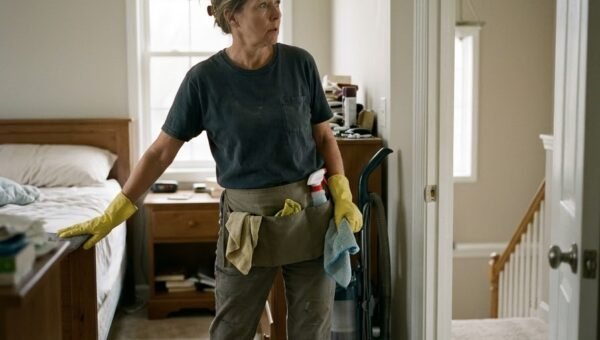
She had a faded red-apple apron she wore every Thanksgiving. I’d bought it for her at my school’s holiday market when I was ten. I still remember the rough little paper tag scratching my thumb.
Eleanor showed up carrying only her purse. She looked around the kitchen and said, “The flowers are lovely. A little low, but lovely.”
She opened the fridge and asked Mom if the cranberry sauce was homemade.
“It is,” Mom said.
“Daniel likes the canned kind.”
Mom stirred the gravy. I was close enough to see her mouth press into a line, but I didn’t say anything.
I didn’t want a scene before dinner. That was the excuse I used, anyway. I kept telling myself I was helping by staying out of it.
By noon, nine guests had become twelve. Dad’s cousin brought someone nobody had met. Dad’s sister wanted a separate stuffing because her husband had changed his diet. Dad opened wine and got thanked for helping, even though Mom had done the cooking, shopping, and cleaning.
I heard Eleanor tell a guest, “Claire can handle absolutely everything.”
She said it like praise. Mom was in the kitchen with one hand on the gravy spoon and the other wiping a spill off the counter.
Dad was on his phone. He smiled at something on the screen.
I noticed. I noticed that he didn’t look at Mom. But I didn’t ask what was going on. I picked up more plates instead.
At about one, Eleanor came into the kitchen while Mom basted the turkey.
“My boy is lucky,” she said. “Claire can manage anything.”
Dad kept looking at his phone.
I was standing by the pantry with the ice bucket. I could have said, “Then why isn’t he helping her?” I could have asked Mom if she was okay. I said nothing. It’s a bad feeling, realizing you were there and still managed to make yourself useless.
At 2:17, Dad walked into the kitchen and loosened his tie.
“Claire, we have to talk.”
Mom didn’t turn around right away. “Can it wait until dinner’s over?”
“No.”
She set the spoon down. The room got quiet behind us. Dad’s sister stopped with a pile of plates in her hands. Eleanor rested both hands on the breadbasket.
“I want a divorce,” Dad said.
I was holding the blue-flower plate. I didn’t drop it. I didn’t move. I just stood there holding a plate like it had become my job.
Mom looked at him, then at Eleanor.
“How long have they known?”
Dad glanced down. “This doesn’t concern them.”
“How long?”
Eleanor answered for him. “A few weeks.”
I remember the gravy making a little popping sound behind Mom. She’d spent hours cooking for people who had already heard Dad planned to leave her. Nobody had thought she deserved to know before she started the turkey.
Then Dad said, “I met somebody else. She fits the life I want.”
Mom asked, “Does she have a name?”
“Natalie.”
I knew Natalie. I’d seen her at one of Dad’s company events. She was his new marketing consultant. I’d noticed a diamond bracelet on her wrist in a photo from the company holiday party. I hadn’t asked who bought it.
Dad looked at the oven. “I don’t want to ruin today. Everybody drove a long way. Finish dinner, and we can talk after.”
I can still hear that sentence. Not because it was the worst thing he said, but because he said it like Mom was an employee whose shift wasn’t over.
Mom untied her apron. She folded it carefully and set it on the counter. The red apples were faded from years of washing.
Then she looked at Eleanor.
“If Natalie is the better fit for this family,” Mom said, “she can finish the cooking.”
Eleanor pursed her lips. “Claire, this is hard on everyone.”
Mom reached over and turned off the stove burners.
Dad said, “Don’t be dramatic.”
“I’m leaving.”
“The turkey isn’t carved,” Eleanor said.
“That’s your problem now.”
Mom picked up her purse and walked through the living room. I set the plate down. I didn’t follow her right away. I waited one stupid second to see if someone else would move first.
Nobody did.
So I went after her.
Dad followed us to the door. “Where are you going?”
“I don’t know,” Mom said.
“You can’t just leave like this.”
She looked back at the dining table. “You already decided I could.”
Then she went out.
I remember the cold air through the open door. I remember Dad’s sister staring at the plates. I remember Eleanor asking somebody to turn the oven back on. And I remember not knowing whether to follow Mom or stay and make sure my family had a place to sit.
I followed Mom.
She drove toward the airport and checked into a plain hotel. I didn’t go with her. I told myself she might want space. I called once and left a message that said, “I’m sorry. Call me when you can.”
I didn’t say I was sorry for not speaking up. I was still trying to make the apology small enough that I wouldn’t have to feel it.
The next morning, Mom had thirty-two missed calls. Dad had called about the gravy recipe. Eleanor wanted to know where the good serving platters were. Dad’s sister asked where the insurance papers were kept.
The messages changed after that.
“You embarrassed your father.”
“Your grandmother is very upset.”
“Come home so we can talk like adults.”
Dad’s last message came after one in the morning.
“Natalie isn’t answering. I need you to call me.”
Mom showed me that one later. She didn’t laugh. She just handed me the phone and asked if I wanted coffee.
I didn’t know yet that the blue folder was in her car. I didn’t know she’d been collecting documents for days. I thought she’d walked out with her purse and a hotel key, and that was all.
Two days earlier, our credit union had called Mom about a $75,000 home-equity loan. Dad had applied through the business. The house was in both their names, so the bank needed Mom’s signature.
Dad told her it was money for an expansion. When she asked to see the books, he called her paranoid. The next morning, her login to the company accounting software stopped working.
That was when she started looking through the records she still had. She found the founding agreement that showed her inheritance had bought her a fifty-percent stake in Dad’s construction company. She found mortgage statements showing she’d paid the house notes from her salary during the years Dad wasn’t taking a paycheck.
She found hotel bills from Charleston, too. Dad had said he’d been in Richmond for work those weekends.
Then she found $32,000 sent from the company account to an LLC registered to Natalie.
Mom told me all this later, piece by piece. At the time, she was careful not to give me the folder until she’d talked to a lawyer. I understand why. I was Dad’s daughter, and I’d spent years treating what he said as fact.
Mom had already spoken to Tanya Brooks, a divorce lawyer a coworker had recommended. On Saturday, I went with Mom to Tanya’s office. I carried the blue folder because Mom’s hands were shaking a little, though she said it was the cold.
Tanya asked, “Are you safe?”
“Yes,” Mom said.
“Are you going back to the house?”
“No.”
“Good. Keep every message. Don’t move money. Don’t sign anything.”
Mom nodded. I sat beside her and stared at the blue folder. It was the same color as the plate I’d set down at Thanksgiving. I know that’s a silly thing to remember, but I do.
Tanya opened the folder and started going through the papers. Every few pages, she stopped and asked a question. Mom answered in the same plain voice she used when she was reading out a grocery list.
“When did you get this statement?”
“October.”
“And the hotel receipt?”
“Found it in the desk drawer.”
“Did you know about the transfer to Natalie’s LLC?”
“No.”
I watched Mom keep her face still. I wanted to take her hand. I didn’t, because I worried she’d think I was doing it to make myself feel better.
Tanya finally took off her glasses.
“Daniel seems to think the house and company belong to him alone.”
“He’s always called it his company,” Mom said.
“He can call it whatever he wants. This agreement says something else.”
She turned to the last page of the founding contract. Mom’s name was there. Her signature. Her inheritance recorded as the first money put into the business.
I looked at her name and felt embarrassed. I’d heard Dad say “my company” for years. I’d repeated it myself. I’d never once asked what Mom had put into it.
Dad called Mom from an unfamiliar number that afternoon.
“You need to come home,” he said.
“No.”
“What do you mean, no?”
“I mean no.”
“This isn’t how grown adults handle a divorce.”
Mom sat back in Tanya’s chair. “Grown adults don’t announce a divorce while their spouse is cooking Thanksgiving dinner.”
Dad breathed hard into the phone.
“My family is a wreck right now.”
I looked at Mom. She didn’t answer for a moment.
“Then they can help each other,” she said, and hung up.
Three weeks later, Dad’s lawyer tried to get Mom to sign away her claim to the company in exchange for keeping the house. Tanya told her not to sign. The credit union put the home-equity loan on hold once Mom disputed the application.
Dad said he’d never intended to use her signature without asking. That didn’t match what the bank had told her, but I could see how he’d convinced himself it was just a formality. He’d been used to Mom handling the paperwork. He thought her money and work were part of the company because they’d always been there.
He also said the $32,000 transfer was a marketing expense. The LLC was Natalie’s. Natalie stopped answering him. I don’t know whether she’d been promised anything or whether she just took the money and walked. I know Dad wanted Mom to fix it for him anyway.
The business records were clear enough for Tanya to negotiate a settlement. Mom kept the house. Dad bought out her half of the company over time, with a signed agreement and payments Tanya tracked. The divorce went through the next spring. The company survived, but Dad had to sell a truck and let two office staff go before he could meet the first payment.
I felt bad for the staff. I also felt angry that Dad had put them in that spot. Both things were true.
Mom never moved back in with him. She didn’t take him back after he apologized, either. He apologized for “how the timing looked.” He apologized for making Thanksgiving awkward. He didn’t apologize for the loan application or the money sent to Natalie.
I stopped answering his calls for a while. That was my choice, and it cost me. Dad and I spoke again months later, but not the way we had before. I don’t think we ever got back to that.
Mom started doing Thanksgiving at her own place. The first year, she made cranberry sauce from scratch again. She also bought a can of the kind Dad liked, then left it unopened in the pantry.
I asked why she kept it.
“Habit, I guess,” she said.
I’m the one who puts out the plates now. Mom still wears the red-apple apron when she cooks, though it’s thin at the ties and one of the pockets has a small tear. I’ve offered to replace it. She won’t let me.
I can’t undo the seconds I spent waiting for somebody else to move. I can’t make my mother feel like I had her back that day, because I didn’t. What I can do is show up now, and I do.
On the agreement that settled the company, Mom’s name sits beside Dad’s, each of them owning half. I still hear him calling it his company. I still remember how long I believed him.