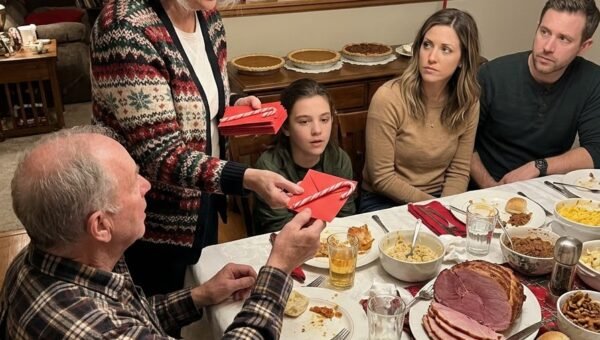
Vanessa’s hand was already moving toward the envelopes when I set my palm on top of Hank’s old briefcase. I didn’t raise my voice. I just held it there, because if she took the wrong envelope first, I knew I might lose my nerve. Toby’s folding table wobbled under the dinner plates. The boys were in the next room watching a cartoon, and Bradley was still wearing his coat. I had invited all three families to Thanksgiving dinner in my youngest son’s small apartment. I had told them I was bringing something of their father’s to hand out.
Three months before, I’d told each of them I had nothing. Not a home, not savings, not even a place to sleep. Two of them had found ways to end the call. Toby had offered his bed. None of them knew Hank had left me $3.8 million. I could have put that truth in an envelope and mailed it. Instead, I waited until they were all sitting at Toby’s table. I’m not proud of that part. I wanted to see their faces, and I wanted to make sure I understood what I’d already seen.
Hank sold his freight hauling business two years before he got sick. He and I agreed not to tell the kids. We kept the same modest house, the same sedan, and the coupons on the fridge. Hank said money could show a person’s real self, and he didn’t want the money to get in the middle of our family while we were still here to see it. I thought I understood him. I did not expect I’d someday use the same idea as a test.
The money was real, though. Hank sold the business and its trucks after years of hauling loads across Ohio and neighboring states. I remember the sale because the lawyer’s office had a bowl of stale peppermints, and I kept taking one even though I don’t like mint. Hank came home with the papers in a brown folder and told me the final amount. There were taxes, fees, and things I didn’t understand, but after it all, there was enough to make sure I would be safe. We put the money where it could earn interest and left our daily life alone.
I’d asked Hank once if we should tell the kids. Bradley had just bought a big house, and Vanessa was talking about private school for her children. Hank rubbed the side of his thumb with a napkin. “Let’s not find out until we have to,” he said. I thought he meant we should wait until someone asked for help. I didn’t think I’d be the one asking.
When Hank got sick, I became the person who kept track of the pills and the appointments. I learned which nurse liked her coffee with two sugars and which doctor rushed through the part about what came next. I don’t mean that as a complaint. It was just the work in front of me. The bills arrived too, but I knew the difference between being scared and being broke. I paid what needed paying and used the insurance we had. Still, after Hank died, I found myself staring at every envelope that came through the mail slot.
At the funeral reception, I watched the kids more than I meant to. Bradley sat with his phone in his hand while people came by to tell me they were sorry. He works in business and has a five-bedroom house. I know he loves me. I also know he has always been good at making a problem sound like something that belongs on someone else’s calendar. Vanessa pulled me aside twice to ask if Hank had left important paperwork. The first time I assumed she was trying to help. The second time, I heard the question underneath it.
Toby washed all the dishes in the hall kitchen. Nobody asked him. He’d spent most of his life being the one I thought needed the most help. He barely got through high school, works long weeks at an auto repair shop, and lives with Tessa and their two boys in a two-bedroom apartment above a laundromat. The dryers downstairs thump through the floor at night. Toby used to joke that he could tell what time it was by the spin cycle. At the reception, he didn’t ask about papers or money. He just rinsed a plate and put it in the rack.
I decided to make the calls a week later. That sounds planned now, but it didn’t feel planned then. I’d been sitting at the kitchen table with Hank’s reading glasses beside me, picking up the phone and setting it down. I wanted to know what each child would do if there was nowhere easy to send me. I also wanted to know if I could still trust the family I thought we had. Those are not the same thing, and I knew it even then.
I called Bradley first. He answered on the fourth ring. I told him the medical bills had taken everything, that the bank was foreclosing on the house, and that I didn’t know where I could stay. I kept my voice level. I’d worked too many hospital shifts not to know that people listen differently when they think the other person is about to cry. I did feel like crying, but I didn’t want to do it on the phone.
Bradley went quiet for a while. I could hear his car’s turn signal clicking. Then he said he was sorry, but it wasn’t a good time. Claire’s mother was coming in the spring, and the guest room was being used as Claire’s home office. I could look into senior apartments, he said. He’d send me some links. He sounded uncomfortable, not cruel. That almost made it worse. I could hear him trying to get through an awkward call without having to say no in a plain way.
He sent the links later that afternoon. Three of them. No note. I printed them out and set them beside Hank’s glasses. One page had a photo of a smiling older couple in front of a building. I turned it over so I wouldn’t have to keep looking at them. Then I told myself Bradley had his own family, his own bills, and a wife whose mother was coming to stay. I said all of that to myself because I wanted it to be enough.
Vanessa cried when I called her. I knew the sound of her crying. I had heard it when she fell off her bike as a girl, when her first marriage ended, and when one of her kids broke an arm. I didn’t question it at first. I explained the same things I’d told Bradley. The house, the bills, the foreclosure. She asked how much money I had left. When I said nothing, her crying stopped. Not slowly. It just stopped.
She suggested shelters, then called them community-run housing places, as if that made the word easier. I didn’t correct her. She said some of them were nice now. Then she remembered she had to pick up her kids from soccer. I said goodbye. I sat with the phone in my hand until the screen went dark. I could have called her back and told her what I’d really done. I didn’t.
Toby was the last call. I almost stopped before dialing. I remember the small nick in the kitchen table where Hank had once dropped a screwdriver. I kept pressing my thumb into it while the phone rang. I told Toby I had nowhere to go. I hadn’t finished the part about the house when he said, “Come tonight, Mom. You’ll take our bed.”
I told him he didn’t have room. He said Tessa and he could sleep on the couch. The boys would be happy to have me there. I told him I couldn’t pay him anything. He laughed, not in a mean way. “Mom, you raised me. I’m coming to get you right now.” Then he hung up before I could argue.
He pulled into my driveway in forty minutes. His work shirt smelled like oil, and there was black grease around two fingernails. He’d come straight from the shop. I had a small suitcase by the door, though I hadn’t packed much. When he saw it, he asked if that was all I had. I said it was enough for a few days. He looked at the suitcase and then at me, like he knew I was leaving something out, but he didn’t push.
I left the house locked and empty. I took Hank’s reading glasses by mistake. I didn’t notice until I’d been at Toby’s for a few days and went looking for them in my bag. The glasses had a scratch on one lens, and one arm was loose. I put them on the shelf by the bed. They became a small reminder of the life I’d said I’d lost, though I hadn’t lost the house or the money. I’d only left them behind on purpose.
Tessa made room for me without making a show of it. The first night, she pulled the sheets back and said the bed was ready. Toby brought two pillows out to the living room, where the couch sagged in the middle and had a broken spring that made a little metal squeak when he sat down. I offered to sleep on the floor. He said no. Tessa said, “You’re staying here, Lorraine. That’s it.” I could tell she meant it.
Their apartment wasn’t comfortable for three adults and two boys, but there was room in the way families sometimes make room. The boys climbed into bed with me on Saturday mornings and watched cartoons. One of them always kicked the blanket off. I’d pull it back up, and he’d kick it off again. Toby and Tessa slept on the couch for three months. I didn’t tell them about the money. Every morning, I told myself I’d tell them that night. Then I would hear the dryers rumbling downstairs and decide to wait until the right time.
The wrong thing about testing people is that the test doesn’t stay neat. Toby had sore shoulders from that couch. Tessa got up early even after working late. The boys asked when I was going back to my house, and I told them soon. They would ask if I could stay one more Saturday. I said yes. I did not tell them their grandmother could have paid for a much larger place. I let them think I was the one with nothing.
Bradley called twice. The first time, he asked if I had found a place yet. The second time, he said Claire’s mother had her travel dates figured out and asked if I still needed the senior housing links. He sounded relieved when I told him I was staying with Toby for now. He said it was good to hear. I didn’t tell him I’d been waiting to hear whether he might offer to come get me.
Vanessa called once. She asked if I still had Hank’s vintage watch. It had belonged to his father, and she had always liked it. I said it was in the house. She asked if I could keep it somewhere safe. She didn’t ask how I was sleeping or whether Toby and Tessa were managing. I told myself she was busy with her children. I still felt the little pinch of it.
When I finally called my lawyer, I didn’t tell him I had run a test. I told him I wanted to change my will. He had prepared the old one with Hank years before, and he knew about the sale of the business. He asked if I was sure. I said I was. He asked whether I wanted to leave something to each child. I said I wanted him to write what I had decided, not what sounded fair in a room with a desk and a clock.
I didn’t make the change that same day. I went home first. I stood in the front hall, looked at the little dish where Hank kept his keys, and found dust on the dining room table. I had not been able to bring myself to sell the house or rent it out. I had told myself I was waiting for a clear head. Really, I was waiting to see if the phone would ring. It didn’t.
At the lawyer’s office, I read the new will twice. I asked him to explain what would happen if Toby died before me. I asked about taxes. I asked if the document could be challenged. He answered each question. It was all dry and ordinary, which helped. I signed the papers in front of a witness. I was not giving Toby money that day. I was deciding who would receive what I had left when I was gone.
I chose Toby. The money Hank left me would go to him, along with the house and the rest of my estate. I didn’t choose him because he needed it more, though he did. I chose him because when I said I had nowhere to sleep, he made room before he knew what it might cost him. That is the plain version. There are other parts I don’t like saying. I was angry at Bradley and Vanessa. I wanted them to feel the size of their answer. I wanted them to see what Toby had done. I wanted to punish them, and I knew that too.
The lawyer gave me copies for the kids. I put each one in an envelope and wrote a name on the front. I kept Hank’s sale papers in a separate envelope. I could have stopped there. Instead, I put all four papers in Hank’s briefcase and carried it to Toby’s for Thanksgiving. I told the children I had something of their father’s to hand out. Bradley and Vanessa both came, though neither seemed comfortable in the apartment. Bradley kept his coat on for most of dinner. Vanessa asked what I had brought before the food was cleared.
Tessa had made a good meal in a kitchen with barely enough counter space for the dishes. The boys wanted to tell me about a school project. Toby moved between the table and the stove, checking the food and trying to keep the little one from dropping a fork. I watched him pull his sleeve down over the grease stain that had survived the wash. I felt my face go warm. It was the same shirt he’d worn when he came to get me.
After dinner, I opened Hank’s briefcase and set the envelopes on the table. I made sure the one with Toby’s name was in the middle. Vanessa leaned forward. Bradley’s eyes went to the papers, then to me. Toby didn’t reach for anything. He was watching my hand.
I told them I had lied about being broke. I said Hank had sold his business two years before he got sick and left me $3.8 million after the sale and expenses. Nobody spoke for a few seconds. Then Bradley took off his coat and folded it over the back of his chair. Vanessa said, “You told us you had nothing.”
I said I had. Not the truth, but I had said it. I told them I wanted to know what they would do if I needed a place to stay. I said I had made the choice to ask them without telling them about the money. I did not say it was a fair test. I don’t think it was.
Bradley said I could have told him the truth. He said his house was large, but Claire had reasons for keeping the office, and he had thought I needed links while they sorted out other options. Vanessa said she had thought I wanted advice, not for her to move me into her house. She sounded angry, but she also looked embarrassed. I didn’t interrupt either one. Their reasons were real. They were also not the same as offering me a place.
Toby finally asked what the envelopes were. I told him each one had a copy of my will. I told all three of them the papers were signed and witnessed. I said Bradley and Vanessa would not receive my estate. Toby would. I placed the separate sale papers beside them, so there would be no question about where the money came from.
Vanessa reached for her envelope. Bradley didn’t. Toby looked at me instead. His hands were still rough from work, and there was a small cut near his thumb. He said he hadn’t asked me to do this. I told him I knew. I told him he could refuse it, and I meant that. He asked me to take the money back out of the decision until he’d had time to think. That made me want to cry, so I kept my voice steady.
I had expected gratitude from him, if I’m honest. I had pictured him relieved, maybe even happy. Instead, he looked worried about the trouble the will might bring. I saw my own mistake then, though I didn’t say it aloud. I had made his kindness into a contest he never agreed to enter. Still, the papers were signed, and I wasn’t going to pretend I could turn the past three months into something else by changing the subject.
Bradley and Vanessa left with their copies. Nobody yelled. That would be easier to remember, actually. Bradley said he needed time. Vanessa said she didn’t know what to say. Toby stayed at the table while Tessa walked the boys to bed. I didn’t ask him to forgive me for the lie. I didn’t ask him to keep the money. The will remained exactly as I’d signed it.
The next day, I went back to my house. I put Hank’s reading glasses in the dish by his keys. They were still scratched, and one arm still sat loose. I could have gone back to Toby’s that night. Instead, I slept in my own bed. On the kitchen table, I left the copy of the will with Toby’s name on it, turned face down beside the spare key to the house.