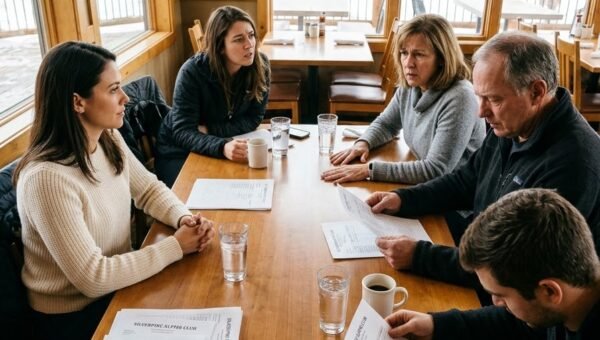
My dining room in Fairhope is where I came home from six weeks on the road and got cherry punch poured down my birthday shirt.
I’d been home two days. I was still waking up at 4:30 because my body thought I had a delivery to make, and my duffel bag was still by the laundry room. Mom, my sister Jessica, her husband David, and their son Carter had come over for dinner. I’d bought a new shirt for the occasion. Nothing fancy. It fit right, and I liked it.
Carter was nineteen and sitting across from me with an empty glass in his hand. The punch ran down my chest and into my lap. Ice clinked off my plate.
“Now you look as cheap as you really are,” he said.
My mother gave a short laugh. “Matthew, it’s just a prank. Don’t make a whole thing out of it.”
Jessica pressed her napkin to her mouth. David looked down at his food. Nobody told Carter to apologize.
I’d spent the ride home thinking I might finally ask Jessica about the charges on my card.
Instead, I sat there dripping red punch while my family waited for me to make things easy again. That was the part I couldn’t stop thinking about later. Not the shirt. The waiting.
I’m a long-haul trucker. I run one truck under my own authority and take refrigerated loads wherever the work is. I’m not rich, but I’ve been careful. I put money away when other people bought new boats, and I don’t mind driving an old sedan. A paid-off vehicle is a quiet thing. I like quiet things.
Jessica used to call me when something went wrong. At first it was small.
A late power bill, a tire, a pharmacy copay for Carter. I’d send money because I could, and because she was my sister. She’d say, “I owe you one.” I’d say, “Don’t worry about it.” That sentence got too easy.
Then the requests got bigger. Their roof needed work. David’s truck needed a transmission. Their property tax bill was due. Jessica always had a reason ready, and she was never asking for anything for herself, she said. It was for the family. I wanted to believe her because it let me feel useful without having to ask why I was the only one paying.
Two years before that birthday, Jessica called while I was parked outside a grocery warehouse in Mobile. Carter needed a car, she said. He was working part-time and taking classes, and the bus was making him late. She asked if I could help them get a used Honda.
I met them at the dealership after I finished a run. There wasn’t a Honda waiting for us. There was a black Porsche Macan on the lot, and Carter was taking pictures beside it.
I should’ve left. Instead, I looked at the price, looked at Jessica, and asked how much she could pay each month. She gave me a number that sounded possible. David said he’d help. Carter said he’d be careful. I told myself I was buying him a chance to get to work, not buying him a toy.
I paid $41,800. The title and registration went in my name. I told Carter he could drive it, but it was still mine. “You make the payments you promised,” I said, “and keep it clean. If you don’t, I take it back.”
“Yeah, yeah,” he said. “Thanks for the wheels, Uncle Matt.”
They never made a payment. Not one. I paid the insurance and registration because the car was in my name, and because every time I brought it up, Jessica said she’d catch up next month. By the second year, I’d stopped bringing it up. That’s on me.
The card came later, after Jessica showed up at my kitchen table with a grocery receipt and a stack of bills. She said she and David were short until his next job paid. She needed help with food and gas. I had a spare card linked to my account, so I gave it to her and spelled out the rules.
“Groceries, gas, pharmacy, heat,” I said. “That’s it. Emergencies only.”
She looked me in the eye. “I promise.”
I believed her. Or I wanted to be the kind of brother who could believe her.
The first few months, the charges looked normal. A grocery store. A gas station. One pharmacy. Then the amounts got odd. A salon. A steakhouse. A boutique in Birmingham. I noticed, but I was driving and kept telling myself I’d check it when I got home. I wasn’t proud of that. I was tired, and ignoring the problem was easier than starting the same family fight again.
My banker called me on a Thursday. She’d flagged several charges and wanted to know whether I recognized them. I pulled over at a rest stop and opened the account on my phone. There were flights, concert tickets, clothing, and dinners. Some were clearly Jessica’s. Some might’ve been David’s. I couldn’t tell who had bought what, and I didn’t feel like giving them the benefit of the doubt anymore.
The balance was $14,862.39.
I read the number twice. Then I sat in the cab with the engine off and listened to the fan tick as it cooled. It reminded me of the truck after a long climb, when everything takes a minute to settle. I called Jessica. No answer. I sent a text asking her to call me. She replied, “We’ll talk when you’re home.”
That was three days before my birthday dinner.
I didn’t call again. I told myself I wanted to hear what she’d say face-to-face. Truth is, I was afraid she’d cry, Mom would say I was being hard on her, and I’d end up apologizing for asking about my own money. I had done that before.
So I went home. I washed my work clothes, bought the shirt, and tried not to rehearse the conversation in my head. I thought about saying the balance out loud and asking for a payment plan. I thought about letting the card go and calling it a lesson. I didn’t decide which one until Carter emptied his glass.
There was no card on the table. Nobody had brought a gift. Mom gave me a quick hug when she arrived and said, “Happy birthday, honey.” Jessica asked how the drive was. David asked if I was still thinking about getting a boat, which I wasn’t.
Carter barely looked up from his phone. At one point he called his girlfriend and talked about changing the Porsche’s rims. He said he might trade it for a newer one when he turned twenty. Jessica smiled at something he said. David passed him the potatoes.
I remember the potatoes because I’d made them with garlic, and Mom always says she likes them. I’m not sure why I remember that. Maybe because the table still looked so ordinary while I sat there trying to decide whether to bring up nearly fifteen thousand dollars.
Then Carter glanced at my shirt.
The punch came fast. He didn’t spill it by accident. He tipped the glass right over me and watched it go.
“Now you look as cheap as you really are.”
Mom laughed. “It’s just a prank.”
For a second, I wanted to ask her what exactly was funny. I wanted to ask Jessica why her son thought he could talk to me like that. I wanted to ask David if he was going to say anything at all. But I knew how that would go. They’d all look at me until I made the room comfortable again.
I stood up and wiped my chin with my napkin.
“Excuse me,” I said. “I need to change.”
Upstairs, I took off the shirt and dropped it in the trash. I didn’t try to rinse it. I know that sounds petty, but I didn’t want to keep it. It was the first thing I’d bought for myself in a while without checking whether somebody else needed the money more.
When I came back down in jeans and a black T-shirt, the table had gone quiet. I could feel them waiting for me to start something.
I didn’t. I poured water and asked David about the boat he’d mentioned. He talked for ten minutes. Carter went back to his phone. Mom served dessert.
I drank coffee, cleared my plate, and saw them to the door. They left at about nine, laughing in the driveway. I watched from the front window until their car turned out of sight.
At 9:17, I locked the door. At 9:23, I opened the account on my laptop. At 9:26, I canceled Jessica’s card. Not paused. Canceled.
Then I called the number on my insurance paperwork and asked what I needed to do to move the Porsche back to my house. The woman asked whether the car was in my name. I said yes. She told me to have my registration and ID ready, and to use a licensed tow company if I didn’t want to drive it myself.
I called my friend Luke. He owns a small towing company outside town. I told him the car was mine, gave him the address, and offered to send a photo of the registration before he agreed. He said, “Send it. I’m not getting in the middle of a family mess without paperwork.”
That was fair.
I sent him the registration and the title. He called back after looking them over. “This is clean,” he said. “You sure you want it tonight?”
I looked at the shirt in the trash upstairs. “Yes.”
We met near Jessica’s place at 1:48 in the morning. I stayed on the public street while Luke checked the address and the plate. The Porsche was sitting in the open driveway. He took a photo, checked the paperwork again, and called the non-emergency line to ask if there was anything else he needed to do. The officer on the phone said it was a civil matter and didn’t send anyone out.
Luke loaded the car. I didn’t go up to the house. I didn’t knock. I didn’t want a midnight argument with Carter standing there in his socks and Mom getting a call before sunrise. I knew what I was doing, and I knew there would be a price for it.
At 2:11, the Porsche was on the truck. Luke dropped it at my place and left me with the spare key. I parked in the kitchen window’s line of sight, though I’m not sure why. It was a car. It was still a car.
At 8:40 the next morning, my phone started buzzing across the table.
Jessica. Mom. David. Jessica again.
I let it ring twice more before I answered.
“Matthew, someone stole Carter’s car,” Jessica said. She was shouting. “The Porsche is gone.”
I took a sip of coffee. “Are you sure it was his?”
There was a pause. Then she said, “What does that mean?”
“It means the title’s in my name. The registration’s in my name. I paid for it.”
“You can’t just take his car.”
“I can take my car.”
Carter got on the call. His voice was rough, like he’d just woken up. “Uncle Matt, what did you do?”
“I brought the car home.”
“You stole it.”
“I have the title.”
“You gave it to me.”
“I let you drive it. I said that from the start.”
He went quiet. Jessica came back on. “You did this because of some charges?”
I almost laughed, but I didn’t. “You spent $14,862.39 on my card.”
“I was going to pay you back.”
“When?”
“We’ve had a lot going on.”
“That’s why I gave you the card for groceries.”
Her voice softened. “I needed it. The kids, ”
“Carter’s nineteen.”
“Well, I still needed help.”
I looked at the spare key on the table. It had a small strip of blue tape around the ring because I’d marked it when I bought the car. I’d forgotten about that tape until then. It was such a small thing. I’d kept it because I thought the spare key would come in handy if Carter locked himself out.
“I’m done paying for things you won’t talk to me about,” I said.
“You’re punishing us,” she said.
“No. I’m stopping.”
Mom called ten minutes later. She didn’t yell. That was worse, somehow. She asked if I had really taken Carter’s car overnight and whether I could give it back before things got ugly.
“It’s in my driveway,” I said. “Nobody’s stopping you from coming by.”
She sighed. “You know what I mean.”
I did. She wanted me to undo the thing I’d done so she could go back to calling it a prank and a misunderstanding. I told her I wasn’t returning the car.
Jessica and David showed up just after ten. Carter came with them. He walked straight toward the Porsche, and I stepped between him and the driver’s door.
“Move,” he said.
“No.”
He pointed at the car. “That’s mine.”
I took the title from my back pocket and held it out. “Read the name.”
Jessica reached for the paper. I kept it in my hand. She stopped herself, then pressed her lips together. The only sound for a moment was Carter’s shoe scraping the driveway.
David said, “Matt, this doesn’t have to turn into a whole legal thing.”
“It already is a legal thing. The title says my name.”
Carter made a small scoffing sound. “You bought it for me.”
“I bought it because your mother said you needed a car for work. I let you use it. I told you the deal.”
“You’re unbelievable,” Jessica said.
That landed harder than it should have. I’d spent years believing the worst thing I could be was unhelpful. I’d let them set the rules, then acted surprised when they expected me to follow them.
I looked at Jessica. “I gave you a card for groceries and medicine. You used it for flights and clothes. I asked you to make payments on the car. You didn’t. And last night your son poured a drink on me while Mom called it funny.”
Jessica looked down at the title. “I didn’t know he’d do that.”
“No,” I said. “You just didn’t stop him.”
Carter stepped closer. David put a hand out to hold him back. “Let’s go,” David said.
Carter pulled away. “You’re acting like we owe you everything.”
I almost answered with the exact number on the card. I didn’t. I’d already learned that saying the number didn’t make them understand it.
“Take your things out of the car,” I said. “I’ll leave them in a box by the garage.”
Jessica’s face changed then. Not guilt exactly. More like she’d finally noticed that I wasn’t going to fix this for her. She started to say something, stopped, and looked at Mom.
Mom had come with them. She was standing behind David, rubbing the edge of her purse strap with her thumb.
“Matthew,” she said, “I shouldn’t have laughed.”
I’d wanted an apology at dinner. By then, it didn’t feel like it could put anything back. Still, I nodded once. I didn’t tell her it was fine.
The charges didn’t disappear because I canceled the card. They were mine to pay, and I paid them down over the next few months. Jessica texted twice to say she’d send money. She didn’t send any. I stopped asking. That was my choice, too, though I’m not sure it was the smart one.
The Porsche stayed with me. I sold it a few weeks later to a man who drove down from Pensacola with a cashier’s check and a list of questions. Carter had left a phone charger and a pair of sunglasses in the console. I put them in a box with his other things and told Jessica to pick them up. She sent David.
I didn’t cancel my family. I didn’t have some big talk where everyone understood me at last. I did cancel the card, and I stopped sending money when Jessica called with a new emergency. The first time she asked for help after that, I said, “I can’t cover it.” She didn’t answer for a while. Then she said, “Okay.”
Mom called about a month later and asked if she could come by for coffee. I said yes. She brought a small lemon cake from the grocery store and set it on my kitchen counter. We didn’t talk about Carter or the card right away. We talked about my next route and whether the old pecan tree by her driveway needed trimming.
Before she left, she said, “I should’ve told him to apologize.”
“Yeah,” I said. “You should have.”
She nodded. She didn’t ask me to make it easier for her.
I still have the blue tape from the spare key in my desk drawer. I don’t know why I kept it after I sold the car. Maybe because it reminds me of the part I got wrong. I thought being there meant being useful, and I thought being useful would make people careful with me.
It didn’t. But Mom still comes by for coffee sometimes, and now, when she asks if I’m free, I tell her the truth.