The foil on the plate was still warm when I found out I’d been left off the reunion list. I’d stopped at Vance’s Bakery for a slice of cherry pie, and Martha behind the counter asked if I’d recovered from the weekend. I hadn’t been anywhere that weekend, so I asked what she meant. She mentioned the lake house and the family barbecue. I got in my car, opened my phone, and saw the pictures.
There were more than fifty people in them. Michael was at the grill, Jessica’s relatives were gathered around the tables, and cousins from my late husband’s side were there too.
The banners were made for the event, and somebody had gone to the trouble of ordering desserts. I lived close by in Seattle. My daughter, Olivia, lived in Colorado and missed plenty of family events, so I understood why she wasn’t there. I didn’t understand why I was.
For five years after my husband died, I’d worked hard to be easy to ask. Every Thursday, I watched Michael and Jessica’s twins. I kept their camping things and winter clothes in my garage. If money got tight, I helped with groceries. I never made a list or asked them to pay me back.
I thought that was just what family did, and I was proud that they could count on me. Maybe I was also afraid that if I stopped being useful, I’d become easy to leave out.
Ten minutes after I saw the pictures, Jessica texted that she and Michael were coming by with a surprise. They arrived with a foil-covered container. “We brought you a plate,” Jessica said. Inside were two cold ribs and a spoonful of potato salad. She called the reunion a last-minute gathering and said she knew I wouldn’t want to deal with all the noise. Michael kept looking at the food instead of at me.
I told them I’d seen the photographs and asked how a last-minute gathering got personalized banners and a catered dessert table. Jessica said social media made things look bigger than they were. I didn’t argue with her. I picked up the container, walked to the kitchen, and dropped the leftovers in the garbage. “I don’t eat scraps,” I said. Then I asked them to leave. I didn’t shout, which almost made the whole thing feel worse.
After the door shut, I sat at my desk and opened my financial records. My husband and I had always lived below what we could afford.
Most of his life insurance money was still invested, and I had never told Michael or Jessica much about it. I drove an older car and bought clothes when I needed them. They seemed to take that as proof that I didn’t have much. I’d let them think that, partly because it was none of their business and partly because I didn’t want money to become another reason they called.
Three weeks later, on a Thursday I would usually have spent with the twins, I drove east to look at a small cottage near the Cascade Mountains. It had two bedrooms, three acres, a wraparound porch, and a wood-burning stove. The oak doors stuck a little when I tried them. I remember that because I had to pull twice, and the agent laughed and said the place had “a bit of character.” I liked it anyway. It was quiet in a way my own house hadn’t been for years.
My phone rang while I was walking the property. Jessica asked where I was. The children were waiting outside my house, and she had a Pilates class in twenty minutes. “You always watch them on Thursdays,” she said. I told her I wasn’t available that day or the Thursday after it. I said she’d need to make a different childcare plan from then on. She went quiet for a beat, then said she’d thought I liked having the kids. I did like them. That didn’t mean I had to be on call.
I finished walking the property and bought the cottage in cash. The deed went in my name alone. Olivia was the only person I told at first. She said I deserved a place that was mine, then reminded me not to let Michael and Jessica turn me into their permanent emergency plan. I told her I knew. Truthfully, I wasn’t sure I did. I’d spent years saying yes before anybody had to ask twice.
Over the next month, I moved my husband’s books, my favorite quilts, and the dishes I actually used. I didn’t announce the move. I wanted to know what it felt like to get settled without turning it into a family discussion. The old arrangements changed, too. Jessica had to pay a sitter on Thursdays. I asked Michael to remove his boat and camping equipment from my garage. He missed the date I gave him, so I had everything taken to a storage unit, paid for the first month, and mailed him the key.
Michael came over angry. He said Jessica was upset and the storage fees weren’t in their budget. I reminded him that my garage wasn’t a warehouse. He looked around and finally noticed the empty shelves in my living room. “What are you packing for?” he asked. “Whatever I decide to do next,” I said. He stared at the room as if it might give him a different answer. Then he left without taking the key from the counter.
Two weeks later, Jessica found the cottage. I was working in the garden when her white SUV came up the gravel drive. She looked over the porch and the acreage, then asked how I could afford another house. I told her I’d used my savings. She asked whether I’d borrowed against my city house and said she and Michael should’ve been consulted if I planned to use “the family’s equity.” I reminded her that my city house had no mortgage. The cottage didn’t either.
She asked whose name was on the deed. I told her mine. Then she suggested adding Michael’s name for “security,” because probate could get complicated if something happened to me. I said I felt secure already and went back to the garden. I could have said more. I could have told her that she hadn’t consulted me before excluding me from a reunion or expecting five years of Thursdays. I didn’t. I was still learning that a boundary didn’t need a speech attached to it.
Three days later, Olivia called and told me Jessica had been telling relatives the cottage was an investment property for Michael. According to the story, he’d supplied the down payment and I was staying there temporarily while I got it ready to rent. None of that was true. Olivia also told me Jessica had been asking around for an independent property assessor. I bought a thick chain and a brass padlock for the gate. I didn’t lock it that morning, though. I also took the ownership papers from my safe-deposit box, put them in a plain manila folder on the kitchen table, and made coffee.
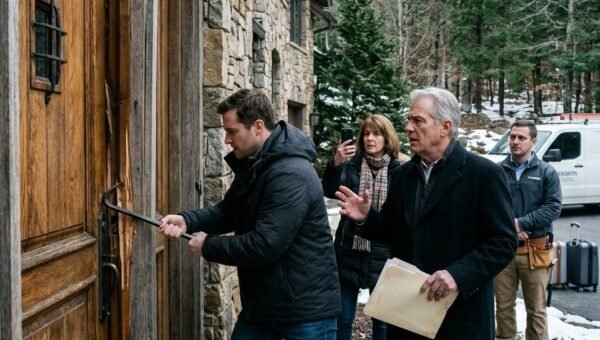
That Saturday, Olivia was with me on the porch when a black sedan stopped outside the gate. Michael’s SUV pulled in behind it. He got out and removed the chain I’d left unlocked. Jessica climbed out carrying a clipboard, and a man came around the sedan with a laser measuring device. Jessica had been smiling when she got out. Her smile disappeared for a second when she saw Olivia sitting beside me. I stayed where I was.
Jessica said she’d brought an appraiser to look at the place. She said she wanted an independent value before “the family made any decisions.” The man shifted the measuring device in his hand and looked from her to me. I asked him who had hired him. Jessica said she had. He explained that he’d been asked to assess the property’s market value. He wasn’t there to decide who owned it or whether anyone had a legal claim.
That answer changed the way Jessica held the clipboard. She pressed it against her chest and said she’d understood the appraisal would help sort out the ownership. The appraiser said it wouldn’t. He could measure rooms, look at the land, and prepare a value report for the person who hired him. He couldn’t tell us who had paid for the cottage or whose name was on its deed. Michael kept standing by the gate. The chain hung from one hand.
I picked up the folder from the table and opened it. I had the recorded deed and the purchase papers there, along with the latest property tax statement. I set them down in front of the appraiser. I didn’t want him to have to guess what I owned, and I wanted everybody else to stop talking as if it was a family question. He looked over the pages and told Jessica the deed showed me as the sole owner. He said his appraisal wouldn’t change that.
Jessica asked whether there could be some claim based on Michael helping me. The appraiser said he couldn’t advise her on legal matters. He also said he had no reason to think Michael had provided the purchase money, based on the documents he’d been given. That was enough. There was no hidden family share to uncover and no mortgage they could point to. The cottage belonged to me. Jessica’s story about Michael’s down payment wasn’t supported by anything on the table.
Olivia put her hand on my forearm. Jessica looked at her, then at me, and asked why I’d brought her into it. Olivia said she’d been invited to visit and didn’t need permission to sit on my porch. I didn’t enjoy seeing Jessica embarrassed, but I didn’t rush to save her from it either. I’d spent a long time smoothing things over before anyone asked me to.
I told Jessica I wanted to know why she’d excluded me from the reunion. I said I wasn’t asking because I expected an apology to fix everything. I wanted her to stop acting as if my help meant she had a say in my home. She said she didn’t think I’d enjoy the event, and she thought it would be simpler not to invite me. Then she said the cottage had made the family finances confusing. I reminded her that my finances weren’t family finances.
She told me she’d only wanted to protect Michael. She’d thought he should know what was happening with the property, and she was worried that a move would change what the family could count on. “I thought you’d keep helping us,” she said. That was the first honest thing she’d said all morning, even if she didn’t mean it as an apology. I understood the fear behind it. I didn’t accept what she’d done with that fear.
I told her the Thursday childcare was over. I told her the garage was no longer available. I said I’d help when I chose to help, but there would be no more standing arrangement and no more assuming I’d take the kids because she had somewhere else to be. She started to answer, then stopped. Michael finally set the gate chain down. He said he should’ve told me the reunion was happening, and he should’ve picked up his things when I asked.
I asked why he hadn’t. He said he’d wanted to avoid a fight with Jessica, and he thought I’d get over being left out. I told him he’d made it easy for everybody else to pretend it didn’t matter. His eyes went down to the documents. “I’m sorry,” he said. I wanted to believe him. I also wanted to know whether he was sorry because he’d hurt me or because the appraiser had just made it plain that the cottage wasn’t his to discuss. I didn’t ask him to prove it right then.
Olivia said she’d come back in a few weeks, and she and I could have lunch in town or spend a day in the garden. She didn’t offer to fix things between me and Michael. I appreciated that. Jessica picked up the folder but didn’t move it. I took it from the table and put the papers back inside. The appraiser said he could still complete the assessment if I wanted him to. I told him I hadn’t hired him, and there was no need to continue. He packed his device and left with Jessica.
Michael stayed behind for a few minutes. He said he wanted to bring the twins out sometime, if I was comfortable with it. I said he could ask me about a visit, but I wasn’t promising a regular Thursday or childcare. He nodded. Jessica was already waiting by the SUV. He looked back toward the porch and said, “I hear you.” It wasn’t much, but it was more than I’d heard from him before that day.
Three weeks later, Michael called before coming over. He asked if he could bring the twins for lunch on Sunday. I said yes, and told him we’d need to be done by three because Olivia and I had plans to talk. The kids ran around the yard and asked about the stove, the trees, and whether they could help me water the garden. They were still my grandchildren. I loved them. I didn’t have to turn that love into an unpaid job.
Jessica didn’t come that day. Michael said she wasn’t ready to visit, and I said that was her choice. He didn’t ask me to change my mind about the cottage or put his name on anything. I didn’t offer to resume the old arrangement. We ate lunch at the porch table, and I packed the twins a few cookies for the drive home. When they left, the house was quiet, but it felt like my quiet.
I still think about the reunion sometimes. Not the food or the pictures so much as how quickly I’d trained myself to accept whatever place they left for me. I can’t say I handled every part of it perfectly. I should’ve said no sooner, and I should’ve been honest about how much the Thursdays mattered to me. But I’m not going back to being available by default. The recorded deed stayed in the folder, my name alone on the page, while I went back out to the garden.