My phone showed a text from Julian while I was checking the alarm panel: “We’re here. Open the door.” The Christmas tree was still in its box, and my family had arrived with a locksmith, two suitcases, and a lease they claimed gave them the right to live in my house. I watched them on six camera feeds from inside the entrance hall. My father held the papers up toward the nearest camera like he was presenting proof in court.
My mother had her phone out, recording. Julian stood by the circular drive with the suitcases. Dad did most of the talking. He’d always been good at making a demand sound like a reasonable request, especially when he knew people were watching.
“Clara,” he called. “We’re taking possession today.”
I pressed the intercom. “You don’t have permission to enter.”
Dad smiled toward the camera. “Our daughter is refusing access to her lawful tenants.”
They thought the house was empty except for me. It wasn’t. Two police officers were waiting in the library. Three investigative reporters sat in the dining room, and my attorney, Harrison Sterling, stood near the stairs with a binder of records.
I’d spent weeks making sure I wouldn’t have to rely on my word alone.
The locksmith looked at the lease. “I need you to confirm you have the legal right to occupy this place.”
“I confirm it,” Dad said.
“And you understand the owner has denied permission?”
“She doesn’t have the capacity to deny it.”
That was when one of the officers stood up behind me. I didn’t look back. My hands were cold, and I remember being annoyed because I’d forgotten to put on gloves. It was such a small thing to notice.
My name is Clara Vance. I’m thirty-five, and my family had been leaving me out of Christmas for most of my life.
The strange part was how ordinary they made it sound. They forgot a present when I was eleven, so my mother wrapped a sweater from her own pile and wrote my name on it. Later, Dad told relatives I’d refused to open gifts because I was going through a difficult phase.
When I was sixteen, my parents left for a ski trip without telling me when they were leaving. I woke up to an empty house and a note asking me to feed the dog. I spent three days eating canned soup. In the family Christmas video, Dad said I’d chosen to stay with friends. I didn’t have friends in town.
I kept correcting them for years. Dad called me vindictive. Julian said I was obsessed with the past. Mom got quiet and said she couldn’t handle another fight. Eventually, I stopped telling the stories. It was easier than watching them get changed again.
At twenty-two, I brought four framed architectural sketches to Christmas dinner. One of Dad’s business partners asked who I was. Dad laughed and said, “That’s Clara. She disappears for years, then comes back when there’s free food.”
I lived fifteen minutes away and called my mother every Sunday. I remember the little red mark the picture frame left on my thumb because I’d carried all four sketches in one trip. Nobody asked to see them.
Years later, Dad still called my work a hobby. By then, I’d illustrated three bestselling books, painted a large city mural, and worked on a national ad campaign. I’d also sent my parents $15,000 when Mom said their company couldn’t cover employee health insurance. I didn’t tell anyone how much it was. I thought if I helped enough, I’d count.
That’s embarrassing to admit. I knew better, probably. I kept doing it anyway.
After one Christmas dinner, I drove home and opened a blank document. I titled it The letter I will never send. I wrote that I was done trying to become memorable to people committed to forgetting me. Then I saved it and changed my phone number.
I closed the joint account Mom had asked me to keep. I froze my credit. I moved my business mail to a private mailbox. For five years, I worked out of a small apartment with unreliable heat, painting murals by day and drafting architectural renderings at night. I slept on a foldout couch because my bedroom had become my studio.
I didn’t become independent in one big moment. I did it one invoice at a time. Then I found the estate outside Asheville.
It had fourteen rooms, a library, two courtyards, unfinished galleries, and a detached carriage house. The old plumbing needed work. So did the wiring. Most buyers saw a long list of repairs. I saw a place I could make useful.
I bought it through a company connected to my design business. My plan was to make part of the estate an artist residency for women rebuilding after emotional or financial abuse. Guest rooms could become temporary housing. The grand hall could host shows. A portion of sales could help cover legal advice and moving costs.
I didn’t tell my family. I wanted one thing that didn’t become an argument before it was real.
Then an envelope arrived at my private mailbox. It contained a $2.1 million loan guarantee with my name on it. The signature looked close to mine, but the middle initial was wrong. The address was an apartment I’d left seven years earlier.
There was a note in Dad’s handwriting: Call your father before this becomes embarrassing.
I called Harrison instead. Within two days, he found the loan papers had been used in a restructuring of Dad’s logistics company. An employee at the company had notarized the guarantee. I hadn’t signed it.
When I confronted Dad, he said I had a “selective memory.” Mom warned that my old anxiety might make people question my version of events. That was when I understood the lease wasn’t the only document they planned to use.
The fake psychiatric letter said I had impaired judgment and that my parents had authority to step in on housing decisions. The doctor I’d briefly seen after college had never written it. Harrison said the letter, the lease, and the loan guarantee all needed to be preserved exactly as they were. So we made copies, recorded what we could, and told investigators what we’d found.
A few days later, Julian sent me a photograph of the estate. “Nice place,” he wrote. “Dad says family property should stay in the family.”
I didn’t answer. I saved the message.
A locksmith Julian hired contacted me before the break-in. He’d been given the lease and copied pages from my closing file, along with a counterfeit notary seal. When he realized the owner was objecting, he called Harrison. He agreed to cooperate. We set up the cameras and waited.
Now Julian had a metal pry bar wedged against my front door. The alarm was screaming. The frame had cracked, and my mother had lowered her phone.
“Julian, wait,” she said.
Dad pointed toward the lock. “Keep going.”
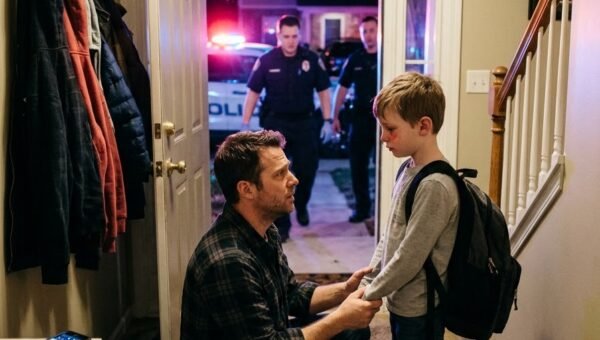
The library doors opened behind me. The two officers came out. One called for Julian to put the pry bar down. The other stepped between him and the locksmith.
Julian looked at Dad. “You said this was handled.”
“Put it down,” the officer said.
Julian dropped the bar. It hit the floor hard enough that I heard it over the alarm. The locksmith raised both hands and took two steps back.
Dad tried to speak over everyone. “This is a family matter.”
One officer told him to stay where he was. Then Harrison walked forward with the binder. The reporters stayed in the dining room doorway, cameras running, but nobody made a speech. It was mostly people asking short questions and waiting for answers.
Harrison handed over copies of the lease, the guarantee, and the psychiatric letter. He pointed out that the address on the guarantee was seven years old and the doctor had denied writing the letter. He also gave the officers the recording of Dad saying I lacked the capacity to refuse entry.
Dad shook his head. “That’s not what I meant.”
“You said it clearly,” Harrison told him.
Mom started crying. “We were trying to protect you.”
I had heard that line in different forms most of my life. “Protect me from what?”
She didn’t answer.
Dad said the company was in trouble and he’d been trying to keep people employed. That part might even have been true. I knew the business had debt. I knew he was scared of losing it. But being afraid didn’t make my name his to use.
“I didn’t sign the guarantee,” I said. “I didn’t sign this lease. I didn’t give you permission to come in.”
Dad raised his voice. “You’re making this worse than it is.”
“No,” I said. “You did that before you got here.”
Julian rubbed both hands over his face. “I thought we were going to talk.”
“You brought a pry bar.”
He looked down at it. “Dad said the papers were real.”
I wanted to ask why he hadn’t called me. I wanted to ask why he’d needed two suitcases before he’d even seen the inside of the house. I didn’t ask. I had spent too many years asking questions that made room for everyone else’s excuse.
One reporter asked if I’d be willing to speak on record. I said not right then. Harrison had told me to keep the focus on the documents and not get pulled into arguing about my childhood in the doorway. I didn’t need a stranger to decide which version of my family sounded more believable.
The officers told my family they had to leave the property. They took statements and documented the damage to the door. They did not arrest everyone on the spot. There were questions to investigate, and the police were careful not to promise what would happen next. Julian and the locksmith stayed while the officers sorted out what they’d seen and heard. Dad objected several times. It didn’t change the instructions.
The locksmith apologized to me before he left. “I should’ve checked more carefully.”
“You did check,” I said. “That’s why you called.”
He nodded, then packed his tools into the van. The pry bar stayed on the floor until an officer picked it up.
My mother’s phone was still in her hand. She’d recorded the whole thing, including Dad’s statement and Julian trying to force the door. I noticed she’d stopped crying by then. She looked tired, like she had after long drives when I was a kid, but I didn’t mistake tired for sorry.
“Clara,” she said. “Can we talk alone?”
“No.”
She pressed her lips together. “I’m your mother.”
“I know.”
That was all I said. It was enough for that day.
Dad left last. Before he went, he looked back at the house and said, “This isn’t over.”
Harrison answered him. “The property documents are clear. Any further contact can go through my office.”
I watched Dad’s mouth tighten. Then he walked to the car. Mom followed. Julian didn’t look at me as he got in.
The officers stayed until my family was off the drive. Harrison kept the binder with him, and I kept the recordings backed up in two places. I stood by the damaged door for a while after the cars were gone. The alarm had stopped, but I could still hear it in my head.
The next morning, I spoke with the reporters in the grand hall. I kept it plain. I told them I’d found a forged guarantee in my name, that my family had tried to use a false lease to enter the estate, and that investigators had the paperwork and recordings. I told them the estate was meant to become a residency for women who needed a safe place to start over.
One reporter asked why I’d planned to do that.
I looked at the unfinished rooms. “Because I know what it’s like to need somewhere that’s yours.”
I didn’t tell them the whole story. Not because I was ashamed. I just didn’t want my family’s past to become a show people could watch while eating lunch. The report came out later, with documents reviewed and the company’s response included. Dad’s company denied wrongdoing and said it was cooperating with the inquiry. I didn’t expect one article to settle a case.
It did make it harder for my family to tell people I was confused. There were recordings. There were documents. There was the crack in my door.
Harrison and I filed formal complaints about the forged loan papers and the false lease. We also worked with the lender’s fraud unit to remove my name from the guarantee. That took months, not days. I had to send copies of my identification, old records, and proof of where I lived at the time. I signed forms until my hand cramped.
The lender eventually confirmed in writing that I wasn’t responsible for the loan. The guarantee was not valid against me. The company still had its own financial problems, and I didn’t try to fix them. Dad’s actions were referred for further review. I didn’t get a neat ending where one hearing put everything right. I got a record that showed what had happened and a boundary I could enforce.
Julian sent an email two weeks later. He said he was sorry he’d brought the pry bar. He also said he’d believed Dad about the lease. I read it twice. He didn’t mention the fake psychiatric letter, or the loan, or the suitcases.
I wrote back: “Don’t contact me unless you’re ready to tell the truth about all of it.”
He didn’t answer. I didn’t chase him.
Mom sent a card before New Year’s. There was no return address, but I knew her handwriting. She wrote that she hoped I was safe and that the family had made mistakes. I put it in a drawer. I didn’t throw it away, and I didn’t call her. That was the honest answer I had.
The front door took three weeks to repair. I kept the estimate and the photos. The locksmith who did the work found the little crack in the frame and ran his thumb over it. “We can make this good as new,” he said.
I said, “I don’t need it to look new. I need it to lock.”
He understood. The repaired door looked like the same door, except the wood around the lock was slightly lighter. I liked being able to see where it had been damaged.
I started the residency the following spring, with two rooms instead of six. I couldn’t fix every part of the estate at once. I could get the rooms clean, make the bathrooms usable, and set aside money for legal appointments. The first guest arrived with two bags and a folder of paperwork. I didn’t ask for her whole story at the door.
On the first evening we opened the grand hall for a small art show, I brought out the four old sketches I’d carried to Christmas dinner at twenty-two. One frame had a scuff on the back from all those years in storage. I hung them near the entrance. Nobody asked whose work they were. I put my name on the label myself.
I still don’t know what my mother tells people about that Christmas. I know what the recording says. I know what the documents say. And I know my name is on the door to the rooms I built.