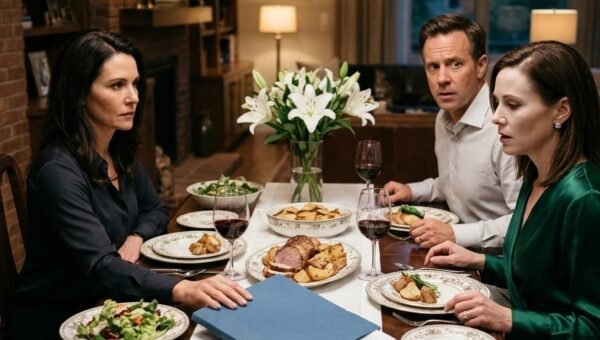
My father had just asked whether anyone wanted trout before he looked across the patio and said, “People of our standing don’t share vacations with someone like you.”
I kept my hands around my water glass. Uncle Greg didn’t even wait for the rest of us to look up. “Frankly, Elena, the rest of us would breathe easier if you left.” I gave a small nod, as if they’d asked me to pass the salt. The napkin in my lap was folded into a neat square.
I remember that because I’d been smoothing the same corner for several minutes.
It was the Vance family’s annual retreat, a tradition my father, Arthur, had kept going long after our family business started losing money. We were at Highstone Sanctuary, a mountain estate with a long waitlist and prices that made people sit up straighter when they heard them. My father had arranged the booking two months earlier. He told me he’d found a “corporate courtesy rate,” then made a point of saying I could pay my own share.
I’d offered to cover my part because I wasn’t going to let him pay for me.
Somehow, he managed to make that sound like proof I didn’t belong.
I had arrived that morning with a small suitcase and no real plan for how long I’d stay. I’d been telling myself that maybe this year would be less awkward. That sounds foolish now, but I’d been doing it for a long time. My father could be perfectly pleasant when he wanted the family to look close. He’d ask after my work in front of other people, then change the subject before I could answer.
At 1:00, he didn’t bother pretending.
I can’t tell you every word that came before the insult. I remember the ice clinking in the tumblers, and I remember my cousin’s fork stopping halfway to her mouth.
I also remember not saying what I wanted to say. I wanted to ask what “someone like me” meant. I wanted to ask if he’d ever learned what I did for a living. Instead, I sat there and let the sting settle somewhere I could keep it out of my voice.
I’d spent years learning that arguing with Arthur didn’t change his mind. It only gave him something to complain about later.
So I said, “I heard you.”
He looked satisfied, which was worse than if he’d looked angry.
For half an hour, I stayed at the table. Nobody knew what to do with their food.
Greg examined his phone. My aunt asked if anyone needed more bread, then didn’t wait for an answer. I can still hear a server setting down a glass behind me. It made a small, clean tap against the table, the kind of sound you notice when you’re trying very hard to act normal.
I wasn’t waiting for an apology. I don’t think I believed one was coming.
Marcus Keller, the estate manager, walked past the family at 1:30 and stopped beside my chair. He was always careful with names and timing. That was part of why I trusted him to run Highstone.
“Ms. Vance, your private pavilion is prepared,” he said.
My father’s eyebrows lifted. He looked first at Marcus, then at me.
Marcus kept his voice even. “Regarding their booking, would you prefer to break the news, or shall I?”
The table went quiet. My father’s smirk stayed on his face for another second, but it didn’t look like his anymore. I glanced at Marcus. He had a thin tablet tucked under one arm.
“Give me a minute,” I said.
“I can handle it privately,” he said. “If you’d rather.”
I could have let him. It would have been easy to stand, go to my pavilion, and leave Arthur to learn the details from someone else. I even wanted to. But I’d been letting my father define what I was allowed to say for years. I didn’t want to make a scene, but I also didn’t want to disappear neatly just because he’d asked.
“Stay,” I told Marcus. “I’ll talk to him.”
My father gave a short laugh. “What is this?”
“I’m about to find out,” I said.
Marcus placed the tablet on the table. The screen showed the Vance party reservation, the dates, and a commercial partner code. My father’s electronic signature appeared below a statement saying the group met the requirements for executive sponsorship through a hospitality business.
I read it twice. Then I looked at Marcus.
“Is this the courtesy rate?” I asked.
“It is,” he said. “It’s reserved for verified commercial partners. The certification has to be accurate.”
I already knew my father hadn’t run a hospitality business. He had spent his working life at the Vance commercial textiles brokerage, a company founded by my grandfather and still treated by Arthur as if the name alone could keep it afloat.
My father leaned toward the screen. “There’s been a mix-up.”
Marcus didn’t argue. “The partner information didn’t verify.”
Greg sat forward. “We were told we qualified.”
“Who told you that?” I asked.
Greg looked at my father. “Arthur handled the booking.”
My father brushed at the edge of his napkin. “It’s a small technical issue. We’re family. We can sort it out without making this public.”
“It’s already at the table,” I said.
I wasn’t proud of how flat my voice sounded. I was angry. I also knew that if I let myself talk as fast as my father, I’d say something I’d regret and he’d use that instead of answering the question.
Marcus explained the terms. The reservation couldn’t stand under the unverified partner code. The group could authorize the full peak rate, which was nearly three times what they had booked for, or they could leave before evening service. The deposit would be applied to the administrative costs under the guest agreement.
My father stared at Marcus. “You can’t just cancel us.”
“I can explain the policy,” Marcus said. “The booking is no longer valid at the discounted rate.”
“You’re telling me we have to pay full price today?”
“If you’d like to keep the rooms, yes.”
My father turned to me. “You can fix this.”
That was when the small details I’d been collecting for years seemed to line up, though I hate saying it that way. They didn’t line up like some clever puzzle. They were just there. My father had asked me to pay my share before he knew what my share meant. He had ignored my work. He had signed a statement he couldn’t back up. And now he expected me to make the uncomfortable part go away.
I looked at the screen again. “Did you know the code was for verified partners?”
My father pressed his lips together. Greg looked down at his hands.
“We were trying to keep the family tradition going,” my father said.
That wasn’t an answer. It was the kind of sentence he used when he wanted credit for the intention and no questions about the choice.
For eight years, I’d built Vance Heritage Holdings without a dollar from my family. I left the textiles firm after one meeting where my father called my plan “a hobby with a tax number.” I’d wanted to restore old places and keep them open, not buy them, strip them down, and turn them into something unrecognizable. I knew it was a risky business. I also knew I would rather fail at my own work than spend the rest of my life trying to impress him inside his.
He made sure I understood how he felt about that. “You’ll be back when you need real work,” he said.
I didn’t go back.
My first project was an old lodge on a patch of land most investors had written off. I spent months sorting permits and repairing what could be saved. I took calls from contractors while eating lunch in my truck. Once, I had to tell a crew to stop work because a pipe had been installed wrong and I couldn’t afford to pay twice for the same mistake. I wasn’t some brave business genius. I was tired, scared about cash, and stubborn enough to keep showing up.
Highstone was the biggest property I’d taken on. I’d bought it through the company, restored the main lodge, and built a small group of private guest spaces around it. The sanctuary had been open long enough to earn a good reputation. My father had never asked how it was doing.
That part wasn’t an accident. I’d sent him company updates. I’d sent him an annual report once, partly because I thought he might be proud. He never mentioned it. Later, I found out from my aunt that he’d tossed the envelope with my company name on it without opening it. I didn’t ask her to repeat that.
He’d stopped asking about my work years ago. I’d kept sending information anyway, which is embarrassing to admit. I think I wanted him to know without having to ask him to care.
Marcus held out the tablet to me. “Would you like to review the owner record?”
“Yes.”
I took it from him. The owner-level screen showed the company name and my name as sole managing partner. I turned it enough for my father to see. His mouth opened, then shut. Greg leaned toward him to read the display.
“Highstone is mine,” I said. “It belongs to Vance Heritage Holdings. I’m the managing partner.”
My father looked at the screen like he expected a different name to appear if he waited long enough.
“You own this place?” Greg said.
“I do.”
“You never told us,” my father said.
“I sent you the company notices.”
“You didn’t tell me you bought Highstone.”
“I sent the announcement when we closed. You didn’t answer.”
He waved that away. “I don’t read every piece of mail.”
That was true, I suppose. But I had watched him ask other people about their businesses, their children’s jobs, their new houses. He could remember the details of a man he met at a trade dinner once. My work had been the one thing he didn’t have room for.
“You never asked,” I said.
He tried to recover his footing. “This doesn’t change that we’re family.”
“It doesn’t change the booking policy either.”
“Come on, Elena.” He lowered his voice. “Do you really want to do this to us?”
I felt my thumb press into the side of the tablet. I loosened it. I’d spent so much time worrying that setting a boundary made me cruel. My father knew that. He’d always been good at making me feel like the unkind one when I stopped doing what he wanted.
“I didn’t make the reservation,” I said. “I didn’t use a partner code.”
“We didn’t have another option,” Greg said.
“There were other places.”
“Not for the whole family,” he said.
My father cut him off. “I’m not going to be lectured at my daughter’s table.”
I looked around at the table. My aunt had folded her napkin in half. My cousin was staring at the pitcher of water. Nobody spoke for him this time.
“You told me people of your standing didn’t share vacations with someone like me,” I said. “I’m trying to understand what family means when it’s only brought up after you need something.”
His jaw tightened. “That’s not what I meant.”
“You said it plainly.”
“I was frustrated.”
“So was I.”
I could feel the old part of me wanting to explain everything. The years of work. The choices. The fact I hadn’t asked for help. The times I’d sent a card or made the drive for a birthday and still felt like an extra chair. I knew better than to lay all of that out for him. He would pick one detail and argue with it.
Marcus waited beside me. He didn’t rush the answer, and he didn’t speak for me.
My father glanced toward him. “There must be some way to make an exception.”
“There is an owner’s waiver,” Marcus said. “Ms. Vance would need to approve it.”
My father looked at me. “Then approve it.”
No apology. Not even a question.
“I’m not signing a waiver,” I said.
His face changed in a small way, like he’d expected a different answer and was checking whether I meant it.
“You’d make us leave over paperwork?”
“You signed the booking.”
“I made a mistake.”
“You said it was a mix-up. Marcus said the certification was signed under your name.”
My father turned toward him again. “Can’t you give us until tomorrow?”
“I can’t change the terms without the owner’s approval,” Marcus said.
“And she’s the owner,” Greg said, quietly.
That was the first time he said anything that sounded like the truth.
My father rubbed his forehead. He looked tired suddenly, but he still didn’t look at me like a father looks at a daughter. He looked at me like I was a problem he had not planned for.
“What’s the full rate?” he asked.
Marcus gave him the amount privately, leaning in enough that the rest of the table didn’t hear. My father’s eyes flicked down. He asked Marcus to repeat it. He did.
The number was beyond what my father could pay for the family on short notice. It wasn’t only the room rate. The whole point of the discounted booking had been that the group couldn’t afford Highstone at its regular price. The peak rate was nearly three times their reservation total.
My father looked at Greg. “We’re not paying that.”
Greg’s face had gone slack. “We can’t.”
My father didn’t want to stay under my roof as a guest, and he couldn’t afford to stay as a paying customer. He seemed to understand both parts at once. I wasn’t pleased. I didn’t feel like I’d won anything. I just felt tired in a way I couldn’t fix with sleep.
“You’ll need to pack before dinner,” Marcus said. “I can have the staff bring carts.”
My father sat back. “This is humiliating.”
I almost said, “You should have thought of that earlier.” I didn’t. I had enough of my own part to own. I’d kept hoping that if I stayed calm and sent enough proof, he would one day see me. That wasn’t his fault alone. I had chosen to keep trying long after he’d shown me what he would do with the chance.
“I’m sorry you’re in this position,” I said.
He gave me a sharp look. “Don’t pretend you’re sorry.”
“I am sorry it came to this. I’m not changing the decision.”
My aunt stood first. She took her room key from the table and put it beside her plate. “I’ll pack,” she said.
The rest of them followed, slowly. No one made a speech. A couple of cousins asked Marcus about the closest motel. He gave them the name of a regional place about thirty miles down the highway. It wasn’t a resort. It had rooms available and a parking lot big enough for the family’s cars.
My father stayed at the table while the others went upstairs. He looked at the abandoned plates, then at the tablet in my hands.
“You could have told me,” he said.
“I did.”
He shook his head. “You know what I mean.”
I did know. He meant I could have told him in a way he couldn’t miss, at a time he had to listen, with no chance to pretend it was ordinary mail. I’d spent years making my news smaller so he wouldn’t feel challenged by it.
“You could have asked,” I said.
He didn’t answer.
When he finally stood, he took his key card and left it on the table beside my folded napkin. I watched him walk toward the lodge. I did not follow.
The staff brought their bags down before dinner. My father had a hard time getting the last suitcase into his sedan, and Greg helped him lift it. I could see the staff trying not to look over. They were being polite, not cruel. That mattered to me.
Marcus checked with me once more before closing the booking. The deposit would be forfeited toward the administrative costs, as the agreement stated. I told him to follow the agreement and nothing more. No extra charge, no special treatment, no quiet favor that would leave another guest paying for my father’s choice.
I also asked him to make a note on the account. Any future booking from the Vance firm had to go through the regular public process. No partner access unless the business was actually verified. That was all.
Marcus nodded. “Understood.”
I could have asked for something more. I could have put a note in the file about how Arthur spoke to me. I didn’t. The facts were enough. I wanted the same rule for them that we used for everyone else.
By the time the cars pulled away, the patio had been cleared. I went up to my private pavilion alone. I’d planned to use it that night, but I hadn’t planned to feel the way I did. The room was ready, the staff had left a cup of cedar tea for me, and the little card beside it had my name written in Marcus’s careful hand.
I sat on the stone terrace with the warm cup between my hands. The tea smelled faintly like the cedar shelves in my first lodge, back when I’d been trying to do repairs with money I didn’t have yet. I used to think that if my father ever saw what I built, the hard years would feel less lonely.
He had seen it. He just hadn’t cared enough to look.
At dusk, I watched the headlights of his sedan wind down the mountain road. I held the cup steady. The valley below filled with evening mist, and for once I didn’t try to think of a reason he might call.