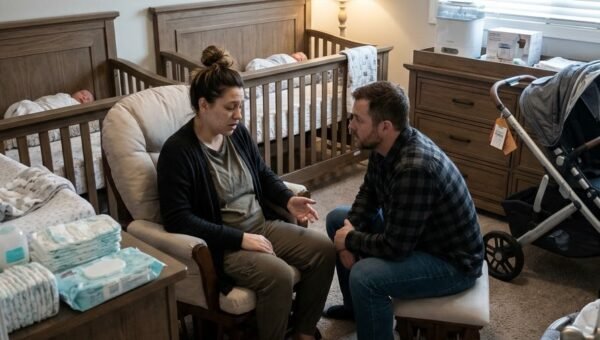
I was wrong to think Christy’s allergy was the only danger in that room.
I’m Fred. Christy’s my wife, and I watched her cut into a pear tart at her sister Michaela’s baby shower while Michaela stood there smiling and waiting for her to take a bite. I was across the living room, holding the family iPad because Michaela had asked me to fix the speaker. I saw a message come up on the screen. Then another. I didn’t know yet what the whole thing meant. I knew enough to text Christy.
“Put the plate down. Don’t eat anything she hands you.”
Christy had a tree nut allergy since she was little. Not the kind where her mouth gets itchy and she takes a pill. She carries two emergency pens because one may not be enough. I’ve seen her use one. I’ve driven her to the emergency room afterward. I’ve watched her get back to work the next day and act like we didn’t both spend the night scared.
So when Michaela said she’d had a separate dessert made for Christy, I didn’t think anything was wrong.
I didn’t like how much she was pushing it, but sisters tease each other. I told myself that was all it was.
Michaela had set a blue ceramic plate in front of Christy. Everyone else had pink paper plates. The tart was small, with powdered sugar on top and a little paper flag stuck in it. She said the bakery had made it just for Christy, and she’d checked three times to make sure it was safe.
“I had them make yours separate,” Michaela said.
Christy thanked her. Michaela laughed and told her not to be rude by letting it sit there.
I should’ve paid more attention to that. I didn’t. I was trying to get a Bluetooth speaker to connect, and Terrence was talking to me about a little league coach. I had my hands full of a cable and somebody’s tablet, and I chose the easy version of what I saw.
That was my part in this. I chose the easy version.
Then I saw the messages on the iPad. It was still logged in to Michaela’s account. A new notification came down while I was looking at the speaker settings. The first message was from Christy’s mother, Denise, asking if Christy had gotten the blue plate. Michaela answered that she had.
I read the next line. I read it again, because I didn’t want to read it right.
The tart had walnuts in it. Christy’s allergy pens were in Michaela’s diaper bag. And she had to be kept away from a man named Ashby until Friday.
I texted Christy. She looked down at her phone, then up at me. I was holding the iPad and my own phone, and I must’ve looked like somebody who’d just broken the speaker instead of fixed it.
I typed, “I’m serious. Look at me.”
She lowered her fork.
I stood there, still holding the iPad, with Terrence beside me. His face had changed when he saw the screen. He didn’t say anything. I don’t blame him for that. I didn’t say anything either, at first. I was trying to decide whether I had read it wrong, and whether I could be certain enough to make Christy leave.
She set her plate on an end table and covered it with a napkin. Then she went into the hallway to check her purse. I followed her.
The purse was hanging from the closet doorknob. She opened the inside pocket and took out the little fabric case where she kept the pens.
It was empty.
She looked at me. “They’re gone.”
I’d seen the messages, but the empty case made it real in a different way. The phone screen had words on it. Her purse had a space where the pens were supposed to be. I still hear the little click the zipper made when she shut it.
I showed her the screenshots. I’d taken pictures of the messages before the iPad could lock. Then I emailed them to Christy and to Kelly, her closest friend, and told them not to delete them.
Christy read the screen twice. She didn’t cry. She didn’t ask me what to do. She stood in the hallway with her hand on the purse strap and said, “Who’s Ashby?”
I didn’t know.
At that point, I wanted to get her out of there. I also wanted to walk back into the living room and ask Michaela what she thought she was doing. I wanted to say a lot worse than that. I didn’t. I was afraid that if I made a scene, Christy would feel like she had to defend her sister or explain herself to everybody in that room.
I’ve done that before. Tried to keep a family thing from becoming a family thing. I thought I was being helpful. I wasn’t.
Christy went back into the living room and picked up the plate. She kept the napkin over the tart. She carried it into the kitchen and asked where she could put it. Michaela’s kitchen counter was full of gift bags, so Christy slid the plate into a freezer bag and sealed it. Then she took pictures of the bakery box and the receipt.
Michaela came in as Christy was doing that.
“What are you doing?” she said.
“Keeping the plate.”
“Why?”
“I’m leaving.”
Michaela looked at me, not Christy. “What’s going on?”
I could’ve shown her the phone. I could’ve said the whole thing out loud. Instead I said, “Christy doesn’t feel well.”
Michaela’s smile pulled tight at one corner. “You didn’t even eat anything.”
Christy held the bag up a little. “I’ll return your plate.”
Michaela glanced toward the freezer bag, then at me. I remember her hands. She had one thumb hooked through a baby-shower ribbon, pulling it around and around. She looked like she was about to say something, but Terrence came into the kitchen and she stopped.
We left. That was the first decision I felt sure about all day.
I drove Christy to a pharmacy. She got replacement pens, and we sat in the car afterward with them in her lap. Her hands were on either side of the box. I held her hand. We didn’t talk much.
She said, “I don’t understand.”
I said, “I know.”
That was all I had.
The next morning, I heard more than I wanted to hear. Not because Christy sat me down and made a case against her family. She didn’t. She was trying to make sense of a thing she didn’t want to believe. She’d remember one old incident, then stop and say maybe she was being unfair. Then she’d remember another.
When Christy was eight, she had a reaction after the labels on two cookie tins were switched. Her mother called it an accident. I wasn’t there, so I’d only heard that story once or twice over the years.
At sixteen, Christy’s emergency pen went missing on a camping trip. It turned up in the bathroom trash at home. Michaela said she’d been cleaning out a bag and didn’t realize what it was.
Before our wedding, Michaela told the caterer to take the tree nut restriction off the menu. Christy caught it because she called the caterer herself. Michaela said she’d misunderstood the plan.
I had asked Christy once how many times the same kind of mistake had to happen before it stopped being a mistake. I said it in our kitchen, after the wedding menu mess. Christy told me she didn’t know. Then she asked me not to make her choose between her sister and me.
I let it go.
Not because I thought Christy was wrong. Because I didn’t want to be the man who pushed her away from her family. That sounds noble when I say it that way. It wasn’t. I wanted to be liked. I wanted us to have normal holidays. I didn’t want to argue with Michaela or Denise, and I let Christy carry the hard part alone.
There were good things, too. Michaela slept on Christy’s floor during pharmacy school when Christy was overwhelmed and lonely. Christy gave the toast at Michaela’s wedding. She helped with Michaela’s fertility bills when it looked like they might not have a baby. Christy never brought it up afterward. She didn’t even tell me the exact amount until much later.
That history was still there on Sunday. It didn’t make the messages less true. It made them harder to look at.
Michaela sent Christy thirty-seven messages between Sunday afternoon and that night. I know the number because Christy counted them. She had a hard time putting her phone down, even though she kept saying she wasn’t going to answer.
The messages went from “You left without saying goodbye” to “You stole my plate” to “You ruined the shower.” Then Michaela said Christy had misunderstood a joke. She never said the tart was nut-free. She never asked whether Christy was okay.
One message said, “Mom says you’re making this bigger than it is.”
Christy read that one out loud. Then she put her phone face down on the table.
I said, “We have the screenshots.”
“I know.”
“We have the plate.”
“I know, Fred.”
She sounded tired, not angry. I hated that. I wanted her to be angry, maybe because I was angry and didn’t know what to do with it.
On Monday, we took the sealed tart to a food-testing lab. I wanted a record of what was in it, not just my word or Christy’s. The woman at the front desk asked us to sign a form and gave us a number for the sample. I remember the smell of the cleaning spray on her counter. It was lemon, too sharp, and it stayed in my nose on the drive home.
We also made a report. The person who took it down didn’t promise us anything. He gave us a case number and told us to keep the messages and the receipt. We had already done that.
The test took a few days. While we waited, Christy wrote out a timeline at our kitchen table. She wrote the blue plate first. Then the missing pens. Then the messages. She listed every time she could remember something similar happening, but she wrote “maybe coincidence” beside two of them.
I watched her do that and felt guilty all over again. She was still trying to be fair to people who hadn’t bothered to be fair to her.
The next morning, Denise called. I picked up because Christy was in the shower. Denise asked if she was there, then said Michaela had cried herself to sleep.
I said, “Did you send the message about the blue plate?”
There was a pause. I could hear the radio in the background, some farm report about irrigation costs. Denise has always listened to that station in the morning.
“You’re taking it out of context,” she said.
“What context makes that okay?”
“Don’t talk to me like I’m a criminal.”
“Where were Christy’s pens?”
“I don’t know.”
“Michaela’s message says they were in the diaper bag.”
Denise sighed. “You don’t know what you saw.”
I didn’t have a good answer for that. I had the screenshots. I had the empty case. I had a wife who was safe because she hadn’t taken a bite. Still, I didn’t know what Denise thought she was doing, or what she thought would happen.
So I asked the question that had been sitting there since Sunday.
“Who’s Ashby?”
She hung up.
I told Christy when she came back into the kitchen. She sat at the table and stared at the timeline she’d made. Then she searched the name on her phone.
The first result was an estate attorney’s office near the cottage that belonged to her grandmother. His name was Gregory Ashby. Christy knew the name from the obituary, but she didn’t know why he’d be trying to reach her.
She called the office as soon as it opened Tuesday morning. I sat beside her. She put it on speaker.
The receptionist asked for Christy’s name. Then she went quiet for a moment.
“I’ll get Mr. Ashby,” she said.
Christy took a pen from the mug on our counter. It was one of those pens a feed store gives out, with the name printed on the side. She held it ready over a piece of junk mail.
Mr. Ashby came on the line and said he’d been trying to reach her since August.
Christy looked at me. “Why?”
“I can’t discuss all of this over the phone,” he said. “But your grandmother left you something, and I need to explain the paperwork in person.”
He asked whether she could come in before Friday. Christy said she could. I wrote the time down because her hand had started to shake, and I didn’t want her to have to remember it.
That was why Michaela and Denise wanted her away from Ashby. We didn’t know the rest yet.
The office was plain. There were framed certificates on one wall and a basket of hard candy on the desk. Gregory Ashby was older than I expected, maybe late sixties. He had Christy’s grandmother’s file open in front of him.
He started with the cottage. It had been left to Christy in a trust, along with a small strip of land beside it. Her grandmother had set it up several years before she died. She’d wanted Christy to have a place that was hers, without owing the rest of the family anything for it.
Christy looked at the papers. “My mother said Grandma left it to all of us.”
“She did not,” he said.
I’m not a lawyer. I don’t know all the terms. What I understood was that Christy owned it, and Denise had been trying to sell it without her. A developer had offered $318,640 for the cottage and the land. Denise and Michaela had signed papers saying Christy agreed to the sale and had given them permission to sign for her.
Christy had not.
There was a copy of her signature on the form. It looked close enough that I could see why someone might believe it at first glance. But I knew how Christy wrote her name. The C was wrong. The last stroke went too far up.
Ashby said he’d tried calling her at the number Denise had given him. He’d left messages at the wrong number, then mailed a letter to our old address. When he finally got the right number from another family member, he learned Denise had told him Christy was out of state and didn’t want to be involved.
“What happens Friday?” Christy asked.
“The buyer’s representative expects the signed documents by then,” Ashby said. “I stopped the transfer when I saw the concern about your authorization. I wanted to confirm your wishes before I took further action.”
Christy looked at the file. There was a copy of a note from her grandmother, written in a shaky hand. I could see the loops in the words from where I sat. Her grandmother had written it before she died. Ashby had kept it with the trust papers because it explained why she’d set things up that way.
He slid the note toward Christy.
She read it silently. Then she read the last part out loud.
“If they tell you I changed my mind, call Gregory.”
That was the line she kept reading. Quietly. Once, then again.
She had been holding that feed-store pen. It had stopped working, so she kept rubbing it over the paper without making a mark. I reached over and gave her my pen.
I wanted to tell her I was sorry I hadn’t pushed harder years ago. But she was reading the note, and I didn’t want to make her take care of my guilt at that moment.
Ashby told us the cottage was still safe. He’d put a hold on the sale. He’d sent notice to the buyer that Christy hadn’t agreed to anything. He gave us copies of the forms. We also gave him our screenshots and the case number.
It wasn’t a clean fix. The false paperwork still had to be dealt with. The food test wasn’t back yet. The report was still open. But the cottage wasn’t going to change hands on Friday, and Christy had not signed anything.
She made the decision about the cottage herself. She wanted it. Not because it was worth $318,640. Because she remembered spending summers there with her grandmother, eating toast at the kitchen table, and being allowed to read all afternoon while the adults worked outside. She didn’t want it sold out from under her. She didn’t want the money split among people who’d already decided she didn’t need to be asked.
That afternoon, Michaela called. Christy put it on speaker. I could hear how carefully she was breathing.
Michaela said the message had been a joke. She said Mom had panicked about the sale and they’d made a mistake with the paperwork. She said the dessert had been ordered from a bakery that used nuts, but the separate tart was supposed to be safe.
Christy asked, “Why were my pens in your diaper bag?”
Michaela said she’d moved them by accident.
“Why did you say I had to stay away from Ashby?”
“I don’t know. Mom was upset.”
“Why did you keep telling me to eat the tart?”
“I wanted you to try it. I didn’t know it had walnuts.”
There was a pause. Christy looked at the table, where her timeline was still spread out. I saw her press the nail of her thumb into the side of her finger.
Michaela said, “You’re making it sound like I wanted to hurt you.”
Christy didn’t answer right away. I could hear a truck going by outside. Then Christy said, “You knew I could die.”
Michaela started crying. She said she hadn’t thought it would go that far. She said the sale was only supposed to get them through a hard year. She said she was scared Denise would lose the house and she’d lose the baby’s room and everything would fall apart.
I could understand fear. I could understand being scared about money. I couldn’t make that fit with Christy’s missing pens.
Christy didn’t yell. She didn’t call her names. She said she wouldn’t speak with Michaela or Denise unless it was through a lawyer for now. Then she ended the call.
The food lab called the next day. They found walnuts in the tart. The result was sent to the person handling our report. I didn’t know what would happen after that. I still don’t. But there was no more room for “maybe the bakery got it wrong” or “maybe Christy misunderstood.”
The hardest part wasn’t the cottage, though that hurt. The hardest part was hearing Michaela say she hadn’t thought it would go that far. It was almost worse than if she’d said she meant it. She had looked at Christy’s allergy like a risk she could take for herself.
We went out to the cottage the following weekend. We didn’t stay long. Christy unlocked the door, went in, and stood by the old kitchen table. She ran her finger along a little notch in the wood where her grandmother used to set a mug down too hard.
She didn’t cry there either. She just said, “I thought she was protecting me.”
I knew she meant Denise. I also knew it could’ve meant Michaela, too.
I said, “I’m sorry I let you think you had to handle it alone.”
She looked at me. “You didn’t know what they were doing.”
“I knew about the other times.”
She nodded once. That was all.
The next call with Denise was short. Denise wanted Christy to withdraw the report and stop making the family look bad. She said the cottage had been meant for everyone. Christy told her it wasn’t. Then Denise said she couldn’t believe Christy would take a sister away from her newborn over a misunderstanding.
Christy stayed quiet for a moment. I was sitting beside her at our kitchen table. The empty fabric case for the allergy pens was in the drawer, where she’d put it instead of throwing it away.
Then she said the thing I don’t think she’d been able to say at the shower.
“You didn’t want me dead. You just thought I was worth the risk.”
Denise didn’t answer.
Christy ended the call. The cottage was still hers. The tart had walnuts in it. Her pens were back in her purse. None of that made her family feel safe again.
I kept thinking I’d know the moment someone crossed a line. I didn’t. I knew about the other times, and I kept calling them accidents because I wanted to keep the peace.
Christy slid the empty pen case into the kitchen drawer beside the feed-store pens. I didn’t ask her to throw it away.