“Could you grab a loaf of bread on your way back?” my mother said. I was standing by her kitchen counter, with my keys in my hand, and it was such a normal thing to ask that I said sure.
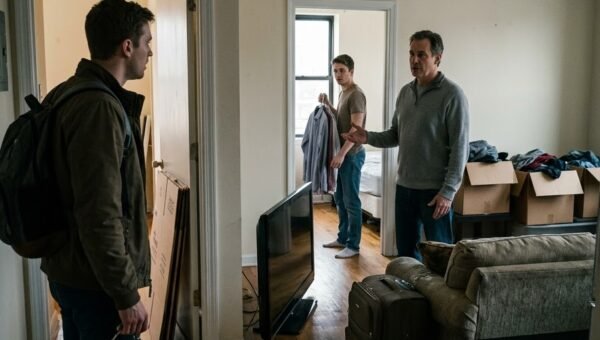
Three days later, Scarlett asked me to co-sign her third luxury-car loan. When I said no, she screamed, “You’ve ruined our lives!” My mother stood beside her and said, “We’d be happier without you.” So I packed two suitcases and walked out into the cold November air.
I didn’t argue. I already knew where I was going, and I had the one thing they didn’t know I’d kept.
I’d spent twenty-six years paying bills, fixing emergencies, and getting blamed when things went wrong. For most of that time, I told myself I was helping because family helped family. I didn’t see how often “help” meant my name on a bill, my card on a payment, or my savings filling a hole they’d made.
The first thing I did after leaving was carry the suitcases up one flight of stairs to my new apartment. It was a small one-bedroom in a nearby town, nothing fancy, but the lease was mine alone.
I set my bags down, put the kettle on, and stood in the kitchen listening to the refrigerator hum. Nobody asked me to fix anything.
Then I opened the fireproof lockbox.
Inside was the file I’d been building for months. Bank statements, canceled checks, utility records, paid collection notices, repair invoices, and notes I’d made whenever I covered something for Mom or Scarlett. I’d sorted it by year. I’d also written down what each payment had been for, because I’d learned that my memory got fuzzy whenever somebody told me I was making things up.
The total came to $183,416.
I checked the number twice. Not because I thought it was wrong, but because the figure looked like the kind of thing people made up to win an argument.
It was money I’d paid toward a house I didn’t own and debts I hadn’t run up. I put the papers back in order and didn’t call anyone.
Six months earlier, Scarlett had stopped paying on her second car. The lender started calling the house, then sent letters. Mom said the whole thing was a misunderstanding. Scarlett said she’d catch up once she got more hours at work. I paid the overdue amount because Mom told me the calls were upsetting her and asked me to handle it.
Afterward, Scarlett’s car sat in the driveway with a dent on the passenger door.
She’d scraped it against a parking post, then said the car was “basically worthless now” and started looking at another one. Mom didn’t ask how the old loan had been paid. She asked me to bring home groceries.
That was the sort of thing that got under my skin. The money didn’t disappear in some big, dramatic way. It went out in chunks. A roof repair. A past-due water bill. A medical copay. The property levy Mom had forgotten was due. I could cover each one, so each one became my job.
When I tried to talk about it, Mom would say, “You’re better with money than we are.” It sounded like praise, and I liked hearing it. That’s embarrassing to admit now. I wanted to be the reliable one. I wanted them to notice that I was reliable.
Scarlett knew how to turn that into a demand. “You can help me this once,” she’d say. Or, “You’re the only one who can do it.” If I hesitated, she’d look at Mom, and Mom would sigh like I’d embarrassed her in public.
I wasn’t always quiet. I could be sharp. I kept score in my head, then acted like I wasn’t keeping score. I’d say yes, resent it, and later bring it up when we were all already mad. I’m not proud of that. But I also know I wasn’t the one asking people to take on my debt.
When Scarlett’s second car payment fell behind, something finally stopped feeling temporary. I opened a bank account in my name only. I checked every account and service tied to my name and started moving things where they belonged. I made sure the mortgage, utilities, and repair debts were in Mom’s name, not mine. I wasn’t trying to punish her. I was trying to leave without being dragged back by another bill.
I found an apartment and signed the lease. I paid the deposit and first month’s rent from my own account. Then I started going through boxes of old paperwork. Some of it was in file folders. Some of it was stuffed in a desk drawer or folded inside envelopes. I kept finding records I’d forgotten about, and the file got thicker.
I didn’t tell Mom or Scarlett. I knew how they’d hear it. They’d say I was planning to abandon them, as if the years I’d spent helping were a promise to do it forever. So I kept going through the papers and let them think everything was normal.
Three days before I left, Scarlett came to me with an offer sheet for a new car. It was a luxury model, the kind she liked because it looked expensive in the dealership lot. She wanted me to co-sign. Her credit wasn’t good enough on its own.
I asked what happened to the second car. She said she still had it. I asked if she’d caught up on the payments. She said, “That’s not the point.” Mom was at the kitchen table, folding a dish towel into neat squares.
Scarlett pushed the papers toward me. “They need your signature today.”
“No,” I said.
She stared at me like she hadn’t heard right. “You’re not even going to think about it?”
“I’ve thought about it. I’m not signing.”
Mom put the towel down. “It’s just a signature.”
“It’s a debt,” I said. “If she stops paying, it’s mine.”
Scarlett pulled the papers back. “I won’t stop paying.”
I didn’t say what I was thinking, which was that she had already stopped paying before. I didn’t want to make the conversation bigger. I was tired of having the same conversation and watching it end with me fixing the problem anyway.
The next day, I picked up the bread Mom had asked for. I put it on the counter and drove back to my apartment. I remember that detail because I’d bought the same kind of loaf for years, and I still went through the motions even though I’d already decided to leave.
That night, Scarlett came into the kitchen with Mom right behind her. The loan papers were on the table. I’d put my keys down beside them. Scarlett was talking fast, and Mom kept interrupting to say I was being selfish. I told them I wasn’t changing my mind.
Scarlett’s voice rose. “You’ve ruined our lives!”
Mom didn’t tell her to calm down. She looked at me and said, “We’d be happier without you.”
For a second I waited for one of them to take it back. Nobody did. I picked up my keys and went upstairs. I packed two suitcases, took the lockbox, and checked the apartment address on my phone even though I knew it by heart.
I could hear them talking downstairs. I didn’t hear the words clearly. I didn’t go back to find out. At the front door, I nearly left the loaf of bread on the counter, then realized I’d already brought it to my apartment earlier. I don’t know why that small thing made me laugh, but it did. Just once.
The door clicked shut behind me.
The first week at the apartment was quiet. I bought groceries for one person. I made toast in the morning. I slept badly, but I slept in my own bed, with nobody banging on the door to ask about a bill.
I expected a call. I didn’t expect one that first night, but I thought Mom would call within a few days and say something softer. She didn’t. Scarlett didn’t either.
By the end of the first week, I had twenty-three missed calls. Some were from Mom. Some were from Scarlett. I didn’t listen to every voicemail. The first ones were angry. Later ones sounded worried, though I couldn’t tell if they were worried about me or the accounts I’d left behind.
Mom left one that said, “You need to come home and handle this.” I played it twice, then deleted it. The next day, she called again and said the heating bill was overdue. It wasn’t in my name. I didn’t call the company or pay it.
That was the first time I let a problem stay where it belonged.
Scarlett’s new car application was turned down. I learned that from a voicemail, not from her. She said the dealership had rejected her because her credit was “being affected by family drama.” I wasn’t on her credit report as a co-signer. I knew that. She wanted me to feel responsible anyway.
Then the house started costing what a house costs. The furnace needed work. The water bill came due. The pantry didn’t fill itself. Mom had been used to me picking things up on the way over, paying a bill when she handed me the envelope, and making calls until somebody agreed to wait.
Without me, the bills came to her.
She called and said I was making her choose between heat and groceries. I asked if she’d called the utility company to ask about a payment plan. She said, “I don’t know how to deal with this.”
I almost said I’d do it. That’s the part I still don’t like telling people. I had the number on the bill. I could have called and done what I’d always done. My thumb was already over the screen when I remembered what she’d said at the door.
“We’d be happier without you.”
I set the phone down.
The next few days were full of messages from relatives. Mom had told them I’d left in the middle of a family crisis and refused to help her. One aunt wrote that Mom was heartbroken. A cousin asked if I’d really walked out “over a car.” Nobody asked what the car cost or whose name would be on the loan.
Aunt Evelyn called me herself. She was Mom’s older sister, and for years she’d believed I was selfish with money. Mom had told her I lived at the house without contributing, that I spent my paycheck on myself, and that she and Scarlett were always bailing me out. I could have corrected her sooner. I hadn’t, partly because I was ashamed and partly because I thought family business should stay in the family.
Evelyn asked, “Is it true you left them with nothing?”
I said, “No.”
She paused. “Your mother says you won’t even pay the heat bill.”
“It’s not my bill.”
That was all I said. I didn’t send her a picture of the file. I didn’t try to win her over on the phone. I was tired of explaining myself in pieces while Mom got to tell the whole story.
A few days later, Evelyn invited everyone to her house. She said she wanted us to talk and clear things up. I didn’t want to go. But I knew Mom would keep telling the same story unless somebody saw the records. So I put the file in a tote bag and drove over.
Mom and Scarlett were already there. Mom had brought a folder of her own, but when I asked what was in it, she said it was none of my business. Scarlett sat with her arms folded and her phone in her hand. She looked as if she were waiting for the meeting to be over so she could leave.
Evelyn had set out coffee. The smell of it was too strong, almost burnt. I noticed that because I needed something to focus on besides my mother’s face.
Mom spoke first. She said I’d left her alone with bills she couldn’t manage. She said she’d always taken care of me, and now I was turning my back on her because Scarlett wanted a car. Scarlett said I’d embarrassed her by refusing to help.
I let them finish. Then I put the file on the table.
Mom looked at it and gave a short laugh. “What’s that supposed to prove?”
I opened it to the first year and turned it around so Evelyn could read the payment list. Then I showed her the canceled checks, the paid utility notices, the roof invoice, and the records for Scarlett’s earlier car payments. I had bank statements for each transfer. I had the property levy receipt and the collection notice I’d paid after Mom ignored it.
I’d marked the total on a sheet at the front: $183,416.
Evelyn leaned closer to the page. She picked up one of the checks. “This is yours?”
“Yes.”
“And you paid this for the roof?”
“Yes.”
Mom reached for the paper. “That was years ago.”
“It was still my money,” I said.
Scarlett stood up so fast her chair scraped the floor. “You’re making it sound like we stole from you.”
“I’m showing what I paid.”
“You lived there,” Mom said. “You owed us.”
I looked at her. For years I’d tried to explain that I paid more than my share. Now I could see she hadn’t forgotten. She just thought I owed it.
“I paid the mortgage when you were short,” I said. “I paid your medical bills. I paid Scarlett’s car arrears. I covered the roof and the utilities. None of that was money you gave me.”
Evelyn kept reading. She looked from the checks to the bank statements, then at Mom. “You told me she didn’t contribute.”
Mom’s mouth tightened. “She’s leaving out plenty.”
“Then tell us what,” Evelyn said.
Mom didn’t answer.
Scarlett started saying the records didn’t prove anything about the new car. She was right about that. They proved the old ones. They proved what I’d already paid and who had asked me to pay it. They proved that I wasn’t the person who had been living off the family.
Evelyn closed the binder. “I’m not paying Scarlett’s car debt,” she said. “And I’m not sending money for the bills until I know what’s going on.”
Scarlett looked at her. “You’re really going to do this to me?”
“No,” Evelyn said. “I’m not doing it to you.”
There was no big scene after that. A cousin who’d been quiet the whole time said he’d assumed I didn’t help. Another relative asked Mom why she’d told everyone I was a burden. Mom said we were all making too much of it.
I wanted to say more. I wanted to list every time I’d come over after work, every check I’d written, every insult I’d swallowed so dinner could stay pleasant. Instead I closed the binder and picked it up.
Mom said, “So that’s it? You’re just leaving?”
I said, “Yes.”
Scarlett didn’t ask me to stay. She looked down at her phone.
Evelyn walked me to the door. She said she was sorry she’d believed Mom without asking me. I told her I understood why she’d believed her, which was true, but I didn’t tell her that I was still hurt.
After that meeting, the family group chat went quiet. The relatives who’d been sending messages stopped asking me for money or telling me to apologize. Mom and Scarlett still tried. Mom left a few voicemails. Scarlett texted that I’d made her look bad. I didn’t answer.
I blocked their numbers. I’d already moved my money and removed my name from the accounts I could legally close or transfer. The house and bills were theirs to manage. Mom eventually sold the house and moved somewhere smaller to cover the repairs and what she owed. Scarlett had to sell her car and use public transit for a while. I heard those things through Evelyn, not from them.
I didn’t celebrate any of it. I didn’t want them ruined. I wanted them to stop treating me like the person responsible for every hole they dug. There’s a difference, even if it took me years to understand it.
A few weeks later, I sat by the sunny window in my apartment on a Sunday morning. The leaves on the balcony blew across the concrete in little dry piles. I had a mug of black coffee in my hands, and the place was clean because I’d cleaned it, not because somebody else had left the mess for me.
My phone was facedown on the counter. It stayed there.
For once, I didn’t pick it up to see what needed fixing.