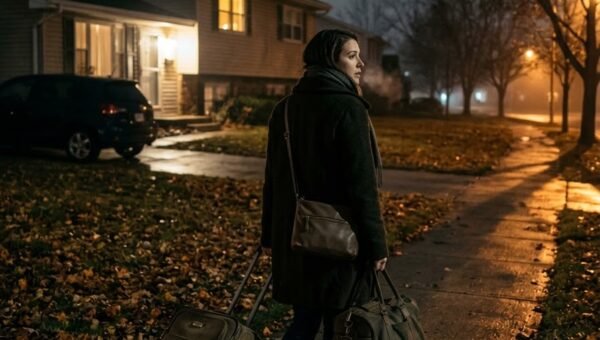
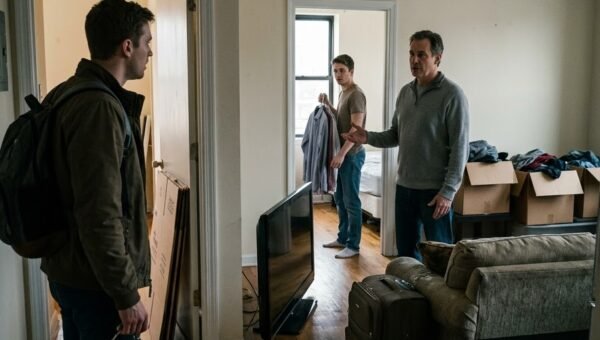
The little Popmart figurine my brother bought Mom was still in its paper bag when Arthur opened the front door a few inches. I had a new novel tucked under my arm, the one based on a series starring Mom’s favorite actress. We’d planned to surprise her for her birthday. Arthur looked at the gifts, then at us, and whispered, “You shouldn’t have come.”
The deadbolt clicked behind the door. I heard it because the house was so quiet. My brother, Ben, glanced at me.
Arthur didn’t move aside. I pushed through the opening anyway, knocking his shoulder with mine. The book nearly fell. “Where’s Mom?” I said. Arthur shut the door and answered, “She’s resting.” That was when I knew I wasn’t leaving without seeing her.
Arthur had been married to Elena for two years. They’d dated for a year before that. He had a decent job, remembered birthdays, and never raised his voice around us. People who met him once liked him. I did too, at first. That’s part of what makes this hard to say. I kept making excuses for things that were right in front of me.
The first time I felt uneasy, Arthur had walked into Mom’s kitchen and asked why she’d gone out the back door. She’d been in the yard for ten minutes, watering her pots. He said a door sensor had alerted him. “It’s just for safety,” he told us. Mom smiled and said he was a little overcareful. I smiled too. I was embarrassed that I’d found it odd.
Later, he installed more sensors. He said the neighborhood had seen a few break-ins. The house was in an old textile town in South Carolina, not the kind of place where I expected a security system to become a family member.
There was a screen by the kitchen that showed the doors and windows. Arthur said the double locks helped him sleep. Mom used to call me whenever she was bored. After the locks went in, she called less.
When Ben joked that Arthur must be tracking our phones, we laughed. Kind of. Arthur had a way of knowing when we were in the house even if he wasn’t home. He’d text Mom, “Your kids are here,” before she’d mentioned we’d arrived. I assumed there was a camera by the front door. There probably was. I didn’t ask. I wish I had.
In the hall that day, I tried to call for Mom again. “Elena?” The house smelled like the lemon cleaner she used on the counters. Every blind was closed, even though it was early afternoon. The place was tidy in a way that didn’t feel like Mom. Her shoes weren’t by the back door. Her purse wasn’t on the kitchen chair. I noticed because I’d brought her a book and expected her to drop everything to hug us.
Ben moved ahead of me. Arthur stepped sideways to block him. “You need to give her a minute,” he said. Ben stared at him. “A minute for what?” Arthur kept his voice soft. “She’s upset.” I asked why. He said she’d had a difficult morning and didn’t want visitors. The answer came too quickly. I remember thinking, This is how a fence gets built, one reasonable board at a time.
The smart-home screen was lit on the kitchen counter. I hadn’t meant to look, but it was right there. A row of alerts showed the back study door opening and closing. Under that were entries marked “access denied.” I saw several from that morning. Then I saw a note in Arthur’s handwriting on a piece of paper beside it: “Study stays locked until she calms down.” I picked up the paper. My hand was shaking enough that it crackled.
“What does this mean?” I asked. Arthur reached for it. Ben got between us. “Don’t,” he said. Arthur looked honestly annoyed, like Ben had moved a chair in his way. “This is private,” he said. I put the paper in my pocket. “Where’s our mother?” I said. Arthur’s eyes moved to the hallway at the back of the house. Just for a second. It was enough.
I started down the hall. He followed close behind me. “She’s fine,” he said. “You’re making this worse.” I could hear Ben behind us asking Arthur to stay put. Arthur answered, “You don’t know what she’s been like.” I hated how calm he sounded. I hated that a part of me still wanted him to explain it so I could go home and feel foolish.
The study door was shut. It had a lock on the outside that I’d never noticed before. I turned the knob, then the lock. It wouldn’t open. I called Mom’s name. At first, there was nothing. Then I heard a muffled sound from inside. Not words. A small, strained breath.
Arthur reached for my arm. I jerked away. “Open the door,” I said. “She needs to calm down,” he replied. Ben pushed him back toward the entryway. “You locked her in there?” Arthur said she’d tried to call someone behind his back and wouldn’t listen. He said he was keeping her from making things worse. He said it as if I should be relieved.
I tried the handle again. It rattled, hard. “Mom, it’s me.” I heard another sound, sharper this time. Ben had Arthur backed up near the front door, one arm held out to keep him from coming closer. Arthur wasn’t fighting. He kept saying, “You don’t understand.” I was done trying to understand. I braced my shoulder against the door and shoved. The frame gave with a crack that sounded too loud in that closed-up house.
Mom was bound to a chair in her own studio. A strip of cloth covered her mouth. Her wrists were tied, and her hair had come loose around her face. She gasped through the cloth when she saw me. It took me a second to move. Then I went to her. I untied her wrists with fingers that didn’t seem to work right and pulled the gag away.
“Mom, it’s me,” I said. “You’re okay. I’m here.” She coughed and tried to speak. I held her hands while she caught her breath. She looked straight at me and said, “I tried to call Ruth.” Ruth was an old friend Arthur didn’t want her seeing. Mom had been told she was a bad influence, then told the friendship was over, then told she’d caused trouble by trying to reach out.
I had to stop myself from asking how long. She was shaking. Her wrists were red where the ties had been. She leaned into me and whispered, “I thought you’d come tomorrow.” I didn’t tell her we nearly had. Ben had bought the figurine that morning, and we’d changed our plan at the last minute. I just kept saying, “We’re here. We’re here.”
Arthur called from the hall, “She asked me to keep her safe.” Ben answered, “No, she didn’t.” Arthur said Mom had been confused and emotional. He’d said some version of that for years, apparently. I learned later he’d used it to make her friends doubt her and to make us wonder whether her missed calls were really missed calls.
I heard Ben tell him to stay by the door. “I’m calling 911,” Ben said. Arthur’s voice changed then. “You’re going to ruin my life over this.” Ben didn’t answer. I used Mom’s phone, which was on a shelf just inside the studio, turned off. I’d thought it was missing. I dialed emergency services and told the operator we were at Mom’s house, that she’d been tied up, and that Arthur was still there.
I kept my voice low because Mom was beside me. The operator asked if we were in immediate danger. I looked at the broken door, then at Mom’s hands. “Yes,” I said. “We need help here now.” That was the first time I stopped trying to make this sound less bad than it was.
The operator stayed on the line. I asked Mom if she could walk. She said yes, but her legs felt weak. I helped her up and sat her in the kitchen while Ben kept Arthur near the entryway. The screen still showed the door alerts. One after another, little records of where she’d gone in her own home. I turned the screen face down.
Arthur tried to talk to her. “Elena, tell them you’re safe.” Mom flinched at his voice. I stepped between them. “Don’t speak to her.” He said he loved her. She stared at the floor and said, “You locked me in.” It was quiet and plain. He had no answer that made it sound better.
When the officers arrived, Ben opened the front door and told them what had happened. They separated us, asked Mom questions, and looked at the room. One officer photographed the restraints and the lock. Another took the note from my pocket and asked about the smart-home system. Arthur said he’d only been trying to stop her from calling Ruth while she was upset. The officer asked why she was tied up. Arthur looked at the floor.
They detained him while they sorted out what had happened. I don’t remember all the questions. I remember Mom sitting at the kitchen table with my hand around hers, and the paper bag with the figurine slumped over on the counter. I remember an officer asking whether she had somewhere else to stay. I said, “With me.” Mom nodded. That was enough.
I didn’t handle every part well. I snapped at the officer when he asked whether Arthur had ever hurt her before. I wanted to say no because I didn’t know what counted. I wanted to say yes because I’d seen the locks and ignored them. Mom squeezed my fingers and said, “Don’t do that to yourself.” I still do it, just less where she can hear me.
Over the next few weeks, we learned how much of her life had been narrowed down. Arthur had kept the car keys in a drawer he controlled. He’d made her ask before going out, then called it checking in. He’d changed her passwords and set alerts for doors and windows. When friends stopped hearing from her, he told them she was busy or needed space. Mom had started to believe that every small argument was proof she was hard to live with.
She wasn’t. She’d tried to call Ruth because she wanted to hear a familiar voice. Arthur caught her and locked her in the studio. He said he meant to let her out when she calmed down. That explanation was his, not hers. Mom told the police she’d been afraid he would come back and make it worse. It mattered that she said it in her own words.
We took the house keys and the phone to the officers. Mom didn’t want to go back inside that night, so she stayed with me. She had the novel on her lap in the passenger seat. I drove slowly because every stoplight made her grip the book tighter. Ben followed behind us with her purse and the little figurine. None of us talked much. The only sound for a while was the heater clicking on and off.
The next day, Mom filed for an emergency protective order. She also spoke with a counselor who worked with people leaving controlling relationships. It took time for the legal pieces to settle. Arthur was kept away from the house, and Mom later got a restraining order. The marriage was dissolved after the court process. It wasn’t one clean phone call that made everything safe. It was paperwork, calls, and Mom choosing what she wanted next, one decision at a time.
I stayed with her for the first stretch. She wanted the curtains open, then shut, then open again. I didn’t ask her to explain. She kept her phone beside her while she slept. She jumped when the doorbell rang. It was a delivery driver with a package, and she apologized to me for being scared. I told her she didn’t owe me an apology. I wasn’t sure she believed me yet.
A few months later, she came to my place for dinner. Ben brought the same little figure she’d gotten for her birthday. The novel was on the porch table, its pages bent from being carried around. Mom sat in the evening sun with the book in one hand and the figurine in the other. Behind her, the front door stood unlocked. She knew it was unlocked. I knew it too.
She stayed there a long time, listening to the ordinary sounds of my street. Then she set the figurine beside the book and said, “I think I’m ready to go in.” I walked in with her, and left the door unlocked behind us.