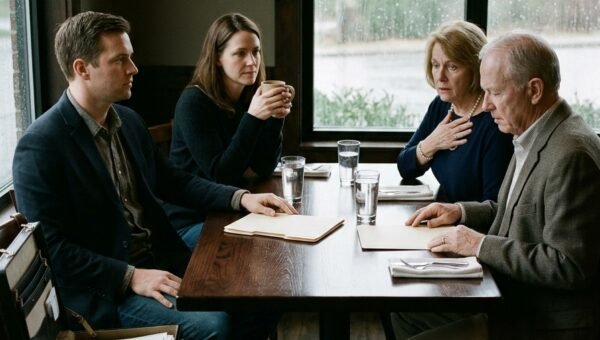
The conference room at Whitmore Realty is where Preston’s hand stopped on the page with Adrienne’s name.
I was standing by the coffee pot, holding a paper cup I’d already forgotten to drink from. Simone Grant, the lawyer from Dallas, had turned the agreement toward him. Preston had been smiling when she arrived. He was still trying to smile, but it wasn’t working. “Where is Adrienne?” Simone asked. Preston glanced at me, then back at her. “She won’t be joining us today,” he said. He thought that was the whole problem.
I’m writing this to Adrienne, though I don’t know if I’ll ever send it. I should have said more while she was still coming into that office every day. I kept telling myself I was just the bookkeeper. That was true, but it was also a handy excuse.
The coffee pot was making that little burnt smell. I remember it because nobody touched the cups.
I need to go back.
Adrienne was thirty-five when the divorce became final. I was sixty-one, and I’d been keeping books for Whitmore Realty for eight years by then.
I’d seen her come in early with wet hair, eat crackers over a spreadsheet, and stay after the agents had gone home. She never made a fuss about it. If a file was wrong, she fixed it. If somebody’s commission check was short, she found out why.
Preston liked to tell people he was the face of the company. That wasn’t even a lie. He was good on camera, good at dinner with clients, good at remembering people’s kids’ names. Adrienne was the one who made sure our deals closed and our accounts balanced. We had forty-six agents by the time the divorce started.
Most of them knew Preston’s name. They called Adrienne when something was on fire.
I noticed that before I understood what it meant.
At the office, she’d put her purse under her desk and set her coffee mug beside the keyboard. The mug had a chipped handle, and she’d had it forever. I once offered to buy her a new one. “This one’s fine,” she told me. Then she went right back to correcting an agent’s closing statement.
That was Adrienne. Fine meant she could live with it. It didn’t mean she liked it.
The first thing that changed was Preston’s calendar. He’d always asked Adrienne to check his appointments, even though he had an assistant.
Then, all at once, he stopped asking. He started taking calls in the hall. He turned his office door partly shut when she came by. I noticed, but I didn’t ask. I was afraid of getting caught in the middle, and I told myself that was being sensible.
It wasn’t.
By October, Preston had moved into Madison’s downtown condo. Madison was an agent at the company, younger than Adrienne, and always wore white suits that looked like they’d never seen a car seat. I’m not saying she caused the marriage to end. I don’t know what went on between them before that. I do know Preston had moved out and was still telling Adrienne she had a place at Whitmore.
One afternoon I brought some invoices to Adrienne’s office and heard him say, “Don’t worry about your future.”
She didn’t answer.
“You’ll always have a position here,” he said. “We need you.”
I put the invoices down and backed out without making a sound. It was the way he said need that stayed with me. Like she was a piece of equipment he planned to keep.
After he left, I asked if she wanted me to put the invoices in the blue tray.
“Sure,” she said. “Thanks, Bea.”
I wanted to say, That wasn’t a nice thing he said. Instead I went back to my desk. I thought she might be embarrassed if I brought it up. So I gave her the privacy she hadn’t asked for.
The next month, Adrienne started checking the escrow records more closely. This wasn’t unusual. It was her job to review them, and she’d caught mistakes before. But I noticed she stopped humming while she worked. She printed things and didn’t leave them in the shared tray. She asked me to lock the file room when I went home.
“Did you see these entries?” she asked me one morning.
She had four transfers written on a yellow pad. The total was $212,400. I looked at the dates, then opened the ledger.
“I’ll check the backup,” I said.
“Please do.”
That was all. No accusation. No raised voice. She just sat there with the yellow pad under her hand.
I found the entries. I couldn’t tell who’d approved them from the ledger alone, so I checked the stored forms. The approvals had her name on them. The signature looked close enough that someone who didn’t know her might not have noticed. I’d watched Adrienne sign checks for years. She didn’t make that little hook on the last letter.
I printed the records. Then I checked them again because I didn’t want to be right.
One date fell during a training seminar in Jefferson City. Another was the day Adrienne had been at Research Medical Center. The last two landed on days she’d been in divorce depositions. I knew about the hospital because I’d driven her home after she called me. She’d been embarrassed to ask. She had a paper wristband on when she climbed into my car.
I kept the printouts in my bottom drawer and did nothing for half a day.
Then I put them on Adrienne’s desk.
She looked at each page without saying much. When she got to the last one, she rubbed the edge of the paper with her thumb.
“I didn’t sign these,” she said.
“I know.”
I wish I’d said more. I wish I’d asked if she wanted me to call someone. Instead I said I’d make copies and keep them safe. I was scared Preston would learn I’d seen them. I was also scared of what it meant if I didn’t act. Both things were true.
Adrienne took the pages to her attorney, Darlene. I wasn’t there, but I saw her come back with her mouth set tight and her shoulders held up. She didn’t cry at the office. She opened her laptop and worked through lunch. Then she went home.
The next odd thing showed up seventeen days before the divorce was final. Adrienne came into my office carrying a printed email. She set it beside my calculator.
“Is this real?” she asked.
The email was from Simone Grant at Redwood Realty Partners in Dallas. The attached agreement said Redwood was prepared to buy Whitmore Realty for $14.2 million. Preston had signed a letter of intent six days before the divorce trial. At trial, he’d said the company was worth $380,000.
I read those numbers twice. I’m a bookkeeper. Numbers don’t usually make me feel anything. That time, I had to sit down.
Adrienne watched me. “He told the court the company was worth less than the building,” she said.
“I heard him.”
“He’s selling it for fourteen million.”
I didn’t have a good answer. So I said the first thing I could think of. “You should talk to Darlene.”
“I already have.”
She showed me the next part. Redwood’s offer depended on Adrienne staying with the company for three years. Her name was in the agreement under key staff. There was a separate employment page, too, with a space for her signature.
“He signed this,” she said.
“Does he know you’ve seen it?”
“I don’t think so.”
I couldn’t believe he’d signed an agreement that made the sale depend on her and still stood in court saying the company was worth a fraction of the offer. But I wasn’t the one who had to make sense of it. I just knew the deal had Adrienne’s name in it, and Preston had kept that from her.
The next day, she came back from Darlene’s office carrying a thin folder.
“Darlene says I have a choice,” she told me.
“What choice?”
“Stay three years and help him close the deal. Or leave.”
She set the folder down carefully. She looked tired, but not confused.
“What are you going to do?”
“I’ve given him nine years.”
She said it as if she was checking the count.
I said, “You don’t owe him the rest.”
She looked at me then. “I know.”
That was when I saw she’d already decided.
The divorce hearing came and went. We all knew it was coming, but I still felt strange when the final papers arrived. Thursday evening in March. The office had mostly cleared out. A couple of agents were grabbing coats and talking about weekend showings. Adrienne sat at her desk reading the judgment on her laptop.
I heard her close it.
I went to her doorway. “Honey, you’ve been awfully quiet tonight.”
“The divorce is final, Bea.”
I asked if she wanted me to stay. She told me to go home, then asked if I could come in at 7:30 the next morning.
I said yes. I didn’t ask why.
She looked at me for a second. “You know something’s up.”
“I’ve kept books for thirty-eight years,” I said. “I can tell when Friday’s going to be a long one.”
She smiled. It was a small one.
Then she began packing.
Her personal laptop went into a bag. So did the family photos, the coffee mug, and the framed real-estate license she’d kept behind her chair. She left the company files where they were. She didn’t take anything that wasn’t hers.
I stood by the door while she wrapped the mug in a dish towel.
“I can carry some of that,” I said.
“I’ve got it.”
I could have told her I was proud of her. Instead I said, “I’ll be here early.”
She nodded and kept packing.
At 11:40 that night, she sent a report to the state authorities about the escrow records. I know the time because I saw the receipt later. At 11:58, she emailed her resignation to Preston and copied the company’s attorney.
Then she put a document in the middle of Preston’s desk. Under it she wrote one line in blue ink: “You should have told me about Dallas.”
She drove to her grandfather’s cabin at Truman Lake. She didn’t tell me she was going until she was already on the road. I didn’t ask her to stay. I thought leaving was probably the only way she could sleep.
I came in at 7:30 Friday morning. Her office was empty except for the desk and the faint coffee ring she’d missed. I set her mug’s coaster in the drawer. I’m not sure why I did that. Maybe I couldn’t stand to see it sitting there without the mug.
Preston came in a little after eight. He walked straight toward her office, then stopped at the doorway.
“Where is she?”
“I don’t know,” I said.
It was true. I didn’t know which road she’d taken or whether she’d slept. I also didn’t tell him about the report. That wasn’t mine to tell.
He went into his office and found the paper. A few minutes later, he came back out holding it.
“What does she think she’s doing?”
I kept my eyes on the books. “She resigned.”
“She can’t just walk out.”
“She can.”
He looked at me like I’d changed sides. Maybe I had. Maybe I should have changed sides sooner.
He called her forty-eight times before breakfast, according to the call log she showed me later. I knew about the calls because his phone kept lighting up on the conference table while the Dallas team waited.
At 8:40, Madison arrived wearing a white suit. She went to Preston’s office and closed the door. I heard them talking, but not the words. After a while he came out and asked me to make coffee for the meeting.
“Four cups,” he said.
“There are five people.”
He looked at the empty chair near the end of the table. “Adrienne won’t be there.”
“I counted you,” I said.
I’m not proud of how sharp I sounded. I’d been up most of the night thinking about those transfer forms. But he didn’t answer. He just went to check the reception area.
I made five cups anyway.
Simone arrived at 9:02 with three people from Redwood. Preston met them with his usual smile. He’d done this a hundred times. He knew how to shake hands, how to make people feel welcome, how to ask about the drive. I watched him do it and felt that old, familiar guilt. He was pleasant to everyone in the room. He could be. That didn’t change what he’d done.
Simone sat down and opened her portfolio. “Where is Adrienne?”
Preston adjusted his jacket. “She won’t be joining us today. But I’m prepared to finalize everything.”
Simone didn’t nod. She turned to the agreement and found the page with Adrienne’s name. Preston leaned over the table.
“Is there a problem?”
Simone tapped the paper. “This agreement requires Adrienne to remain with Whitmore for three years.”
“She’s an employee,” Preston said. “We’ll sort it out.”
“She resigned last night.”
His mouth tightened. “I can rehire her.”
Simone looked at the page again. “That isn’t what this says.”
Preston reached for the agreement. His fingers stopped on Adrienne’s name. That was the moment I saw his face change. Not because he’d just learned she’d left. He’d known that since the night before. He was realizing the buyer wasn’t going to treat her like a desk he could fill.
Simone closed the folder halfway. “We’re not closing today.”
Preston’s voice went flat. “The company is mine.”
“The company may be yours,” she said. “This deal still has conditions.”
Madison was standing behind him. She didn’t touch his shoulder. She didn’t speak. I noticed she had her hands clasped in front of her, the way agents do when they’re trying to look calm in front of a client.
Preston turned toward me. “Did you know about this?”
“I knew the agreement required Adrienne,” I said.
“And you let her leave?”
I felt my face get hot. I had been trying for weeks not to anger him, not to get involved, not to make anything worse. I was tired of hearing my own excuses.
“I didn’t make her leave,” I said. “She left because you treated her like she was replaceable.”
He stared at me.
My voice was shaking, but I kept going. “You called her your assistant. She built this place with you. I watched her do it.”
Nobody at the table picked up a cup. The coffee had started to taste burnt.
Simone took the agreement and set it back in front of Preston. The sale was on hold. Redwood would review the company’s records, the divorce disclosures, and the escrow entries before deciding whether to move forward. The $14.2 million was no longer something Preston could count on. He couldn’t sign his way around Adrienne’s resignation or the report she had filed.
That afternoon, I called Adrienne at the cabin. She answered on the second ring.
“Bea?”
“They stopped the sale.”
She was quiet. I heard a door creak on her end.
“Did Simone tell him?”
“She did.”
“Did you say anything?”
I told her I’d said she built the place. I expected her to laugh, or to tell me it was about time. Instead she said, “Thank you.”
I started to tell her I was sorry. I said I should’ve spoken up earlier. I said I’d seen the signs and kept quiet because I didn’t want to be in the middle.
“I know,” she said.
That didn’t make me feel better. It wasn’t supposed to.
The state review took months. I stayed at Whitmore and gave them every record they asked for. Preston stayed too, though he stopped telling people the sale was a sure thing. I don’t know what happened to his marriage with Madison. I didn’t ask. The company’s books had enough trouble without me taking attendance on everybody’s private life.
Redwood eventually withdrew its offer. Their letter cited unresolved financial questions and the loss of a key employee. Preston still owned Whitmore, but the deal he’d been counting on was gone. The escrow investigation continued. That part wasn’t mine to decide.
Adrienne bought a smaller place of her own and took a job with a brokerage that didn’t have Preston’s name over the door. I visited once. Her mug was on the kitchen counter, chipped handle and all. She poured me coffee into it, then remembered and handed me a different cup.
“Sorry,” she said. “Old habit.”
I told her it was fine.
It was. But I wish I’d told her she didn’t have to keep making things fine for other people.
I still work at Whitmore. Some mornings I pass the empty office before the new hire gets there. The desk is being used again. The coaster I put away is still in the drawer, and I haven’t thrown it out. I know that sounds silly. I’ve kept less useful things for worse reasons.
I don’t know if Adrienne will ever read this. I only know that on that Friday, when the buyer asked for her, Preston finally had to hear what I’d been too scared to say.
“She built this place.”