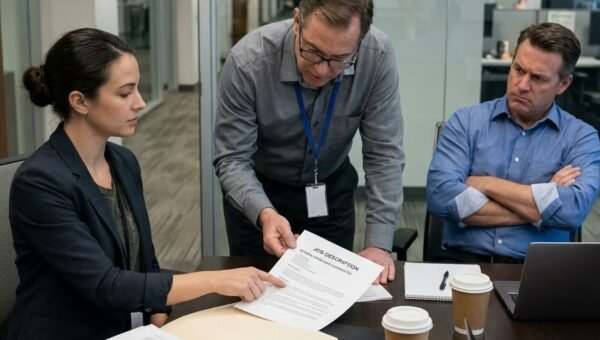
“The dumb one can read it herself,” Dad said, and slid the contract across Grandma’s dining table.
I was sitting beside him. Caroline was across from us, with our lawyer, Douglas Mercer, watching her pick up the photocopy. I remember the little click her fingernail made against the paper. I remember it because I’d heard Dad make that joke for years and never once told him to stop.
I’m Madison Whitmore. Caroline is my older sister by two years. I’m the one who went to Harvard, the one Dad brought up when he wanted people to know the family was doing well.
Caroline learned differently. She was diagnosed with dyslexia in third grade, and our parents turned that into a nickname before she was old enough to understand what it meant.
I went along with it. Not every time, maybe, but often enough.
At my Harvard graduation lunch, Dad made a speech about how proud he was of me. He promised me a Tesla and a $13 million house. I laughed because everyone else did. Then a man in a gray suit walked over to Caroline’s chair and handed her a thick envelope.
He said the acquisition was on schedule for June 26. He mentioned our grandmother Eleanor.
He didn’t raise his voice, but the whole private dining room went quiet anyway.
Dad put down his champagne glass very carefully. Mom lowered her napkin. I had a real estate listing open on my phone, and I remember closing it like the phone itself had become embarrassing.
Caroline said it was her company. Dad asked if she meant the dog biscuits.
She said yes. The company was being bought for $74 million.
I laughed. I wish I could say I laughed because I thought it was impossible. I laughed because I was used to Dad treating her work like a small, odd hobby, and I wanted to keep the mood where he’d put it.
Then I found the acquisition announcement on my phone and turned it toward him.
His face changed while he read.
Caroline and I were close when we were kids, before I learned how useful it could be to be Dad’s favorite. She used to let me sleep in her room when thunder kept me awake. She’d make up ridiculous names for the shadows on the wall, and I’d hold her wrist until the storm passed.
Then Grandma Eleanor began helping her with schoolwork twice a week. Grandma was a reading specialist. She kept a wooden tray of sand on the kitchen table and showed Caroline how to trace letters with one finger.
I sat nearby doing my own homework and thought it was boring.
“Take your time, sweetheart,” Grandma would say. “Understanding matters more than speed.”
Caroline still reads with her finger under the lines. I know because I saw her do it at that table, years later, while Dad and I watched.
I left Louisville for school. Caroline stayed close, then started a dog treat business at twenty-three with $80 in her checking account and $6,000 Grandma had given her. The money came from Grandma personally. Dad said it was a gift, and I believed him because believing him was easy.
Caroline bought a used freeze dryer and rented a kitchen in a church basement. For a while, she slept in her Subaru with Tucker, her rescue dog, when she couldn’t afford rent and business costs at the same time. I knew that part. I didn’t know the numbers that came later.
She invited us to the opening of her new factory. Dad said he had a client dinner. Mom had Pilates. I was in Boston and didn’t come either. I sent Caroline a text with a heart on it, then got back to my day. I can still tell you exactly what I ordered for lunch that day. I can’t tell you what her factory looked like.
By the time she invited us to my graduation, her company had 64 employees and sold products through stores I’d heard of. She never made a speech about it. She just said she was proud of the people who worked there.
I thought it was nice. I didn’t ask what the business was worth.
The envelope at lunch held a note about the closing. The man, whose name I later learned was Daniel, worked for the company buying Oak & Paw Provisions. The deal was valued at $74 million, with $50 million due in cash when it closed. He was there to confirm that the paperwork was moving ahead.
That was when Dad brought up Grandma’s trust.
He said there had been an agreement from 2017 giving her trust 30 percent of Caroline’s company. He said the claim had to be dealt with before the acquisition. He said it like a family matter, not a demand for more than $22 million.
I saw the photocopy for the first time that Sunday at Grandma’s old house on Cherokee Road. Dad and Mom had moved in after Grandma died. Dad sat beneath the dining room chandelier beside Mercer. The paper was in a manila folder between them.
Caroline came in without a folder. She put her keys on the table and didn’t take off her coat.
Dad said Grandma had helped establish Oak & Paw, so the trust had a share.
Caroline said Grandma gave her $6,000.
Dad tapped the copy with one finger. It said the trust owned 30 percent. There were two signatures at the bottom, one for Grandma and one that was supposed to be Caroline’s. The date was March 3, 2017.
I was standing near the kitchen island. I could see the signature from there. It looked neat and joined-up, the way people think a signature should look. Caroline’s actual signature was blockier. I’d seen it on birthday cards and checks, but at the time I didn’t stop to compare.
Dad said it had been years and Caroline probably didn’t remember.
I knew that sounded wrong. I also knew the Cambridge house I’d put a deposit on had cost more than I could afford. Dad had told me the money came from Grandma’s trust and that it was meant to help me get started. The deposit was $650,000. I didn’t ask for a statement. I didn’t ask who else had received money.
Caroline read the paper slowly. She used her finger. Dad made that joke about her being the dumb one, and Mercer looked down at the folder. I could have said something.
I didn’t.
Caroline asked for the original. Mercer said they’d provide it if needed. He explained that the claim could delay the acquisition unless she agreed the trust was owed its share. Dad looked at me as if I was supposed to nod along.
I didn’t know what to do with my face, so I looked at the table.
Caroline folded the copy once and put it down. She said she wasn’t signing anything that day. Then she left.
For two days, Dad called the matter a misunderstanding. He said Caroline was upset because the company was selling. He said he was trying to protect Grandma’s wishes. I repeated his words to myself because I didn’t want to think about the house deposit.
Then Caroline’s attorney, Katherine Doyle, contacted the company buying Oak & Paw. The closing team asked for more documents. The June 26 date stayed on the calendar, but the buyer would not release the money while the trust claim was unsettled.
That wasn’t an abstract problem. Sixty-four people had jobs tied to the company. Some had spent years there. The sale was supposed to give them a stable next step, and now one family argument could hold it up.
Dad said Caroline should settle. He said $22 million would still leave her with plenty.
I heard the phrase “still leave her with plenty” so often that week it started to sound like a number on its own. Dad never said what it would leave her with besides money. He didn’t ask whether she trusted him. He didn’t ask what she wanted. He talked about what the family was entitled to.
Katherine found the trust records. Grandma had set aside $900,000 for each of us, including money we could use to start or grow a business. Dad had told Caroline there was nothing available for her. That was the first thing that made me ask about my own deposit.
Katherine also found the $650,000 transfer to the Cambridge title company. It matched the deposit on my house down to the dollar.
I was sitting at the end of the table when she showed Caroline the entry. I had no good answer. I said Dad told me it was for me. Caroline didn’t call me a liar. I almost wished she had. Instead she asked if I’d known the money came from Grandma’s trust.
I said I hadn’t seen the paperwork.
That was true. It was also a way of avoiding what I had done. I’d accepted a house deposit without asking why there was money for me and none for Caroline. I knew how Dad talked about her. I knew how he talked about me. I’d let the difference benefit me.
Caroline said, “I’m not asking you to give the house back today.”
I said I was sorry.
She nodded once. It wasn’t forgiveness. It wasn’t nothing, either.
Dad called me that night and told me not to let Katherine make me feel guilty. He said Caroline was using me to get leverage. He said I’d worked hard for my degree, and I deserved the help.
I said, “I need to see the trust records.”
He got quiet, then said I was being dramatic.
The next week, the acquisition team asked for more time. The employees heard rumors. Caroline went to work every day and kept running the company while the lawyers sorted out the claim. I don’t know how she did that. I would have been furious all day. She seemed almost boringly practical about it.
That’s not a compliment I knew how to give her then. It is now.
On June 16, I went with Dad to Caroline’s deposition. I told myself I wanted to hear both sides. I also wanted to see whether Dad had the original agreement, because I was starting to believe he didn’t.
Mercer put the photocopy in front of Caroline and asked her to read it aloud. I sat beside Dad with a yellow legal pad. I had written down three questions and crossed out two before we started.
Caroline placed her finger under the first line. She read slowly, not because she couldn’t understand it, but because she was making sure she understood every word. Dad shifted in his chair. I watched her finger move down the page.
She got halfway through, stopped at the name of the company, then went back to the date at the top.
I knew Oak & Paw. I’d seen it on boxes. I’d seen it on her website. I didn’t know she’d chosen that name in May 2018, more than a year after the agreement was supposedly signed.
Caroline asked when the original would be produced. Mercer said he’d check with his client.
Dad told him the photocopy was enough for now.
Caroline turned the paper around so the name faced him. She didn’t raise her voice. She asked how an agreement from March 2017 could name a company that didn’t exist until May 2018.
I watched Dad’s hand close over the edge of the table. It was the first time all day he looked at the paper instead of at her.
I wanted to say I’d seen the problem too. I wanted to say I’d known there was something wrong from the start. I hadn’t. I’d just watched her read until she found it.
Katherine requested the original, Grandma’s trust files, and handwriting samples. Dad’s attorney said the agreement might have been updated later. That explanation lasted less than a day. The date had not been crossed out or changed. The document said March 3, 2017, and it named Oak & Paw as if the company had already been formed.
Caroline’s attorney hired a document examiner. Grandma’s signature was genuine. Caroline’s was not. The examiner found that the signature on the agreement had been copied from an old school form. Dad had been the one who kept those forms in Grandma’s files.
I didn’t learn that from a big confession. I learned it in a lawyer’s office, from a report in a plain binder. The examiner had marked the matching shapes in blue pen. Caroline’s name on the agreement was not written by Caroline.
Dad said he’d made a mistake. He said Grandma had told him what she wanted and he’d put the wrong wording into the document. He said the company name had been added after the fact, to make the agreement match the business.
That story still left the fake signature. It still left the date. It still left the money he’d told Caroline wasn’t there.
I sat in Grandma’s dining room with Dad after the report came in. He wanted me to say the family should settle privately. He said the whole thing could be handled without humiliating anyone.
I asked him if he’d made the signature.
He said, “I was trying to do what Eleanor wanted.”
It wasn’t an answer, but it was the closest I got.
I told Katherine I would give a statement about the house deposit and what Dad had told me. I wrote down what I knew, including what I had not asked. I didn’t pretend I had been fooled about everything. I had benefited, and I had chosen not to look closely.
Dad called that betrayal. Mom said I was tearing the family apart. I didn’t argue with either of them. They had been saying those things about Caroline for years, and I’d helped them say it.
The trust claim was withdrawn. Dad agreed to repay the $650,000 deposit from his own accounts, and the estate’s records were corrected to show that Grandma had left $900,000 for each granddaughter. The company’s lawyers confirmed the trust had no ownership stake in Oak & Paw.
Dad didn’t admit to forging the paper in court. He didn’t have to. The signed agreement was withdrawn, and the document examiner’s report stayed in the case file. I don’t know whether he ever told himself that what he did was forgery. He still calls it a mistake.
The acquisition closed on June 26. Caroline’s team got the deal they’d worked toward, and the 64 employees kept their jobs through the transition. The $50 million payment went through as scheduled. The rest of the deal was structured around the company’s future performance.
I watched the announcement come up on my phone while sitting in my car outside the lawyer’s office. I didn’t feel happy exactly. I felt relieved, then embarrassed that relief was what came first.
Caroline still hasn’t invited me to Boston. She did let me visit the factory after the sale. I went on a Thursday because that was the day she used to meet Grandma for tutoring. The floor smelled faintly like warm oats and cleaning soap. One worker had a little dog asleep under a desk.
Caroline walked me through the place and told me which machines were staying. She didn’t say she was proud of me. I didn’t expect her to.
At the end, she handed me a printed copy of Grandma’s old recipe notes. The writing was small, but I could read it. I put my finger beneath the lines anyway.
Caroline noticed. She didn’t laugh.
I still don’t know what to call that. But she let me keep reading.