I was setting a glass of iced tea beside Grandma Evelyn when Andrea called from the airport. Grandma had one of those paper bands from the heart clinic still on her wrist, and I was trying to get the sticky part of it off without pulling her skin. My hands were wet, so I tapped speaker. Andrea’s voice came through over the rattle of suitcase wheels.
“She’s your burden now,” she said, and laughed.
I stopped with the tea in my hand. Grandma was looking right at me. The paper band hung halfway off her wrist.
“What did you say?” I asked.
“We left Grandma at your place. You can take it from here.” Someone near Andrea said something I couldn’t make out. Her husband, Todd, I think. Then he laughed too.
I set the glass down. “I thought you were taking her home after the appointment.”
“Plans changed. We got a last-minute flight to Florida.”
“You could have called me before you dropped her off.”
“We just did,” Andrea said. “We’re boarding.”
The call ended. I can still hear the little click it made. Grandma rubbed the red mark left by the paper band and said, “I suppose she forgot I could hear.” I started to say I was sorry.
She shook her head, not sharply, just enough to stop me. Then she looked at the glass of tea and asked if I had lemon. It was such an ordinary question that I almost cried right there.
I’d bought groceries that morning, mostly the things she liked because she’d been staying with Andrea for a few days. There was a bag of soft pears in the car and a loaf of rye bread I’d picked up from the bakery by the river. I carried everything inside while Grandma stayed on the porch swing. I didn’t know what else to do.
My first thought was to call Andrea back and tell her exactly what I thought of her. My second thought was that Grandma was still sitting there, and I’d better not make the whole afternoon about my temper.
When I came back out, I had a fresh glass of tea with lemon. Grandma accepted it, took one sip, and said, “That’s better.”
“Where’s your overnight bag?”
“In Andrea’s car.”
“Your medicine?”
“In the bag.”
I put the glass down too hard. “You’ve got enough for today?”
“I do.”
“I’m calling her.”
“No.” Her voice stayed quiet. “Sit down, Claire.”
I sat on the other end of the swing. The chain gave a small squeak every time I moved.
Grandma opened her handbag and took out her old leather checkbook. The corners were worn smooth. Grandpa had given it to her years ago, and I’d seen it on the kitchen counter more times than I could count.
“Will you drive me downtown?” she asked.
“To the bank?”
“My estate attorney.”
I stared at the checkbook. “Today?”
“Before their plane lands.”
“Grandma, you don’t have to make a big decision while you’re hurt.”
She closed the cover. “I’ve been making this decision longer than you know.”
That was when I understood I wasn’t going to talk her out of it. I still tried, a little. I said she should get her medicine first. She told me she’d call the pharmacy. I offered to call Andrea about the bag. She said no again. The whole time I was thinking I should have noticed something was wrong before that call. That is the part I keep coming back to. Not because I could have stopped Andrea from being cruel, but because I had helped make it easy for everyone to pretend Grandma was fine with whatever happened.
I drove Grandma to the pharmacy before we went downtown. The girl behind the counter recognized her and asked how the heart appointment went. Grandma gave her the short version, then checked every bottle and the receipt before she put them in her purse. She thanked the pharmacist by name. She was 82, tired from the appointment, and upset. She was also sharp enough to catch that the pharmacy had filled the smaller bottle instead of the larger one.
On the drive, I kept both hands on the wheel. It was a hot afternoon, and the air conditioner made a rattling sound when I turned it up. Grandma watched the storefronts pass. We’d been quiet for a while when she said, “People think betrayal is one big thing.”
I glanced at her. “I guess.”
“Most times, it starts with what’s easiest.”
She told me Andrea had canceled lunches, then told other people Grandma didn’t feel up to going out. Andrea had skipped two appointments and said she’d handle the next one. She’d started making plans for Grandma without asking her. Last Christmas, Andrea told the family Grandma was tired and needed to leave before dessert. I’d helped Grandma find her coat. I hadn’t asked if she wanted to go.
“She said you were worn out,” I said.
“I wasn’t.”
I tightened my grip on the wheel. “Why didn’t you tell me?”
“Because I didn’t want you to fight with your sister over me.”
I hated that answer because I understood it. I also hated that it made me sound kinder than I had been. I’d been glad Andrea was handling Grandma’s day-to-day stuff. I had work, a house, a grown son who still called when his car needed something. I had let “Andrea’s got it” become a whole plan.
Grandma looked out the window. “I started wondering whether they loved me, or whether they loved being in charge of me.”
I almost said, “I love you.” I didn’t, because she knew that, and because I had no answer for the rest.
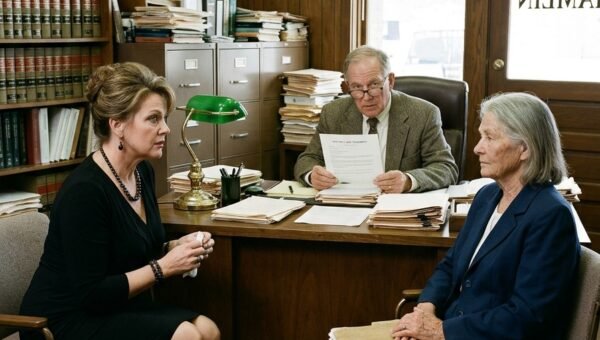
The attorney’s office was in an old brick building by the courthouse. I’d been there once for Grandpa’s paperwork, but the hallway still smelled like floor cleaner and old paper. The receptionist recognized Grandma before we reached the desk.
“Mrs. Brooks. We weren’t expecting you.”
“I know. Is William in?”
William Bennett came out a few minutes later. He’d handled Grandma and Grandpa’s legal matters for decades. He took her hands, then glanced at me.
“Evelyn, I wish you’d called first.”
“If I’d called, somebody might have told me to wait.”
He looked at me again. Grandma caught it.
“Claire stays.”
In his office, William asked Grandma if she wanted me there for the whole meeting. She said yes. He explained that he represented her, not me, and that he’d ask questions to make sure she understood what she wanted. He asked if anyone had pressured her or promised her anything.
“No,” Grandma said. “Andrea left me on Claire’s porch and called me a burden. That’s all the push I needed.”
He didn’t make a face. He just wrote it down.
Then he asked whether Andrea had used Grandma’s power of attorney recently.
Grandma’s forehead creased. “I don’t know.”
William turned toward his computer, then called for a blue folder from his paralegal. It took a few minutes to arrive. I watched the folder land on his desk, and I watched his expression change as he read through it. He didn’t look shocked. He looked annoyed in a tired way, which was worse.
“Evelyn, Andrea contacted this office three times recently,” he said.
“About what?”
“The first time, she asked for a summary of your trust. The second time, she asked if she could change the mailing address for some of your records. The third time, she asked whether your monthly transfer to her could be increased.”
Grandma sat straighter. “What transfer?”
I looked at her. She didn’t look at me. William opened another page.
“Let me be clear. I haven’t changed anything. Andrea asked whether it could be increased from twelve hundred and fifty dollars to eighteen hundred.”
The room got very still. I heard the paper shuffling under William’s hand.
Grandma said, “I give Andrea money?”
“You set up a monthly transfer six years ago,” William said. “You’d told me it was help with her mortgage. I didn’t know the amount had continued without being reviewed.”
Grandma looked at me then. “Did you know?”
“No.”
I said it too quickly, like I wanted to get ahead of some accusation. I’d never seen a check to Andrea. I’d never seen her ask Grandma for money. I’d never asked, either. I knew Grandma had helped both of us when we were younger, but I thought those days were over. Maybe part of me had preferred not to know. It’s easy to call yourself the dependable one when someone else is handling the bills.
William laid out the papers. Andrea hadn’t managed to raise the payment. She’d asked. But she had also asked the office to send her a copy of Grandma’s trust details, and she’d tried to use her power of attorney to get information the office wouldn’t give her without Grandma’s approval. William had noted the calls and made no changes.
Grandma read each page herself. She asked what would happen if she revoked Andrea’s power of attorney. She asked what would happen to the monthly transfer. She asked who could access her records after that.
William answered every question. He explained that her will and trust could be updated, but he didn’t push her to change anything else. Grandma asked him to draft a new power of attorney naming me as the person to call if she couldn’t handle things herself. I told her I didn’t want to take Andrea’s place.
“I’m not giving you her place,” she said. “I’m choosing who I trust.”
“I don’t want to be in the middle of this.”
“You already are.”
I had no good reply to that.
William asked if she wanted to stop the monthly transfer. Grandma folded her hands on top of the checkbook. For a few seconds she looked tired in a way I hadn’t noticed before. Then she said, “Yes.”
He asked if she wanted to make it effective right away.
“Yes.”
“And the trust information?”
“Only send it to me.”
He started explaining the forms again, but Grandma stopped him. “I understand. I’m not confused.”
“I know,” he said. “I still have to ask.”
She signed the revocation first. Then the new power of attorney. Then a letter to the bank directing them to stop the monthly payment. William called the bank with her permission and asked what else they needed. The answer was that the signed letter would be enough, but it might take until the next business day to show in the system.
Grandma wrote her name slowly. She didn’t shake. I watched the pen press into the paper, and I kept thinking of the checkbook on her lap at home. Same old leather cover, same careful hand.
William asked if she wanted to change her will too. Grandma said she wanted to review it, but not that afternoon. She didn’t want to make every decision at once. I was grateful for that, even though I knew it wasn’t my call.
That was the point when I felt ashamed of how badly I wanted her to be reasonable in a way that suited me. If she’d yelled, I could have called her angry. If she’d cried, I could have fussed over her. Instead she was calm, and there was nothing for me to fix.
William gave Grandma copies of everything. He put the signed bank letter in an envelope for her to bring to the branch in the morning. When we left, she asked me to stop at a diner near the courthouse. She wanted toast and tomato soup. I ordered the same thing, though I wasn’t hungry.
We sat in a booth by the window. Grandma dipped the corner of her toast in the soup and said, “I should have stopped it earlier.”
I wanted to say no, she shouldn’t have to think about that. But I’d spent enough of the day telling her what she didn’t have to do.
“You were trying to help her,” I said.
“I was trying to keep the peace.”
I looked down at my soup. I knew that habit. I’d done it too. At family dinners, I’d changed the subject when Andrea complained about driving Grandma to the doctor. I’d offered to take the next appointment, but then I’d let Andrea decide when that was. I wanted everyone to get along, which mostly meant I wanted the person who was upset to stop talking.
“I should have asked if you wanted to leave Christmas,” I said.
Grandma picked at a crumb. “Yes.”
That answer was plain. It didn’t let me off the hook.
“I’m sorry.”
“I know you are.”
I waited for something softer. A pat on my hand, maybe. She didn’t give me one. She ate her toast. I let her.
At home, I moved her medicine into the kitchen cabinet where I could see it. She said she could manage her own pills. I said I knew that, and left them where she asked. We called the clinic and made sure the appointment notes went to her, not Andrea. Then I put fresh sheets on the bed in my spare room. Grandma folded her cardigan over the back of the chair and said the room was too warm.
I lowered the thermostat. She said it was fine now.
I kept checking my phone. Andrea’s plane was due to land at 8:40. At 8:13 she sent a text asking if Grandma had her medication. No hello. No mention of the call. I wrote, “Yes. She’s safe.” Then I stared at the screen, wanting to add the rest. I wanted to tell her Grandma had heard. I wanted to tell her about the attorney. I wanted her to feel a little scared for once.
I didn’t send any of that.
Grandma was in the next room, and I didn’t want to make her evening worse just to get my own anger out. That sounds noble when I type it. It wasn’t. I was also afraid of what would happen if Andrea got mad at me.
At 9:02, Andrea called. I answered in the kitchen.
“Is Grandma there?” she asked.
“She’s resting.”
“Did she hear what I said earlier?”
I looked through the doorway. Grandma was sitting on the bed with her shoes off, reading the cardiology handout.
“Yes,” I said.
Andrea didn’t speak for a second. Then she said, “I didn’t mean it like that.”
“What did you mean?”
“I was stressed. We were already at the airport.”
“You left her without her bag or her medication.”
“She has enough for the day.”
“You knew that because you were holding her bag.”
“That’s not fair.”
I could feel myself getting loud. I lowered my voice. “No, Andrea. It isn’t.”
She exhaled into the phone. “I’ve been helping her for years.”
“I know.”
“I had to keep changing plans. She’d call me about everything.”
I wanted to say that Grandma had called me too, and I’d sometimes let it ring while I finished what I was doing. I wasn’t perfect. But Andrea was the one who’d taken the money and then called Grandma a burden.
“She heard you,” I said.
“I know. I said I was sorry.”
“No, you asked if she heard.”
Andrea went quiet again. Then she said, “What’s that supposed to mean?”
“It means she’s making her own decisions.”
“Like what?”
I didn’t answer. I’d promised myself I wouldn’t use the papers to punish her. Grandma could tell her when she was ready. I was not going to become another person speaking for her.
“I’m not going to discuss it for her,” I said.
“You’re making this worse.”
“I’m not making anything.”
She hung up.
The next morning, Grandma dressed herself and asked me to drive her to the bank. I offered to go inside with her. She said I could come in, but she’d do the talking. She carried the envelope herself. The teller copied the letter, checked Grandma’s ID, and said the automatic transfer would stop before the next scheduled date.
Grandma asked her to confirm the amount.
“Twelve hundred and fifty dollars,” the teller said.
“Every month?”
“Yes, ma’am.”
“Then please cancel it.”
The teller did. Grandma signed one last form, thanked her, and tucked the receipt into the old checkbook. That checkbook had been in her purse through the appointment, the porch, and William’s office. It had held the thing she’d been giving away and the paper that stopped it.
I sat in the car while she went into the grocery store next door. She came back with a little bag of apples and a paper cup of coffee. She put the apples in my lap.
“For your house,” she said.
I laughed once. “You don’t have to buy me anything.”
“I know.”
That was a small light. Not forgiveness, not some big family fix. Just apples rolling around in a bag between us while she drank coffee in the passenger seat.
Andrea called again that afternoon. Grandma answered from the kitchen. She put the phone on speaker but kept it close to her.
“Mom, are you okay?” Andrea asked.
“I’m fine.”
“Can we talk about yesterday?”
“We can.”
“I’m sorry I said that.”
Grandma moved one apple from the counter to the bowl. “I heard you.”
“I was upset.”
“I know.”
“I’ve done a lot for you.”
“I know that too.”
Grandma didn’t raise her voice. She didn’t tell Andrea what I’d been waiting to hear. She didn’t bring up the transfer. She let the quiet sit there until Andrea spoke again.
“Are you coming home?”
“No. I’m staying with Claire for now.”
“Are you sure?”
“Yes.”
Grandma ended the call and set the phone down. Then she asked if I had any more tea bags. I got the box from the pantry.
The following week, William called Grandma directly to confirm the bank had stopped the transfer and to set a time for reviewing the trust. She wrote the appointment in her own calendar. I asked if she wanted me to go.
“Not this time,” she said.
I nodded. I meant to. My first impulse was still to handle it for her, to take the paper, drive the car, call the office. I had to keep reminding myself that help wasn’t the same as taking over.
Grandma stayed with me for twelve days. She went back to her own house after that, with her medication in the kitchen drawer where she wanted it and a new copy of her power of attorney in a folder beside her phone. I drove her home and carried in the pears that had gone soft. She said she’d make them into sauce. I said I’d come by Saturday to help. She said, “If you want.”
I came Saturday.
Andrea and Grandma are talking again, some. They haven’t gone back to how things were, whatever that means. The monthly transfer is still canceled. Grandma chose not to reinstate it. She hasn’t told me what else she plans to change in her will, and I haven’t asked.
That evening she made pear sauce while I washed the jars. The kitchen smelled like cinnamon, and the old checkbook sat beside her phone. I put a jar in my bag when I left. Grandma said to bring the jar back next time, and I told her I would.
I’m trying to learn the difference between being needed and being allowed to help. So far, I’m not very good at it. But the next time Grandma says she has something handled, I’m going to believe her.