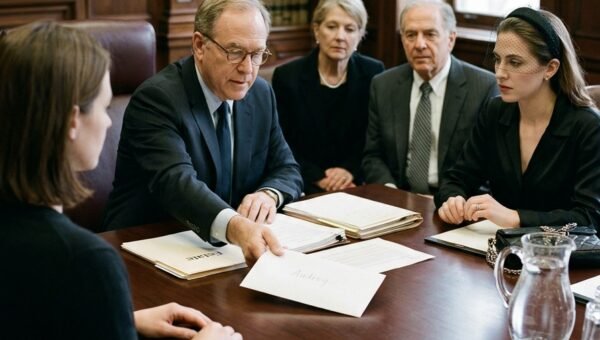
The blue file box was under my kitchen table when Scott brought the divorce papers home. It had been there for years, holding tax returns, school forms, and things I was always told I didn’t need to worry about. Scott used to call it my church-basement filing system, which was meant as a joke, I suppose. I didn’t laugh much. By the time he left that night, I had signed the papers he put in front of me, and he thought the box was full of ordinary old paperwork.
Scott came in at 10:41 on a Thursday in late August. I remember the time because I had just checked the oven timer, and the grilled chicken was already drying out. Ben was in the den with his game. Ellie was upstairs, or pretending to be. Scott set a manila folder on the counter and said he wanted a divorce. He said the house, the money, and the business were all going to him. Then he said if I fought him, he’d make sure I never saw the kids again. That was the one part I heard clearly.
I didn’t argue. I didn’t cry. I wiped a spot of sweet tea off the counter with my sleeve and read the papers.
Scott had that navy blazer on, the one he wore when he wanted people to think he’d come straight from an important meeting. He watched me for a while, waiting for me to ask him to reconsider. Instead I signed where he pointed. The pen scratched once. “I’m not fighting you,” I said. Scott smiled like I’d finally understood something.
I should say that Scott wasn’t always a man who walked into the kitchen with a threat. When we were younger, he’d make pancakes on Sunday mornings and let Ben stir the batter, even though Ben always got it on the floor.
Scott built a crooked shelf for Ellie’s room and left the screws in a coffee mug for months because he said he’d fix it later. I remember those things because I don’t want to pretend I never loved him. I did. I also spent a long time accepting a version of love where I was expected to stay quiet.
Scott ran a small commercial flooring business outside Indianapolis. I did the books for a few years, until he said he needed me more at home. By then we had two kids, and it didn’t take much for me to agree.
I handled the school forms, the dentist, the bills I could see, and the family calendar. Scott handled the rest. When I asked about a charge, he’d say it was business. When I asked about a transfer, he’d tell me not to get worked up over numbers. I’d let the conversation die because I was tired of being told I was making trouble.
The first time he called my questions “home stuff,” I was sitting beside him at a church fundraiser. He laughed and told another couple he took care of the real money while I kept the household running. I smiled because the people at the table were laughing, and I didn’t want to make a scene. That’s the kind of little choice I made over and over. I was not trapped in a locked room. I was just tired, and tired people make small choices that add up.
So when Scott dropped the folder on the counter, I knew there was more to do than read his version of the ending. I also knew the signature he wanted wasn’t a final divorce decree. I didn’t know all the legal language, but I knew enough to keep copies. Scott had put a proposed property split and a custody plan in the folder. I signed the receipt page and the petition where he told me to sign. I did not sign a final settlement. I could tell he didn’t know the difference, or he thought I wouldn’t.
The next morning I took the papers to a lawyer in Indianapolis. Her office had a little American flag on the reception desk and a jar of hard candy no one had touched. I sat down and put my hands in my lap while she read. When she got to the custody page, she looked up and asked if I understood that Scott couldn’t decide the children’s schedule by himself. I said I did. My hands stayed folded. My voice did too. She explained what the papers were, what they weren’t, and what I needed to save.
I went home with a list. Bank statements. Tax returns. Business records. Anything that showed where money had gone. The lawyer told me not to take anything I wasn’t allowed to access, and not to change accounts or hide money. I was relieved she said that. I didn’t want to become the kind of person Scott said I was. I only wanted to know what was real. Lord knows, I had spent enough years guessing.
For two weeks, Scott acted like the matter was finished. He rented a downtown apartment and posted pictures of expensive dinners. He told his brother I was being reasonable. He told one of our neighbors I’d accepted the terms. When I went to the grocery store, people who knew both of us started looking at me with that careful, pitying face. I didn’t correct every story. I had learned there was no point trying to argue with a man who had already told everyone I was unreasonable.
At home, I kept the kids’ routines as normal as I could. Ben asked why his dad was sleeping somewhere else, and I said Scott and I were working out grown-up problems. Ellie didn’t ask anything. She started leaving her headphones on at dinner, which she’d never done before. I told her to take them off. She did, but she didn’t tell me about school that night. I didn’t press. Maybe I should have. I was so busy keeping things calm that I sometimes mistook quiet for okay.
When the kids were asleep, I brought the blue file box into the garage. The floor was cold through my jeans, and the light over the workbench made a faint buzzing sound. I spread out the old statements and tax returns by year. I had not looked at some of them in six years. Scott used to tease me for keeping every paper, but I had kept them anyway. I went slowly, because a pile of statements can start to look like a blur when you’re scared.
There were transfers I couldn’t explain. Some were small enough to look like bills, except the dates didn’t match any bill. Others went out in amounts like $3,248 or $6,710, then showed up under a business label I didn’t recognize. I marked each one with a yellow tab. I didn’t call Scott. I wanted to, more than once. I wanted to hear him say I’d misunderstood. Instead I kept reading, because I knew his answer would not change what the papers said.
The first account I found was ending in 4821. I knew the number, though I couldn’t have told you why at first. It was on a statement tucked between Ben’s school forms and an old tax return. I had put it there years earlier because Scott said the account was for Ben, and I thought that meant it was safe. My aunt had left Ben money when he was small, and Scott said he’d put it somewhere sensible for college. I remember him telling me, “That money’s for Ben. I won’t touch it.” Then he took the paperwork and handled it.
I called my lawyer the next morning. She said not to jump to conclusions, but she asked me to bring every page that mentioned 4821. I found nine statements. The first few showed deposits, including my aunt’s gift and small yearly additions. Then the balance got bigger. After that came withdrawals. I had to take the pages out of order and lay them on the table to see the pattern. The money hadn’t vanished in one big move. It had gone out in pieces, each one small enough that I might not notice if I only saw one statement.
My lawyer asked a forensic accountant to review the records. I didn’t understand everything he explained, and I told him that. He didn’t make me feel foolish. He showed me how the money moved from Ben’s account into the business, then through two other accounts before it paid business expenses. Some of those expenses were real. Payroll, a truck repair, an insurance payment. That didn’t make the transfers right. The account belonged to Ben. I had never agreed to use it for Scott’s business.
I kept thinking of Scott at the kitchen counter saying he was taking everything, even the kids. The threat sounded different once I knew what was in that account. He had talked about the kids as though they were something he could claim in the same breath as a house or a bank balance. I had let him talk that way before, too. I’d told myself he was just angry. That was a bad call. Anger was not the same as harmless.
A few days later Scott called to ask me to sign another form. He said the bank needed it and that I was holding things up. I asked what the form was for. He said it was a business matter and I didn’t need to make it complicated. I told him I’d send it to my lawyer. There was a pause. Then he said I was making the divorce harder on the kids. I nearly apologized. That part still embarrasses me. I nearly said sorry for asking what I was signing.
At the temporary hearing, Scott wore the same navy blazer. He sat beside his lawyer and looked like he was there to close a deal. I sat beside mine with the blue file box at my feet. The courtroom smelled like floor polish and old coffee. I could hear a fan ticking somewhere, and it reminded me of the kitchen. I tried not to look at Scott. I looked at the judge instead, though I couldn’t see much past the papers on the table.
Scott said he had managed the family money responsibly. He said I’d agreed to the way things were divided. His lawyer talked about the business, the house, and how the children needed stability. I listened. I kept my hands still. My lawyer waited until Scott finished, then asked about the account ending in 4821. Scott’s smile stayed in place for a second. Then he looked down at the table.
He said it was an old account and that he had moved money around to keep the business running. My lawyer asked whose name was on it. Scott said he was the custodian. She asked whose money it held. He said it had started as money for Ben, but the business had been short and he meant to replace it. I felt my fingers pinch the edge of my skirt. I had heard the excuse before, but not the admission. Not in a room where it had to be written down.
My lawyer laid out the statements. The judge asked Scott whether I had agreed to those withdrawals. He said he thought I understood how tight the business was. I hadn’t. I did know the business had been struggling. Scott had told me that much. He had not told me he was using Ben’s account. He said he expected the next few jobs to cover it. He said he thought he could put it back. He didn’t sound proud or cruel. He sounded like a man who’d been repeating the same excuse to himself long enough that he believed it was almost true.
The judge ordered a full accounting and told Scott not to move any more money while the case was pending. The custody threat did not go the way Scott had promised. The kids stayed in the house with me during the week, and Scott had regular time with them. I wasn’t happy about every part of the schedule, but it was a schedule made for the kids, not a punishment for me. Scott didn’t get the house or all the money. I didn’t get to pretend the fight was over, either.
When we left the courtroom, Scott asked me to talk. I said my lawyer was waiting. He told me he hadn’t wanted to hurt Ben. I believed that he hadn’t planned to hurt him. I also believed he had known the money wasn’t his. I said, “You told me you wouldn’t touch it.” Scott rubbed his thumb along the edge of his phone and said he thought he could replace it before anyone noticed. I didn’t answer. There wasn’t a kind way to make that sound better.
I told Ben only what he needed to know at first. His college money had been used without my permission, and the adults were working on it. He looked at me for a while, then asked if he’d done something wrong. I said no, not even a little. He nodded and went back to his room. I stood outside his door longer than I needed to. I wanted to tell him everything, but I didn’t want my fear to become his job.
The divorce took months, not two weeks. The accountant found more business transfers, but not all of them came from Ben’s account. Scott had been trying to keep the company going and had hidden how bad things were. That explained some of it. It didn’t excuse the lie. The final agreement gave me the house and a fair share of what remained, and it set out a repayment plan for Ben’s account. Scott kept the business, though he had to sell a truck and give up the downtown apartment. We shared custody. The kids were not taken from me, and I didn’t try to keep them from him.
Scott and I don’t talk unless it’s about the kids. He still says he was going to put the money back. Maybe he believed that when he said it. Maybe I would have believed him too, if I’d found the papers later or not at all. I don’t hate him every minute. That would be simpler than what I feel. I can forgive him for being scared and still know he chose to use Ben’s money instead of telling me the truth.
The last statement came in after the agreement was signed. I opened it at the kitchen table, with the blue file box beside me and the kids’ school forms stacked nearby. I read the account number twice. The account ending in 4821 had been opened for Ben. The balance on the final page was $87.16.