“She’s not your daughter. Don’t parent her.”
Maggie said it from the end of the kitchen table, and I was still wearing my work boots. Chloe had just called me “the help” in front of Maggie’s sister and my stepson, and I had asked her not to talk to me that way. I didn’t yell. I didn’t even sit down. I just looked at Maggie and waited for her to say something else. She didn’t. What I did next started the morning after, but that sentence had been waiting for me before I even got home.
I drive long-haul. I’m fifty-four, and the longest run I take most years is around eleven weeks. Maggie and I had been married four years. Chloe was twenty and in college, and I knew from the start she wasn’t mine. I didn’t need to be her dad to care about her. I did think, maybe stupidly, that caring counted for something. I had been gone nine weeks and five days when I pulled into our driveway in Cary, North Carolina. I remember because the truck’s dash clock was twelve minutes fast, and I hadn’t bothered to fix it.
Maggie was glad to see me. She hugged me by the front door and said, “You look beat.” Chloe came down the stairs later, gave me a quick “Hey,” and asked whether I’d brought the charger she’d mentioned.
I had. I set it on the kitchen counter, and she took it without looking up from her phone. I told myself that was just how twenty-year-olds were now. Bless his heart, I have used that phrase about people who were not in the room, too. It doesn’t make me right.
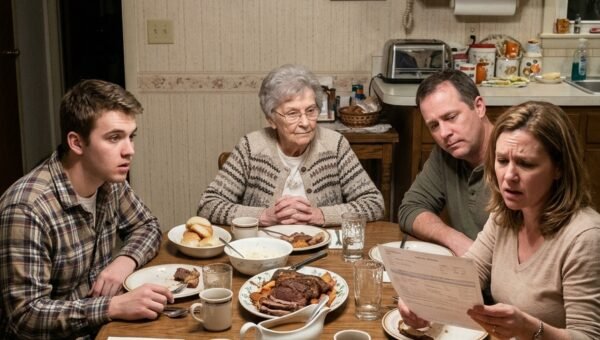
That night, Maggie had invited her sister Sarah and Sarah’s husband, David, over for dinner. Liam, Maggie’s grown son, came by after work. I had been home less than a day, but I didn’t mind. Maggie likes a full table, and I like watching her get everybody fed. She had made chicken and biscuits, the kind with too much pepper, which I like.
I was still putting away my jacket when Chloe opened the fridge and said, “Is there anything besides leftovers?” Sarah gave me a small look. I pretended I hadn’t noticed it. That was my first mistake that evening.
I was grateful to be home, honestly. Nine weeks on the road gives a man plenty of time to miss little things, like the sound of Maggie humming while she rinsed a pan, or the way she tapped her spoon twice on the coffee mug before setting it down. I wasn’t looking for trouble. I had brought home a bag of pecans from a stop in Georgia because Maggie likes to bake with them.
She had put them on the counter, still in the paper sack, and said she’d make a pie later. I figured I had time to settle in first.
At dinner Chloe kept her phone beside her plate. I asked how school was going. “Fine,” she said. I asked if she was still thinking about the summer program she had mentioned before I left. “Maybe.” That was about it. Sarah asked a follow-up, and Chloe answered her in a whole sentence. I didn’t take it personally. Or I tried not to. Then Chloe turned to Sarah and said, “How long has Maggie been running things like this?” Sarah asked what she meant. Chloe looked around the table, then shrugged. “She acts like she owns the place.” The place was our home. Maggie and I paid the mortgage together, and I had put down most of the first payment. Still, I didn’t jump in right away.
Maggie said, “Chloe, don’t start.” Chloe rolled her eyes. Then she looked at me, and said, “Honestly, he’s basically the help around here.” I remember the chicken was a little dry. I remember because I was chewing it when she said that, and it took me a second to swallow. I set my fork down and told her, “Don’t talk to me like that.” Chloe said, “See? This is what I mean. You always have to make a thing out of it.” I answered that I lived in the house too, and I wasn’t going to be insulted at my own table.
Maggie leaned forward. “She’s not your daughter. Don’t parent her.” There it was. The sentence I can still hear clean as a bell. Sarah stopped moving her fork. David looked at the TV in the next room like it might give him somewhere to go. Liam stared down at his plate. I felt my ears get hot, but I didn’t have a clever answer. I nodded once and said, “Okay.” That was all. I didn’t tell Maggie that I had spent the past four years paying for a lot of things she called “ours” when the bill came due.
The rest of dinner went on, sort of. Sarah asked David about the game. Liam said he had to get up early. Chloe picked up her phone again. Maggie didn’t look at me. I stayed until everyone left, because I didn’t want to make the whole night about me. Then I washed the plates. Maggie went into the living room. I dried the forks and put them away, and I folded the damp dish towel into a square. I do that when I don’t know what to say. It doesn’t help, but I do it.
I went to bed close to midnight. I heard the floorboards creak when Maggie came upstairs. She got in, turned away, and said nothing. I lay there with one arm under my head and watched the ceiling fan go around. I wasn’t angry at Chloe as much as I thought I would be. What bothered me was that Maggie had decided, in front of everybody, that I could be trusted with responsibility but not with a voice. I had paid for Chloe’s car. Her phone. Some of her school. And yet I was told not to parent her because she wasn’t my daughter.
That might sound petty. I know it does. I wasn’t trying to buy a place in Chloe’s life. I had just assumed we were a family in the plain, daily way. The kind where if you help keep a kid’s tires on the road and her phone turned on, you can ask her not to call you the help. I was wrong about that. But the money was not the only reason I was awake. There were little things that had been off before I left, and now I was lining them up.
I got up at 4:48. Maggie was still asleep. I made coffee and sat at the kitchen island with my laptop. I handled the household accounts because I had always been better with dates and due bills. Maggie was good with people. She could remember who liked cream in their coffee and which cousin’s kid had allergies. I could remember what drafted on the fifteenth and what needed to clear by the thirtieth. Together, we had made it work. At least, that was what I’d thought.
My card was attached to more than I remembered. Chloe’s Honda lease, insurance, phone plan, parking pass, and part of her tuition. Maggie had called the school payment a temporary bridge when Chloe’s grant came up short. That was last fall. I had been driving then too, so I said yes without asking what “temporary” meant. There were also transfers to Maggie with notes like “school,” “books,” and “misc.” Some were $73.19. Some were $241. I wasn’t accusing anybody yet. I was trying to see the whole thing.
I pulled up the bank statements and started comparing them with the bills. I didn’t know why I remembered the date of one transfer, but it was May 17, while I was in Missouri. It was $486. Another transfer, $612.50, had gone out four days later. The descriptions said “school supplies” and “car.” I called Maggie’s phone from the kitchen, then remembered she was asleep upstairs. I canceled the call before it could ring. I had no good reason to wake her just to ask about two entries on a screen.
What got me was how the amounts came in bunches. Small enough that I had never thought much about any one of them. I found one from December, one from February, then a string through April and May. I knew the car and school costs. I didn’t know about the extra transfers. I wrote them down, one by one, on a yellow pad. The numbers looked like nothing at first. Then they started to look like a pattern. I checked the shared account again. I checked the dates against my road logs. Every time I was far away, there was another transfer.
I wasn’t proud of the next part. I opened every account I could get into. The car portal. The phone plan. The college billing site. I wanted the facts before I talked to Maggie, but I was also looking for a way to feel like I had control again. Those aren’t the same thing. I knew that even while I was doing it. I found that the Honda lease payment was due in four days. The insurance was due the next week. The tuition payment was set to draft at the end of the month. I sat there for a while, with the coffee gone cold beside me.
I removed my card from the car account. I switched off the automatic payment for Chloe’s phone. At the school portal, I deleted my card but did not cancel her classes or anything like that. I left the lease itself alone. I didn’t want to do something that could wreck her credit. The insurance was more complicated, so I called the company when it opened and asked what would happen if I stopped covering the premium. The woman on the phone gave me the date and said the policy would need another payment to stay current. I wrote that down too.
Chloe texted me around seven. “My card got declined. Did you do something?” I saw the message while standing by the sink. I didn’t answer right away. I had taken one of my accounts off, not shut off her card, but she wasn’t wrong to ask. Then came another message. “Dad said you’d handle it.” I read that twice. Dad. She meant her biological father, who had been gone from her life for years. Or maybe she just meant Maggie. I couldn’t tell, so I didn’t reply.
Maggie came downstairs in her robe, poured coffee, and looked at her phone. The easy look left her face. She looked at me. “What did you change?” I slid my yellow pad across the counter. “I stopped paying for Chloe’s things until we talk.” She didn’t touch the pad. “You can’t just do that.” I said, “I can take my card off a bill.” She lowered her voice. “You know she’s in school.” I said I did. Maggie sat down, and for a second I thought she might explain the transfers. Instead, she said, “You embarrassed her last night.” I let out a short laugh. I shouldn’t have. “She called me the help in front of my family.”
Maggie looked at the pad. “She’s been under a lot of stress.” I asked what the transfers were for. “House stuff,” she said. I pointed to the dates. “These all came out when I was gone.” She reached for the paper, but I put my hand on it. “Just tell me what they are.” She said, “I don’t keep track of every little thing.” I said, “I do.” The phrase came out sharper than I meant it to. She got up, took her mug, and walked into the living room. “This is why I can’t talk to you,” she said. I was too tired to follow her.
I spent the day trying to decide what I had actually done. I hadn’t canceled Chloe’s school. I hadn’t taken the car away. I’d stopped my card from being the answer to every bill. But a person can make the same choice for two reasons, and I wasn’t sure which one was driving me. Part of me wanted Maggie to see how much I carried. Part of me wanted to punish her for what she said at dinner. I told myself it was only about fairness. I knew that wasn’t the whole truth.
That afternoon, I called Chloe. She picked up after the fourth ring. “What?” she said. I asked if she knew why those extra transfers were happening. She went quiet. Then she said, “Ask Mom.” I asked if the transfers were hers. She said, “I don’t know what you’re talking about.” I could hear a door shut on her end. “Chloe, I’m not trying to corner you.” She said, “You already did.” Then she hung up. I sat there with the phone in my hand, listening to the dead line for a few seconds. I felt bad, but not bad enough to pretend the question had gone away.
For the next two days, Maggie and I talked about everything except the money. We talked about groceries. We talked about the trash pickup. She asked whether I was going to Georgia the following week, and I said I didn’t know. I couldn’t tell if she was waiting for me to apologize or waiting for the next bill to hit. Maybe both. I made my usual lists. I checked what I had promised Chloe. The car was one thing. Tuition was another. I decided I would pay for the school bill when I knew what the money was doing, but I wasn’t going to put the card back on autopay without a conversation.
On Thursday morning, I heard Chloe in the laundry room on the phone. The door was open a couple of inches. I wasn’t trying to listen, but she said my name. “He thinks I took it,” she said. There was a pause. “I told you I can’t keep doing this.” I went still beside the hall closet. Then she said, “No, Mom. I’m not mad about the car. I’m mad you told him I was using his money.” She stopped talking. I backed away before she saw me. My face felt hot again, the same as at dinner. I couldn’t tell whether I had just learned something important or only one more piece of a fight that wasn’t mine to hear.
I waited until she left for campus. Then I asked Maggie to sit with me at the kitchen island. She stayed standing. I said, “Chloe thinks I accused her of taking money.” Maggie said, “You were checking up on her.” I said I was checking the accounts. “Same thing,” she answered. I asked her why she hadn’t told me about the transfers. She said, “It was handled.” I asked by whom. She turned away. That was when I saw the envelope half sticking out of the drawer where we kept coupons and takeout menus. It was addressed to Maggie, from the mortgage company. Not the usual bill. A past-due notice.
I pulled it out and put it on the counter. Maggie’s hand moved toward it, then stopped. “How long?” I asked. She said, “A while.” I asked whether we were behind on the mortgage. She said, “Not now.” That answer left too much unsaid. I was tired of guessing, so I opened the envelope. There were two notices inside, both with late fees. One had a date from April. I read the amount and looked up. “You told me everything was current.” She said, “I was going to catch it up.” I asked how. She didn’t answer.
I wasn’t proud of what I said next. “With the money I sent for Chloe?” Maggie’s eyes filled, but she didn’t cry. “I didn’t take it from you.” I said, “It came out of the account.” She said, “Chloe put it in.” I stared at her. She nodded once, then sat down. “She was working extra shifts. She said she could help.” My first thought was that I had misunderstood. My second was that I had not. I asked why Chloe was paying our mortgage while I was gone. Maggie covered her mouth with her hand. “Because I lost my job in March.”
I had been out on the road. Maggie had told me she was taking fewer hours at the salon because she was tired. That had been true, I guess. It just wasn’t the whole truth. She’d lost the job, fallen behind, and told me she was fine. I sent money when she asked, but she said it was for household costs and Chloe’s school. Some of it was. Some of it had gone toward the mortgage. Chloe’s extra transfers were not from our account to her. They were from Chloe to Maggie, then to the mortgage company. The little notes I’d treated like proof of someone taking from me were Chloe trying to keep her mother from falling behind.
I felt ashamed, but I also felt mad. Both things can be true. I said, “You let me think she was taking money.” Maggie said, “I didn’t say that.” I reminded her that she’d said she couldn’t keep track, and she’d let me see the transfers without telling me what they were. She said, “I thought you would be angry.” I said I was angry now. She nodded, looking at the table. “I know.” Then she said, “I was ashamed.” I wanted to ask why she had been able to let Chloe call me the help but couldn’t tell me she was out of work. I didn’t ask. I already knew part of the answer: Maggie had decided I was safer to use than to trust.
Chloe came home later that afternoon. I was at the kitchen table with the notices and the yellow pad. Maggie had told her I knew. Chloe set her backpack down and looked at the papers. “You read those?” she asked. I said yes. She rubbed her thumb over the strap of her bag. “I was going to tell you.” I asked why she hadn’t. She said, “Mom asked me not to.” Then she looked at Maggie. “And I didn’t want to be the reason you got mad at her.” I said, “You were working and paying this?” Chloe nodded. “Not all of it. Just what I could.” She had paid $8,416 over six months. She said it plainly, like she was reading a grocery total. I looked at the dates again. Two payments came in during weeks when I had been in Colorado.
I asked why she had called me the help. She stared at the table. “Because you kept saying it was your house.” I had said that once, maybe twice, when we were arguing about chores and she had left food out. I had not thought much of it. She had. I told her I was sorry I made it sound like her home depended on me. She said, “I didn’t say you weren’t helping.” I waited. “I said you acted like you got to decide everything.” I started to defend myself, then stopped. There was some truth in it. I kept the bills, the passwords, the dates. Sometimes I had treated that like the final word.
I turned to Maggie. “You should have told me you lost your job.” She said, “I know.” I asked why she had told Chloe not to tell me. She rubbed her eyes and said, “I thought I’d fix it before you got home.” I said, “I was home.” It came out quieter than I expected. She looked at me then. Not angry. Just worn down. I could see how long she’d been trying to hide the problem, but that didn’t make it fair to me or to Chloe. I wasn’t going to pretend one bad month had made everything fine.
We sat there for a while and sorted the bills. I put my card back on the tuition payment, but I set the payment to come to me first so I could see the amount and due date. I paid the insurance before it lapsed. I did not put the car lease back on autopay. Chloe said she could cover it if she picked up another shift, and I told her we would talk about that after we looked at her budget. Maggie said she would call the salon owner and ask about work. I told her I would not cover the mortgage alone without knowing what was going on. She said, “That’s fair.” She didn’t say she was sorry. Not then.
Chloe pushed the yellow pad back toward me. “You should keep these,” she said. I looked at all the dates and dollar amounts, then at the mortgage notices. I had come home thinking I was the only person holding things together. I was wrong about that. I had been carrying a lot, and Chloe had been carrying more than I knew. Maggie had let us both think we were alone in it. None of that made the dinner comment okay. None of it made my choices clean, either.
The next day I called the college office and confirmed the payment date. I called the insurance company and got the policy back on track. I sat with Chloe to go over her car and phone bills, and she agreed to pay a set amount herself, not because I ordered her to, but because she wanted to. Maggie booked a meeting with the salon owner. We didn’t settle everything in one afternoon. We at least stopped pretending that a declined card was the biggest problem in the house.
Before Chloe left for campus, she put a folded envelope beside my coffee mug. I opened it after the front door closed. Inside were the mortgage receipts, each one clipped to a page from her work schedule. The last receipt was for $1,286. It had been paid while I was somewhere outside Denver. On the back, in Chloe’s handwriting, were six words: “Please don’t tell Mom I paid.”