I came home from 41 days on the road and found a widow saving my seat at church. By Thanksgiving, she’d brought me three pies and asked me to fix two things at her house, while my own kitchen sink leaked into a bucket.
I knew what Claudette had put in that big red box before Trudy opened it. I knew because I’d seen the plates stacked in our garage. I still didn’t stop her. That part gets left out when I tell this story to people who ask if we’re all right.
We’re still married. I’m still driving. The sink got fixed. None of those facts mean I can say we’re all right.
Claudette and I had been married thirty-eight years. She’d spent most of those years working at a truck stop off the freeway, pouring coffee and remembering which regulars wanted their eggs hard. She could read a person quick. I used to brag about that, mostly because she’d read me as generous when I was younger. I didn’t think about how long it took to change somebody’s mind.
I drove long haul. Some months I was home more than others.
That fall, I was gone for 41 days, hauling a load east and back. I came in late on a Saturday with a stiff neck, a bag of laundry, and the smell of diesel on my jacket. Claudette had left a plate in the fridge with foil over it. She’d written MYLES on a scrap of masking tape.
I remember that tape. I don’t know why. Maybe because by Thanksgiving I was eating pie from somebody else’s plate and acting like I didn’t see the difference.
Trudy had moved to Reno after her husband died in the spring. She was new at our church, and I’d seen her a few times before I left town.
When I came back, she was at a potluck with red lipstick and a cherry pie. She sat near me while Claudette stood in line with a green chile casserole.
Trudy looked at Claudette and said she’d have me by Thanksgiving. Then she added that Claudette had had me long enough, and she could share.
I laughed. Not a big laugh. Just a grin, like it was harmless. Claudette said my name, and I told her Trudy was kidding. I could see from her face she wasn’t buying it, but I didn’t want the whole church turning toward us. That’s the truth. I wanted to keep the room easy for me.
I also liked being wanted. I’d been away a long time. People at home mostly asked when I’d fix something or whether I’d be around for dinner. Trudy looked pleased to see me. I told myself that was all it was, and I didn’t ask why I was so eager to believe it.
The next Sunday, Trudy brought a cherry pie. She set it down beside me in the church parking lot and asked if I wanted a slice. I took one. It was good, with the crust browned darker at the edge. She waited while I finished it, then handed me another forkful from the plate.
Claudette was a few steps away. I saw her watching me. I could have put the fork down. I could have said thank you and carried the pie inside for everyone. Instead, I ate the second piece too.
The week after that, Trudy brought peach. She had a reason for calling me over to look at her kitchen sink, and I went. I told Claudette it was the Christian thing to help a widow. She said I could start by being a Christian in our own kitchen.
Our sink had been leaking for months. There was a plastic bucket underneath it, the sort with a faded handle that pinched your fingers. I’d promised twice to fix it. I’d even taken the wrench out once, then set it back when a load came in early. Claudette had stopped asking, which I read as permission to stop feeling bad.
At Trudy’s place, I replaced a loose washer and told her to call me if it started again. She thanked me like I’d done something big. I went back the next Tuesday because her porch light wasn’t working. That took ten minutes. I stayed another half hour talking about her husband, who’d worked in a parts shop and apparently kept every receipt he ever got.
I remember the sharp smell of machine oil on the old toolbox in her garage. I remember that because it reminded me of mine, still sitting under a shelf at home, right beside the bucket under our sink.
Trudy called our landline one night at supper. Claudette still liked having one, and I’d teased her about it until I needed to call home from a motel with no cell service. Trudy said her garbage disposal was making a noise and asked for me.
Claudette told her to turn it off. Trudy laughed and asked to speak to me. I took the phone into the hall, where the cord barely reached the little table by the coats. We talked for twenty minutes. I don’t know how. Mostly I explained that she should stop using the disposal until I could look at it.
When I came back, Claudette had put my dinner in the microwave. I asked if she was mad. She said no, and that was worse than if she had been. I made a joke about the landline being useful after all.
She didn’t laugh.
After that call, I started noticing the bucket. It was in the way when I went for a glass. I nudged it with my shoe once, and a little water sloshed over the rim. Claudette wiped it up with a dish towel and hung the towel over the oven handle.
I said I’d fix the sink that weekend. I meant it when I said it. Then dispatch called with a load I couldn’t turn down. Claudette told me to take it. I took it.
I was gone another week. When I got home, the bucket was still under the sink. Trudy’s porch light worked. I told myself I’d deal with the sink Monday. That Sunday, Trudy brought coconut cream pie and said Claudette didn’t bake for me anymore.
I don’t remember what I said back. I remember Claudette smiling at her, then turning to me. She said she’d get Trudy a little something for Thanksgiving, just from her. Trudy looked pleased. I was relieved. I thought Claudette had decided to stop taking the whole thing so seriously.
That’s a thing I did a lot. I called her calm when she’d simply stopped telling me what I was doing to her.
For the next few weeks, I came home to the same small scenes. A pie plate in the passenger seat of my truck. A text from Trudy asking if I was around Tuesday. Claudette moving the bucket so she could mop under the sink. I was usually home for one Sunday, then gone again for a few days. I kept saying it was nice that Trudy had somebody to call.
Claudette never yelled. She never checked my phone. She never asked where I’d been every minute. I thought that meant I was getting away with it. It meant she was trying to decide what she wanted to do without me talking her out of it.
I don’t say that to make her sound clever. I say it because I was so busy worrying about whether people at church would think she was jealous that I didn’t notice how lonely she looked at home. That’s the part I can’t dress up.
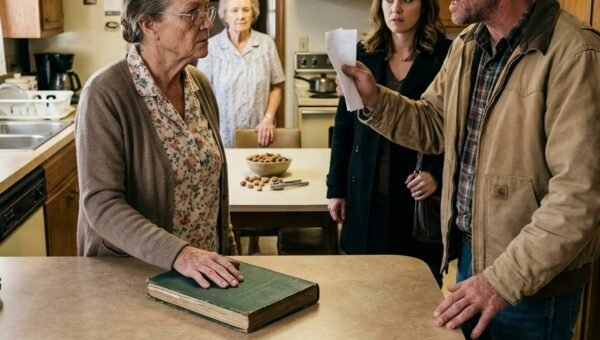
One Tuesday, I got back from a short run and saw her on the old lawn chair in the garage. There was a cup of decaf on a crate beside her and a big box on the floor. Red paper was spread over it. Claudette had a pair of scissors in her hand.
I asked what was in the box. She said it was Trudy’s present. I told her not to make a scene at church. I said people wouldn’t sit with her if she embarrassed Trudy in front of everyone.
Claudette looked at me for a while. Then she said, “It’s a gift, Myles.”
I said I knew that. I walked back into the house and went to bed.
The box was still in the garage the next morning. The lid was on. I could see one corner of a pie plate through the gap. I knew which plate it was. Trudy had brought it with the cherry pie, and I’d carried it to my truck after eating two pieces. I’d brought it home because I said I’d return it.
I could’ve taken the box apart. I could’ve asked what she was doing. Instead, I left for a load. I told myself Claudette wouldn’t actually make a scene, because she’d always been the one who kept things from becoming scenes.
I was home again for the church Thanksgiving supper. I’d been back three days. The fellowship hall had long folding tables, paper turkeys, and the big coffee urn with the chipped black handle. That chipped spot is about the only thing I remember from the room before the box came out.
Trudy wore a red sweater and had saved me an end seat beside her. She called to me from across the hall. I looked at Claudette before I moved. She said I should sit wherever I wanted.
I went to Trudy’s table anyway.
The pastor said the blessing. People began passing rolls and bowls of green beans. Claudette stood up with the big red box in her arms and said she had a little something for Trudy. Trudy put a hand on her chest and said Claudette shouldn’t have.
I was already halfway out of my chair. I stopped when Claudette set the box in Trudy’s lap.
The ribbon came loose first. The red paper fell over the edge of the table. Trudy lifted the lid.
The three pie plates were on top. Under them sat a small stack of folded papers and a plumbing invoice. The paper had the dates of every Sunday Trudy had brought a pie. Beneath those were the Tuesdays I’d gone over to her house, with the things I’d fixed written beside them. The invoice showed that Claudette had paid $219 to have our sink repaired while I was away.
I knew the amount because she’d told me. I’d asked if she could wait until I got home. She hadn’t.
The room didn’t erupt. Nobody gasped. It was just quiet enough that I could hear somebody set a fork down.
Trudy looked at the invoice, then at Claudette. I couldn’t make out what she said. Claudette told her the pie plates were hers, and she’d thought Trudy would want them back. She said the plumber’s bill was there because she’d been paying somebody to do the work her husband kept promising to do.
That was the first time I heard her say it out loud.
I’d been so worried about Trudy taking me that I hadn’t understood how little there was to take. I was a man who could drive across three states, fix a stranger’s porch light, and still leave a bucket under his own sink. I’d let attention feel like love because it asked less of me than love did.
I went around the table. I didn’t grab the papers or raise my voice. I asked Claudette if she wanted to leave.
She said she wanted to eat her dinner.
Trudy slid the pie plates back into the box. I started to tell her she didn’t need to do that, then stopped. It wasn’t my place to rescue her from being embarrassed after I’d helped set the whole thing up.
I said I was sorry. It came out small. Claudette didn’t answer. She reached over and took the invoice from the top of the stack, smoothed one corner, and put it back.
I sat down beside her. Not across from her. Beside her. I didn’t try to touch her hand, because I could see she wasn’t asking me to.
Trudy left before dessert. I didn’t follow. I didn’t offer to bring the plates home for her. I stayed in my chair and helped carry the dishes after supper.
The next morning, I called Trudy and told her I wasn’t coming over anymore. I told her she should call a plumber if something broke. She said she understood. I didn’t ask if she was mad at me.
Then I took the bucket out from under our sink. The new plumbing had already been put in, but Claudette had kept the bucket. I washed it out and put it on the shelf in the garage. I didn’t know what else to do with it.
Claudette watched me from the kitchen doorway. She said the sink was working now. I said I knew. I told her I was sorry for letting her carry the whole thing while I played helpful somewhere else.
She said, “You liked being the good man.”
I wanted to tell her I wasn’t a bad man. I wanted to talk about the miles and the long days and how people on the road got lonely. All of it was true. None of it answered what she said.
So I said I did.
We ate dinner that night at the kitchen table. The sink didn’t leak. The bucket was in the garage. Claudette had made soup and set one piece of bread beside my bowl, not two like she used to.
I didn’t ask her to forgive me. I’m still learning not to make my guilt another job she has to do.
The receipt stayed on the table for two days. Then Claudette put it in the drawer with the takeout menus. I still see the empty spot under the sink when I walk in there, and I still think about how long I left the bucket there.