I watched my husband get laughed at over his father’s will, and I didn’t say a word.
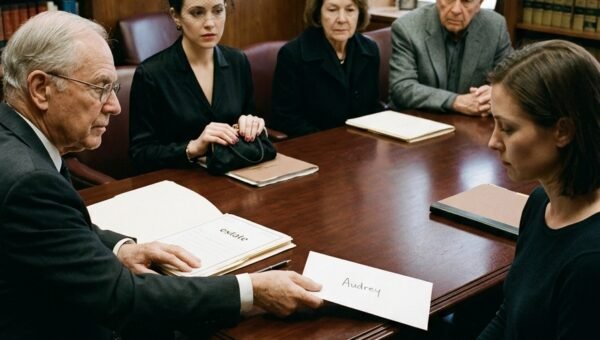
I was sitting close enough to feel Daniel’s knee bouncing under the table. Sheila had just heard she’d get the house, both cars, the lake place, and $2.1 million. Daniel had been left a sixteen-foot fishing boat with a cracked seat. Then Sheila laughed so hard she had to step into the hall.
I stayed seated. I keep coming back to that part.
This was in a lawyer’s office in our paper-mill town in Maine, two weeks after Gordon died.
Daniel wore the same blue flannel he’d worn at the hospital. I remember the frayed cuff because I’d tried to sew it the night before and made a mess of it. Sheila had on black clothes and sunglasses, even indoors. I was thirty-nine, Daniel was forty-one, and I figured I knew what grief looked like by then. I didn’t know what to do with the way it looked on him.
Gordon had married Sheila four years after Daniel’s mother died. Sheila had worked as his bookkeeper. Then she became his girlfriend, then his wife. The wedding was in a courthouse on a Tuesday, with no family there.
I didn’t love that, but I told myself it wasn’t mine to judge. That was how I handled a lot of things with Sheila. I waited for Daniel to make the call, and then I acted like waiting was the same as helping.
Daniel never asked me to like her. He did ask me once to stop calling her “Dad’s bookkeeper” when we were alone. I’d said I was only being honest. He didn’t argue, but I could tell I’d hit a sore place. Sheila and I were civil, mostly. I was not proud of how often I let her take up the whole room just because I didn’t want a fight.
The boat was the one thing Daniel had with Gordon that Sheila didn’t get to manage. It was a 1987 aluminum hull, sixteen feet, with a forty-horse motor. Gordon had patched the bench with silver duct tape in 2003, and every spring he put on another strip because the old stuff peeled at the corners. The seat still had a little dip in the middle from the two of them sitting there for years.
They went out most Saturdays from April through October. They’d be on the water by six, sometimes before I’d poured my coffee. Daniel told me they didn’t talk much. “We don’t have to,” he’d said once, like he was explaining why the silence was not a problem.
He came home smelling like lake water and stale coffee, and he always brought the boat back with the gas tank nearly empty.
Sheila called it “that tin can.” Gordon never corrected her in front of me. I wish he had. I also wish I’d said something, but I didn’t. I told myself it was their marriage and Daniel’s relationship with his father. There’s always a reason to let a thing go when you don’t want to be the one who makes it worse.
Gordon’s stroke came on a Wednesday afternoon in September. The hospital called Daniel at 3:18. I was in the kitchen sorting out a bag of clean shirts when he picked up, and I watched him go still. He said, “I’m coming,” then set the phone down and didn’t move for a few seconds. I grabbed my keys and went with him.
We didn’t make it in time. Gordon was sixty-nine.
At the funeral, Sheila stood close to the front and held on to Daniel’s arm when people came to offer condolences. He let her. I was glad he did. That doesn’t mean I believed her tears, which is a nasty thing to admit. I saw her crying in the parking lot once, alone by the passenger side of Gordon’s truck, and I looked away. I didn’t know what she was feeling. I still don’t.
The will reading was two weeks later. Mr. Pruitt, the lawyer, read the list in a steady voice. House to Sheila. Both vehicles to Sheila. The lake house to Sheila. The remainder of the investment accounts to Sheila. He gave the amount as $2.1 million.
She dabbed at her eyes with a tissue that looked dry to me. I know how petty that sounds. I noticed it anyway.
Then Mr. Pruitt read Daniel’s name and the boat. Motor and trailer included. That was all.
Sheila made a snorting sound, then laughed. She leaned a hand against the table like she needed to steady herself. “The boat? Oh, Danny. The boat.”
I felt Daniel’s knee stop moving. I reached for his hand, but he’d already put both hands flat on his thighs. Sheila walked out into the hallway still laughing. I could hear her from the office. I did not follow her. I did not tell her to come back and apologize. I didn’t even look at Daniel right away because I didn’t want him to see me looking at him.
Mr. Pruitt wasn’t smiling. He took off his glasses and wiped them with a cloth. Then he told Daniel that Gordon had been very exact about the boat. He’d added the hull identification number to the will and had left a note saying to take it to Hank at the marina before taking it anywhere else.
Daniel looked at him. “Did he say why?”
Mr. Pruitt said he hadn’t. He only knew Gordon had repeated the instruction twice.
On the drive home, I asked Daniel if he thought the boat needed work. He said maybe it needed a new registration. I said we could take it in on Saturday. I didn’t ask him how he felt about the will. I knew how he felt. I was afraid that if he started talking, I’d have to say something honest about my own part in it.
He didn’t sleep much that night. I heard him get up and go into the garage. When I went out, he was checking the boat’s trailer lights. He had a flashlight between his teeth and a screwdriver in his hand. I leaned against the garage door and watched him test each signal.
“You don’t have to fix it tonight,” I said.
“I know.”
He kept working.
The next Saturday, we drove the boat to the marina. Hank had run the place since before Daniel was born. Gordon had known him for forty years. I knew him too, in the way you know a person who has seen you at the same town events for decades and never remembers what your job is. He came outside when he saw the trailer.
He touched the bow with his palm and stood there a moment. I noticed a faint line of black grease across his thumb. It was the kind of detail I remember when I can’t remember what people said.
“Your dad told me you’d come,” Hank said.
Daniel nodded. “He told me to.”
Hank looked at both of us. He seemed to be weighing something. Then he said he’d need to keep the boat for a few days and pull the registration. Gordon had filed something on the hull in 2019. Hank said that was all he could tell us until he found the paper.
I asked whether there was a problem with the boat. Hank said there wasn’t. His voice had gone flat, though. Daniel asked if it had to do with the motor. Hank shook his head and said, “No. It’s not the motor.”
We left the boat there. Daniel kept glancing back at it while we drove out. I said we’d get it in a few days. That sounded like a promise, but I didn’t know what I was promising.
The following week was mostly quiet. Daniel went to work. I cooked dinner. We talked about bills, the funeral thank-you notes, whether the truck needed new tires. He brought up the will once, then stopped when I said maybe Sheila was just reacting badly. I didn’t mean to defend her. It came out that way all the same.
He looked at me and said, “You heard her.”
“I did.”
“Then why are you explaining it?”
I said I didn’t know. That was true, but it wasn’t the whole truth. I didn’t want to tell him I felt ashamed that I’d sat there with my hands folded while Sheila laughed. He didn’t press me. I wish he had.
Hank called me at work a week after we left the boat. It was 10:42 in the morning. I know because I’d just come back from the break room and was trying to get coffee off my thumb with a paper towel. Hank asked for Daniel. I told him he was in a meeting, and Hank said he needed Daniel to come down to the marina with ID.
I asked if something was wrong.
“Nothing’s wrong with the boat,” he said. “Just have him come in.”
Then he asked if Sheila knew. I said no. He told me not to bring her.
I called Daniel’s office. He came out of the meeting and called me back within five minutes. I told him what Hank had said. He didn’t ask me to come with him. I went anyway.
Hank had us meet him in his back office. There was a thick folder on his desk, and the boat registration sat on top. Daniel had brought his driver’s license and set it beside the papers. Hank pushed the folder across the desk. He didn’t say anything until Daniel opened it.
The first page was ordinary registration information. The second was dated 2019, signed by Gordon and Hank, and notarized. Daniel read the heading twice. Then he sat down in Hank’s chair.
I didn’t ask what it said. I could see the way he was gripping the paper, and I knew the answer had changed something.
“It’s the marina,” Daniel said.
Hank nodded.
I looked from one of them to the other. Daniel told me the document was an assignment of Gordon’s ownership in North Cove Marina LLC. Gordon had bought the place from Hank in 2019. Hank had stayed on to run it. Gordon had transferred his full share to Daniel that same year.
The boat’s hull number was written on the attached schedule. Gordon had told Hank to keep the assignment cross-referenced under it, so nobody would find it by searching his name or the business records alone. The marina file was the reason Hank asked for Daniel’s ID. The will had left him the boat because the marina was already Daniel’s.
I looked at the page again. Gordon’s signature was the same one I’d seen on birthday cards and the backs of checks. It leaned up at the end. I had watched him sign our wedding card. I’d watched him write Daniel’s name on the Christmas gifts he brought over. I had not known he owned the marina.
I asked Hank whether Sheila knew.
“No,” he said. “I don’t think Gordon wanted her to know before the will was read.”
Daniel kept staring at the assignment. I could tell he was trying to figure out why his dad had not told him. I had the same question. Hank said Gordon had come to him after a health scare and asked him to witness the transfer. Gordon didn’t want to make a show of it. He said Daniel already knew how to work the place, and he trusted him with it.
That hurt in a plain way. Gordon had trusted Daniel with a business and never said so. He had left him to find out after dying, with me sitting beside him and not helping.
Mr. Pruitt called back that afternoon. Daniel had asked Hank to send a copy to the lawyer. Mr. Pruitt confirmed that the assignment was in the company records and had been completed years before Gordon died. The marina wasn’t part of the estate, so it hadn’t appeared in the will. He said the boat was an actual gift, not a joke or a decoy. The instruction to take it to Hank was Gordon’s way of making sure Daniel got the rest of the story.
Sheila found out three days later. Mr. Pruitt told her, because he had to answer questions about the estate. She called Daniel and said she wanted to meet. He asked me to come with him. This time, I did not wait to be asked twice.
We met her in Mr. Pruitt’s office. She had a folder with her and a list of questions. She asked how much the marina was worth, whether Gordon had been paid for it, and why she hadn’t been told. Daniel answered what he could. Mr. Pruitt explained that Gordon had transferred the ownership in 2019 and that the signed records supported it.
Sheila kept her voice low. She said she thought the marina was part of Gordon’s estate. She said she had handled his books for years and never saw a sale. She said she had no idea he had been able to keep something that big from her.
I believed her when she said that last part. I didn’t like her, and I didn’t trust her, but I believed she hadn’t known. Maybe she’d thought the laughter was harmless. Maybe she’d thought Daniel had been given an old boat and nothing more. Maybe she was scared about losing control of the only future she’d pictured for herself. I can understand fear without pretending it made the way she treated him okay.
She looked at Daniel and said she hadn’t meant to make him feel small. He said he knew. I thought he might say more, but he only asked whether she’d taken the keys to the lake house. She said yes.
That was the end of the meeting. Not forgiveness. Not a big fight. Just the end.
The following month, Daniel went to the marina every morning before work. He and Hank went over the books, the slip rentals, the winter storage schedule, and the old equipment. The place needed repairs. One dock board was soft underfoot, and the fuel pump had been acting up. Daniel didn’t complain. He said Gordon had left him work, not a prize.
The boat stayed there too. Hank offered to let Daniel use a slip without charge, but Daniel refused. He paid the regular rate. He said it was his business now, and he didn’t want to start by acting like the rules didn’t apply to him. I told him that sounded like Gordon. He said, “No, it sounds like me.”
I thought he was right.
I still feel bad about the will reading. I should have stood up when Sheila laughed. I should have said something, even if it was only, “That’s enough.” I didn’t. I was afraid of making Daniel’s day harder, so I let him sit there alone while I tried to keep the room calm. I see that now. I don’t know if he has forgiven me for it. He says I don’t need to keep bringing it up. I keep bringing it up anyway.
Sheila never asked Daniel for the boat. She did ask him to hold some boxes for her while she moved out of Gordon’s house. He said yes. They sorted through them at the marina because it was easier than bringing everything to our place. He made coffee for her in the little office and didn’t mention the will. She thanked him for the coffee. They didn’t become close. They did manage to talk without hurting each other every time.
That’s more than I expected.
Last month, Sheila mailed in a winter storage form for her small runabout. The marina had sent the same form to every customer. She signed it, paid the deposit, and dropped it off in the office. Daniel brought it home because he wanted to show me her handwriting at the bottom. It was a plain signature on a plain form. I don’t know why it got to me.
The boat is still there. The cracked seat is still taped. Hank says Daniel ought to replace it before next spring, but Daniel says the tape has held this long. I can see both sides. I have stopped asking him to fix it.
On Sheila’s storage form, under “Marina,” she’d written North Cove, and beneath that, Daniel’s name.