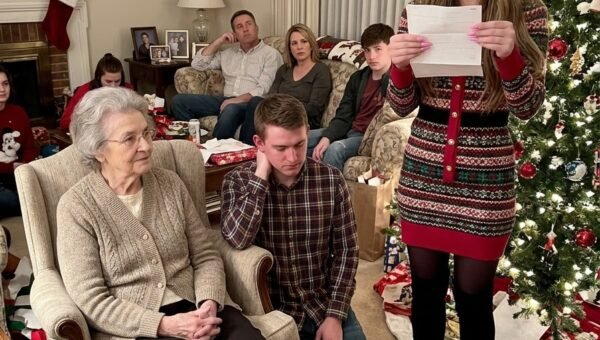
I got Mason wrong. I thought keeping quiet around his mother would keep his home safe, and I watched him learn to step around me like I was another piece of furniture.
I’m Martha, I’m 72, and Mason is my 17-year-old grandson. I love him. I also let his mother, Elena, and her husband, Derek, use my money and my name for years because I was afraid of being the difficult old woman in the house. I have to say that plainly, or the rest makes me sound like I had no part in it.
The day I finally said no, Elena had filled three shopping carts at a supermarket in Savannah. Derek was having his boss over for dinner. There were steaks, seafood, imported cheese, wine, a cake, and flowers. I remember the flowers because one stem had snapped and was lying across the cart handle.
I had added a box of chamomile tea. The cashier read the total, $980.43, and Elena turned toward me as if she’d been waiting for a cue.
“Take out your card,” she said.
I told her I couldn’t pay for all of it. My pension was $1,220 a month, and Social Security was $810.
Almost $300 went to heart medicine. I had enough left for my own bills, not three carts of food for a dinner I wasn’t hosting.
Elena glanced at her phone. “It’s the least you can do for living with us.”
That sentence made the store go quiet in my head. Not in the dramatic way people write about. I could still hear a cart wheel squeaking behind me. I could smell the sharp, sweet smell from the cut flowers. I just couldn’t make myself reach for my wallet.
I’d made the mistake of thinking a home could be safe because my daughter had asked me into it.
Four years earlier, after my husband Robert died, Elena sat at my kitchen table and held both my hands.
“Come live with us,” she said. “We’ll find a house with a downstairs suite. You won’t be alone.”
I was 68, newly widowed, and I did not want to make decisions. Elena sounded so sure. I sold the house Robert and I had lived in for nearly 40 years. The new place cost $447,000. I put in $286,000 from the sale, about 64 percent of the purchase price, and Elena and Derek covered the rest with a mortgage.
My name went on the deed for 64 percent ownership. The attorney who handled the sale, Harrison Vance, also made sure I had a lifetime right to live there.
He’d found a note Robert had left in our estate folder. Robert wrote it by hand, in the block letters he used for shopping lists: If Martha ever sells our home, make certain the money remains hers. She trusts too easily when she loves someone.
It wasn’t a legal document. Harrison told me that. But he said Robert’s concern made sense, so he protected my share in the deed and the occupancy agreement. Elena and Derek signed both papers. I was at the closing, but grief had made everything feel like a pile of forms someone else had to sort through.
Elena kept saying it was all standard. “The ownership percentages are just for the bank,” she said. “It doesn’t change anything between us.”
I believed her. I wish I could say I didn’t. I did.
I also had $78,000 in a savings account. Elena called it my security fund. At first, I agreed to put $1,740 a month into the household account for six months while they got used to the mortgage, taxes, and insurance. Six months became a year. Then it became the way things were.
I paid part of the utilities and groceries on top of that. I let Elena use my emergency credit card because she said it was easier for household expenses. I saw the charges for salon visits and restaurant meals. I noticed a $620 handbag. I told myself I was being petty. That word still bothers me, because I used it to make myself smaller.
The promised downstairs suite became storage. Derek’s golf clubs and exercise equipment took up the room. My bed was pushed against a wall that stayed damp, and the little bathroom became a laundry room. I cooked and cleaned. I ironed Derek’s shirts when Elena was busy. I drove Mason where he needed to go, and I walked their dog when nobody else wanted to.
Mason didn’t ask me to do all that. He’d say, “You don’t have to, Grandma.”
“I know,” I’d tell him.
Then I’d do it anyway.
At the register, Elena leaned toward me and spoke through her teeth. “Stop embarrassing me and take out your card.”
I told her the house had been paid for with my money too.
Her face got tight. “You gave us that money voluntarily. Stop playing the victim and pay.”
The cashier lowered her eyes. The people behind us became very interested in their shopping. I could feel my face getting hot, and I wanted to end it. That’s what I had done for years. End it by giving in.
Instead, I closed my red wallet.
“No.”
Elena stared at me. “What did you say?”
“I’m not paying.”
“You’re creating a scene.”
“No. I’m ending one.”
I turned around and walked toward the doors. She called after me, first asking me to come back, then telling me Derek’s boss was coming, then saying if I left I shouldn’t come back to her house. I walked through the automatic doors anyway.
I didn’t have a plan. I had my purse, my phone, and a bus stop nearby. My hands were shaking so badly I mistyped Clara’s number once. Clara Jenkins had been my friend for more than 20 years. She was a retired teacher, and she was the one person who never asked me to explain why I needed help before she offered it.
Elena called 14 times while I was on the bus. I answered on the fifteenth call, mostly because I was afraid something had happened to Mason.
“I had to abandon three carts,” she said. “Derek’s boss is coming, and there’s no dinner.”
“That’s your problem.”
“You’re behaving like a child.”
I looked down at the tea in my bag. “I couldn’t afford your groceries.”
She told me I’d be back by morning. I said I didn’t know where I was going to sleep. That part was true. She hung up before I could say anything else.
I got off near my bank at 4:40. They were closing at five. I walked in with the tea box sticking out of my bag and asked the woman at the desk if someone could help me stop a transfer.
Her name was Sonia. She had neat handwriting and a little scar across one eyebrow. I remember the scar because I kept looking at it while I tried to tell her what I needed.
The $1,740 deposit was scheduled for midnight. It usually went into Elena and Derek’s household account three days before their mortgage payment was due. I had not thought of it as a choice in a long time. I thought of it as a bill.
Sonia helped me cancel it. Then I asked her to remove Elena as an authorized user on my emergency card and freeze the card. I opened a new account for my pension and Social Security. The new account was mine alone, though I felt ashamed saying that out loud.
Sonia asked if Elena had access to any other financial information. I said she knew where I banked, had seen my account statements, and had access to my old card. Sonia told me to check my credit report.
A loan inquiry showed up from Atlantic Horizon Financial.
I hadn’t applied for a loan. I said that twice, like maybe the first time hadn’t counted.
Sonia stopped typing. “Then call the lender and talk to an attorney.”
Outside, I called Clara. I didn’t make it sound pretty. I said I needed somewhere to stay that night.
“Where are you?” she asked.
I told her. She said she was coming.
When Clara arrived, she looked at my face and then at the shopping bag with the tea in it.
“You finally said no,” she said.
I started crying. Not loud, just enough that I had to sit down on the low wall beside the parking lot. I was embarrassed about that too. Clara held my hand and didn’t tell me to stop.
I slept in her spare room that night. I barely slept. Elena texted that dinner had been ruined. Derek texted that my “little performance” might have cost him a promotion. I read both messages and didn’t answer.
At 12:08 a.m., my bank confirmed that the deposit had been canceled. Three minutes later, Derek called. I let it ring. I sat on Clara’s bed with my shoes still on, listening to the phone buzz against the nightstand.
The next morning, Clara drove me to see Sylvia Rossi, an attorney she knew from her divorce. I brought every paper I could find from the house purchase. I had kept the folder in a drawer under old birthday cards, which is odd, I know. Maybe I wanted the papers close but didn’t want to look at them.
Sylvia read quietly for almost half an hour. Then she turned the deed toward me.
“You own 64 percent,” she said. “And this agreement gives you the right to live there for the rest of your life.”
“Elena said those were formalities.”
“They weren’t.”
I felt relieved for about ten seconds. Then I felt ashamed that I needed a lawyer to tell me what my own name meant.
Sylvia helped me call Atlantic Horizon. They verified my identity and opened a fraud review. The lender had not approved or paid out a loan. It had an application for $184,620 against the house, with my name listed as a co-borrower and my signature on the consent form.
The application said I had agreed to borrow the money with Elena and Derek. It also said the loan was for home improvements and debt consolidation. None of that was true. I had not agreed to borrow anything, and I hadn’t seen a contractor or a loan officer.
The lender sent Sylvia a copy of the application. There was my name, written in a hand that was trying hard to look like mine. The signature had come from somewhere. Later, Harrison told me it looked like the signature on the deed.
Sylvia asked if I wanted to file an identity theft report. I said yes, then sat there feeling sick about what that meant for Elena. That was the part I hated most. I was more worried about what might happen to my daughter than what she had done to me.
Sylvia looked at me. “You didn’t make this happen.”
I nodded, but I didn’t believe her yet.
That afternoon, Elena called. I let it go to voicemail. She called again. On the third call, I answered because I wanted to hear what she’d say without Derek beside her.
“Where are you?” she asked.
“I’m safe.”
“You canceled the deposit.”
“Yes.”
“You can’t just stop helping us.”
“I can stop sending money.”
She started crying. She said Derek was furious, the dinner had been a mess, and his boss had left early. She said I had embarrassed her. I listened until she stopped.
Then I asked about the loan application.
There was a pause. Not long, but long enough.
“What application?” she said.
“Atlantic Horizon. The one with my signature.”
She said Derek had handled it. Then she said she thought I’d signed something at the house closing. I told her I hadn’t. Her voice got smaller.
“We thought you’d say yes if we explained.”
That was not an explanation. I told her the lender had the form. She said they were under pressure and Derek needed to clear some debts. I asked whether she knew my signature was on the application.
She didn’t answer. Then she said, “We didn’t think it would be a big deal.”
I wanted to shout. I wanted to ask how many times she’d said that to herself while using my money. Instead I said I was going to let Sylvia handle it.
Elena said I was choosing a lawyer over my family.
I told her I was choosing not to sign a loan I never agreed to. Then I ended the call. My hand hurt from gripping the phone.
Derek texted later. He said the lender had made a mistake and I was making things worse by involving attorneys. I sent the message to Sylvia and didn’t answer him.
The next week wasn’t dramatic. It was paperwork, calls, and waiting. The lender put the application on hold, then marked it as disputed after Sylvia sent the fraud affidavit. I filed an identity theft report. Harrison checked the deed and confirmed the ownership and occupancy agreement were still in place. Nobody could take my share of the house through that application.
It still could have happened if the loan had gone through. That fact sat with me. I kept thinking of Mason. He lived there too. I had spent years convincing myself that if I stayed quiet, I was helping him keep a stable home. I hadn’t thought about what he saw when his grandmother kept giving in.
Clara let me stay while Sylvia talked with Elena and Derek. I didn’t want to move back in, but I also didn’t want to give up the lifetime occupancy right that Robert and Harrison had put in place. I didn’t have to decide that first week. Sylvia told me to take time.
I went back once to get clothes and my medicine. Elena opened the door. She had been crying, though I couldn’t tell if it was from the fight or the house feeling different without me.
Mason came down the hall. He had one of my old grocery bags in his hand, the kind I kept folded in a drawer.
“I put your things in here,” he said.
“Thank you, sweetheart.”
He looked at me, then at Elena. “I’m sorry.”
I told him he didn’t need to be sorry. I wanted to say more. I wanted to tell him I’d noticed him watching me do everything, and that I was sorry I’d let him think being loved meant never saying no. But Elena was standing there and I didn’t know how to make the words come out without making things worse for him.
So I took the bag.
Elena asked if I was coming back that night. I said I hadn’t decided. She looked like she might say something, then shut the door without it.
For a while, we all waited for somebody else to make the next move. I was still paying the house utilities from my own account, so I stopped. Sylvia told Elena and Derek I would not put money into the household account or cover household expenses while the loan application was under review. They had to take over the bills themselves.
They managed, though they complained that I’d left them in a bad spot. I didn’t argue. I knew they had a mortgage and a lot of expenses. I also knew my share of the house was not a reason they could use my identity.
After the lender closed the fraud review, Sylvia gave Elena and Derek a choice. They could buy out my 64 percent share, or we could sell the house and divide the proceeds by the percentages on the deed. They didn’t have enough money to buy me out, and they couldn’t get another loan while the application was under review. So we agreed to list the house.
I was scared of selling. That house held the last plan I’d made with Robert, even if it was a plan that didn’t work. It also held his note in the file and the room where I’d slept against a damp wall. Both things were true.
We signed the listing papers together. Elena kept her eyes on the table. I did too. We used a neutral agent, and Sylvia stayed involved so there would be no arguments about how the money was divided.
The house sold five months later. I received 64 percent of the net proceeds, as the deed said. Elena and Derek received the rest. The lender confirmed the application had never funded, and the fraud mark was removed from my credit file after its review. Sylvia kept copies of everything. Harrison kept copies too. I kept my own set in a folder that I no longer hid under birthday cards.
I rented a small apartment a few miles from Clara. It has one bedroom, and the bathroom is mine. I still catch myself listening for Derek’s shirts in the dryer or Mason coming down the hall to ask for a ride. That part hasn’t gone away.
Mason visits when he can. We don’t talk much about the loan. Once, he told me he knew I’d been sending money every month. I asked why he hadn’t said anything.
“I thought you wanted to,” he said.
I told him I had wanted to help, but I hadn’t wanted to be treated like I owed them my whole life. He nodded. He’s 17. I don’t expect him to know what to say to that.
Elena and I talk sometimes. Not like before. I don’t know if we’ll get back to what we were, or if what we were was mostly me trying not to upset her. She hasn’t apologized in a way I can accept yet. I’m not sure what I’d accept, if I’m being honest.
I still buy chamomile tea. It’s cheap, and I like the smell when I open the box. The first time I made it in my apartment, I put one cup on the counter and left the other cupboard empty.