I stood up and walked into the kitchen.
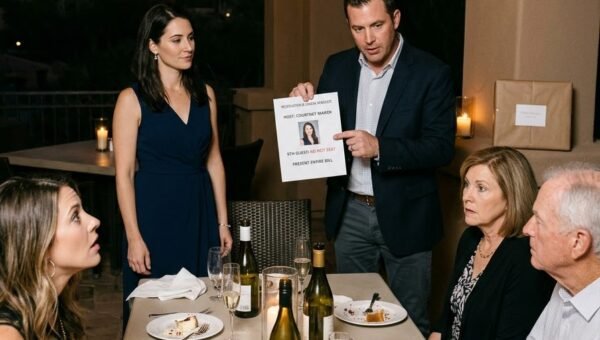
I didn’t run. I didn’t raise my voice. My phone was still in my hand, and my fingers were tight around it. The laughing stopped when I reached the doorway. Michael had a glass in front of him. Olivia was sitting beside him, and David and Jessica were across the table. For a second, none of them said anything.
Then Michael looked past me toward the living room.
“What happened?” I asked.
“You know what happened,” Sarah said from behind me. Her voice was thin, but she’d gotten up off the floor. She was holding a dish towel to her eyebrow.
Michael pushed his chair back. “Dad, she slipped.”
“Don’t,” I said.
He stopped moving. I turned the phone so they could see the photos I’d just taken. I didn’t hand it over. I didn’t want anyone touching my phone or the folder in the living room.
“Sarah’s bleeding,” I said. “The forms are right there. I called 911.”
That was the first time Michael looked at me instead of toward the living room. His face changed, but not in the way I expected. He looked more annoyed than scared.
“You called the cops on your own son?”
“I called for help for my wife.”
Olivia stood up. “This is getting out of hand.”
“It was out of hand before I got home.”
David picked up his glass, then seemed to think better of it and set it down.
Jessica had her hands folded on the table. She didn’t look at Sarah. I remember that part. I remember a little piece of parsley stuck to the edge of David’s plate, too. That’s what my mind grabbed while I tried to keep my voice level.
Michael came around the table. I stepped between him and the doorway.
“Move,” he said.
“No.”
He glanced at the phone in my hand. “You’re turning this into something it isn’t.”
I could hear Sarah behind me, breathing unevenly. The dispatcher was still on the line. I told Michael the police were coming and to stay where he was.
He gave a short laugh, the kind he used when he wanted to make me feel foolish for taking something seriously.
Then the sirens came up the street.
Michael stopped laughing.
I went back to Sarah while keeping the kitchen in view. She sat on the sofa this time, the dish towel still pressed to her eyebrow. I crouched in front of her. I wanted to take the towel away and check the cut again, but I didn’t want to make it hurt more.
“Do you feel dizzy?” I asked.
“A little.”
“Did you hit your head when you fell?”
“I don’t know. I hit the table.”
I hated that I couldn’t answer the next question for her. I was standing in our house with my phone full of pictures, trying to keep my son from walking out, and I still couldn’t tell whether Sarah needed stitches or whether she’d lost more blood than I could see.
The dispatcher asked me to unlock the front door. I did. I also told Sarah I’d stay beside her.
“Don’t let them talk you into saying it was nothing,” I said.
“I know what happened.”
“I know you do.”
The first officer came in and asked who had called. I raised my hand. He took one look at Sarah and called for medical help. Another officer went to the kitchen. Nobody shouted. The whole thing got quieter in a way that made every word feel official.
The officer asked Sarah what happened. She looked at me once, then told him.
“Michael grabbed my arm,” she said. “I pulled away and fell into the table.”
Michael answered from the kitchen. “That’s not how it happened.”
The officer told him to wait. I had never heard a stranger use that tone with my son. It was plain, not angry, and it worked better than anything I could have said.
I showed the officer the pictures on my phone. I pointed out the folder on the coffee table, the notary packet, the county recorder forms, and the deed draft. I did not pick them up. He took pictures of the papers and the pen where it lay.
“Were you trying to get her to sign these?” he asked.
Michael said, “We were talking about the beach house.”
Sarah was on the sofa, still pressing the towel to her face. “You were trying to make me sign it.”
“It was a business idea,” Michael said.
“Not my business,” I said.
The officer asked everyone to stop talking over one another. I was glad he did. I had spent those few minutes in the kitchen thinking I’d be able to keep the whole thing under control if I just stayed calm. I wasn’t in control of it. I could only keep from making it worse.
One of the officers asked Michael to come into the living room. He looked at me as he passed.
“Are you really doing this?”
I didn’t answer. I was afraid I’d say something I couldn’t take back. The officer asked him to sit and tell his version. Michael said he had reached for Sarah’s arm because she was walking away with the papers. He said she stumbled. He said he never meant for her to hit the table.
Sarah said, “You held on after I told you to let go.”
Nobody rushed to fill the space after that.
The officers took separate statements. They asked Olivia and her parents what they had seen. Olivia said she’d been in the kitchen and hadn’t watched the whole thing. David said they’d come over to discuss a possible investment. Jessica said she didn’t know Sarah had been hurt until I walked in.
I couldn’t prove what each of them had seen from the kitchen. I could prove what I’d found: Sarah injured, the documents open, the pen beside them, and the laughter that stopped when I said I’d called for help. Sarah’s account was clear. I kept my own part to what I had seen and heard. I didn’t need to make it bigger.
An EMT checked Sarah and said she should get examined at the hospital because of the cut and the dizziness. She agreed. I went with her. Before we left, the officers told us they were still gathering statements and would follow up about the incident. They didn’t promise me an arrest or a court result, and I didn’t ask them to. I wanted them to write down what happened. I wanted the record to be there whether Michael liked it or not.
At the hospital, Sarah got stitches above her eyebrow. The doctor said the cut was deep enough that it needed them, but she was otherwise alert and able to answer questions. I sat beside her while she gave the nurse her name and the date. There was a little line of dried blood near the collar of her blouse. I wanted to wipe it away, but it wasn’t my job to do that while someone was asking her questions.
When the nurse left, Sarah looked at me.
“I’m sorry.”
“For what?”
“For making this happen in our house.”
“You didn’t make him grab you.”
She looked down at her hands. “I should’ve stopped pushing back.”
I knew what she meant. She’d refused to sign, and part of her was trying to make that refusal sound like a mistake. I nearly said that none of this was her fault, full stop. Instead I took her hand and told her I was glad she hadn’t signed.
That night, our home felt too quiet. The paperwork was still where it had been when I took the photos, but I locked the front door and put the folder in a drawer. I didn’t sign anything. I didn’t tear anything up. I wanted every page left in the same condition until we had advice from someone who knew property law.
The beach house belonged to Sarah. It had come from her mother, and the idea that we could lose it in one bad conversation was enough to make me sick. So I made calls the next morning. We asked a lawyer to review the documents and to tell us what steps would keep the property from being transferred without Sarah’s consent. Until we had that advice, there would be no sale and no deal with David’s restaurant.
Michael called twice. I didn’t answer. Olivia texted that the family had misunderstood each other. I saved the message. I wasn’t doing it to punish her. I had learned in one evening that people can remember the same room very differently, and I didn’t want to rely on my memory alone.
A few days later, Sarah and I spoke with the lawyer. She explained what the papers appeared to be and what they didn’t do. Nothing had been signed, and the deed had not been transferred. The beach house was still Sarah’s. We made sure any future questions about it went through the lawyer, not through Michael or David.
I felt relief, but it wasn’t the kind that lets you sleep well. I kept thinking about my son sitting at our kitchen table while Sarah bled in the next room. Then I’d get mad at myself for thinking of him as a boy, because he wasn’t a boy. He was a grown man who knew exactly how to reach her and had chosen to do it anyway.
I also knew I had no clean way to tell him that. There was no sentence I could say that would make him my son and the man who hurt Sarah at the same time without changing either fact.
About a week later, I met with my sister and two other relatives. Michael and his in-laws weren’t invited. I didn’t call it a family meeting. That would have sounded like we could vote on what happened.
I told them why I wanted to speak. I said Sarah was safe at home, the property was protected while we got advice, and the police had taken statements. I asked them not to carry messages between us or pressure Sarah to forgive Michael.
My sister said, “He’s still your son.”
“I know,” I said.
“He made a bad choice.”
“He hurt his mother.”
She looked down at the table. I wasn’t trying to cut Michael out of the family forever. I also wasn’t going to treat this like a bad choice about a car or a job. I said he would not come into our home unless Sarah agreed, and he would not discuss her inheritance with either of us directly. If he wanted contact, he could start by taking responsibility and respecting those limits.
Nobody had a magic answer. I didn’t expect one.
Michael eventually sent a message asking to talk. He wrote that he’d lost his temper and that he hadn’t meant for Sarah to get hurt. I read it twice. It was the first time he’d admitted he’d lost his temper, but it still didn’t say he was sorry for grabbing her. I didn’t answer that night.
I showed Sarah the message the next day. She read it, gave the phone back, and said she wasn’t ready to speak with him. I told her that was enough for now. She didn’t owe him a quick answer just because he had sent one.
The legal questions took longer. The immediate danger had passed, but that didn’t mean the family part was fixed. Sarah still checked the front door when a car slowed outside. I started putting my phone on the table when we ate, which she said was unnecessary. I kept doing it for a while.
One Friday afternoon, we sat in the living room. The bakery box was long gone, and the wine bottle had never been opened. Sarah’s stitches were healing. The rug still showed the dark mark where her blood had landed.
She asked if I was going to have it cleaned.
“I don’t know,” I said.
“Me neither.”
I sat beside her, close enough that our knees touched. I wanted to say we’d get past it. I didn’t know if that was true, and I didn’t want to make her carry my optimism on top of everything else. So I stayed there.
The rug stayed under the sofa, with the stain still in it.