The study was the one room Grandpa kept neat without making a point of it. The desk had a stack of mail squared to the edge, his reading glasses sat beside a yellow legal pad, and there was a faint smell of the peppermint tea he drank when his stomach was bothering him.
I opened the door and saw Evelyn Vance and Robert Hayes at the desk. Evelyn had a folder open in front of her. Robert was holding a document with both hands.
My parents had come up behind me, close enough that I could hear Mom’s handbag buckle click against the doorframe.
Dad stopped. “What’s this?”
Evelyn stood. “I’m Evelyn Vance, Mr. Sterling’s attorney. This is Robert Hayes, the successor trustee.”
Mom looked at the papers, then at me. “Why are they in here?”
“I asked them to be,” I said.
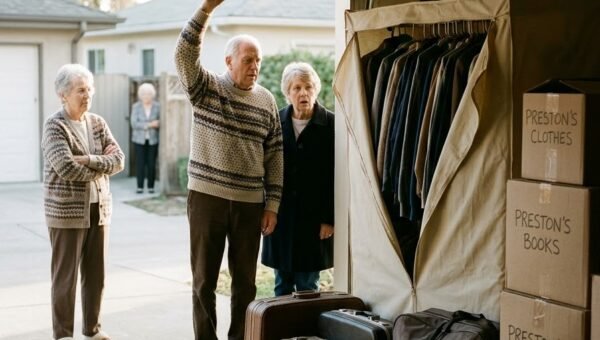
It came out steadier than I felt. I’d been standing in that hallway with the same family who had left me at Grandpa’s house when I was five. They had a moving truck outside and two black garbage bags waiting for me to fill.
I had no idea what the papers said. I only knew Grandpa had told me to let them talk, then open his study.
So I let Evelyn do the talking.
She told my parents the house was held in a trust Arthur had set up years earlier. She said she and Robert were there to go over his instructions and make sure nobody removed property before the estate was settled.
Dad reached for the paper in Robert’s hands. Robert pulled it closer to his chest.
“Don’t touch that,” Evelyn said.
Dad gave a short laugh. “I’m his son.”
“And I’m the trustee,” Robert replied. “We’ll go through the documents together.”
For a moment, nobody moved. From upstairs, I heard Chloe shift something across the floor.
I remembered the sound because it was the same scrape Grandpa’s chair made when I pulled it out for him at dinner.
Evelyn asked everyone to come into the study. Mom said she didn’t see why we needed an audience. Dad said he had a right to know what was going on. Evelyn answered that he would know, but not by ordering movers to clear the house before the trust was reviewed.
That was when Dad looked at me.
“You set this up?”
“No,” I said. “I called Evelyn after you texted that you were coming to clear the house.”
“I said we’d be there to sort things out.”
“You said clear it.”
Mom made a little noise, like she was annoyed I’d repeated his exact words.
I could feel myself wanting to make the moment easier for her. That was an old habit. I’d learned early that if I was pleasant enough, grown-ups might not leave again.
They had left anyway.
Evelyn read the first page aloud. Grandpa’s trust owned the house. I was the named beneficiary. The trust directed that the house transfer to me after his death, subject to the final paperwork and the usual steps for recording the transfer.
Dad shook his head before she finished.
“That can’t be right.”
Evelyn turned the document so he could see the signatures. “It is right.”
He stepped closer. “My father would have told me.”
“He was not required to tell you,” Evelyn said.
Mom sat down on the chair by the wall. She took off her sunglasses and folded them in her hand. I kept looking at the arms of the glasses. They were a little bent, like she’d sat on them before. I don’t know why that’s what I noticed.
Dad looked at the trust again. “She’s twenty-two. She can’t manage this.”
“I can manage a house,” I said.
He stared at me as if I’d interrupted a grown-up conversation.
Evelyn explained that Robert would handle the trust’s final steps. I’d have to sign some documents, and the county would need to record the transfer. It wasn’t happening by magic that morning, but the trust’s instructions were clear. My parents had no right to move in or take the furniture.
Dad said the house had been his father’s. Evelyn said that didn’t make it his.
Then she opened the folder and took out an envelope with my name on it. It was Arthur’s handwriting. I knew the long M he used because he wrote my name on birthday cards and notes for the lunch I took to school.
“This was left with the estate papers,” Evelyn said. “Arthur asked me to read it if your parents came to claim the house.”
I didn’t like that sentence. It made the whole morning feel planned in a way I hadn’t wanted to think about. Grandpa had known they might come. He’d had time to prepare for them, even while he was sick.
Evelyn asked if I wanted her to read the letter aloud.
I said yes. My voice cracked on the word, so I cleared my throat and said it again.
She read that Arthur had taken me in after my parents left, and that he had tried to keep the door open for them to come back into my life. He had called. He had written. They had not answered or followed through. He wrote that he didn’t know all the reasons they had left, and he wasn’t going to pretend he could speak for them.
That mattered to me. Grandpa could have made the letter sound like a courtroom closing argument. He didn’t.
He wrote that he had loved me as his granddaughter, not as a replacement for anyone. He’d made the trust because he wanted me to have a secure place to live and the choice to decide what came next. He didn’t want the house to become a prize my parents could take just because he was gone.
Mom said, “We were struggling back then.”
I turned to her. “You said you’d come back Sunday.”
She pressed her lips together.
Dad walked to the desk. “This is family business. We can discuss it without the lawyer.”
Evelyn put the letter down. “The trust is family business. It’s also a legal matter.”
I was relieved she said it. I was also embarrassed that I needed her there to make my parents listen.
Mom looked at me. “I thought he’d let us work things out.”
“Work what out?”
She didn’t answer right away. That silence was different from the one I’d spent years trying to fill as a kid. Back then, I used to make up reasons for them. They were busy. They had car trouble. Maybe they’d call next week. Now I was old enough to know that a person could keep choosing not to call.
Mom finally said, “We thought you were better off with him.”
I heard the words, but I didn’t know what to do with them. Maybe she believed that. Maybe she was trying to make herself feel less guilty. It didn’t change what it was like to sit at the front window in my yellow dress, waiting past Sunday.
“You never came back,” I said.
Dad snapped, “We’re not doing this.”
Evelyn closed the folder. “That’s enough for now. The moving company needs to be told not to remove anything.”
Dad stepped into the hall and called someone. He spoke in a low voice, then came back and said the movers would wait while he figured out what was going on.
That was not the same as apologizing. Still, it meant Grandpa’s furniture was staying where it was.
I found Chloe upstairs in Grandpa’s room. She had opened the closet and was pulling out a stack of sweaters. One of them had a loose thread at the cuff. Grandpa used to rub it between his fingers when he was thinking.
“Stop,” I said.
She looked at me. “I’m just checking what’s here.”
“You said you were taking the room.”
“I didn’t know about the trust.”
“You didn’t ask.”
She dropped the sweater onto the bed. “Maya, I haven’t seen this house since I was a kid.”
“You were older than me.”
“I was a teenager. Mom and Dad made the decisions.”
I didn’t have a neat answer to that. Chloe hadn’t left me there herself. She was a kid too. But she had come into the house and claimed Grandpa’s room like it had been waiting for her.
“I’m not saying you made the decision,” I said. “I’m saying you can’t throw his things out.”
“I wasn’t going to throw everything out.”
“You asked Mom if you could toss his books.”
She looked down at the sweater. “I don’t know what you want me to say.”
I didn’t either. I wanted her to remember me as a little girl. I wanted her to have missed me. I wanted her to tell me she’d thought about calling, even if she hadn’t. But standing there, I could tell I was trying to get something from her she might not have.
“Leave his things alone,” I said. “That’s what I want.”
She nodded once and put the sweater back in the closet. She didn’t apologize. I didn’t ask her to.
When I went back to the study, the moving crew was still outside. I could see one of them through the front window, waiting beside the truck with his hands in his pockets. Nobody had told him the job was canceled yet.
Robert explained the next steps to me. The trust owned the house, and the paperwork naming me as beneficiary had been signed and witnessed before Grandpa got too ill to manage things himself. Evelyn would handle the filing. Robert would keep an inventory of the property until the transfer was done.
Dad interrupted twice to ask whether he could challenge it. Evelyn told him he could speak with his own lawyer, but he couldn’t use that possibility as permission to take the house or its contents.
The plainness of it helped. There wasn’t a hidden fortune, or some big trick. There was a trust, a will, and a record of what Grandpa wanted. My parents could be angry, but anger didn’t change his signature.
Mom sat with her sunglasses in her lap. “We didn’t come here to fight.”
Dad looked at her. “We came to get what was ours.”
The words hung there. Mom stared at the floor.
I could have asked why they’d decided to come now, after the funeral. I could have asked why they hadn’t called me on my birthday, or why they’d never sent a Christmas card. The questions were still in me, but I was beginning to understand that I might not get answers that made the years feel different.
I had spent most of my childhood trying to be good enough to bring them back. That morning, I realized I still wanted them to explain themselves, but I didn’t have to wait for an explanation before I could decide what to do.
“I’m staying in the house,” I said. “The trust is clear. You can’t move in, and you can’t take Grandpa’s things.”
Dad’s jaw tightened. “You’re making this ugly.”
“I didn’t bring a moving truck.”
Mom flinched at that. I felt bad almost at once, which annoyed me. I didn’t want to spend the rest of my life measuring every honest thing I said against whether it might upset her.
Evelyn asked my parents to leave the study while she went over the paperwork with me. Dad said he wasn’t leaving until he understood the whole thing. Robert reminded him that he had been given the main terms and could have his own attorney review the copies.
After another minute, Dad walked out. Mom followed. Chloe stayed upstairs, quiet.
The truck crew got the message to leave. I watched the driver climb in and back down the driveway. The engine noise went away. I thought I would feel relieved. I did, some. I also felt like I’d just watched the last chance for a normal family morning pull out of the driveway.
That wasn’t fair to the morning. It had never been normal.
Evelyn and Robert stayed to explain the details. The house would take time to transfer into my name, and I’d need to keep up with taxes, utilities, and repairs. Grandpa hadn’t left me a pile of money to make those things easy. His trust gave me the house, not a life without bills.
I was glad she said that plainly. I didn’t want to hear that I’d won some contest. I had a house to care for, and I’d have to figure out how to do it.
“What if they challenge it?” I asked.
“They’re allowed to talk to a lawyer,” Evelyn said. “That doesn’t undo the documents. I can’t promise they won’t make things difficult, but I can tell you what the trust says.”
Robert gave me a list of what to do first. Keep the utility bills in my name. Don’t sign anything my parents brought. Call Evelyn if anyone tried to remove property. It was ordinary advice, which somehow made the whole thing feel more real.
After they left, I went upstairs and found Chloe sitting on the edge of the bed. The sweaters were back in the closet. Grandpa’s books were still beside the bed, and his glasses were still on the nightstand.
“I’m leaving with Mom and Dad,” she said.
“Okay.”
“I’m sorry I said I was taking the room.”
I nodded. I didn’t tell her it was fine. It wasn’t, exactly. But I didn’t need to turn her apology into something bigger than it was.
She asked if she could take one of the old family pictures from the hall. I said yes. It was a picture of the three of us as kids, before they left. I didn’t know if she wanted it because she missed that time or because she wanted something to carry home. Either way, she was allowed.
Mom came to the doorway and asked if we could talk alone. I said not today.
She looked like she might argue, then she noticed Evelyn’s folder tucked under my arm.
“I didn’t know he’d made those arrangements,” she said.
“You didn’t ask.”
“I know.”
It was the closest thing to an apology I got that day. It was not enough to make me feel better, and I didn’t tell her it was. She said she would call later. I told her I wasn’t making any promises about answering.
Dad was waiting downstairs. He didn’t say goodbye. He told me I was making a mistake by choosing the house over family.
I answered, “This is my home.”
He shook his head and walked out. Mom went after him. Chloe followed with the picture held against her coat.
I locked the door after them, then stood with my hand on the knob for a while. I had locked that door before, of course. I just hadn’t ever thought of it as mine to lock.
The next few weeks were paperwork and phone calls. Evelyn filed what needed filing. Robert kept track of the trust property. My parents did not return with another truck. They didn’t call every day, either. I had a short conversation with Mom twice, both times about documents. Dad sent one text asking when he could pick up some things. I told him to talk to Evelyn first.
There was no grand reunion. No sudden confession that made the past make sense. I stopped expecting one.
I began figuring out the house expenses. I made a list on the yellow legal pad Grandpa had left on his desk. The first month, I had to call the utility company twice because I didn’t understand one of the bills. I also learned that the loose kitchen cabinet door needed a new hinge, and that Grandpa had kept spare screws in an old jam jar in the basement.
The house was not a gift that solved my life. It was work, and a place to sleep, and the rooms where I’d learned what it felt like to be cared for. I chose to stay.
The trust transfer went through. Evelyn sent me the recorded paperwork, and Robert helped make sure the house and its contents were listed properly. My parents had a chance to contest the estate through the proper channels. They didn’t. After that, they couldn’t make me leave or claim the house as theirs.
I didn’t have to shout to get that answer. I just had to stop treating their certainty as proof.
Chloe texted once to ask if I’d found a small photo album from the hall closet. I found it under a stack of old school papers and mailed it to her. She sent back, “Thanks.” I typed out three different replies, then settled on, “You’re welcome.”
That was as far as we got.
I still went into Grandpa’s study most days. At first I kept the door open because closing it felt wrong. I moved slowly. I didn’t want to turn the room into a shrine, but I didn’t want to clear it out either. I kept his legal pad on the desk and his glasses beside it.
Sometimes I sat in his chair and got mad that he had known what my parents might do and had been too sick to stay and see me through it. Then I felt guilty for being mad. Both things could be true. He had protected me as much as he could, and I still wished he had been there when I opened the door.
A month after the transfer, I found the letter Evelyn had read tucked inside the folder. The paper had a crease through the middle. I had read it once in the study, with my parents waiting in the hall and the moving truck outside. I wanted to read it again when nobody was rushing me.
I sat at Grandpa’s desk. His glasses rested by my hand. The house was quiet, except for the refrigerator starting up in the kitchen.
The letter didn’t tell me why my parents had left in a way that made their choice acceptable. It didn’t give me a missing piece I could fit into the years. Grandpa wrote that he had asked them to come back, and that they’d chosen not to. He wrote that he’d never wanted me to believe their absence was something I had caused.
Near the bottom, he had added one line in his uneven handwriting. I read it once, then again.
“You were never the one who left.”