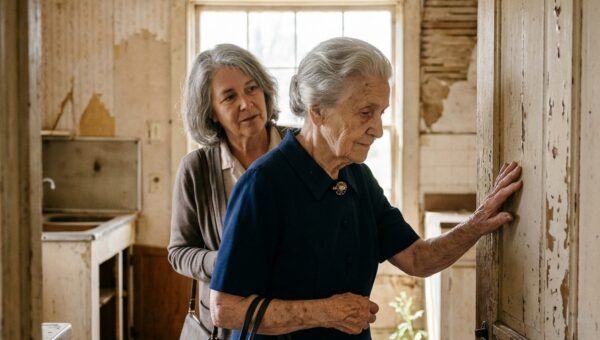
I was more afraid of moving into that house than I was of losing Nolan.
That was the part I had to admit to myself. I loved him, and I still wanted the life we’d talked about. But I kept picturing my things disappearing one reasonable decision at a time, each one made before I could say no.
Nolan came over the next evening. He brought the lease application in a folder, the same one he’d used when we first looked at the house.
He set it on the coffee table, then sat on the edge of my couch instead of straightening the cushions like he usually did.
“I want to talk about the application,” he said.
“I figured.”
He looked at the piano. “I know I handled that badly.”
I waited. He’d apologized before, but the apology had always come with a reason. This time he seemed to notice I wasn’t going to help him finish the sentence.
“I thought I was solving a problem,” he said. “I thought the arts center was a better place for it.”
“You thought you could decide that for me.”
He rubbed his thumb along the folder’s edge. “Yes. I did.”
That was more than he’d admitted the day before. It wasn’t enough to make the whole thing small.
I asked him why he’d chosen that way to handle it after we’d already agreed on the downstairs study. He said he’d been trying to picture the house and kept seeing the piano taking over the room. He said he’d convinced himself that if it was going to help children, giving it away was the sensible answer.
I told him I already help children. I told him my students come to my apartment and sit at that piano. He knew that, of course. He said he did know, but he’d started thinking of the instrument as a large thing in the way of the home he wanted.
“Not a piano,” I said. “My piano.”
He nodded, but I could see he was still trying to make the facts fit his rules.
“I’m not saying the piano is more important than us,” I said. “I’m saying you don’t get to decide what matters to me.”
“I hear that.”
“Do you understand it?”
He looked down at his hands. “I’m trying to.”
I didn’t take that as a promise. I also didn’t take it as nothing.
The next few days were quiet. We texted about ordinary things, which felt strange after what had happened. Nolan asked if I’d eaten after a long day at school.
I sent him a picture of a student’s crooked music stand, the leg held together with tape. He sent back, “That’s going to be a long week.”
We were still us, in some ways. That made the decision harder, not easier.
On Saturday, my aunt called to ask how things were going. I told her Nolan had come back, and that I still didn’t know what to do. She didn’t tell me to leave him. She didn’t tell me to stay.
“What did you say you wanted?” she asked.
I had been thinking about her question since she left. I didn’t want to make a speech, but I wanted to be able to say the answer without checking Nolan’s face first.
So I wrote it down. Not a list of furniture. The feeling.
When Nolan came over that Sunday, I asked him to sit at the kitchen table. I put my notes beside the folder. My handwriting was messy. I’d crossed out “welcoming” and written it again because the first version looked too much like a school assignment.
“I want people to be able to drop by,” I said. “I want the kids I teach to feel like they can make a mistake and try again. I want music in the house. I want books where I can reach them.”
Nolan listened without interrupting. I had expected him to point out how much space the books would take. He didn’t.
“I don’t need every room full of things,” I went on. “But I don’t want to feel like I have to prove everything I own is useful enough to stay.”
He glanced at the notes. “I never thought of it that way.”
“I know. That’s why I’m saying it.”
He said the house felt calmer to him when there was less in it. He said he’d grown up in a home where every surface had something on it, and he’d hated feeling like he couldn’t rest. That was the first time he’d told me that plainly. I felt bad for not knowing. Then I felt annoyed that he’d used that old hurt to make rules for both of us.
“I’m not asking you to live in my apartment,” I said. “I’m asking you to make room for me in a place that’s ours.”
He looked at the paper for a long time. Then he said the piano could go in the study. He could accept a few shelves, if we agreed on where they went. He said the spare room didn’t have to be only for meditation.
It was a start. It was also a start after he had already ignored the clearest boundary I’d given him.
“Those are things we can talk about,” I said. “The piano isn’t up for another vote.”
“I understand.”
“And neither is who gets to decide about my things.”
He nodded. “I won’t arrange anything like that again.”
I wanted to believe him. I really did. But I didn’t want to sign a lease just to find out whether he meant it.
I asked what would happen the next time we disagreed about something that wasn’t a piano. He said he didn’t know, but he’d have to ask instead of acting. He didn’t say he’d suddenly love my books or stop caring about every crowded shelf. I appreciated that he didn’t pretend.
“I can make room for your things,” he said. “I don’t know if I’ll ever feel the same way about them that you do.”
“I’m not asking you to feel the same,” I said. “I’m asking you to respect that I do.”
He looked at the lease folder. “So do we move forward?”
I could hear how much he wanted me to say yes. I also knew how easily I could say it just to stop the conversation from hurting.
“No,” I said. “Not now.”
His mouth tightened. He looked back at the piano, then at me. “Are you ending this?”
“I’m not ready to end our relationship. I’m not moving in with you either.”
He asked if I was sure. I said I was sure about the lease. I wasn’t sure about everything else, and I didn’t want to lie just to make him feel better.
We withdrew the application together. We hadn’t signed a lease, and we knew we might lose the holding deposit. Nolan asked if I wanted him to contact the landlord. I said I’d rather do it together, so nothing got decided for me again. He agreed, and we sent the message side by side at my kitchen table.
It felt like a small thing. It wasn’t.
We agreed to keep seeing each other, but without another move-in date hanging over us. I told him I needed time to see how he handled ordinary disagreements, not just this one. He said he understood. I didn’t call that forgiveness. I called it room to find out.
Nolan left the folder with me. I set it on a shelf, then moved it because I didn’t want to see it every time I walked past.
That night I sat down at the piano. My aunt had taught me the same warm-up scale so many Saturdays that I can still hear her counting when I start. I made it through the first few notes, then hit one wrong and stopped.
I tried again.
My eyes filled before I got to the end. I wasn’t crying because the house was gone. I was crying because I’d finally said what I wanted without asking permission to want it.
The piano stayed where it was. Nolan and I stayed in separate homes. I didn’t know what that meant for us a year from then, but I knew I wasn’t going to trade my home for a promise that had not yet been kept.
I played the scale again, and this time I let the wrong note stay.