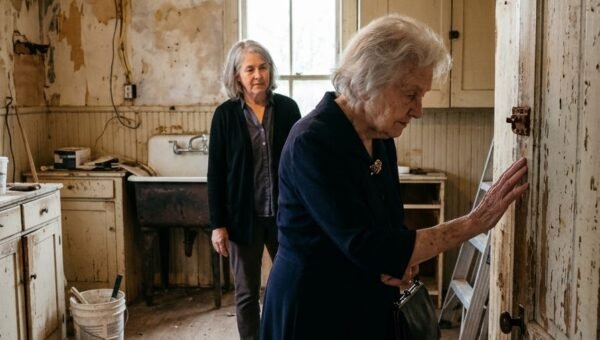
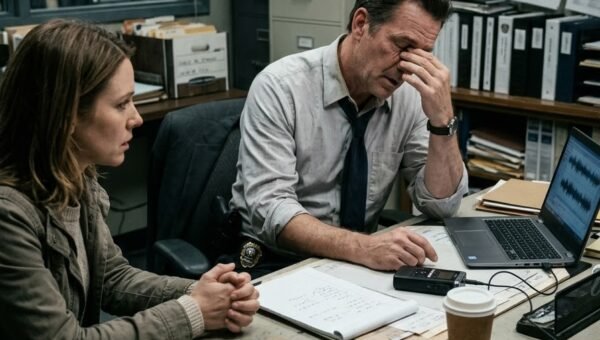
I thought Wyatt was working himself to the bone for us. That Tuesday, I walked into Saint Ambrose Memorial Hospital with his favorite lunch, still believing every late night had an ordinary explanation. I had roast beef on sourdough, kettle chips, and a slice of peach pie in a brown bag. Under the fork, I’d tucked a note that said, “You don’t have to take care of everyone. Let me have a turn.” I was already picturing him smiling when I saw Beth at the nurses’ station. Her smile vanished before I could finish saying hello.
Wyatt and I had been married eleven years. He was a surgeon, and I knew the job could swallow a day without asking permission. I wasn’t naïve about it. There were patients who needed him, shifts that ran long, and emergencies that didn’t care if it was Thanksgiving. I was proud of him. But for the past year, I’d been putting his dinner away before I sat down to eat mine, and telling myself that was what marriage to a surgeon looked like.
He missed Thanksgiving. Then our anniversary. Then Maisie’s eighth birthday. Maisie had made a card with a crooked cake drawn on the front and left it beside his plate until bedtime.
Wyatt called from the hospital and said he was sorry. She told him it was okay, because she was eight and wanted it to be okay. I was less generous, at least inside my own head. Still, when Wyatt came home looking worn out, I swallowed what I wanted to say. I knew how long his days could be, and I didn’t want to be one more person asking something from him.
“We’re short-staffed, honey,” he’d say. “Please don’t stay awake waiting for me.”
I believed him. Or maybe I needed to. When he finally got into bed, he was so tired that even turning toward me seemed like work.
He started keeping his hands in his pockets at home. I noticed, but I didn’t ask. I made excuses for him because I thought that was the kind thing to do. A marriage can get into a bad rhythm one small excuse at a time.
One night, I woke and saw him sitting on the edge of the mattress. His shoulders were trembling. I remember the little click from the radiator, which is an odd thing to hold on to, but I do. I asked him what was wrong. He wiped his face fast and said it had been a rough night, then told me to go back to sleep.
I reached for his hand. He let me touch it for a second, then gently pulled away and stood up.
I should have asked him to sit back down. I should have said I knew something was wrong and I wasn’t going to accept “rough night” as an answer. Instead, I watched him walk out of the room. That was easier. At the time I called it giving him space. It wasn’t. I was scared of hearing something I couldn’t fix, so I helped him keep quiet.
That Tuesday, after he left for work with his hospital badge clipped to his pocket, I decided to surprise him. I made his favorite lunch and packed it carefully, though the sandwich was already getting warm by the time I crossed Indianapolis. I put the pie in a little plastic container and slid the note beneath the fork. It was a simple thing. I wanted him to feel looked after for once.
At Saint Ambrose, I saw Beth and asked where Wyatt was. I told her not to warn him because he’d say I’d gone to too much trouble. She glanced at the nurse beside her, and neither of them answered. I tried to smile through it. Then I asked if something had happened. Beth looked down at the counter.
“Where is my husband?” I said.
Luke was walking toward me from the hall. He was Wyatt’s closest colleague, and we’d known each other for years. He moved slowly, which felt wrong before I understood why. I raised the bag and asked him to tell me where Wyatt was. Luke looked at the bag, then at me. Tears gathered in his eyes.
“He hasn’t told you anything, has he?”
The bag slipped in my hands. I tightened my grip and asked what he meant. Luke looked toward Beth, then back at me. He said Wyatt wasn’t in surgery. He was upstairs, in a hospital bed. For a second, all I could think was that I’d driven across town with a sandwich while my husband was sick somewhere in the building.
I told Luke to take me to him. He started to say he could explain in the family lounge, but I cut him off. I didn’t want a chair and a cup of water. I wanted to know where Wyatt was, and I wanted to hear it from him. Luke nodded and led me away from the surgical floor.
We passed the doors to the operating rooms. I knew that hallway. I’d waited there before, tapping my foot, looking at the clock, trying not to text Wyatt while he was working. Luke didn’t take me toward the operating suites this time. He led me past them toward the elevators and the step-down wing. My lunch bag brushed my leg with every step.
“Is he hurt?” I asked.
“He collapsed,” Luke said. “He’s awake now.”
“From what?”
Luke took a breath. He said Wyatt had been admitted after fainting in the basement administrative wing. He’d been dehydrated and exhausted, and his medication had just been adjusted. Luke gave me the short version, the way people do when they’re trying not to say too much. It still wasn’t enough. I asked what medication. He said he didn’t know how much Wyatt had told me, then stopped himself.
The elevator doors closed. I looked at Luke’s hands. He had them clasped in front of him, tight enough that his knuckles pressed together. I asked if Wyatt had been operating that morning. Luke said no. Then, because I wasn’t letting it go, he said Wyatt hadn’t held a scalpel in ten months.
I thought I’d heard him wrong. “What do you mean, he hasn’t operated?”
Luke told me Wyatt had given up his surgical privileges. He said Wyatt’s name had come off the call board months ago, and that the hospital had moved him into chart review, research, and case consultations. He said Wyatt had asked them not to tell me. Luke had kept that promise longer than he could live with, but he still didn’t tell me everything in the elevator.
“He made us promise,” Luke said. “I thought he’d tell you himself.”
The elevator opened, and the words kept running through my mind. Ten months. His name removed from the call board. All those nights I thought he was in surgery, or on his way to a surgery, or being pulled into one more emergency. My brain went back through the year and started changing the labels on things. Missed dinners. Missed holidays. His hands in his pockets. The night on the edge of the bed.
The doors to Room 412 were open. I saw Wyatt before I saw anything else. He was awake against the pillows, wearing a hospital gown with an IV taped to his arm. His face looked tired in a way I’d never seen at home. His right hand lay on the sheet, trembling hard enough to make the fabric twitch.
I stopped just inside the doorway. The lunch bag was still hanging from my hand. Wyatt saw me and tried to pull the blanket over his hand. He didn’t get far. I put the bag on the chair and went to the bed.
“Don’t hide your hand from me,” I said.
He closed his eyes. “I’m sorry.”
I had a lot of things I wanted to say. I wanted to ask why he’d let Maisie wait for him on her birthday. I wanted to ask how he’d looked at me across our kitchen table and let me think he was in surgery. But the first thing out of my mouth was, “What happened?”
Wyatt told me he’d noticed a tremor in his hand during a complicated procedure eleven months earlier. At first he thought it was fatigue. Then it happened again. He went to a neurologist without telling me and was diagnosed with early-onset Parkinson’s disease. Ten months ago, he gave up surgery because he didn’t trust his hand not to betray him in the middle of an operation.
He said it in pieces. He looked at the wall while he spoke. He told me the tremor had started small, then gotten harder to hide. He told me he had kept his hands in his pockets at home because he didn’t know how to let me see them. He said he’d been afraid of looking like a different person to me.
“I thought if I told you, everything would change,” he said.
“Everything already changed,” I said. “You just left me out of it.”
He nodded. He was crying now, but he didn’t turn away. I kept my voice level. I’m not always good at that. In the past, I’d get sharp when I was scared, then act like the sharpness meant I was right. This time I was trying to get the truth, not win an argument.
He explained the long hours. After giving up surgery, he’d taken on chart reviews, clinical research, and case consultations at the hospital. He’d also been working on disability filings and grants for an endowment scholarship fund. He wanted Maisie’s college money protected. He wanted the mortgage covered if his health got worse. He was trying to put everything in place before he told us.
He’d convinced himself this was love. He was ashamed of losing the work that had been his whole life, and he was scared of what Parkinson’s might take from him next. He said he didn’t want me to have to watch him struggle while also worrying about money. So he worked longer, slept less, and came home to us carrying the secret like another shift he could finish alone.
“I thought I could get it all settled first,” he said.
“How long were you going to wait?”
He didn’t answer. Maybe he didn’t know. His new medication had been adjusted, and he’d been pushing through the side effects instead of telling anyone he was exhausted. That morning he’d collapsed in the basement office. The doctors were keeping him overnight to give him fluids and sort out his medication. Luke and Beth had watched him hide the illness for months. They’d also watched me bring lunch through the hospital doors, still thinking he was at work as a surgeon.
I sat down beside him. The sandwich was still in the bag. The note was still tucked under the fork. I took both out and set them on the tray. Wyatt’s eyes landed on the pie first, then the note.
“You wrote this for me?” he asked.
I nodded. He lifted his right hand, but the shaking made it hard to reach. I picked up the note and placed it in his fingers. He looked at the words for a while. His mouth moved once, but no sound came out.
I told him I was angry. I told him I was hurt. I told him that I wasn’t going to punish him for being sick, but I wasn’t going to pretend this secrecy had protected us. I said eleven years of marriage wasn’t an audience watching him stay invincible. It was two people carrying the load together, even when one of us was scared and didn’t know what came next.
Wyatt began to say he was sorry he’d failed as our protector. I stopped him there. I told him he hadn’t failed by getting sick or by losing surgery. He’d hurt us by deciding on his own that we couldn’t bear the truth. Those were not the same thing.
He cried without pulling his hand away. I’m not saying I felt better right then. I didn’t. I had to sit with the fact that my husband had been grieving beside me while I took his silence for distance. I’d been trying to be patient, but patience had turned into a reason not to ask him anything hard.
I took his trembling hand between both of mine. He let me hold it. I could feel each small shake against my palms. For once, he didn’t try to tuck it away.
We talked about what happened next. He was staying overnight. His neurologist would review the medication and make a safer plan. The disability paperwork and the financial plan were not going to stay hidden in a binder on the bedside table. We would go over them together. Wyatt agreed to accept a permanent daytime faculty and consulting position at the hospital’s medical school. He wouldn’t keep working himself into the ground to prove he could still be useful.
It wasn’t a happy ending. Parkinson’s didn’t disappear because we finally said its name out loud. Wyatt’s hands still shook, and there would be hard days ahead. But he agreed to tell me when he was afraid. I agreed to ask instead of filling in the blanks with the answer that hurt least at the time.
Before we left the room for the evening, we called Maisie together. Wyatt told her he was in the hospital and that he had a sickness that made his hands shake. He said he’d be home when the doctors were ready to let him go. Maisie asked if he could still read her bedtime book. He said yes. I knew we’d have more to explain, but we weren’t going to make her carry a mystery the way I had.
Wyatt tried a bite of the roast beef sandwich. He said it was good, though the bread had gone soft from the drive. He ate some of the peach pie, slowly, and I kept my hands around his trembling fingers as he did. The note was still there beside the fork.
His hand shook against both of mine, and neither of us let go.