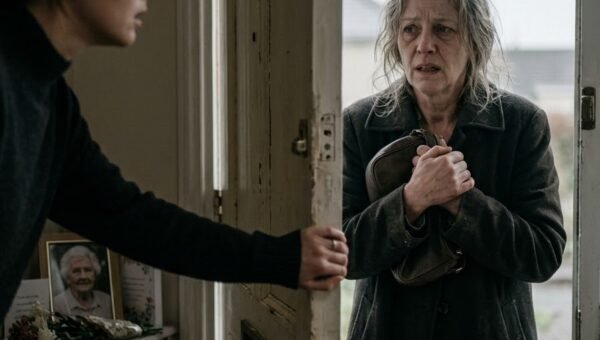
The cedar floorboards of the Grandview foyer held a very particular kind of dry, varnished chill that morning, even though the thermostat by the archway had been pushed to seventy-four degrees since dawn. I remember staring down at the dark grain of the wood right near the umbrella stand while my mother talked about the market in Sarasota. She had her coffee cup cradled in both hands, the way she always did when she was about to explain why my life choices were slightly inconvenient for her social calendar.
My father was standing by the sideboard, humming something formless while he checked the cork on a bottle of sparkling wine that probably cost more than my first set of winter tires. It was Christmas Day, or at least that was what the calendar on the kitchen wall insisted, though the light coming through the leaded glass windows had the flat, gray glare of a Tuesday in November. I had driven down from the ridge two hours earlier because my mother had used that specific tone on the telephone three days ago, the one that meant she had arranged something behind my back and wanted an audience for the reveal.
“We sold your house,” my mother announced on Christmas morning. “You never use it anyway.”
My father grinned over his champagne. “$2.8 million. We even collected a fee!”
Natalie laughed. “Honestly, you should thank us.”
I was thirty-six, sipping coffee while my family celebrated selling an estate they had no right to touch. I didn’t scream or argue. I just asked, “What date did the sale close?”
Dad proudly named the day.
I checked my phone and smiled. “Perfect.”
Minutes later, the doorbell rang. Three black SUVs sat idling out front. An attorney stepped onto the porch, flanked by five men, holding a heavy folder.
Dad’s grin vanished when the attorney spoke: “Which one of you authorized the sale?”
Mom tentatively raised her hand.
“Then you’ve just admitted to something far worse than fraud,” he said, turning to me. “Ms. Peton, shall I explain who actually holds the deed, and what happens next?”
I set down my cup. “Please. They deserve to hear every word.”
The silence in the room suddenly felt heavy, thick with the smell of scorched pine needles from the drying tree in the corner. My father lowered the champagne bottle, the golden liquid sloshing against the rim of his crystal flute before he managed to set it down on the mahogany side table without spilling a drop.
His eyes darted from the tall, broad-shouldered man standing in the doorway to the two uniformed county marshals stationed just behind him on the porch. My mother’s hands began to shake slightly against her white ceramic mug, the hot liquid inside sending up a thin spiral of steam that caught the morning light. She looked at me, really looked at me, for the first time in months, her mouth parting in a confused little circle of disbelief. She had spent five years treating my home on the coastal ridge as a sort of overflow hotel for her bridge club and a convenient storage unit for Natalie’s endless collection of seasonal decor, never once pausing to consider that ownership might involve something more substantial than a spare set of brass keys left under the ceramic duck by the back porch.
Five years ago, when I bought the historic stone estate with the money from my own consulting firm and three exhausting years of eighteen-hour days, my parents had treated the acquisition as a family milestone rather than my private achievement. They had arrived with a carload of potted ferns and a box of mismatched china before the moving trucks had even cleared the cattle guard at the end of the long gravel drive. Back then, I had been foolish enough to let them keep a key for emergencies, thinking that was what normal families did when someone bought a house with an old oil furnace that tended to lock up when the temperature dropped below zero.
It took me three years of boundary-setting, two major arguments about Natalie throwing impromptu weekend parties while I was away at conferences, and one very unpleasant confrontation over my private study to realize they viewed my hard work as common property. They never called it stealing when they took things from my pantry or brought prospective buyers up from the village to admire the exposed ceiling beams in the library; they called it sharing. They genuinely believed that everything I owned was just a temporary holding deposit until they found a better use for it.
The six months leading up to this morning had been a slow, grinding escalation of financial desperation on their end, though I didn’t learn the full scope of their debts until the title alert pinged my phone three weeks ago. Natalie’s boutique in the village had gone under after she tried to expand into imported ceramics without capital, and my father had quietly leveraged his share in their primary residence to cover her commercial lease defaults, forgetting that the bank had already foreclosed on their second mortgage twelve months prior. They had come to me in November demanding I refinance my coastal property to bail out Natalie’s failing business, and when I told them no in plain, unmistakable terms, my mother had looked at me with a cold, narrowed gaze and promised that I would regret being so selfish.
I remember sitting in my kitchen on that rainy Tuesday evening, watching the water run down the windowpanes while I listened to my father shouting down the telephone line that I was ungrateful for every meal they had ever bought me. I didn’t argue with him. I simply called Attorney Vance Ward first thing the following morning and set the wheels in motion for the legal transition that would permanently remove the property from their reach.
The legal strategy had been precise, cold, and entirely airtight, coordinated with state land fraud investigators who had been keeping an eye on my father’s small-time notary business for months. Two months ago, I placed the entire historic estate into an irrevocable conservation land trust, transferring the title to a state-chartered conservatory dedicated to protecting the local wetlands and native wildlife habitats. Under the ironclad rules of the trust, the property could never be sold, subdivided, or developed by any private individual, including myself; I remained merely the appointed trustee tasked with maintaining the grounds according to strict environmental covenants.
When my father discovered the original deed was no longer in my personal name at the county recorder’s office, he didn’t check the trust filings properly. Instead, relying on an outdated photocopy of the title from five years ago and utilizing his old notary stamp, he drafted a fraudulent limited power of attorney, forged my signature with a shaky imitation he must have practiced over the kitchen table, and submitted it to an aggressive commercial development syndicate based in Chicago that had been trying to buy up the entire ridge for a luxury golf resort.
Attorney Vance Ward stepped fully into the foyer, his polished leather shoes leaving a faint trace of melting snow on the dark wood floorboards. He didn’t take off his coat, which gave him an air of permanent official business that terrified my father more than any shouting match ever could. He opened the heavy leather binder in his hands, turning past several pages of stiff blue-backed legal paper until his thumb rested on a stamped municipal seal near the bottom of a certified manifest.
“Mr. Peton,” the attorney said, his voice level and entirely devoid of holiday cheer. “According to the county recorder’s digital ledger and the wire transfer receipts subpoenaed by the state banking commission yesterday morning, you and your daughter Natalie accepted a developer’s deposit of two million eight hundred thousand dollars for a parcel of land that was already federally protected marshland. Furthermore, you personally collected a two hundred and eighty thousand dollar consulting fee, which was wired directly into a joint savings account bearing your name and your daughter’s name at four minutes past eleven on the morning of December eighteenth.”
My father’s face went a dull, mottled shade of gray, the sort of color that old plaster turns when water gets behind it from a leaking roof. He opened his mouth, closed it, and then looked frantically toward my mother as if she might somehow magic up a clever excuse out of thin air. “That was just an internal arrangement,” he stammered, his voice cracking on the final syllable. “We were handling the family assets. She was away on business. It’s a civil matter between relatives, surely. We have papers right here.”
“You have a federal felony, Mr. Peton,” Vance replied smoothly, not even looking up from his binder. “Forging a state-chartered trust instrument, executing a fraudulent conveyance of public-protected wildlife land under penalty of perjury, and accepting commercial kickbacks on an illegal title transfer cross the line from a family disagreement into interstate wire fraud and grand larceny of trust property. The U.S. Attorney’s office was briefed at eight o’clock this morning. The commercial developers have already been served with an immediate asset freeze and a federal injunction halting any demolition of the wetlands. Their acquisition contract is null, void, and legally nonexistent.”
Natalie let out a sharp, breathless gasp that sounded like a deflating tire and stumbled backward until the back of her knees hit the edge of the dining room table, sending a crystal water pitcher rocking violently against a silver bowl. “You can’t do this,” she whispered, her eyes wide and staring directly at me as if I were the one holding the handcuffs. “We used that deposit to clear the shop debts. We paid the back taxes on the village house. If you freeze those accounts, they’re going to foreclose on Mom and Dad by Monday morning. How could you do this to your own family on Christmas Day?”
I didn’t move from my chair by the fire. I simply looked at her, noting the expensive cashmere sweater she was wearing, one she had undoubtedly charged to my father’s dwindling credit lines, and felt a strange, hollow sort of peace settle into my chest. “You spent five years assuming my life was just a safety net for your bad business ventures,” I said quietly, my voice barely carrying over the hum of the refrigerator in the kitchen. “You forged my signature on legal documents, you lied to developers, and you thought you could sell my home out from under me while I was drinking coffee in the next room. I didn’t do this to you, Natalie. You built this exact room for yourselves, brick by dishonest brick, and now you’re finally going to have to sit in it.”
My mother dropped her coffee mug. It didn’t shatter against the hardwood the way china usually does; it hit the heavy wool area rug with a dull thud, spilling dark brown liquid across the cream-colored fibers in a spreading, jagged stain. She didn’t look at the mess. She took two stumbling steps toward my chair, her hands outstretched in a pathetic, pleading gesture that she must have used a thousand times to get her way out of trouble when we were growing up.
“Please,” she choked out, tears suddenly spilling over her lower eyelids and cutting tracks through her makeup. “Please, sweetheart, talk to this man. Tell him it was just a terrible misunderstanding. We can give the developer their money back. We can undo the paperwork. We’re your parents. You can’t let them arrest your father. Think of what the village will say. Think of Christmas.”
“Mother,” I said, my voice dropping an octave as I looked straight into her red, swollen eyes. “The village already knows. The state land investigators have had a file open on Dad’s shady notary practices for six months. I didn’t call them today because I wanted to ruin your holiday. I called them because the title transfer cleared at nine o’clock last Tuesday, and Vance was waiting for the exact moment the final wire hit your joint account so the state could freeze every single penny of it legally and permanently. There is nothing to undo because you never owned the door you’re standing in front of.”
Attorney Ward raised his hand, signaling the two county marshals waiting on the porch to step across the threshold and into the warm air of the foyer. The heavier of the two men, a broad-shouldered deputy with silver hair and a neat mustache, pulled a stack of stiff white documents from his belt pouch and stepped toward my father with slow, deliberate authority.
“Arthur Peton,” the deputy said, his voice deep and flat as he held out the papers. “You are hereby served with a temporary restraining order, a federal grand jury subpoena, and a notice of immediate asset seizure issued by the district court of this county. Step away from the side table, please, and keep your hands where I can see them.”
The sound of the front door clicking shut behind the marshals seemed to drain every last drop of defiance out of the room. My father didn’t reach for the papers; he just let his arms fall limp to his sides, staring down at the polished toes of his loafers as the deputy pressed the formal notification directly into his trembling hand. Natalie was crying openly now, her face buried in her hands as she slid down the edge of the dining room table until she was sitting in a crumpled heap on the floor right beside the spilled water pitcher. My mother stood frozen between them, looking like a ghost in her holiday sweater, completely paralyzed by the sudden, terrifying realization that her charm and her social standing couldn’t talk her way past a federal judge and an irrevocable trust document.
I picked up my empty coffee mug from the side table, my movements slow and deliberate, and set it down on the tray by the window. I stood up, smoothing the front of my wool sweater, and reached for my heavy winter coat hanging from the brass hook by the front door. I slid my arms into the sleeves, adjusting the collar against the cold draft blowing in through the slightly ajar front door, and pulled my leather gloves from my pocket. Nobody spoke as I zipped the coat all the way to my chin. The only sound in the room was the heavy, rhythmic ticking of the grandfather clock in the corner, marking out the seconds of a Christmas morning that none of us would ever forget.
I pushed open the heavy front door and stepped out onto the snow-dusted front porch, leaving my family behind the glass pane clutching their legal notices and staring out into the gray winter light. The three black SUVs were still parked along the curving drive, their exhaust pipes sending up faint plumes of white vapor into the crisp morning air. I walked down the stone steps, my boots crunching firmly against the frozen gravel, feeling the sharp, clean bite of the December wind against my cheeks. I pulled my car keys from my pocket, unlocked my sedan with a familiar beep, and climbed into the driver’s seat, closing the door with a solid, reassuring thud that shut out the noise of the house entirely.
As I turned the ignition and backed down the long drive toward the open road, I didn’t look back once at the porch or the people standing behind the glass; for the first time in thirty-six years, the road ahead of me was entirely my own.