The morning air in Harbor Springs had that particular bite to it that usually meant frost was holding on just a bit too long into May. I was standing at my kitchen counter with a ceramic mug of black coffee, watching the robins argue over a dry crust of bread in the grass, when the red glare caught my eye through the bay window. At first, my brain simply refused to translate the shapes. Red plastic, white block letters, stuck dead-center in my perennial garden right beside the hydrangeas I had pruned the previous Sunday.
It took me a full three seconds to process the single word stamped across it in stark white vinyl. Sold. Not pending. Not under contract. Just sold, as if the soil and timber I had poured forty-two years of my life into were nothing more than a used armchair left on the curb for trash day.
I didn’t drop my mug, though my hand tightened around the handle until my knuckles turned the color of lard. I set it down on the tile with a small, flat clink that sounded entirely too normal for a Tuesday morning that had just unmoored from reality.
The front screen door gave that familiar, loose squeak of the upper hinge, the one Dominic had promised to oil three separate Thanksgivings ago and never touched, and then the crunch of gravel on the driveway told me I wasn’t going to have to guess who had rearranged my front yard. Footsteps, heavy and hurried, came up the porch steps, followed by the clack of hard-soled shoes that belonged to my son, and the lighter, sharper click of Italian leather heels that could only belong to Amber.
The front door swung wide without so much as a polite knock, because Dominic had long since stopped pretending this house belonged to anyone whose permission he actually needed.
He came into the kitchen carrying a lightweight leather garment bag over one shoulder, looking flushed and entirely too pleased with himself, wearing that half-smile he always wore whenever he had finagled some small advantage in a used car lot or an insurance seminar. Amber drifted in right behind him, scanning my ceiling medallions and crown molding with the appraising, greedy eye of a woman who had already spent the equity on marble countertops she would ruin with lemon juice within six months. They were surrounded by three pieces of brand-new, charcoal-gray luxury luggage still bearing their paper airport tags, looking like tourists who had wandered into the wrong terminal and decided to take possession of the lounge.
“Morning, Mom,” Dominic said, tossing a set of brass keys onto my maple butcher-block island with a sharp clatter. “Hope you slept well, because the movers are coming for your bureau tomorrow morning while you’re at the intake appointment.”
I kept my hands flat on the cool tile of the counter, my fingers curled just slightly over the front edge. I didn’t turn around right away. I let the silence stretch for a beat, two beats, long enough for the smugness in Dominic’s posture to curdle just a fraction into confusion. I have lived in this county long enough to know that when a man starts giving orders in a house he didn’t build, he has usually forgotten whose name is signed on the deed at the courthouse down on Chestnut Street. Dominic shifted his weight from one foot to the other, his gaze darting toward the hallway as if he expected me to start packing my winter coats into garbage bags right then and there.
“What intake appointment would that be, Dominic?” I asked. My voice didn’t shake. It was thin, perhaps, but it had the flat, dry weight of a cellar floor.
Amber sighed, that little theatrical puff of air she used whenever she had to explain something complicated to someone she considered slightly slow on the uptake, like a teller at the bank who couldn’t find an account number. She stepped forward, her diamond tennis bracelet clicking against her watch with a sharp, expensive sound. “The Pine Ridge facility up in Traverse City, Eleanor. We went over this at Easter. You can’t possibly manage three thousand square feet by yourself anymore. The stairs alone are a liability. Dominic handled all the paperwork with the intake coordinator yesterday afternoon, and honestly, you should be thanking us. They have a very nice garden room where you can do your little puzzles.”
Dominic nodded along, his chin coming up in that defensive jut he had inherited from his father, a man who could spend his way through a hardware store payroll and then blame the register for shorting him. “The market’s peak right now, Mom. The developer offered cash, three hundred and forty thousand, firm, no inspections, five-day escrow. If we waited until winter, the rates would have chewed half of it up in holding costs. This way, your care is fully covered for the next four years, and Amber and I can finally take that holiday we’ve been putting off since our fifth anniversary. It’s a win-win. Really.”
He said it so casually, leaning his hip against my oak cabinets as if he were discussing a minor adjustment to a lawn-mower belt. “You’ll be comfortable in the nursing facility, Mom,” Dominic said casually, reaching down to straighten the lapel of his blazer in the reflection of the microwave door.
I turned around then, slowly, letting my apron strings hang loose against my skirt. I looked at the two of them standing in my kitchen, framed by the copper pots I had polished by hand every autumn since Dominic was six years old. I didn’t scream. I didn’t burst into tears, and I certainly didn’t beg them to reconsider or explain how much my hydrangeas meant to my sanity. I simply smiled. It wasn’t a warm smile, and I didn’t try to make it one. It was just the small, tight parting of the lips that people use when they watch someone step out onto thin lake ice after the first hard freeze of November.
Dominic’s smile faltered first. He looked at my mouth, then up into my eyes, and the little twitch in his left temple, the one he got whenever a blackjack dealer turned over an ace, started to throb beneath his skin. “What?” he muttered, his hands dropping off his luggage handles. “Why are you looking at like that? The papers are signed. The buyer has the title abstract. The escrow closed yesterday at noon.”
“Did it, Dominic?” I asked, my voice barely above a whisper. “Did it really close at noon?”
“Of course it did,” Amber snapped, her patience snapping like an old rubber band left in the sun. “We used the durable power of attorney you executed back when your hip flared up in twenty-eighteen. Our attorney filed the conveyance affidavit with the county recorder yesterday morning. The funds are already in the escrow holding account, and our flight to Rome leaves out of Detroit at six o’clock tonight. We didn’t come here to argue theology with you, Eleanor. We came to tell you the car is picking you up at nine tomorrow morning. Don’t make a scene about it.”
They truly believed it. They had looked at an old, folded piece of legal stationery from six years ago, a draft Dominic had badgered me into signing when I went in for outpatient bursitis, one that gave him administrative oversight for medical bills if I were unconscious, and they had convinced themselves it was a magic wand. They thought they owned the house. They thought they were entitled to the money. But they had forgotten something I had signed years before that, something so thorough and so completely locked into the county records that not even a slick off-market developer with a handful of cashiers checks could pry it loose without my living signature and a co-trustee’s countersignature.
“Have a wonderful trip to Europe, children,” I said, turning back to my coffee mug and taking a slow, deliberate sip. “Flights are terribly expensive this time of year. I hope you remembered to budget for the return journey.”
Dominic stared at me for three full seconds, his mouth slightly open, before Amber grabbed his forearm and gave it a sharp, nervous yank. “She’s losing it, Dom. Look at her eyes. She doesn’t even know what year it is. Let’s just go. The town car is waiting down at the corner because she wouldn’t let them pull up the gravel drive. We’ll deal with the moving company from the hotel in Rome.”
They left within ten minutes, their designer luggage rolling down the gravel path with a dry, rattling rumble that sounded like dry bones in a box. I watched from the front window as they climbed into a black Lincoln town car idling by the mailbox, Dominic looking back once through the tinted glass with an expression that sat somewhere between irritation and a strange, lingering unease. The moment the tail-lights vanished behind the neighbor’s hedge, I picked up the heavy wall telephone in the pantry, the one with the cord that could reach all the way into the broom closet, and dialed Arthur Vance’s direct line.
Arthur didn’t say hello. He never did when I called him during office hours. He just cleared his throat and said, “Eleanor? Is that Dominic’s car I just saw turn off County Road K?”
“It was, Arthur,” I said, leaning my forehead against the cool plaster of the pantry wall. “And the red sign is in the front yard. They think they’ve sold the south forty and the homestead.”
There was a dry, paper-rustling sound on the other end of the line as Arthur adjusted his spectacles. I could picture him sitting behind that enormous walnut desk in downtown Harbor Springs, the one covered in twenty years of probate ledgers and tax assessor rolls. “Well now,” Arthur murmured, his voice as dry and steady as a seasoned oak beam. “That is going to make things remarkably inconvenient for the young man. Did he use the twenty-eighteen medical proxy again?”
“He did,” I said. “He told me the escrow closed at noon today. They’re on their way to Detroit right now, bound for Rome with first-class tickets and seventy-five thousand dollars of someone else’s advance money in their pockets.”
Arthur was quiet for a moment, and then I heard the slow, deliberate scratch of his fountain pen against a legal pad. “Seventy-five thousand? From who? Which outfit?”
“Some development firm out of Grand Rapids called Meridian Holdings. A boy named Tyler Vance, no relation to you, thank goodness, was handling the paper.”
“Tyler Meridian,” Arthur corrected gently. “And they aren’t developers, Eleanor. They’re flippers who buy tax liens and probate scraps before the ink is dry on the death certificate. They rely on people being too old or too scared to check the registry. Let me make two phone calls. One to the county recorder’s office to place a formal notice of fraudulent conveyance on instrument four-zero-two-eight, and the other to the title company holding Meridian’s earnest deposit. You just stay inside, keep your doors bolted, and don’t answer the bell if anyone from Meridian comes by to measure the windows.”
The next three weeks were quiet. Too quiet, perhaps, for someone whose property had supposedly been sold out from under her, but peace has a very specific texture when you know you are standing on solid ground. I didn’t go to the Pine Ridge facility. Instead, I called the director, a nice woman named Mrs. Gable who used to teach third grade with my sister, and told her that Dominic had attempted to reserve a room for me using an invalid proxy without my consent. She was horrified, apologized profusely, and promised to flag my name in their system so that no grandchild could ever check me in between flights to Italy.
Arthur stayed busy. By the end of the first week, the local title company had discovered that Dominic had signed a conditional purchase agreement as “Managing Trustee” using a photocopied, unnotarized signature page from an old draft of my will, a document that had been legally superseded five years prior when I established the Irrevocable Family Trust and recorded a deed-restricted Life Estate with the county clerk. Dominic hadn’t just sold my house; he had sold a property in which he held nothing more than a contingent remainder interest, and he had done it by presenting a forged trustee certification to an out-of-town buyer who hadn’t bothered to send a title examiner to the courthouse before wiring seventy-five thousand dollars into Dominic’s personal checking account.
By the second week, Meridian Holdings had realized they were holding a contract signed by a man who had no legal capacity to convey title, backed by a proxy that had been revoked in writing back when Donald Trump was still hosting reality television. Their corporate counsel sent a blistering letter to Dominic’s home address demanding the immediate return of the seventy-five thousand dollar advance, pointing out that failure to return the funds within ten days would result in a referral to the state attorney general for grand larceny and title fraud. Since Dominic and Amber were currently posting pictures of themselves standing in front of the Trevi Fountain with Aperol spritzes in hand, they didn’t check their mail, and the certified letters simply piled up on my kitchen table like little white bricks of impending ruin.
On day nineteen, Arthur and I went down to the county land records office in person. Deputy Miller, a steady young man whose father used to haul my winter firewood, met us by the recorder’s counter with a thick stack of blue-backed legal documents under his arm.
“We’re ready to serve the notice of trespass and the eviction injunction as soon as they cross the county line on their way back from Metro Airport,” Deputy Miller told me, tipping his wide-brimmed campaign hat back on his forehead. “The developer’s attorney has already filed a civil lien against Dominic’s personal assets to recover the advance, and the prosecutor’s office added a count of uttering a false instrument because he used that forged signature on a public recording.”
“Is it standard procedure to serve them right at the front door, Miller?” I asked, smoothing the front of my wool cardigan.
“Well, Mrs. Vance,” the deputy said with a faint, tight-lipped grin that didn’t quite reach his eyes, “considering he tried to toss you out of your own home so he could buy Italian leather shoes with a developer’s bribe, I figured we’d make an exception for homecomings. We’ll have the locks changed by noon tomorrow. You just let us handle the heavy lifting.”
The morning of day twenty-one dawned clear and cold, the kind of late-spring day where the frost on the pumpkin patch lingered until nine before giving up to a pale, sharp sunlight. I spent the morning in my favorite parlor armchair by the bay window, drinking my coffee from a cup that had belonged to my grandmother, watching a crew of county workers haul the bright red SOLD sign out of my hydrangeas and toss it into the back of a rusted municipal pickup truck. The yard looked better without it. The red plastic always clashed with the purple lilacs anyway.
At exactly 11:42 in the morning, a silver rental sedan turned off the highway and bumped slowly down the gravel drive. I didn’t move from my chair. I simply watched through the clean glass as the car parked right where my old Buick usually sat.
Dominic got out first, looking tanned from the Mediterranean sun, wearing a linen shirt that had seen better days and sunglasses pushed up into his frosted hair. Amber followed him out the passenger side, carrying a small canvas tote bag while Dominic reached into the trunk and hauled out their two largest charcoal-gray suitcases with a confident, effortless heave. They looked relaxed, refreshed, and entirely convinced that they were about to walk into an empty, echoing house where an old woman had already been packed off to eat gelatin in a room with linoleum floors.
Dominic slammed the trunk shut with a solid, echoing thud that carried all the way through the open front window. He grabbed the handles of both suitcases, slung his garment bag over his shoulder, and started walking briskly up the brick path toward the front porch, laughing at something Amber had just said over her shoulder.
He reached the top step, swung his left suitcase around to clear the porch railing, and reached out with his right hand to turn the brass knob of the front door.
His fingers hit the cold metal. The knob didn’t turn. It spun freely, completely disengaged from the heavy-duty electronic deadbolt Arthur and the locksmith had installed the previous afternoon.
Dominic frowned, dropping his shoulder to test the weight of the door with his hip. “Mom?” he called out, his voice sharp and suddenly thin in the morning air. “Mom, open up. We’ve got the keys from the rental drop.”
He reached into his pocket, pulled out the brass key he had tossed onto my butcher-block island three weeks ago, and shoved it into the newly fitted brass cylinder below the handle. He turned it hard to the right. There was no satisfying click of tumblers falling into place. There was only the dead, solid resistance of a modern security strike plate anchored three inches deep into the framing studs by two-inch hardened steel screws.
Dominic cursed under his breath, leaning his forehead against the painted wood of the door. That was when he finally looked down.
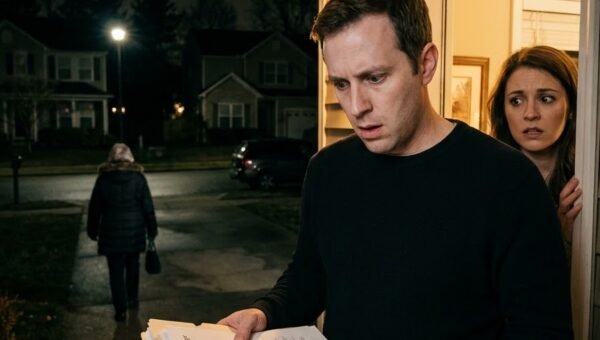
Taped to the center of the mahogany panel, right beneath the polished brass knocker my grandfather had cast in his iron shop back in nineteen-fifty-four, were three distinct sheets of heavy white paper bearing the embossed gold seal of the county circuit court. Above them, printed in large, black bold letters that could be read clearly from the end of the driveway, was a formal Sheriff’s Notice of Trespass, an Eviction Injunction, and a personal summons holding Dominic Vance liable for real estate fraud, forgery, and the immediate return of seventy-five thousand dollars to Meridian Holdings.
Dominic stood there frozen. The silence on the porch lasted for perhaps two seconds, just long enough for the reality of the ink and the seals to sink through his linen shirt and his vacation tan. Then his fingers lost their grip on the leather handles.
The suitcase dropped. It hit the wooden decking of the porch with a heavy, hollow thud that rattled the brass knocker against its plate.
Amber stopped five feet back on the gravel path, her canvas tote bag sliding off her shoulder and landing flat in the dirt beside a clump of my hostas. “Dom?” she whispered, her voice cracking in a way that sounded remarkably like glass under a hammer. “Dom, what is that? What are those papers?”
Dominic didn’t answer her. He didn’t pick up his suitcase. He slowly turned around, his face the color of skim milk, and looked toward the bay window of the parlor where I sat behind the clean glass, holding my grandmother’s china cup with both hands.
As if on cue, Deputy Miller stepped out from the shadow of the garage porch, his hand resting casually on the black leather holster at his hip, walking with that slow, inevitable stride of a man who had all afternoon and nowhere else to be.
“Morning, Dominic,” Deputy Miller called out, his voice carrying clearly across the yard. “Step away from the door, son. We need to talk about a little transaction you tried to pull off while you were over in Rome.”
Dominic didn’t move. He stood there on the porch he thought he had sold, surrounded by the luggage he thought he was unpacking, staring through the glass at me as I raised my teacup in a small, polite salute. Behind him, Amber let out a sharp, breathless sound and started backing toward the rental car, her Italian leather heels sinking uselessly into the wet spring gravel.
I didn’t open the door. I didn’t need to. The house was mine, the title was clean, and the hydrangeas out by the mailbox were finally starting to put out their first pale blue buds of the season. I took another slow sip of my coffee, leaned back into the worn linen cushions of my chair, and watched the tow truck pull up by the mailbox to haul away the silver sedan before it could leave oil spots on my driveway.