Twenty-one years after I handed my first baby to another family, I opened the hospital waiting-room door and saw a faded lavender blanket in someone’s hands. I expected to meet Clara alone. I expected to explain myself, or be asked to. I was ready to hear that she’d changed her mind, even though the donor coordinator had already told me she was here. Instead, I saw the blanket first, then Clara’s face, then the two people sitting close beside her.
My legs stopped working for a second. I had spent most of my life imagining that meeting, but never once imagined it would look like that.
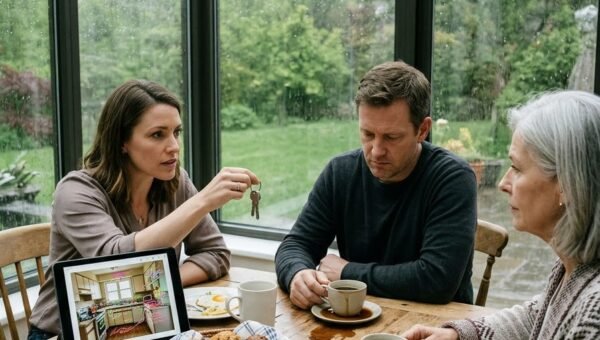
Clara was twenty-one, a college senior, and she had my eyes. Not just the same color. The same little crease at the outside when she was trying not to cry. I knew it from the one photo I’d seen years ago through the adoption intermediary, when the agency had sent a brief update. Beside her sat Arthur and Eleanor Vance, the people who had raised her. Clara held Eleanor’s hand, and Arthur had one arm resting along the back of the sofa.
The blanket lay folded across Clara’s lap. Its edges were frayed in the same places I remembered.
I didn’t say anything useful. I just gripped the door handle and stared at that lavender yarn. Eleanor stood up first. She walked toward me, slowly enough that I could’ve stepped back if I wanted to. I didn’t. She put her arms around me, and I heard her say, “Thank you for twenty-one beautiful years. Today, our girl gives life back to your boy.” I was still trying to understand how she could thank me when I’d come to them asking for help. Then Clara reached for me, too.
I was sixteen when I got pregnant. I grew up in a family where people believed that keeping a secret was the same as solving a problem. My parents were scared for me, and they didn’t know what else to do, but their fear filled up every conversation. I wasn’t forced to sign the adoption papers. I need to be honest about that. I agreed to a private, closed adoption because I thought it was the best chance I could give my baby. I also agreed because I was young and tired and wanted the adults around me to stop looking at me like I’d ruined everything.
I knitted the blanket in a shelter bedroom with a loose window latch that clicked whenever the heat came on. The yarn was a little too thick, and I had to pull out several rows when I lost count. I remember one knot that showed near the corner, though I don’t know why that detail stayed with me. Before I left the hospital, I wrapped my daughter in it and held her close enough to smell the milk on her breath. I called her Clara. The agency told me her adoptive parents would keep the name. Then I handed her over. That’s the plainest way I can say it.
I put my letter in with the blanket. I didn’t write anything wise. I wrote that I hoped she’d be loved, and that I was sorry I couldn’t be the mother she needed then. I didn’t know if she’d ever read it. I didn’t know if the family would want her to know I’d existed at all. My life went on, because life does, even when some part of you is stuck in a hospital room with a newborn you can’t take home.
I met David a few years later, and he never made me feel like the adoption was something I had to hide from him. We married, bought a small house, and had three children. Grace and Nate came first. Leo arrived nine years ago, with a shock of dark hair and a way of grabbing my finger like he meant to keep it. I loved all three of them in the ordinary daily way, school lunches and wet towels and trying to remember which kid had a dentist appointment. I was happy. I was also carrying the old shame, which is a strange thing to admit when I’d built a good life.
I didn’t talk about Clara much. David knew her name, and he knew about the adoption. My kids knew they had an older sister, but they didn’t know her details. I told myself I was protecting her privacy. I was, some. I was also afraid that if I said her name out loud too often, I’d have to face how much I missed someone I hadn’t raised. I never had a right to ask her to make me feel better. I understood that. I still wondered what she looked like.
Six months ago, Leo started bruising too easily and waking up tired. At first, the doctors talked about tests and waiting. Then the words got harder. Severe aplastic anemia. His bone marrow wasn’t making the blood cells he needed. The pediatric hematology team explained the plan in small, careful pieces, and I learned to hear the words without letting my face change. I got good at asking about counts, platelets, and what happened next. I got less good at sleeping.
David stayed beside Leo in the sterile unit while I made calls, filled forms, and tried to remember what the nurses had already told us. The hospital had us tested first. David wasn’t a match. Neither were Grace or Nate. Leo would ask when he could go home, and I’d say, “We’re working on it.” I didn’t want to lie, but I didn’t want to hand him my fear, either. His counts kept dropping. The doctors said we needed to find a donor.
There was one name I could not stop thinking about. I hated myself for thinking of her that way, as if she were the answer to a medical problem instead of a person with her own life. The adoption was closed. I knew the rules. I also knew Leo was nine years old, and there might be a way to send an emergency medical inquiry through the intermediary registry without demanding contact. For weeks, I went back and forth. I tried to talk myself out of it. Then I pictured Leo’s hospital bracelet and filled out the request.
I remember my hand shaking over the final box on the form. The waiver asked whether I understood that Clara could say no and that the hospital would not tell me anything beyond what the process allowed. I checked the box. I wrote that I wasn’t asking for a relationship or an explanation. I was asking if she would consider testing as a possible donor for her brother. I read that sentence until the words looked wrong. Then I sent it.
The registry coordinator called me two months after I first started the process. I was sitting in my car outside the hospital, holding a paper cup of coffee I’d forgotten to drink. She said Clara had responded right away. “She said yes to tissue typing,” the coordinator told me. I asked her to repeat it. She did. I didn’t ask why Clara had said yes. I was afraid any answer would be too much to hear over the phone.
The tests took more time. David and I learned the transplant team needed a close match, and I tried not to build hope around a number before there was one. Then the coordinator called again. Clara was a 10/10 HLA match. I put my hand against the steering wheel and sat there. I was relieved for Leo. I was grateful to Clara. And underneath that, I felt a kind of panic I couldn’t explain. I’d spent twenty-one years imagining that if we ever met, I’d have to earn the right to be in the same room.
Clara agreed to donate. She and I would meet face-to-face on the morning of the procedure, after both of us had signed the hospital’s contact waivers. The donor coordinators handled the details. They made sure she knew what the process involved and that she could change her mind. I was told she’d asked about Leo. That was all. I didn’t want to turn her choice into a promise about how she felt about me. Still, at night I’d hear her “yes” in my head and wonder what she thought she was saying yes to.
On the morning we were supposed to meet, David stayed with Leo. His conditioning treatment was underway, and he was worn out. He looked small in that bed, though he was a sturdy nine-year-old at home. David kissed my forehead before I left the room. “Go meet her,” he said. “I’ve got him.” I wanted to ask him to come with me, but Leo needed him more, and there was no room for both of us to pretend we weren’t scared.
The corridor to Donor Pre-Op Waiting 3B was quiet. My shoes made a squeak on the tile every few steps. I can still hear it if I think about it. At the door I stopped, which was ridiculous because I had walked all the way there. I pictured a girl sitting by herself with her arms crossed. I pictured her asking why I had waited until she might be useful to contact her. I practiced saying I was sorry. I practiced saying she didn’t owe us anything.
Then I opened the door and saw that blanket.
Clara stood when she saw me, and for a second I couldn’t make myself walk farther into the room. I recognized the shape of her nose and the way she held her shoulders, even before she smiled. She looked like me at twenty-one, only steadier. Arthur and Eleanor were there, close enough that she could reach either one without getting up. They didn’t look angry. They looked worried for her, and for Leo, and maybe for me. Clara lifted the blanket from her lap.
“This is yours,” she said. “I’ve had it my whole life.”
I made a sound that wasn’t a word. The knitting was faded and soft, with the same uneven corner I’d worked on in the shelter room. I reached out but didn’t touch it right away. I had pictured that blanket buried in a box or thrown away when Clara outgrew it. I hadn’t pictured it being carried into the hospital by the grown woman I’d wrapped in it before giving her to someone else.
Eleanor held on to my shoulders. I remember the warmth of her fingers through my sweater. She told me Arthur and she had kept the blanket in Clara’s room when she was little, and later in a cedar chest. They had raised Clara knowing she was adopted. They had never told her I didn’t want her. They said I had been sixteen, and that I loved her enough to make a painful choice because I couldn’t give her the life she needed. I kept trying to say thank you, but the words wouldn’t come out right.
“They read your letter to me,” Clara said. “Not all the time. On my birthday, when I asked.”
I looked at her. “You read it?”
“Every few years,” she said. “I wanted to know what you’d said.”
I had written that I hoped she’d be loved. I’d written that I was sorry. I’d written that maybe someday she’d understand. I couldn’t remember the exact words, which bothered me more than it should have. I’d been sure I’d have that letter memorized forever. Clara said her parents had told her the truth in a way that didn’t make her feel caught between families. She knew she was loved by them. She also knew I had loved her, even if I hadn’t been able to raise her.
Arthur stepped closer. “We never wanted her to feel she had to choose,” he said. “She’s ours, and she’s yours in a different way. There’s room.”
I had been so sure they would see me as the person who gave them a child and then came back asking for something. I had imagined judgment in their faces before I ever met them. Instead, Arthur was standing there with one hand near Clara’s shoulder, looking at me like a tired parent who wanted another parent to understand what was happening. I felt ashamed of how wrong I’d been about them. I also felt relieved, which I didn’t think I was allowed to feel.
Clara reached for my hand. “I said yes because Leo’s my brother,” she said. “And because I wanted to.”
I had prepared myself for a lot of things, but not that simple sentence. I wanted to ask if she was sure. The doctors had already done that. I wanted to ask if she was angry. That wasn’t fair to put on her while she was about to go through a procedure. So I said, “I’m grateful. I don’t know how to say it without making it sound too small.”
“You can just say it,” she said.
“I’m grateful.”
She nodded. “Good.”
I sat with Clara for a little while before the staff came to take her back. We talked about school, and I asked what she was studying. She asked if Leo liked baseball. I told her he liked baseball in the way most nine-year-olds like whatever they can talk about for an hour. She laughed. It wasn’t a big laugh, just a little one, but I heard it. I wanted to keep asking questions and knew there would be time for that later if she wanted it.
Before they wheeled her away, she let me hug her. I held on longer than I meant to. She didn’t pull away. Arthur squeezed my arm, and Eleanor brushed a loose strand of hair off Clara’s forehead the way mothers do without thinking. I watched that small gesture and felt something I couldn’t name. It didn’t take anything away from me. It showed me what Clara had been given.
The procedure went smoothly. David came down to the waiting area with two coffees, one for me and one for Eleanor. He had Leo’s latest picture open on his phone, and he showed Arthur the one where Leo was making a face at the hospital food. “He says it’s fine,” David told us. “He just doesn’t want it again.” Arthur laughed, and for a few minutes we talked about an ordinary kid’s complaint instead of the reason we were all sitting there.
When Clara was in recovery, the medical team explained the next steps. Her donation had gone as planned. Leo would receive the cells after the conditioning regimen, and then we’d wait to see whether they engrafted. I listened to the instructions and wrote down the parts I might forget. I was still a mother who wanted a clear plan, even when the plan had no guarantee built into it.
The transplant team coordinated the infusion. Clara and I were allowed to be in the family area, and the hospital kept the consent rules clear for both of us. When the cells were brought to Leo’s room, the nurse explained what was happening. It wasn’t a dramatic scene. There were pumps, a line, and people checking names and numbers. That was how medicine worked. The biggest thing that had ever happened to our family came through a small bag and a tube.
I stood by the glass with Clara. She put her hand against it when she saw Leo. He was sleepy, but he noticed her and raised two fingers in a weak little salute. Clara smiled and returned it. I pressed my palm to the glass beside hers. The blanket was back with Arthur and Eleanor, safely folded while Leo’s immune system was so low. I knew we’d wash it before it went anywhere near his bed. I knew that was the practical thing to think about, so I thought about it.
The next several weeks were slow and hard. Leo had days when he felt awful, and days when he was well enough to complain about the hospital. We kept track of his counts and the signs the team asked us to watch for. Clara stayed in touch through calls and messages, without trying to rush anything. She asked what he liked and what made him laugh. When she was ready, she visited him under the hospital’s rules. David and I stayed close, and Arthur and Eleanor came too. Nobody tried to take anyone’s place.
The first time Clara stood beside Leo’s bed, she brought the blanket. It had been washed and checked with the care team first. Leo was tired and looked at her for a moment, then asked, “Are you really my sister?”
“Really,” Clara said. “I’m your big sister.”
He seemed to think about that. Then he asked if she could teach him how to pick a college. Clara said she could, though she was still figuring out her own. That was the first time I heard them talk like siblings instead of two people connected by a medical chart. I sat in the corner and let them have it.
Leo’s counts didn’t turn around all at once. There were appointments, blood tests, and nights when I checked his temperature because the team had told me to. But the cells engrafted. The doctors kept watching him, and his numbers gradually moved in the right direction. At six months, his blood counts were normalizing. I learned not to celebrate every good result too loudly, but I let myself be glad. Clara’s cells were helping his body make the blood he needed.
By then, the four of us had spent enough time together that the silences weren’t all strained. Clara had her own life with Arthur and Eleanor, and she never had to pretend otherwise. I liked seeing how they teased each other over small things. I liked hearing her call them Mom and Dad. It didn’t hurt the way I’d feared. Or maybe it hurt and healed at the same time. I don’t have a cleaner way to put it.
At Thanksgiving, David made too much food, as usual. Arthur brought a pie, and Eleanor brought a dish she said Clara had liked since she was little. Clara sat between Nate and Leo, and Grace kept asking about her college classes. I had imagined meeting Clara as one enormous moment that would settle everything. It wasn’t. It was the first morning in that waiting room, then another visit, then a message, then dinner. A family can grow by making room one chair at a time.
I had a framed family portrait taken that day. Nobody had to stand in a particular order or pretend we were all the same kind of family. David was beside me. The kids leaned into each other. Clara stood with Arthur and Eleanor, and then she reached over and held my hand. That picture came with us to the hospital for Leo’s six-month checkup. He asked to have the lavender blanket on the bed, so I washed it one more time and tucked it around him.
I used to think that blanket was the last thing I could give Clara. I was wrong about that. It had carried my hope into the home where she grew up, and it came back to us when we needed one another. On the hospital bed, Leo’s cheeks were pink against its faded stitches, while Clara and Eleanor stood beside me looking at the framed picture that held all of us.