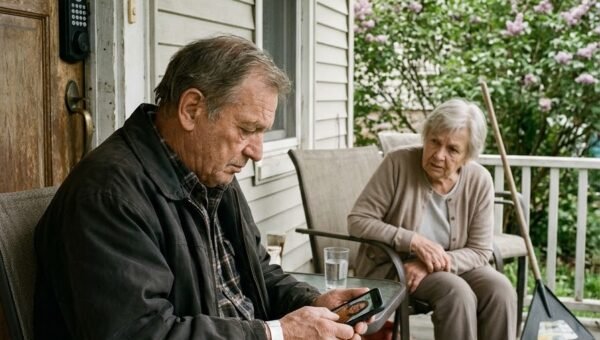
The dish towel was still in my hands when Mark slid the bank papers across my kitchen table. I kept folding the same faded cotton towel, corner over corner, while my 46-year-old son told me his contracting business was $80,000 underwater and the bank needed my house as collateral.
“Mom, if you don’t, we lose the house and the kids change schools.”
He wouldn’t look up. He said, “I’d never ask if there was any other way.”
There were three grandchildren in the sentence, ages 8, 11, and 14.
There was my house, which Frank and I paid off in 1994 after twenty years of doing without things we wanted. Frank’s been gone for six years. I’m 72 now, and I live on $1,900 a month and what we built together. I sat there folding that towel as if the next crease might tell me what to do.
The papers said $80,000. They also said the loan would be secured by my home. I didn’t sign. I told Mark I needed until the next day, and he looked up at me like I’d slapped him.
“You know what this means,” he said.
“I know what it says.”
He collected his coat but left the packet on the table. His new work truck was parked in my driveway, big enough that I had to back my own car out carefully. I noticed it. I didn’t ask him about it. Not then.
After he left, I sat at the table with the papers and the towel. I’ve lived in this house long enough to know every little sound it makes. The refrigerator clicks twice before it settles. The kitchen drawer with the forks sticks unless I lift it slightly. Frank used to tap the table with his knuckle whenever we’d paid another bill and say, “That’s one less thing.” I hadn’t thought about that in a long time.
I read the guarantee again. If Mark missed payments, the bank could come after my house.
I understood that much, but I didn’t understand how quickly it could happen or what “collateral” meant in practice. My pension and Social Security add up to $1,900. I have no second house to move into. No savings sitting around. If I signed and the business failed, I’d be 72 and trying to rent somewhere on that income.
I wanted to call him back and say yes just to stop imagining the kids’ beds being packed. I also wanted to call and tell him he had no right to bring them into it. I did neither. I put the papers in a grocery bag, slept badly, and went to the credit union the next morning.
Jim Keller had known Frank for years. He’d been there when Frank and I made the final mortgage payment, though he wasn’t our loan officer. I asked for him at the front desk and waited in a chair with one leg that kept clicking against the tile. When he came out, he looked at the bank packet and asked whether Mark knew I was there.
“I’m asking what I’d be signing,” I said. “Not what you think I should do.”
He took me into a small office and put the papers on the desk. He didn’t tell me anything private about Mark’s business. He was careful about that. But the loan form itself had enough information for me to ask direct questions, and Jim answered those.
“This is a guarantee against your house,” I said.
“Yes.”
“First lien?”
“For this loan, the bank would place an encumbrance on the property.”
“And if Mark doesn’t pay?”
Jim didn’t rush to answer. “The bank can pursue the collateral. That can mean foreclosure.”
I looked down at the amount again. The form listed an 11 percent default rate. There was language about the full amount becoming due if the loan terms were broken. I asked whether the money would give Mark room to take on new work.
Jim shook his head. “The stated use is to bring existing vendor balances current.”
“So it doesn’t give him fresh money to run the business.”
“It pays the listed debt. It doesn’t fix what caused it.”
That sentence stayed with me. I asked what would happen if the business still couldn’t pay after the loan. Jim said the bank’s review showed the guarantee was not a short-term bridge to new work. The collateral would only move the risk from Mark’s company to me. If I signed, I’d be responsible for his debt even if I had no part in the business.
I asked him how long before the house could be at risk. He said he couldn’t give me a date, because it would depend on defaults and the terms. But based on the paperwork in front of us, the bank’s assessment showed the business was still losing money. A temporary loan could delay the reckoning, not prevent it.
I folded the pages and put them back in the bag. My fingers were stiff by then. Jim asked if I wanted to speak with a lawyer before signing anything.
“I want to talk to my son,” I said.
I drove to Mark’s house that afternoon with groceries and a pan of baked ziti I’d made the night before. I told myself I was bringing food because Sarah had three kids and a lot to do. That was true. It was also an excuse to see the place for myself.
The new truck was there again. Big, clean, shiny, with a monthly payment that had to be something. I didn’t know the exact amount yet. I only knew it didn’t look like the truck of a man who had exhausted every other way.
Mark’s company yard was visible from the road. There were machines and equipment parked behind a chain fence. I recognized some of it from the jobs he’d done. I didn’t know which pieces were paid for and which weren’t. I didn’t know that a supplier had filed a lien. I only knew I’d spent the night hearing that work had dried up while his expensive truck sat in my driveway.
Sarah opened the door and wiped her hands on her jeans. She looked tired. I carried the groceries in and set them on the counter.
“How are things?” I asked.
She gave a little laugh, the kind people use when they don’t want to make a big deal out of being worried. “Mark says the bank’s going to extend the business line. He thinks we can get through this.”
I put the bag of apples down. “He said that?”
“He said they’d approved an extension. We’re just waiting on a few things.” She turned toward the sink. “I don’t understand all the business stuff. He handles that.”
I had the bank papers in my purse. My hand went to the strap and stayed there.
“Did he say anything about my house?” I asked.
Sarah turned around. “Your house?”
I told her Mark had asked me to guarantee an $80,000 loan using my home. She stared at me for a second, then put her hand on the counter.
“He told me the bank approved an unsecured extension,” she said. “He said he was sorting it out.”
I didn’t know what to say. My first thought was that I’d misunderstood Mark. My second was that Sarah had been left out on purpose. I felt mean for thinking it, so I asked her if she’d seen the papers.
“No,” she said. “I didn’t know he asked you.”
She wasn’t angry with me. She looked embarrassed, and then scared. She asked how much the house could be worth to the bank, and I told her I didn’t know. She looked toward the hallway, where one of the kids had left a backpack on the floor.
“They can’t take your house,” she said.
“That’s what I’m trying to find out.”
I left the groceries and went home. I didn’t tell Sarah to confront Mark. That wasn’t my place. But I couldn’t carry his secret for him either. I called Mark and told him I was coming over the next evening. I said Sarah needed to be there.
He asked why. I said, “Because it’s about her family too.”
He went quiet, then said, “Fine.”
I spent the next day thinking about that word. Fine. I wanted to go back to when Mark was little and the worst thing I had to worry about was whether he’d remember his lunch. But he was a grown man. I’d raised him to stand on his own feet, and he had. Until he didn’t. I knew the job market had been rough. I knew a contractor could get hit by a delay or a customer who didn’t pay. I also knew I couldn’t sign away my only safe place because he was ashamed to tell his wife the truth.
The next evening, I drove over with the bank packet and the itemized assessment Jim had explained. Mark and Sarah were at the dining table. I set my papers down between them.
Mark looked at the form and said, “You went to the bank.”
“I needed to know what I was being asked to sign.”
“You could’ve asked me.”
“I did. You said the work dried up.”
He leaned back. “It did.”
“Then tell Sarah what this loan is for.”
His face tightened. Sarah looked at him. The room was quiet except for the dishwasher running in the next room.
Mark said the bank wanted collateral because the business needed to clear vendor balances and keep operating. Sarah said she thought the bank had approved an unsecured extension. He rubbed his hands over his face and said it wasn’t that simple.
“It is for me,” I said. “My house is on the line.”
He got angry then. Not loud at first. He said I was making it sound worse than it was. He said he was going to make the payments. He said the business had work lined up. Every time I asked what the $80,000 covered, he gave me another piece, never the whole thing.
I laid Jim’s assessment on the table. It showed the bank was not offering Mark new operating money. It was asking for my home to secure old balances. The form showed the 11 percent default rate. I pointed to the part that said the full amount could become due if the terms were broken.
“Do you understand what happens if the business can’t make the payments?” I asked.
“I know how loans work.”
“Then you know what happens to my house.”
He said it wouldn’t come to that. I asked him how he knew. He didn’t answer. Sarah picked up the assessment and read it from the top. Her hand stopped at the section on the debt and the collateral.
“Why didn’t you tell me?” she asked.
Mark looked down. “I was trying to fix it first.”
“You told me the bank approved an unsecured loan.”
“I thought they would.”
“That’s not what I asked.”
He said he’d been trying to keep the kids from worrying. Sarah told him they were already worrying because they could hear him and me. He said she didn’t understand the pressure he’d been under.
“I do understand,” she said. “I just didn’t know what was happening.”
That was when he finally stopped talking around it. He said the first big problem started about eighteen months earlier, on a strip-mall build. Costs went over what he’d bid, and the owner kept pushing back the schedule. Mark had floated payroll, expecting the next job to cover it. Then he used supplier credit to keep things moving. When one payment came late, he borrowed forward again.
He’d told himself it was temporary. He took on commercial subcontracts without enough cash behind them, hoping the next payment would catch up the last one. It didn’t. The supplier credit lines tightened, then froze. One supplier filed a lien. The bank reviewed the books and decided an unsecured extension wasn’t safe.
I asked about the truck.
His eyes went to the window. He said it was a $65,000 dual-cab heavy-duty rig, bought on credit last year. He said he needed it for work and that it had helped him look established with clients.
“You said there wasn’t any other way,” I said.
“I said I was out of ways.”
“No. You said there was no other way.”
He rubbed his thumb over the edge of the table. He told us there were pieces of equipment at the yard he could sell. The truck had equity. He could return it, though it would hurt. He could give up the oversized house and rent something smaller. He’d been afraid that selling things would make the failure real. He’d also been afraid Sarah would find out how far behind he was.
“I thought I could catch it up,” he said.
Sarah didn’t raise her voice. “You let me think the bank had it handled.”
Mark said he was sorry. It came out small. I believed he was sorry. I also knew sorry didn’t make the money appear, and it didn’t put my house back if the bank took it.
He looked at me and said, “You care more about bricks than your family.”
That was the line I’d dreaded. It hurt because I loved him, and because I knew how easily I could’ve signed just to prove I didn’t care about bricks more. I looked at him across the table.
“I care about the kids,” I said. “I care about you. I’m not putting my house on a loan that won’t fix the business.”
He started to answer. Sarah put a hand on the assessment and said, “We’re going to look at everything. All of it.”
Mark leaned forward and covered his face. He didn’t cry hard. He just sat there with both hands over his eyes, his shoulders moving once or twice. I wanted to reach across the table and touch his arm. I didn’t. He needed to sit with what he’d done without me making it feel smaller.
I slid the unsigned guarantee toward him.
“I’m not signing this,” I said. “I can help with the kids. I can have them after school. I can’t give the bank my house.”
For a while, nobody spoke. Sarah held the papers. Mark wiped his face with the heel of his hand. Then he nodded once.
The business filed for Chapter 11 restructuring. Mark sold off machinery he didn’t need and returned the big truck. He gave up the oversized house. They rented a modest bungalow three streets over, still in the same school district. The kids didn’t have to change schools.
Those months were hard. Mark and I didn’t talk much at first. He was ashamed, and I was angry that he’d put my home and his children into the same plea. I missed him anyway. I missed the way he used to call to ask whether I had extra soup, even though I knew he could make his own. I also kept thinking about the truck in my driveway and how I had seen it and still tried to explain it away for him.
When the kids moved, I helped carry boxes. Mark didn’t ask me to pay anything. He didn’t make a show of how much he’d sold. Sarah began telling me the truth about what was happening, even when it wasn’t good news. Mark did too, though it took him longer. He still has pride. I know where he got it.
I kept the deed in the tin box in my closet. I checked it twice after the bank papers were returned unsigned. I’m not proud of that, but I did. The house is still mine, and my $1,900 still has to cover the life I have.
At 3:15, when the school bus drops the kids off, I hear their sneakers hitting the porch steps. They come in talking over each other and leave their backpacks by the door. We do homework at the kitchen table. Sometimes Mark comes by after work and picks them up. He doesn’t talk about the bank unless I ask.
The dish towel is folded square on the clean formica counter beside Frank’s brass key hook. The children are still in the same school, and I’m still here when they come through the door.