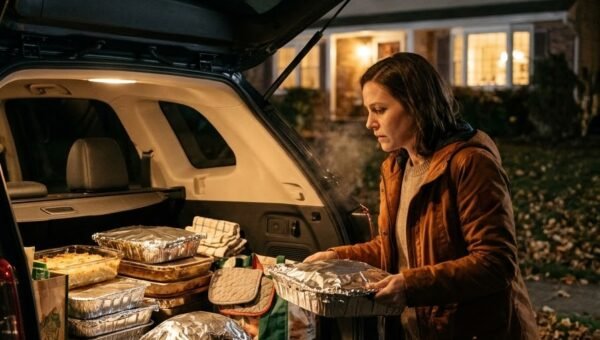
I called my son on Christmas Eve, wrapping supplies in hand, to ask when to come over. His wife intercepted the phone. We did Christmas last night, she said. It just went smoother without the extra coordination. Barrett never took the phone back. I stood alone in the freezing parking lot, listening to my own breathing, and finally managed to say the only words I could form: All right.
Those two words felt thin and dry in the cold air of the strip mall parking lot where I had pulled off Route 9 just to use the dome light for checking my gift tags.
My breath plumed white against the steering wheel of my old station wagon. The rolls of foil paper, green with silver bells, sat on the passenger seat right beside a box of clear tape and a pair of blunt kitchen scissors. I had spent the afternoon baking walnut shortbread because Barrett always loved it when it came out of the oven a little dark around the edges. I had a tin of them in the back footwell, tied with a red ribbon that had started to fray at the ends because I had used it three years running.
The phone felt heavy in my palm, the screen glowing with the gray light of a dead connection.
Alyssa had hung up. She did not say merry Christmas. She did not ask if I wanted to drop the shortbread off on the porch. She simply clicked the receiver off the way a clerk closes a drawer at four o’clock on a Tuesday. I looked through the frosted windshield at the grocery store entrance across the asphalt where a single salvation army bell-ringer was swinging his red tin against the wind, his shoulders hunched up around his ears.
For two years, ever since Barrett and Alyssa bought that big stone house on the ridge outside town, I had been the one doing the coordinating.
That was the word Alyssa liked to use when she wanted things smoothed out. Can you help coordinate the contractor for the back deck? Can you coordinate the extra tuition payment so we do not hit the overdraft limit before the escrow clears? I never minded being useful. When you lose a husband to a sudden heart attack while he is out cleaning the gutters, you look for places to put your hands so they do not shake. Helping Barrett felt like keeping the engine running on a car that belonged to both of us.
I sat there in the dark with the heater blowing lukewarm air against my shins, waiting for my son to call me back and tell me his wife had made a mistake.
Five minutes went by. Then ten. The engine gave that little tired shudder it always did when the thermostat was stuck. Barrett did not call. Barrett never called when Alyssa was in the room because calling me back meant explaining why his mother was crying, and explanation was something Barrett gave up on around the time he turned twenty-five and realized it was easier to let people assume things than to correct them.
I reached down and picked up the roll of silver bells paper. I could have turned the car around and driven back home to the quiet little house on Maple Street where the only sound was the radiator clicking in the hall. I could have put the shortbread in the freezer and gone to bed at eight o’clock with a library book. But I thought about my grandsons, little Toby and the baby, who probably had their stockings hung by that enormous stone fireplace with my name nowhere near them. I thought about the packages in the trunk, sweaters I had knit myself while watching the evening news, each one tagged with a little cardboard mitten.
If I went home now, I was letting her win the whole board. I was letting her turn me into a ghost who only existed when an invoice needed paying.
So I did something stubborn. I stayed right there in the parking lot with the dome light on and wrapped every single gift on my lap. I cut the paper with the dull kitchen scissors, creased the edges with my thumbnail the way my mother taught me back in fifty-nine, and stuck a red bow on each one until my fingers were stiff with cold. By the time I finished, the clock on the dashboard read 5:14. The parking lot was nearly empty now, just a couple of stray grocery carts bumping against the concrete curbs in the rising wind.
My phone buzzed against my knee. It was not a call from Barrett. It was a notification from Facebook, a little ping I usually ignored while driving, but my thumb hit the screen before I could stop it. Alyssa had posted a photo album titled Christmas Eve with the Folks.
I tapped the screen, my thumb leaving a greasy smudge on the glass. There was the big stone fireplace I had helped pay to insulate last November. There was the long walnut dining table loaded down with prime rib and heavy silver chafing dishes that clearly came from a caterer in the city. And there was Alyssa, laughing with her head thrown back, standing between her mother and father, both of whom looked like they had stepped out of a magazine advertisement for retirement in Florida. Barrett was standing at the edge of the frame, holding a glass of amber whiskey, his smile looking like it had been pinned to his face with a staple gun.
I scrolled through the pictures one by one. There was Toby sitting on his grandfather’s knee, opening a large wooden train set that looked expensive enough to make a dent in a used car budget. There was the baby in a smocked velvet romper with tiny leather shoes. Nothing in those photographs looked like a household struggling through a rough patch. Nothing looked like the Barrett who sat across from me at the diner three weeks ago with his head in his hands, telling me the property tax assessment had gone up forty percent and the furnace was leaking carbon monoxide into the basement.
I remember every word he said that afternoon at the diner. He had looked at his coffee cup like it was the hardest thing he had ever had to study. “Mom, if we don’t find five thousand dollars by the end of the month, the county is going to slap a lien on the title. Alyssa is beside herself. She thinks her parents are going to find out we’re underwater.”
I had reached across the linoleum table and covered his hand with mine. His skin was cold, the same way his father’s used to get when he was worried about the harvest. “Don’t you worry about your father’s old insurance payout, Barrett,” I had told him. “We’ll clear it. That’s what family is for.”
I transferred the money from the money market account twenty minutes after I got home from that diner. I did it because he was my only boy and because I still saw him in short pants scraping his knees on the gravel driveway.
Sitting in the freezing station wagon with the empty wrapping paper rolls rolling around the passenger floor, I opened my banking app. My fingers were shaking so hard I had to type my password three times before it let me in. I tapped the history tab and scrolled back through the last twelve months. There was the five thousand for the property taxes. There was the twenty-two hundred for Toby’s private school registration that Alyssa insisted couldn’t wait for the spring semester. There was the eight hundred for the orthodontist consult, and the twelve hundred for the lawn drainage system that had apparently flooded the patio during the October storms.
Month after month after month. A steady, silent drain on the account I had spent forty years building with a man who worked twelve-hour shifts at the grain elevator until his knees gave out.
I did not feel angry at first. Anger comes later, like a hot iron pressed against your ribs. What I felt right then was a strange, hollow quiet, the kind you get when you step outside after a heavy snow and realize every sound has been muffled by the white drift. The extra coordination wasn’t about a busy schedule or a preference for a quiet evening. Alyssa had needed me out of the house because her parents believed their daughter had married a rising young executive who lived in a mortgage-free manor of his own making. If I had walked through that front door with my Tupperware of shortbread and my sensible winter coat, the whole illusion would have wobbled on its foundation.
I was the one person who knew that the stone on the fireplace was being paid for fifty dollars at a time out of a widow’s pension and the sale of her old sewing machine.
I put the phone down in the cup holder and turned the key. The engine coughed twice before catching. I drove back to Maple Street in total silence, the heater finally blowing warm air against my face, though it smelled faintly of dust and old leaves.
I did not sleep that night. I stayed sitting in the wingback chair by the front window with a wool blanket over my knees, watching the streetlights hum through the bare branches of the maple tree. Every time I closed my eyes, I could hear Alyssa’s voice through the tinny speaker of the phone. It just went smoother without the extra coordination. It was such a neat little sentence. It sounded like something she had practiced in the bathroom mirror while brushing her hair.
By five in the morning, the eastern sky had turned the color of a wet slate shingle. The wind had died down, leaving the frost thick and white on the grass across the front lawn. I got up, walked into the kitchen, and put the kettle on for coffee. While the water heated, I went to the small wooden desk in the corner of the dining room where I keep my records in an old leather binder with brass corners.
I didn’t need to look very hard to find what I was looking for. I had the printed monthly statements right there, neatly filed behind green tab dividers. I took out a yellow highlighter and went down the pages line by line, marking every transfer to Barrett’s joint checking account with a bright stroke of neon ink. The total at the bottom of the last page came out to $38,400 for the year. Thirty-eight thousand four hundred dollars. That would have bought three cars back when Frank and I were first married. That would have paid off our mortgage twice over.
I slid the printed pages into a clean manila envelope, sealed the flap with a strip of moisture, and wrote Barrett’s name across the front in my steady, old-fashioned cursive. Then I went out to the garage, loaded the nicely wrapped Christmas packages into the back of the station wagon, and backed out of the drive before the sun had even cleared the neighbor’s roof.
The drive out to the ridge road took twenty minutes. The world looked peaceful in the gray morning light, the frozen fields stretching out on either side of the blacktop like sheets of gray flannel. As I turned onto their gravel drive, I saw that Alyssa’s parents’ Lincoln was parked right in front of the double garage, alongside Barrett’s sedan. The house looked quiet, the chimney sending up a thin, straight line of pale blue smoke into the morning air. They were probably still asleep, or sitting around the big kitchen island drinking coffee from pottery mugs that cost twenty dollars apiece.
I didn’t use the side entrance where the delivery packages go. I walked right up the flagstone steps to the heavy oak front door and pressed the brass doorbell. I could hear the chime echoing inside, a soft, pleasant ding-dong that probably sounded very nice when guests arrived for a dinner party.
It took nearly a minute before the lock clicked. The door swung open, and Barrett stood there in his flannel pajama bottoms and a gray sweatshirt, his hair sticking up on one side where he had been sleeping on it. His face went gray the second he saw my coat.
“Mom?” he whispered, his voice catching in his throat like he had swallowed a dry crust of bread. “What are you… what are you doing here?”
“Good morning, Barrett,” I said, stepping past him before he could put his hand out to block the frame. “I brought the presents for the boys. And something for you and Alyssa, too.”
The smell of cinnamon and roasting ham hit me from the kitchen as I walked down the wide hallway. The house was quiet, the kind of quiet that comes from expensive wool rugs absorbing every sound. Through the wide archway of the living room, I could see the tall Christmas tree sparkling with white lights that were still plugged in from the night before. Gift boxes and colorful tissue paper were scattered across the floor around the base of the trunk like drifted leaves.
Alyssa came out of the kitchen holding a white ceramic coffee mug with both hands. She stopped dead at the edge of the rug when she saw me standing by the fireplace. The color drained right out of her cheeks, leaving her skin looking like curdled milk.
“What is she doing here, Barrett?” Alyssa’s voice was sharp, pitched just high enough to carry down the hallway from the back rooms where her parents were probably still resting. “We agreed, we talked about this yesterday.”
“She didn’t talk to me about it yesterday, Alyssa,” I said, turning to look at her directly. I didn’t raise my voice. When you get to be my age, you realize that shouting just makes people think you’re crazy, whereas speaking very quietly makes them think you’re dangerous. “Your wife told me on the phone last night that you two had already done Christmas. She said it went smoother without the extra coordination.”
Barrett looked back and forth between us like a dog caught between two owners with sticks. “Mom, look, it was just… the schedule was a little complicated with Alyssa’s folks coming in from Naples and everything was, “
“Quiet, Barrett,” Alyssa hissed, her hand tightening around her coffee mug until her knuckles turned white. She took a step forward, trying to herd me toward the front door with her body language. “Listen, Mrs. Miller, this isn’t a good time. My mother and father are still sleeping down the hall, and we had a very long evening, “
“I know you did, Alyssa,” I said. I set the heavy manila envelope right on the center of the mahogany coffee table, right beside a silver bowl filled with pinecones and dried oranges. “I saw the pictures on Facebook. The prime rib looked delicious. The caterers did a wonderful job with the plating.”
Alyssa’s mouth opened, but no sound came out. Her eyes darted toward the hallway behind her as a door clicked open and heavy footsteps began to pad down the oak floorboards.
“Is someone at the door, sweetie?” a man’s voice called out. A tall, silver-haired man in a navy bathrobe appeared in the archway, rubbing his eyes with one hand. It was Alyssa’s father, Arthur, looking every bit the retired bank vice president he liked to remind people he used to be at every Thanksgiving dinner. He stopped when he saw me standing by the tree in my sensible wool coat. “Oh. Excuse me. I didn’t realize we had early visitors.”
“Arthur, good morning,” I said, turning my head toward him with a small, polite nod. “I’m Margaret. Barrett’s mother.”
Arthur blinked, looking from me to Barrett, then over at Alyssa, whose face was now the color of a ripe plum. “Ah. Yes. Barrett’s mother. We heard so much about… well, we understood you lived down in town.”
“I do,” I said. I reached into my coat pocket and pulled out the small canvas tote bag I had brought with me, setting it on the floor by my boots. “I brought the boys’ gifts. The sweaters I knit for Toby and the little one. And I brought something for Barrett, too. Something to help him square away his accounts before the new year starts.”
Arthur frowned, walking a little closer into the room, his bare feet making soft thuds on the wool rug. “Accounts? What accounts? Barrett tells me his firm is doing exceptionally well. They just finished that major subdivision contract over on the west side last month.”
The silence in the room became so heavy you could hear the refrigerator running through the wall in the kitchen. Barrett didn’t look up from the floor. He was staring at the fringe of the rug like he was trying to memorize every knot in the wool.
“Is that what he told you, Arthur?” I asked softly, reaching down and tapping the corner of the manila envelope on the coffee table. “Because according to these bank records, Barrett’s firm hasn’t turned a profit since the spring of last year. In fact, if it weren’t for the thirty-eight thousand four hundred dollars I’ve transferred into their joint checking account over the past twelve months, they wouldn’t have been able to pay the property taxes on this house, let alone afford the caterers you enjoyed so much last night.”
Alyssa let out a sharp, choked sound, her coffee mug rattling against her saucer. “You have no right, you came into our home, Barrett, tell her to get out of this house right now!”
Barrett didn’t move. He kept staring at the floor, his shoulders trembling slightly under the gray sweatshirt. “Alyssa,” he muttered, his voice sounding thin and small, like a boy caught stealing apples from an orchard. “Just… just stop.”
“Stop?” Alyssa turned on him, her voice rising into that shrill, polished register she used when things weren’t going according to her five-year plan. “Your mother comes in here trying to humiliate us in front of my parents on Christmas morning and you tell *me* to stop? Tell her to take her bags and her little envelopes and get out!”
Arthur had stopped three feet from the coffee table. His eyes were fixed on the manila envelope with its flap half-open, showing the edge of the yellow-highlighted ledger sheets inside. He was a smart man; he had spent forty years looking at balance sheets and loan applications where people tried to make bad numbers look like good ones. He didn’t need me to explain what the highlighter marks meant.
“Barrett,” Arthur said, his voice dropping an octave into that cold, official tone he probably used when turning down a bad commercial loan. “Is this true?”
Barrett didn’t answer. He just let his chin drop lower until his forehead nearly touched his chest.
“He’s been lying to you, Arthur,” I said, my voice as calm as pond water on a windless morning. “Just like he’s been lying to me. He wanted to look like a successful man who could give his wife and her family the kind of Christmas they’re used to having. I don’t blame the boy for wanting to look big in front of his wife’s people. But he did it with my grocery money, and he did it by making me a stranger in my own son’s life.”
I picked up my canvas tote bag from the floor by my boots and looked down at the neatly wrapped packages of sweaters still sitting inside. I reached in, took out Toby’s package with its little cardboard mitten tag, and laid it gently on the edge of the sofa.
“Merry Christmas, Toby, whenever you wake up,” I said to the empty room. “And merry Christmas to you, Alyssa. You won’t have to worry about the extra coordination anymore. I checked the routing numbers on my app before I left the house this morning. The automatic transfer for January has been canceled. The bank is officially closed.”
Nobody said anything as I turned toward the front door. The only sound was the floorboards creaking under my boots. Barrett made a small, pathetic sound behind me, just a half-formed “Mom”, but he didn’t reach out, and he didn’t follow me into the hall. He stood there between his wife and his father-in-law, a man who had traded his mother for a set of stone walls and a catered dinner, and found out too late that the bill always comes due after the guests have gone home.
I pulled the heavy oak door shut behind me with a solid, satisfying click that sounded very clean in the cold morning air.
***
The drive back to Maple Street took twenty-two minutes because a slow-moving grain truck had gotten stuck on the county road near the old creamery. I didn’t mind. I rolled the window down an inch and let the cold air hit my face, smelling the wet asphalt and the distant, sharp scent of woodsmoke from someone’s chimney down the valley. My hands on the steering wheel didn’t shake once.
When I pulled into my driveway, the sun was finally high enough to catch the icicles hanging from the front gutter, turning them into little rows of glass needles that flickered in the light. I turned off the engine, grabbed my canvas bag with the leftover shortbread tins, and walked up the front steps.
Inside, the house was warm and smelled faintly of the coffee I had brewed four hours ago before the world turned upside down. I took off my coat, hung it carefully on the wooden peg by the back door, and walked into the dining room.
The sun was streaming right through the lace curtains onto the old walnut table, making long, bright stripes across the wood. I sat down in my usual chair by the window, the one with the worn velvet cushion where I had darned a hundred pairs of socks over the years.
I didn’t turn on the television. I didn’t call my sister down in Creston to tell her what had happened. Instead, I reached into my apron pocket, took out my small gray tablet, and laid it flat on the table in front of me. I tapped the screen to wake it up, opened the banking app with my thumbprint, and scrolled down to the recurring payment profile under Barrett’s name.
The little green toggle switch beside the monthly $3,200 transfer was sitting right there in the middle of the screen, bright and eager. I pressed my finger against it firmly until the toggle slid over to the left and turned gray. A small confirmation box popped up asking if I was sure I wanted to delete the payee profile permanently.
I pressed Delete.
The screen refreshed instantly, showing a clean, empty white space where my son’s name used to be. The account balance at the top of the page remained steady, solid, and entirely my own.
I reached out, picked up my coffee mug from the saucer, and took a long, peaceful sip while the morning sun warmed the back of my hands.