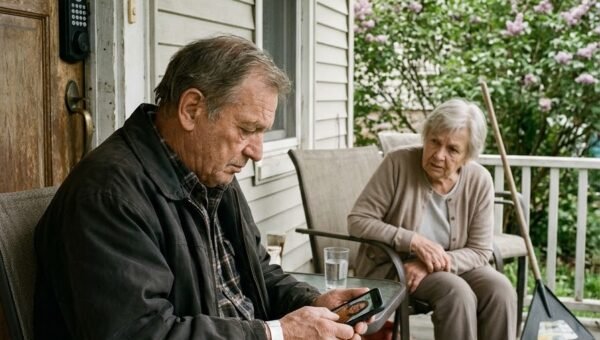
The hospital room where Arthur told me the truth had a clock that ran four minutes fast. I watched it creep toward midnight while I held his hand and tried not to count the little beeps from the monitor. He’d been my father since I was four. So when the doctor told me Arthur might have only hours, I decided nothing in that room mattered more than staying beside him.
I’m writing this down for my daughter, Beth, because I don’t want the story to get smaller every time I tell it.
I also don’t want to pretend I handled the truth well. I didn’t. I thought I knew what Arthur meant to me, and when he showed me that photograph, I was sure I knew what he’d taken from me.
Arthur was the only dad I could remember. My mother married him when I was four, and he never treated me like somebody else’s child. He packed my lunches, checked my spelling, and kept a little jar of buttons in the kitchen drawer because I liked sorting them by color. I know that sounds silly. I remember the buttons because Arthur never once asked why I needed to do it.
He just pushed the jar toward me and went back to washing dishes.
He made apple pancakes on Sundays. Not fancy ones. He grated the apples right into the batter and always left the peel on, so there were little red curls in them. When I got married, he walked me down the aisle and held my arm so tightly I could feel his thumb moving against my sleeve. Years later, he stood beside me at Beth’s baptism, his tie crooked because he’d tied it himself in the car.
I never had a reason to think he wasn’t my father. That was the point, I understand now. But I didn’t know that then.
My mother died when I was twenty-three. Arthur was the one who sat with me through the funeral and drove me home afterward, even though I was married and had a house of my own by then. He brought a pan of soup and put it in my freezer. “You don’t have to talk,” he said. “Just eat something.”
I was grateful. I was also selfish in the way grief can make a person. I wanted him to be fine, and I wanted him to stay exactly as he was. He did both for a long time.
That last night, I’d been at the hospital since late afternoon. Arthur had gotten weaker by the hour, and his mouth kept drying out. I dipped a sponge in water and touched it to his lips. He’d been looking at the ceiling, but when the clock passed 11:52, he turned his head toward me.
“Promise me you won’t hate me.”
I leaned closer. “I could never hate you.”
He started to cry. Not hard. Just tears running sideways into his hair. His fingers tightened around my wrist, and I thought he was scared of dying. I told him I was there. I told him Beth was coming in the morning. I told him the things people say when they can’t think of anything useful.
Then he said, “Everything you believe about your childhood is a lie.”
I looked at him and couldn’t make those words fit with the man I knew. It seemed mean, even if he was dying. I thought he was confused. I thought the medicine had mixed up his thoughts. I told myself a lot of things because the other choice was to hear him.
He reached under his pillow. It took him a few tries. I started to help, but he shook his head and pulled out a small photograph, worn along the edges and bent through the middle.
My mother was in it. She looked younger than I’d ever seen her, with her hair pinned up and one hand resting on the shoulder of a young man I didn’t recognize. He had dark hair and a narrow face. Arthur wasn’t in the picture.
I turned it over. Nothing was written on the back.
“Who is that?” I asked.
Arthur swallowed. “Julian.”
I didn’t know the name. I was angry that I didn’t know the name. I’d been sitting with him while he was dying, and this stranger had suddenly been placed between us like I was supposed to make room for him.
“Why do you have this?”
Arthur shut his eyes for a second. “At the house. Attic. Cedar chest.”
“What’s in the chest?”
“Letters. The truth.”
I wanted him to explain right there. I wanted him to stop speaking in scraps and tell me the whole thing. He tried, but his breath caught and he couldn’t get more than a few words out at a time. Then the nurse came in to check his numbers, and I moved back to let her work.
When she left, Arthur was looking at the photograph again.
“I’m sorry,” he said.
I was so upset I couldn’t answer. I slid the picture onto the table, away from his hand. I thought I was protecting myself from something. Really, I was mad at the only person in the room who couldn’t explain himself.
The doctor came in a little after midnight. Arthur was still alive then. He died before dawn, with my hand around his and the photograph on the bedside table. I remember the nurse telling me the time. I remember saying, “Okay,” as if she’d told me our appointment had been moved.
I didn’t take the photograph home that morning. I left it in the drawer beside the bed, and the nurse found it when she cleared the room. She called me later, and I drove back to pick it up. I almost threw it away. I did put it in my purse, which is a different thing, I guess, but it wasn’t much better.
I went to Arthur’s house the day after the funeral. I told myself I was going to look for a will or insurance papers, though I knew he’d already taken care of those. I was really going because the photograph had made me suspicious of the whole life I’d lived with him.
That sounds awful. I know it does. I was grieving and hurt and trying to find a reason for a thing that had no reason I could understand yet. I was also used to having Arthur handle every hard thing. I wanted to be mad at him for one day, even though he couldn’t answer back.
His kitchen was just as he’d left it. His mug sat beside the sink. There was a little flour on the counter near the stove, stuck in the grain of the wood. I wiped it with my thumb and then stood there looking at the empty space where he usually set the bowl for pancake batter.
I didn’t make pancakes. I couldn’t stand the thought of using his pan.
The attic steps were narrow, and I had to turn sideways when I reached the top. I remembered going up there as a child to find Christmas decorations, though Arthur always insisted I wasn’t allowed to climb without him. I’d rolled my eyes at him then. I wish I could have one more chance to roll my eyes.
I moved a stack of old blankets and found the cedar chest against the wall. There was a small brass lock on it. I tried the key ring from the kitchen drawer first. No luck. Then I remembered the key Arthur kept on a hook in the hall, behind the spare keys, the ones for things nobody used.
It fit.
The lid made a little creak. I know that’s the sort of thing people put in stories, but it really did. Inside, there were envelopes bundled with string, a few papers in a folder, and a black notebook with Arthur’s name written on the first page.
I started with the folder because I was afraid of what I’d find in the letters. I saw my birth certificate first. My mother was listed as my mother. The father’s name was Julian Hale.
I read it twice. Then I put it down and picked it up again.
There was an adoption record dated when I was four. Arthur had legally adopted me. The name change had been filed the same year he married my mother. I’d seen the adoption papers before, or at least I’d seen the new birth certificate when I needed it for something. I’d never asked why there was a court record. My mother had said Arthur wanted to make sure I was his in every way. I took that to mean what I wanted it to mean.
I sat on the attic floor and opened the notebook.
Arthur’s handwriting had always been big and slanted. He wrote down grocery lists and phone numbers in that same hand, so seeing it in the notebook felt ordinary at first. Then I read the date on the first page. It was from the year I was born.
He wrote that Julian had died in a highway accident when I was still a baby. The accident happened on a wet road outside town. Arthur had been the one to identify him. He wrote that Julian had called him his best friend, though Arthur said he hated making it sound so simple. They’d known each other since they were boys. They’d worked at the same mill for a few years and shared a rented house before Julian met my mother.
I had to stop there. The mill was one of those places everyone in our part of South Carolina seemed to have a connection to. My grandfather had worked at one. Arthur had too. It was strange to think of him as a young man with a friend and a whole life before me.
The first letter in the bundle was from my mother to Arthur. I knew her handwriting, though I hadn’t seen it in years. She’d written it not long after Julian died. She was scared, she said. Her family had already started telling her what she should have done, and what sort of woman she was. Some of them wanted me sent to relatives. They didn’t like Julian, and they didn’t want his child tied to their name.
That part hurt, but it didn’t surprise me as much as it should have. My mother never told me much about her family. I’d always assumed they were just distant. Now I understood why she changed the subject when I asked.
A later letter from Arthur was folded in half. I sat with it on my knee for a long time before I opened it. He wrote about coming to see my mother and finding her with me asleep in a laundry basket beside the bed because she’d been afraid to put me down. He said he didn’t know how to help her, but he could give me a safe home. He could keep the relatives from taking me and give my mother enough time to get back on her feet.
Then I found the words he’d written in the notebook.
He’d promised Julian he would look after us. He’d promised to keep me safe from the people who blamed my mother and treated me like a problem that needed to be sent away. Arthur wrote that he thought he was going to keep that promise for a little while, until my mother was steady again.
He married her. He adopted me. He stayed.
The letters showed that my mother had loved both men, but not in the way I’d imagined when I first saw the photograph. She loved Julian and had me with him. She loved Arthur, too, later, when their friendship and care grew into something else. I don’t know how long it took. I don’t know if she ever had a clean line between grief and love. The letters didn’t pretend she did.
One note from her said, “I don’t want her to grow up feeling like a favor.”
I had to put that one down.
Arthur’s answer was on the back of the page. “She won’t. I already love her.”
I read that line again. I remember the dust from the chest bothering my nose, and the way my knees had gone numb on the attic floor. I sat there holding two people’s handwriting and felt angry at both of them for a little while. They’d made a choice about what I could know. They’d decided I was better off without the truth.
Then I read on.
Arthur wrote about the first time I called him Dad. I was four, and he’d been trying to fix a broken drawer in the kitchen. I must have asked him to get me something from the top shelf. He wrote that I said, “Thanks, Dad,” and ran off before he could say anything back.
I didn’t remember that. I’d assumed I’d always called him Dad. He wrote that he sat on the floor by the drawer for a long time after I left. He wrote that he knew the promise had changed shape. He wasn’t just doing what Julian had asked anymore. He wanted to be my father because he loved me.
I started crying then. Not the neat, quiet kind I’d managed at the hospital. I cried with my face down over the open notebook, and my nose ran, and I had to wipe it on my sleeve because I hadn’t brought tissues upstairs.
I still had questions. I still wished he’d told me sooner. It wasn’t my job to make the secret harmless just because Arthur had meant well. He could have told me when I was grown. He could have trusted me to hold the truth and still love him.
But I couldn’t make the lie cancel out the life he’d given me. I couldn’t make the man in the photograph more of a father than the man who sat with me through the flu, taught me to drive in the church parking lot, and walked me down the aisle while his hand shook.
That didn’t mean Julian was nothing. I found one more letter from Arthur to my mother, dated years after the adoption. He wrote that he wanted me to know where I came from someday, but my mother wasn’t ready, and he was afraid of hurting her. After she died, he could have told me. I don’t know why he didn’t. Maybe he thought there would be a better time. Maybe every birthday and wedding and Sunday pancake breakfast made it harder to begin.
The notebook didn’t let him off the hook. It did let me see the whole man.
I took the photograph back downstairs and sat in the living room. Arthur had hung wedding pictures along the wall, including one from my wedding. His tie was crooked in that one too. In the photograph from the hospital, Julian’s face was unfamiliar. In the wedding picture, Arthur’s face was mine in all the ways that mattered: the same stubborn mouth, the same crease between the brows when I was trying not to cry.
I called Beth that evening. She was old enough to understand the truth, but young enough that I didn’t want to drop it on her in a rush. I told her I’d found out Arthur wasn’t my biological father. I told her who Julian was. I told her Arthur had raised me because he’d promised his friend he would, then kept choosing me after the promise was done.
Beth asked, “Are you mad at him?”
“I am,” I said. “A little.”
“Are you still his daughter?”
I looked at the wedding picture on the wall. “Yes.”
She came over the next morning. I was at the kitchen table with the notebook and the photograph. She read the pages I’d marked, then sat with me while I made the pancakes. I hadn’t used the pan since Arthur died. The first one came out lopsided, and the next one burned around the edge because I was reading while I cooked.
Beth ate it anyway.
After that, she started asking about Arthur. Not just the big things. She wanted to know what he did when he was annoyed, what he called the neighbor’s dog, whether he really did put cinnamon in the batter or if I’d made that up. I told her the truth as I knew it. I showed her Julian’s photograph and the papers from the chest. I kept the notebook in the kitchen drawer, near the old jar of buttons.
For a while, I thought the story had to end with me choosing which father counted. I don’t think that anymore. Julian was my father by blood, and I wish I’d known something about him while he was alive. Arthur was my father by every day he stayed, including the days when staying was supposed to be temporary.
I still wish he’d told me. I’m not going to pretend I don’t. But I also understand why he was scared. He thought the truth might make me look back at my childhood and feel like I’d been fooled. Maybe he feared I’d decide the love was only an act, when the truth was that the act had become the real thing before I was old enough to remember.
Months later, Beth sat at Arthur’s kitchen table with a warm plate of apple pancakes between us. The peel showed red in the batter. I’d made them too thick, the way he did when he got distracted talking.
She pointed at the framed wedding picture beside the family photos. “That’s Grandpa Arthur, right?”
“Yes,” I said. “That’s your grandpa.”
Then I passed her the plate, and the photograph stayed beside us on the table.