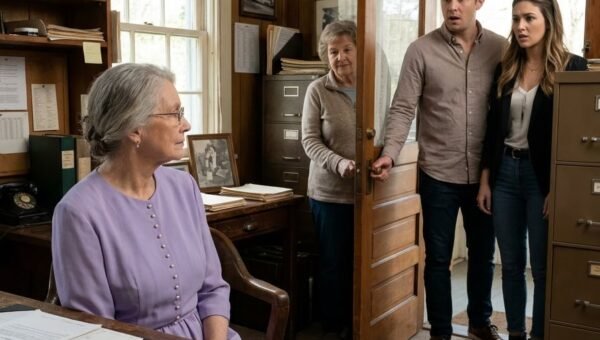
Fourteen months. That’s how long I cared for Mom in her house, and at her funeral my sister Claire said she’d been there for her “every single day.” People went up afterward and hugged Claire. They told her she was a wonderful daughter. I stood near the back, rubbing my thumb over the seam of my black purse, because if I opened my mouth I knew I wouldn’t say anything kind.
I had bathed Mom, changed her sheets, spoon-fed her when her hands got too weak, and slept in a chair beside her bed.
Claire visited four times. I knew the number without checking a calendar. I hate that I knew it. I hate even more that during the funeral I was still counting.
Claire’s speech was polished and warm. She talked about Mom’s strength and how close they’d always been. Her voice caught at just the right spot. I watched people lean toward her. I wanted to stand up and say, “No, you weren’t.” I didn’t. I’d already spent fourteen months being the person who handled things quietly. It’s a habit you can get stuck in.
After the service, people gathered in the church reception room with coffee and little plates of cookies.
I was trying to leave before anybody asked me to tell a story about Mom. I couldn’t handle being asked to make her life sound tidy. Then Mr. Abernathy, the funeral director, came over holding a small black voice recorder.
“Your mother left this with us three weeks ago,” he said. “She gave me instructions.”
He was careful with it, like it was something breakable. Claire saw it in his hand. She stepped forward so fast a paper cup tipped over beside her. “Don’t you dare…” she said.
That was the first time since we’d arrived that she looked at me instead of the people watching her.
Mr. Abernathy glanced at me. He didn’t explain more than that. He said Mom’s instructions were to play the recording only if someone lied about who cared for her.
There were still people around us. Mom’s church friends, two cousins, a neighbor who’d brought food to the house. They’d all just listened to Claire tell them she’d been there every day.
I wanted to hand it back. I wanted to get out of there and let the day be over. I was tired of being the person who made the room uncomfortable. But Claire had heard the instructions too. She knew what the recorder was for. I could see it in the way she kept reaching toward it, then stopping when Mr. Abernathy moved his hand.
I took it from him.
Mom’s fingers had been stiff near the end. She’d still managed to hold the little recorder, apparently, and walk herself through whatever she needed to say.
That was what I thought about while I stood there. Not the words on the tape. Her hand around the recorder.
Claire came closer. “This is private,” she said.
I looked at her. “You just made it public.”
I didn’t raise my voice. I didn’t have to. A few people stopped talking. Claire reached again, but I stepped back and pressed the playback switch.
The room went quiet.
Mom’s voice came through the small speaker, clear enough that I could hear the faint click before she began. It was her regular voice. Not the thin, tired voice from the last few weeks. The voice she used to tell me the grocery list while I was putting on my coat.
She said she was recording this because she wanted the truth about her care to be clear. She named me. She said I had been her day-and-night caregiver for fourteen months. She said I washed her, changed her sheets, handled her medicine and appointments, fed her when she couldn’t manage a spoon, and stayed beside her during the nights when she couldn’t sleep.
I gripped the recorder so hard my thumb hurt.
Mom named the dates of Claire’s four visits. One was a Sunday in October. Another was the day after Thanksgiving. The other two were in January and March. I remembered all four, though I wish I didn’t. I remembered Claire arriving with her coat still on and asking if Mom was up for a picture. I remembered her checking her phone by the bed. I remembered Mom asking her to sit for a while and Claire saying she had to get back across town.
The recorder kept going.
Mom said Claire spent those visits mostly on her phone or asking about the deed to the house. She didn’t say it with anger. That almost made it worse. She sounded tired, like she’d already made peace with what Claire was and wasn’t willing to do.
My sister moved toward me again. I shifted the recorder away from her and let Mom finish.
Mom said she wasn’t recording this to punish Claire. She said she knew people might believe a pretty story if it was told confidently enough. She wanted me to know she saw what I had done, and she didn’t want the truth about her care erased by a practiced liar.
Then the recording stopped.
Nobody said anything for a few seconds. I could hear the hum of the coffee machine. Someone had dropped a plastic fork on the floor, and it was still there by Claire’s shoe.
Claire shook her head. “You made her say that.”
I looked at her, and I still didn’t have a good answer. I could have told her Mom had been clear-headed until near the end. I could have told her about the day Mom asked me to call Mr. Abernathy. I could have given her every date and every small thing I remembered. But she’d just heard Mom’s voice. If she couldn’t accept it, another speech from me wasn’t going to help.
A woman who’d hugged Claire a few minutes earlier took a step away from her. One of Mom’s neighbors picked up her purse and said she was going to check on the car. My cousin looked down at the cookie on his plate like it had become a complicated problem.
Claire kept talking. She said Mom had been confused. She said I’d been alone with her too much. She said I wanted the house. Maybe I did want something from Claire. I wanted her to have shown up when Mom needed her. I wanted her to stop telling people a version of the last fourteen months where she was the one doing the hard part. I wanted an apology. I wanted a lot of things I wasn’t going to get.
Mr. Abernathy held out his hand for the recorder. I gave it back.
I didn’t argue. I didn’t shout. I just turned away from Claire and walked out to my car.
I didn’t feel like I’d won. That word doesn’t fit. Mom was still gone, and the speech had still happened, and her voice on that recorder didn’t give me back a single night of sleep. But Claire had said what she said in front of the same people who’d heard the truth afterward. I didn’t have to spend the rest of my life defending my place in Mom’s last months.
The days after the funeral were full of calls about practical things. Mom had left a will, and it was clear. The house and what remained of her savings were handled according to her wishes. Claire didn’t challenge it. She had no legal reason to, and there was nothing in the will that needed a family fight to explain.
I won’t pretend the estate made everything fair. It didn’t. There was no amount of money that could pay me for changing sheets at two in the morning or helping Mom wash her hair when she hated needing help. I didn’t keep a bill. I wasn’t doing it for a bill. Still, some mean part of me thought about Claire asking about the deed while Mom was lying there. I don’t like that part of myself, but it’s there.
Claire called once after the funeral. She said she wanted to talk. I said I didn’t. She said Mom had turned us against each other. I told her Mom hadn’t needed to do that. She hung up. We haven’t spoken since.
I’m not proud of how relieved I was. I expected to miss Claire more, maybe. I’d been trying for years to make us feel like sisters in the way people expect sisters to feel. We’d shared a room as kids. We’d borrowed each other’s sweaters and fought over the bathroom. I kept thinking that the old closeness was still under all the other stuff, waiting for the right moment.
It wasn’t. Or it didn’t matter anymore.
The first few nights after Mom died, I kept waking up around the time I used to check on her. I’d open my eyes and listen for her calling me. The house had sounds I knew by then: the heater knocking once, the fridge starting up, the hall floor making a little creak near the bathroom. I’d sit up before I remembered there was no reason to.
I had been sleeping in that chair beside her bed for so long that my own bed felt strange. I’d lie down, get too warm, kick the blanket off, then pull it back up. Once I woke at 3:20 and reached for the glass of water I used to keep by Mom’s bed. It wasn’t there. I’d brought it home to my room without thinking.
That’s the part people don’t talk about when they say caregiving is over. The work stops, but your body doesn’t know that right away. I still caught myself checking the time, counting pills that weren’t there, listening for a cough from down the hall. I wanted quiet. I also didn’t know what to do with it when I got it.
The recorder stayed with Mr. Abernathy. I didn’t ask for a copy. I didn’t need to keep it. I’d heard Mom say my name in the room where Claire had just told everyone she’d been there every day. That was enough.
A few weeks later, I went back to the house to collect the last things. I took Mom’s blue robe and the small framed photo from the bedside table. I left the chair where it was for a while. It looked like a chair. Nothing more. I couldn’t make myself move it that afternoon.
The house went to me under Mom’s will. Claire didn’t call about it. I knew the news had reached her, but I didn’t need to hear her reaction. I changed the address for Mom’s mail, returned the medical equipment, and made the calls that had been waiting. There was no dramatic fight. Just forms, keys, and one envelope I put off opening until I’d had coffee.
I still think about Mom making that trip to Mr. Abernathy three weeks before she died. She must have known what Claire might say. Maybe she’d heard her rehearsing the same story around friends. Maybe she was simply tired of seeing the truth treated like it was impolite. Mom had always been practical. She’d label leftovers with the date and put the phone number for the pharmacy on a magnet by the fridge.
I used to think that recorder was just another thing she’d taken care of. One more errand. Now I think about her asking for it, making sure it worked, and leaving it with a man she trusted. I can picture her saying exactly what she needed to say, without raising her voice. She knew I wasn’t going to interrupt Claire. She knew I’d rather leave a room than make a scene.
Mom found a way to speak anyway.
I don’t miss being the one who stayed awake. I miss the little things that came with it. Mom asking me to wet the corner of a washcloth. Mom telling me to stop fussing with her pillow. Her hand tapping mine twice when I put the spoon down. I don’t know if she was thanking me or telling me to get on with it. Probably both.
The last time I went to the house, I stood outside the bedroom for a minute. The bedside chair was still there. I pushed it into the hall, then changed my mind and left it. It wasn’t a memorial. It was just furniture. Still, I wasn’t ready to see it disappear into the garage.
I took the house key off my ring and set it on the entry table. Then I walked down the hall to my own bedroom. I had been putting off sleeping there because it felt too quiet, and because some part of me thought I ought to keep watch.
That night, I shut the front door behind me, dropped my keys on the entry table, and went to my own bed. There was no chair beside it.