On Tuesday, a letter came to my house from a man named Julian Ross. I sat down on the front step to read it, because the first sentence told me he knew about the four minutes.
“I’ve spent two years looking for the woman who held me for four minutes,” it began. “I’m not writing to ask why. There’s something you need to know before I come to your door.”
I read that part twice. I thought I might have to read it a third time, but my hands had started shaking and the paper kept making a little crackling sound.
The envelope had been addressed in careful cursive. I didn’t know the return name, and I didn’t know anyone named Julian Ross. Still, he knew the one thing I’d never told anybody outside my family.
The letter was two pages. I turned it over. There was more.
He was born June 9, 1990. He knew I was his birth mother’s mother. He said his adoptive parents, Frank and Denise, had raised him with the truth and loved him well. Denise had died two years earlier. Before she died, she’d given him a small keepsake box with an old hospital admission card and a note from a nurse.
The note said his grandmother had asked to hold him alone for four minutes and whispered that he was deeply loved.
Then came the rest of his sentence: “There’s something you need to know before I come to your door: I had a wonderful life, my parents raised me to know I was loved, and the girl in my arms was born on June ninth. I need her to know the woman who held me first.”
He’d included his phone number and a photograph. In it, Julian held a baby girl against his chest. She had dark hair and green eyes.
My daughter Clara had those same green eyes, and the high cheekbones that made her look serious even when she was happy.
I stayed on that step a long time. The neighbor’s dog barked at a delivery truck. I remember that because I kept waiting for the sound to stop before I could think. It didn’t stop. Nothing around me stopped.
I’d spent 35 years writing letters he would never get. I’d never known whether he was alive, or where he lived, or if he had been safe. Now he was asking to come to my door, bringing a child born on the same day he was.
I carried the letter upstairs and opened the cedar bottom drawer in my bedroom. The letters were tied with faded twine. Thirty-five envelopes, dated June 9th, one for each year from 1991 through 2025. I’d written them every year, even when I was mad at myself, even when I had nothing new to say. I’d tell him who we were, what Clara was doing, what he might have liked about our family. Then I’d seal each envelope and put it away.
I did not open them. That had been the rule. I wasn’t sure where I’d gotten that rule. It might’ve been the only way I could pretend I was sending them somewhere.
The cedar still smelled like the old drawer my mother had kept in her own house. I touched the stack. Then I pulled my hand back. I had to decide what to do about Clara before anything else.
She lived a short drive away, in a small cottage with a porch she’d painted pale blue. I called her Wednesday morning and asked if I could come by. I didn’t say why. I was afraid I’d lose my nerve if I tried to say it over the phone.
Clara was 16 in 1990. Her father, Arthur, was the sort of man who could make a room feel smaller without raising his voice. He told her that if she kept the baby, he’d disown her. He also told me the adoption was settled, and I was not to interfere. I should have fought harder. I know the reasons I didn’t. I was scared of him, scared for Clara, and scared that I’d make a terrible situation worse. Those reasons didn’t make the choice right.
At the hospital, Clara had just given birth. I remember the paper cup of ice chips by her bed and the nurse saying the baby was healthy. I remember Arthur standing near the door with his coat still on. I remember the little boy’s warm head against my wrist. I held him in the corner nursery for four minutes. I whispered that he was loved. Then the couple who adopted him carried him out.
I’ve replayed that day so many times, I know the parts that aren’t useful by heart. I know I could’ve held on longer. I know I could’ve told Arthur no. I know I could’ve stood in front of that door, though I don’t know what would have happened next. I had one job, it seemed, and I didn’t do it. That is the part I carried into every June ninth, along with the letters.
On Wednesday, Clara had a dish towel over her shoulder when she opened her door. She looked at my face and took it off.
“What is it, Mom?”
I handed her Julian’s letter. I didn’t know how to begin, so I let her read. She went quiet before the end of the first page. Then she sat at the kitchen table and kept reading.
“Is he alive?” she said.
“Yes.”
“He’s looking for us?”
“He found me.”
I sat across from her. I could hear the refrigerator kicking on. Clara put one finger under the line about the nurse’s note, as though she needed to keep her place.
“He knows about the four minutes?”
“I don’t know how much he knows. His mother told him.”
Clara read the next page. Her mouth tightened at first, then loosened when she saw the photograph. She held it in both hands.
“Look at her eyes,” I said.
“I see them.”
“Clara, she has your eyes.”
“I know, Mom.”
I’d never heard her say that without anger in her voice. I didn’t know whether she was going to put the photograph down or tear it in half. Instead, she brushed her thumb over the baby’s cheek in the picture.
“What’s her name?”
“Maeve.”
Clara looked again. “That’s a lovely name.”
It was a small opening. I was grateful for it, and then I saw the letter trembling in Clara’s hand. A moment earlier I’d thought the photograph might be enough to make this easier. It wasn’t. A baby’s face couldn’t give Clara back the day her father took from her. Julian’s kind words couldn’t change that she’d been 16 and had no say in what happened.
“Do you want me to call him?” I asked.
“No.”
I nodded. I could have said more. I could have told her she didn’t owe him anything, or told her she should be grateful he wanted to meet us. Both would’ve been me trying to control her. Arthur had done enough of that.
Clara folded the letter carefully and left it on the table. “I need time.”
“All right.”
I went home without calling Julian. Thursday went by. Friday went by. I kept the letter on my kitchen table, moving it aside to eat and putting it back afterward. Clara didn’t call. I didn’t call her. I was trying not to crowd her. I was also waiting for someone to tell me what to do, which is not a good habit but an old one.
On Friday night, I opened the cedar drawer again. I took out the bundle and set it beside me on the bed. The twine had gone slack. I could see the dates in my own handwriting, each one a little different. In the early years my letters were short. I had worried that saying too much would make it seem like I thought I had a claim on him. Later I wrote about Clara’s job, her friends, the day she bought a house. I wrote about the first time she laughed hard enough to snort and then got embarrassed when I laughed too.
I never wrote that I blamed Arthur. I never wrote that I blamed myself, either. I thought both things might be unfair to the boy I’d never met. So I wrote that he was wanted. I wrote it in different ways. I wrote it even when it felt like a poor substitute for the truth.
When I was done looking at the letters, I put them back. I did not tie the twine. I had no idea whether Julian would want them. I had no idea whether he would be angry that I’d kept them instead of finding some way to reach him. Still, hiding them again felt worse.
Saturday morning, Clara called.
“I’ll come over,” she said. “If he still wants to.”
“I think he does.”
“Then tell him I’ll be there.”
I called the number in the margin of Julian’s letter. He answered after two rings.
“This is Julian.”
“My name is Evelyn. I’m Clara’s mother.”
There was a short pause. “I know. Thank you for calling.”
His voice was steady, but not casual. I heard a soft thump in the background and then a baby fussing.
“Is that Maeve?” I asked.
“That’s her. She’s got the whole house awake already.”
I almost laughed. I wanted to ask him every question I’d held in my head since 1990, but I didn’t want our first talk to become an interview.
“Clara wants to meet you,” I said. “She’s nervous.”
“I understand. I’m nervous too.”
I told him we’d see him Saturday afternoon. He said he’d bring Maeve and his adoption papers. That made me stop.
“You don’t have to prove anything to me.”
“I know,” he said. “I just thought it might help.”
He explained that Denise had kept his old records in a small box. She’d told him the adoption worker slipped her a note from the charge nurse, one that described me asking for four minutes with the baby. The nurse’s log had been saved with the adoption papers. Denise told him about it before she died, so he would know what happened at the hospital. She didn’t want him to think he’d been given up because he wasn’t loved.
“My parents never made me feel like I had to choose,” he said. “I had a good life.”
I was glad. I also had to keep myself from asking why it had taken 35 years. He’d answered that in his letter, though. He’d spent the last two years looking. He began after Denise died and he found her box. He’d been careful not to contact me until he was sure he had the right family.
“Why now?” I asked.
“Maeve was born on June ninth,” he said. “I was holding her in the hospital, and I kept thinking about you holding me. Then my dad died. Denise was gone, and Dad was gone, and I realized I was the one who had to keep the family stories. I want Maeve to know where she got those eyes.”
I held the phone tighter.
“I don’t want you to think I’m coming because I’m upset,” he said. “I’m not. I just didn’t want her to grow up with this part missing.”
“I’m glad you told me.”
“I’d like to meet Clara, if she’s ready.”
“She’s ready enough to come.”
We set the time. Before we hung up, he said, “I’m looking forward to seeing you.”
I could not say the same without my voice catching, so I told him I’d see him Saturday.
Clara arrived early. She’d brought nothing, which was unlike her. Usually she brought bread or a container of soup and left it on the counter like it wasn’t a favor. That day she stood beside me at the window while we waited.
“You think he’ll look like me?” she asked.
“I don’t know.”
“I want him to. That sounds selfish.”
“It doesn’t.”
“I don’t know what I’m supposed to say.”
“Neither do I.”
We set out cups, then put them away because I couldn’t stop arranging them. Clara let me fuss for a while. The house was too quiet, and I kept thinking about the four minutes, as if there were some number of minutes that could explain what had happened. Four was not much time. It was also the only time I’d had with him until that letter.
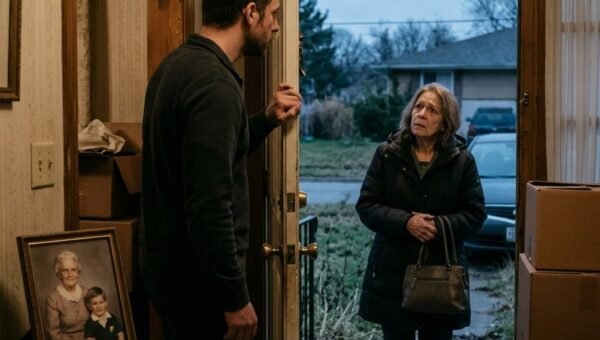
When the knock came, Clara was sitting at the table. I went to the door. Julian stood on the porch with a baby carrier in one hand and a folder tucked under his arm. He looked about 35, with dark hair and a careful, warm expression. He didn’t look like the tiny boy I remembered. I knew that was an impossible thing to expect, but my mind kept trying to match his face to the baby.
“I’m Julian,” he said.
“I know.”
He smiled a little. “Thank you for having me.”
I stepped aside. Clara stood up. Julian looked at her, and Clara looked at him. Neither of them spoke right away.
Then Clara said, “You have my eyes.”
He nodded. “I’ve been told.”
“I’m Clara.”
“I know,” he said. “It’s nice to meet you.”
Clara’s chin moved once, like she was trying to answer and couldn’t. She looked down at the baby carrier instead.
“Is this Maeve?”
“This is Maeve.”
Julian unbuckled the carrier and lifted his daughter out. Maeve made a small snuffling noise, then grabbed a fold in his shirt. Clara held out her arms, but she stopped halfway.
“Would you like to hold her?” he asked.
Clara looked at me, then back at him. “If that’s okay.”
“Of course.”
He placed Maeve in Clara’s arms. Clara sat down with the baby held close, careful at first, then more firmly when Maeve tucked her face under Clara’s chin. She started humming. It was a tune she used to sing to herself as a teenager. I knew it, though I hadn’t heard it in years.
Julian sat across from her. He didn’t push. I was grateful for that.
We talked about Maeve first. She was learning to pull herself up, and Julian said she liked to smack the high chair tray with a spoon. Clara asked if she slept well. He said not really. They talked like people trying to build a bridge from whatever boards they had. I stayed quiet more than I spoke. It felt right to let them find their own words.
After a while Julian took the folder from under his arm. He showed us his certified adoption papers, with the court stamp and the date. I saw the date match the one in Arthur’s old tax records, which I still had in a box. I didn’t need that proof, but I understood why Julian had brought it. He wanted us to know this was real and that he’d come with care.
Then he told Clara what Denise had said before she died.
“She kept the nurse’s note because she thought I should know,” he said. “She said my grandmother had asked for a few minutes alone with me.”
“Four,” I said.
“Four,” he repeated. “She told me you whispered that I was loved.”
I watched Clara’s face. It was a hard thing, hearing those words at last. She had spent years wondering if her baby might believe she’d chosen to leave him. She’d told me once that her father had made it sound like she’d done something shameful. I’d always said he was wrong, but I knew that was not the same as hearing it from her son.
“I didn’t want to give you up,” Clara said. “I was 16. My father made the choice.”
Julian leaned forward. “I know.”
“I’m sorry.”
“You don’t have to be sorry to me.”
Clara turned her head so I couldn’t see her face for a second. Then she looked back.
“I missed you.”
“I know,” he said. “I’m glad we’re here now.”
I went upstairs then. I didn’t want Clara to think I was hiding anything, so I called down that I was getting something. In the bedroom I opened the cedar drawer and lifted out the letters. The bundle was lighter than I remembered. I brought it down in both hands and set it on the table between us.
“These are yours,” I said. “One for every June ninth.”
Julian looked at the dates. He didn’t touch them right away.
“You wrote to me?”
“Every year.”
“Did you ever send any?”
“No. I didn’t know where you were. I kept them here.”
I hated how small my voice sounded. I was ready for him to ask why I hadn’t tried harder. I was ready to hear that letters in a drawer didn’t count. I had already decided not to defend myself. There were plenty of things I could say, and most of them would sound like excuses.
He lifted the top envelope. His fingers stopped on the first date. Then he looked at all the others, one after another, and his eyes filled.
“Every year?” he asked.
“Yes.”
“Even when you didn’t know if I was alive?”
“Yes.”
He bowed his head over the letters. I did not reach for him. I had spent too much of my life acting as if love meant I got to decide what someone else needed. I let him have the moment.
Clara still held Maeve. She began crying quietly, and the baby reached up and caught one of her fingers.
Julian wiped his face with the back of his hand. “I’m sorry. I didn’t expect this.”
“You don’t need to be sorry,” I said.
“I need you to know something.” He looked at me. “Those four minutes anchored me my entire life.”
I could not answer right away. He set the letters down and came around the table. Then he put his arms around me. I held him, this grown man I’d once held as a newborn, and tried not to grip too hard.
Clara stood with Maeve tucked against her shoulder. When Julian let go of me, he went to her. He didn’t ask her to hug him. He just stood close enough for her to choose. Clara reached out and touched his arm.
“Maybe we can have dinner next Sunday,” she said.
“I’d like that,” he said.
We exchanged phone numbers. Julian said he would bring Maeve again. Clara asked what she liked to eat, though Maeve was still mostly at the stage of throwing food. For the first time all afternoon, Clara laughed. It wasn’t a big laugh. It was hers.
Before they left, Julian took the letters with him. He said he wanted to read them, and later read them with Maeve as she grew up. I told him to take his time. There was no date he had to meet, no test to pass. He tucked the bundle carefully into his bag.
I used to think those letters belonged in the drawer because there was nowhere else for them to go. Now they were in Julian’s hands. Clara sat on the porch rocker, humming to Maeve while Julian watched from beside her. The baby’s eyes were open, fixed on the little movement of Clara’s mouth.
I went back inside. The cedar drawer was empty, and I left it open to the summer breeze. Through the window, I could hear Clara singing to her granddaughter on the porch.