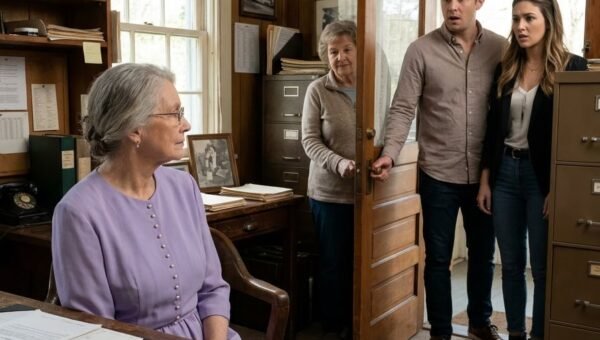
“Mom always wanted us to share.”
Julian said it on the phone eleven weeks after Mom died, like it was something she’d printed on a card and handed out with the Christmas cookies. I was in her dining room with a stack of condolence cards beside me and the China cabinet open. The house still smelled a little like Mom’s hand cream. I had spent the morning sorting papers for the estate, and I was tired enough to let him have his way just to get through one more thing.
He wanted the China set. Not a few plates, not the cups we used at Christmas, the whole set. He said his wife had always loved it, and Mom had promised it to her years ago. I said I didn’t remember that. Julian told me I must have forgotten. To be honest, that was the sort of thing I used to do with him. I would question myself first, before I questioned him.
Mom’s dining table still had the little dent near one corner where I dropped a serving spoon when I was twelve. I caught myself rubbing my thumb over it while Julian talked.
He had missed Mom’s last Christmas, but now he was speaking like the dishes had been waiting for him. He wasn’t shouting. He didn’t need to. He made it sound settled, and I nearly agreed because the funeral had already used up most of what I had in me.
I told him I would pack the China and call him when it was ready. He said that was fair, then added that his wife had a place picked out for it. I didn’t ask what kind of place. I hung up and stood there looking at the cabinet, with my mother’s good plates lined up behind the glass.
Then I started counting them in my head, which is a habit I got from years in a school office. I like a list. It makes things feel manageable, even when they aren’t.
Julian had skipped our last Christmas with Mom. I still had his empty chair in my mind, though I’d stopped setting a place for him after the first hour. Mom hadn’t wanted me to make a fuss. She’d said he had his reasons, and I believed her because I wanted the day to be peaceful. The truth was, she was already having trouble getting through dinner without stopping to rest.
That year, she wore the green sweater I’d given her and kept asking if the ham was dry. It wasn’t. She’d made it the same way for thirty years, with cloves stuck in the top and brown sugar pressed over it. I remember the smell of cloves on my fingers when I helped her carry the platter. The chair at the end stayed empty. I kept glancing at it, which was stupid, but I did.
Julian said he couldn’t come because his wife’s friends had invited them to a Christmas brunch. He’d said it was a long drive and they’d be tired afterward. I lived twenty minutes away and had driven over before daylight to get Mom’s stove going. That wasn’t something I held over him then. I told myself he had his own life. Mom told me not to let one missed meal turn into a family fight. So I didn’t.
But I noticed how she kept setting out the extra gravy boat anyway. She’d bought the China when Julian and I were kids, back when she thought we might both grow into the sort of adults who came home for holidays. She used that set sparingly. Mom washed every piece by hand and put each one away in its own little spot. If a cup went missing, she knew before anyone else did.
The gravy boat was always at the end of the table near Julian’s chair. That detail didn’t mean anything to me at the time. Or I didn’t let it mean anything. Mom had kept that boat even after the handle got a tiny hairline crack, and she never used it for anything but gravy. “It still pours fine,” she’d say if I asked. I used to tease her about keeping it. She’d smile, then wrap it in the same dish towel every time.
After the funeral, I went back to the house most days to sort things out. The estate attorney had given me a list of what needed doing, and I had the signed papers that made me executor. Mom had planned for things carefully. She’d even left notes on the pantry shelves about what could be donated and what should go to the church rummage sale. She’d been that kind of person. I took the papers to the kitchen and laid them beside the China cabinet before I started.
I could have called Julian and asked him to show me where Mom supposedly promised the set. I didn’t. Part of me thought he might be telling the truth. Another part didn’t want to hear him say that I was being difficult again. We had spent years having the same argument in different clothes. He would say something like, “You’re making this a bigger deal than it is,” and I would end up apologizing for being upset.
So I decided to pack it. That was my first wrong choice, though I didn’t know it yet. I told myself that giving him the dishes would save everybody trouble. I even thought about how his wife could use them for company, which was silly because I’d never seen her use anything that needed careful washing. Still, I’d rather make that excuse than admit Julian’s way of asking had already pushed me toward yes.
I cleared the kitchen table and found newspaper from the weekly paper in the recycling bin. I had a roll of bubble wrap in the hall closet, left from when I mailed Mom a framed school picture years earlier. I lined up the plates, then the saucers, then the cups. I put a piece of paper between each one and wrapped them tight enough that they wouldn’t knock together. It took longer than I expected. My hands got dry from the paper, and the tape kept sticking to my thumb.
I was alone in the house. I liked the work, actually. Mom had taught me how to wrap dishes, and I knew which cups had the little gold line that chipped if you got careless. The routine was comforting. Fold, turn, tape. Fold, turn, tape. I had my list on a legal pad, marking each group off with a blue pen. I was so busy doing the careful thing that I nearly missed the gravy boat.
I reached into the cabinet to lift it, and it felt heavier than it should have. Not much. Just enough that I stopped and checked if there was still gravy dried inside. There wasn’t. I set it upside down on the table and heard the smallest scrape against the paper. There was a strip of yellowed tape under the base, flattened against the porcelain.
I didn’t pull at it right away. I just sat down. I had seen Mom use masking tape to label jars and storage boxes, so it wasn’t unusual. But she’d never taped anything to the bottom of the gravy boat. I ran one finger along the edge and felt a piece of paper folded under the base. The tape had gone brittle and came away in little flakes when I eased it loose.
The note was folded twice. Mom’s handwriting was neat, the same steady slant as the grocery lists she used to leave on the counter. I recognized it before I got the whole thing open. I was glad I was alone. Not because I planned to hide the note, but because I didn’t want Julian hearing the sentence before I understood what it meant.
It said: “If Julian or his wife lay claim to these dishes, they do so against every wish of my heart; they are never to cross their threshold.”
I read it once. Then again. The gravy boat was still upside down in front of me, and a fleck of old tape had stuck to my wrist. I couldn’t make the words kinder by reading them slowly. Mom had named him. She had named his wife. She had made it plain.
The note was dated and signed. Beneath it, in Mom’s handwriting, was a short line pointing me to the personal-property direction attached to her will. I went to the folder on the counter. I had seen that direction already, but I hadn’t paid much attention to the China section because I’d assumed there was nothing to argue about. The paper named me as the person who would decide where the set went, and it specifically barred Julian and his wife from taking it. I’d thought it was a general note about the estate. It wasn’t.
I called the attorney’s office. I had to leave a message, then waited about forty minutes before the attorney called me back. I read the note aloud and described the will attachment. She said the signed direction was valid under the terms Mom had left, and that there wasn’t any promise to Julian’s wife in the estate papers. I asked if Mom could have changed her mind later. The attorney said the note was dated six weeks before Mom died. “It’s clear,” she said. “You can follow it.”
I sat with the phone in my hand after we hung up. I wasn’t relieved. I was angry, but not just at Julian. I was angry that Mom had felt she needed to do this. I was angry at myself for almost handing the set over before I even asked what she wanted. And I was angry that I had been so ready to make things easy for the person who had made things hard for her.
I thought about the months before Mom died. Julian and his wife had come by twice, both times for less than an hour. His wife had stood in the dining room looking at the China cabinet and asked if Mom still used the dishes. Mom said only on holidays. His wife said they would look nice in their dining room, then changed the subject. Julian didn’t say much. I remember Mom wiping her hands on her apron after they left, though she’d been sitting down the whole visit.
Another time, Julian called while I was at Mom’s house. Mom had been in bed most of the day. He asked me if she could still sign documents. I said she could, but she was tired. He told me he was asking because he wanted to get some things “straightened out.” I didn’t like the sound of it. I told him to talk to the attorney. He laughed like I was being dramatic. I didn’t tell Mom what he’d asked. I thought I was protecting her from worry. Maybe I was also avoiding another fight.
I don’t know what exact moment made Mom write the note. Maybe there wasn’t one. Maybe it was years of small things. Her hearing about the brunch instead of seeing Julian at Christmas. His wife asking about the dishes while Mom was still alive. Julian calling to ask about her signature while I was the one there bringing soup and sorting her pills. I kept thinking of the empty chair at Christmas. I had let him have a reason. Mom had kept a record.
By then, I had wrapped most of the set. I unwrapped it all again. That part sounds ridiculous, but I couldn’t leave it half packed as if the whole thing were still up for discussion. I put the cups back in their paper sleeves and stacked the plates in a clean box. I placed the note in a plastic sleeve with Mom’s estate papers. Then I called Julian and told him not to come for the China.
He asked what I meant. I told him I’d found a note under the gravy boat, and the will had a signed direction about the dishes. I could hear him shift the phone from one hand to the other. Then he said Mom had promised the set to his wife. I told him I didn’t find anything that said that. He said I was twisting a private note into a legal matter. I told him the attorney had confirmed the direction.
He went quiet for a few seconds, then said he’d come over. I should have told him not to, but I didn’t. Maybe I wanted him to see the note. Maybe I wanted to watch the story he’d made up fall apart in front of him. That’s not a nice thing to admit. Still, I was tired of being the person who swallowed every sharp bit so the room would stay calm.
Julian came by that afternoon. He didn’t bring his wife. He walked straight into the kitchen and looked at the boxes along the wall. I’d put the gravy boat on the table, with the note beside it. I had made tea, then forgotten to drink any of it. The cup had gone cold by the time he sat down.
He said he expected the dishes to be packed and ready. I said they were packed, but they weren’t his. He gave me the same look he used to give me when we were teenagers and I wouldn’t let him borrow my car. Then he repeated that Mom had wanted the two of us to share. “She told me herself,” he said. I asked when. He didn’t answer. He just said his wife had been promised the set.
I passed him the note. He took it and read it once. His mouth tightened at the word wife. I watched his eyes go back to the first line, then down to Mom’s signature. He said Mom must have written it when she was tired or upset. I said she’d signed it six weeks before she died, and the will referred to the same direction. He pushed the paper back across the table as if he didn’t want to leave his fingerprints on it.
He said it wasn’t fair to make this decision without him. I told him Mom had made the decision. He said she wouldn’t have wanted us fighting. I said I didn’t want that either, but I wasn’t going to pretend she had promised the dishes to his wife when her own handwriting said the opposite. That was the first time I didn’t soften what I meant for his sake.
He asked if I’d really keep the China away from him over a note. I said, “You don’t get to call it sharing after Mom had to write this.” He looked at me for a long time. His hand rested near the gravy boat, but he didn’t touch it. The old yellow tape was still stuck in a couple of tiny bits beneath the base. I could tell he wanted to say something that would get him back on top of the conversation, but nothing came.
Then he got angry. He said the estate might have to be reviewed and that a judge could decide whether the instruction was fair. I told him he could call the attorney, and I gave him her number. I didn’t threaten him. I didn’t have to. The will and the note were right there, and he knew it. He put on his coat and said I had always been good at making myself look like the responsible one.
That was unfair, and it also landed because I have spent a long time enjoying being the responsible one. I wanted Mom to notice how much I did. I wanted Julian to feel bad for not doing more. I brought up the things he hadn’t done at moments when I knew they would hurt. I wasn’t innocent in our family. But the China wasn’t a prize I had earned by doing more. It was Mom’s to give, and she had given a clear instruction.
Julian left without taking a dish. He didn’t call the attorney while I was there, and as far as I know, he didn’t call afterward. We had one short exchange about the estate paperwork a few weeks later, mostly handled by email. It was civil in the way a note from a bank is civil. After the estate was settled, we stopped talking.
At first, I told myself the distance felt like relief. It mostly did. But sometimes I still saw the empty chair from Christmas, and I wondered whether Mom had been waiting for him or already knew he wouldn’t come. I can’t know. I don’t want to turn her into someone who saw every hurt coming and had the perfect answer ready. She was just my mother. She got tired. She kept things in drawers. She loved us both, and she got sick of pretending that love meant she couldn’t set a limit.
I kept the China. Not because I thought I deserved it more than Julian, but because Mom’s papers said to keep it from him and because I couldn’t pretend the note didn’t exist. I use the dishes a few times a year. The first time, I nearly put them back in the cabinet untouched. Then a friend from down the road came over with a casserole after Mom died, and I set out the plates. She had sat with Mom for an hour one afternoon when I needed to go home and sleep. That’s who I wanted at the table.
Now the cups and plates are mixed in with the dishes I use every day. I still wash them by hand. I still wrap the gravy boat in that old dish towel when I put it away. The tiny crack in the handle hasn’t grown, and it still pours fine. When people come over, I don’t explain the note unless they ask. It isn’t a secret anymore, but I don’t need to make a speech out of it.
There’s one teacup I leave on the kitchen windowsill because the gold line has worn thin and I don’t want it knocked against the others. In the afternoon, it catches the light from the window, right over the sink where I wash the dishes. I used to think Mom kept that China safe because it was expensive. She kept it safe because she knew exactly who she’d trust with it.