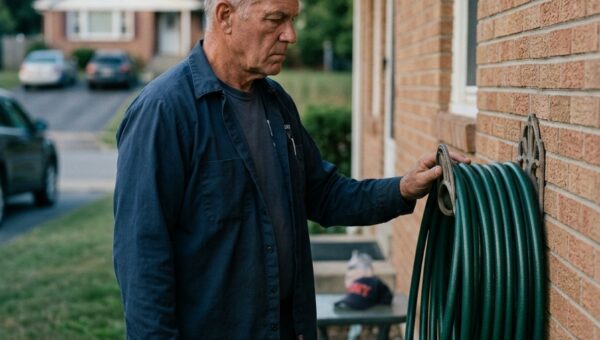

The fourteen-inch pipe wrench in my hand felt entirely too heavy for a Tuesday morning in November, cold enough to bite right through the cotton of my work gloves before I even reached the gravel turnout. County Road 14 had been quiet for the past hour save for the gravel popping under my truck tires and the dry rattle of dead thistle heads catching the tail end of a north wind. I had the toolbox on the passenger seat, a roll of plumber’s tape, and a clear head full of practical arithmetic. Dad had been gone since May, and while the estate lawyers and probate clerks in town kept telling me to take my time sorting through the machinery sheds and the hay barns, the utility bills were another matter entirely. For thirty-eight years, that stock tank out by the county fence line had stayed full right through the scorching dog days of August and the freezing crust of January. It made sense to start there with the shutoff valve, to stop the bleeding on whatever municipal line or electric sub-pump my father had been quietly paying for out of his own pocket every month. Nobody kept a livestock trough running for free in this county without a meter ticking somewhere down the line, and I figured it was time to find out what kind of stupid money the estate was throwing at a bunch of stray cattle and thirsty travelers.
I parked the truck with the driver’s side door practically touching the wooden corner post of the pasture fence, letting the six-cylinder engine ping itself to sleep in the dry grass. The stock tank itself sat about six feet off the gravel, half-sunken in crabgrass and wild aster, ringed around with a muddy shelf where hoofprints had frozen hard into the earth over the weekend. I walked up to it expecting the usual setup: a PVC riser coming up from a buried line tapped into the homestead’s well system, maybe a float box covered in green algae and spiderwebs, and a brass gate valve that would turn stiff if I didn’t give it a shot of WD-40 first. I dropped to one knee in the frozen mud, shoved my gloved hand under the rim of the galvanized basin, and felt around for the water feed. My fingers hit something smooth, cold, and entirely unexpected. It wasn’t plastic pipe. It wasn’t even standard galvanized iron. I pulled my hand back, wiped a smear of reddish-brown slime off my knuckle, and leaned in closer to peer beneath the waterline where the supply pipe rose from the ground.
The float valve wasn’t something you bought down at the Co-op or ordered out of a catalog with a part number stamped on the box. It was a solid, hand-machined piece of heavy yellow brass, gleaming dully through the greenish water like an old belt buckle lost in a creek bed. The arm was thick, curved with the kind of deliberate, slow-handed patience you only see from someone who spent forty years working a lathe in a barn with a single overhead bulb. It wasn’t wired into the rural electric grid either, because there were no conduit pipes running out from the house or overhead lines sagging across the pasture wire. The drop-pipe ran straight down into the earth, but the main feed line didn’t head toward the homestead power pole two miles west. It angled back across the property line toward the old wood-frame windmill standing sentinel on the rise behind the shelterbelt. I stood up slowly, wiping my palms on the thighs of my canvas trousers, and looked back toward the windmill tower. The blades were turning, slow and rhythmic against the pale gray sky, a faint metallic squeak carrying on the wind every time the tail vane shifted forty degrees to the left. There wasn’t any electric pump jack out there. It was a direct-stroke sucker-rod pump working the deep aquifer off pure wind power, pushing water through a buried galvanized line right down to this trough by the public road.
That was the first piece of the puzzle that didn’t fit, but I still had the wrench and I still had my mind set on wrapping up the chores before the weather turned. I figured maybe Dad had rigged up some sort of secondary overflow for his own stock back when he ran heifers in the north quarter, and when he quit cattle ten years ago, he just never bothered to dig it back up. I bent down again to look for the shutoff valve, the main gate where I could drop the pressure and drain the basin so the freezing December nights wouldn’t crack the seams wide open. I didn’t find a valve. I found a steel plate instead, about four inches square, welded directly to the heavy pipe standard holding the tank’s north corner. It was painted over with at least a dozen coats of gray enamel and farm-implement red, the kind of thick, brush-applied lead paint my father used on every piece of equipment he owned because he hated buying two cans when one would do. I took a flathead screwdriver out of my back pocket and started scraping at the corner, flicking off thick curls of dry paint until the bare iron underneath started to show through the rust and grime.
The metal was pitted and rough from forty winters of road salt and blowing grit, but the stamping underneath was deep enough that it had survived the paint layers like a fossil in shale. I scraped harder, clearing away the last stubborn gray flake with my thumbnail, and read the letters stamped one by one into the steel by a man with a heavy hammer and a set of steel punches. “FOR WHOEVER’S THIRSTY. RUNS WHILE THE WIND RUNS. – W.C. 1988.” The date sat right there at the end, clear as day, stamped in the exact same year my younger brother was born and the county burned up in that historic drought that turned every creek bed between here and the state line into a dry ditch of cracked white clay. I didn’t move for a long time. I just squatted there in the frozen mud with the screwdriver in one hand and the fourteen-inch wrench dangling from the other, looking at those initials. W.C. Will Callahan. My father. The man who spent twenty hours a day not talking to anyone, who ate his breakfast at five in the morning in absolute silence, and who treated a lost five-dollar bill like a personal insult against the household.
The silence out on County Road 14 is a heavy thing when you let it settle in around you, but it didn’t stay quiet for long. A mile down the gravel, I heard the distinctive, high-pitched whine of an old Ford six-cylinder engine struggling with a heavy load, the transmission whining in second gear as it crested the rise near the old schoolhouse. It was Martha Vance, driving her beat-up red-and-white feed truck with the wooden livestock racks on the back and a half-dozen empty burlap sacks flapping in the bed like captured birds. Martha has lived in this township since Eisenhower was in office, and she knows every fence line, every mortgage default, and every family feud from here to the river. She saw my truck pulled half into the ditch, signaled with her amber blinker, and brought the big Ford to a rolling stop right beside the trough, her diesel heater ticking loudly as the fan slowed down. She rolled her window down before the dust even settled, resting her forearm against the dirty rubber stripping with a look of mild, neighborly curiosity on her weathered face. “You fixing to cap it off, or is the leather seal just whistling in the wind again?” she asked, her voice raspy from forty years of smoking menthols and shouting over tractor engines.
I stood up slowly, my knees popping in the cold air, and held the wrench against my thigh like I needed something solid to hold onto. “I came out here to shut it down for the winter, Martha,” I said, pointing the tip of the screwdriver toward the welded plate on the tank standard. “I didn’t know it was hooked up the way it is. I thought there was a meter somewhere back at the house.” Martha looked at me for a second, her eyes squinting against the flat November sunlight reflecting off the stock tank’s surface, and then she let out a short, dry laugh that sounded like dry leaves scraping across concrete. “A meter?” she said, shaking her head so her silver earrings rattled against her collar. “Lord almighty, child, your daddy would have rather cut off his own right thumb than pay the county a nickel for water he could pump out of the ground himself. You didn’t know about this tank? Really? Your daddy didn’t ever tell you how he came to weld that plate on there back in eighty-eight?”
I shook my head, feeling a strange sort of hollow drop in my chest that had nothing to do with the cold. “He never mentioned it once. He didn’t talk much about anything unless a fence went down or a calf got out.” Martha reached over and clicked her truck’s hazard lights off, leaving the engine to idle with a low, rhythmic thrum that vibrated through the frozen ground beneath my boots. “Well, I suppose a man like Will Callahan isn’t going to go bragging about his mistakes, let alone how he tried to fix them,” she said, resting her chin on her knuckles. “Most folks round here have forgotten what that summer was like, but I haven’t. That was the year the wells went dry all the way down to the limestone shelf. We had seventy head of stock out on the south forty and we were hauling water in five-gallon milk cans just to keep the calves from dropping in their tracks.” She paused, looking past me toward the windmill turning steadily against the gray horizon. “August of eighty-eight. Right in the middle of that killer heat wave when the temperature didn’t drop below ninety even at midnight. A young family with a beat-up Ford pickup and a two-horse trailer threw a rod right here, fifty yards from your daddy’s front gate.”
I listened, not wanting to interrupt, the cold wind cutting straight through my canvas jacket while Martha painted a picture of a summer I was too young to remember with any real clarity. “The radiator blew right out on the road, water boiling over like a steam locomotive, and that poor mother had two little kids crying in the cab and three head of registered quarter horses standing in that wooden trailer with their tongues hanging out like old red rags,” Martha continued, her voice dropping down to a low, confidential register. “They walked up the drive to your daddy’s house to ask for a few buckets of well water out of the tank by the windmill. Just enough to wet the horses’ throats and limp into town. And your daddy… well, Will was never a warm man, even on his best days. He was sitting on the back porch sharpening a hay knife on an oilstone, and he looked at that young man like he was trying to sell him a bad bull.” She sighed, reaching for a pack of cigarettes on her dashboard before remembering she’d quit back in ninety-four and pulling her hand back empty. “He told them no. Said the well was dropping by the hour and he couldn’t spare a gallon for strangers who didn’t know how to maintain their own equipment.”
I winced, knowing the sound of my father’s voice in my head, flat, indifferent, and absolute as a granite tombstone. “That sounds like him,” I muttered, staring down at the brass float valve. “He never had much use for people who couldn’t pull their own weight.” “It sounded like him right up until the moment those people turned around and walked back down the drive,” Martha said, her tone sharpening with a sudden, fierce edge. “They didn’t make it two miles down the ditch toward the creek. One of the lead mares simply collapsed from heatstroke right there in the middle of the gravel, and by the time the volunteer fire truck got out there with a tank of brackish pond water, the other two horses were down and the family was sitting in the shade of a dead cottonwood tree crying their eyes out.” She shook her head, her gaze fixed on the ripples moving across the stock tank. “Your daddy didn’t go down there to watch. He stayed right up on his porch with that hay knife in his hand, but I saw him watching through the kitchen window. I stayed out here with my truck to help them hook up a tow chain. And I saw the exact moment something broke inside Will Callahan’s chest. He didn’t say a word to a living soul for three weeks after that. But come October, when the first cool snap hit and the ground was still soft enough to dig, he brought his tractor and a post-hole auger out here to this exact corner of the fence.”
The story settled over me like a heavy wool blanket soaked in river water, cold and impossible to shake off. I thought about the man I grew up with, the man who never raised his voice, who never apologized for anything, and who walked the perimeter of our land every single evening with a pair of pliers and a roll of barbed wire in his calloused hands. I always thought his silence was just the natural armor of a man who had lived through hard winters and bad prices. I never guessed it was a cage he built for himself out of shame. “He didn’t want anyone thanking him,” I whispered, the realization hitting me with the force of a physical blow. “That’s why there’s no name on it except those initials. That’s why he hooked it straight to the windmill instead of running a pipe from the house where people would have to knock on his door to ask.” “Exactly,” Martha said, putting her truck into gear with a heavy grind of the shift lever. “Your daddy wasn’t a saint, and he sure as hell wasn’t warm. But he knew what it meant to watch something die of thirst when there was water sitting right underneath the dirt. He built this tank so nobody ever had to walk up his driveway and ask him for a drop of mercy again.”
She gave a short wave, let out a puff of blue exhaust smoke as the old engine caught, and rolled away down the county road toward the grain elevator, leaving me alone with the wind and the water and the fourteen-inch pipe wrench still hanging from my hand. I stood there for a long time after her taillights disappeared around the bend, watching the bay horse from the neighboring ranch walk up to the trough, lower its head, and drink deep, steady drafts without a single care in the world. The float valve hissed softly beneath the surface, the brass arm rising with the water level until the seal clicked shut with the precision of a clockmaker’s watch. I looked down at the heavy iron tool in my grip, then up at the welded plate with its faded letters standing against the rust, and the anger I’d carried around since May, the resentment over the unfinished estate, the endless paperwork, the coldness of a father who left nothing behind but work, simply drained out of me into the frozen mud.
I walked back to the truck, opened the passenger door, and dropped the fourteen-inch wrench into the bottom of the toolbox right beside a can of axle grease and a spare roll of copper wire. I didn’t need the wrench today, and I wouldn’t need it tomorrow either. Instead, I climbed up into the bed of my pickup, grabbed the wooden-handled grease gun from behind the cab, and started walking across the frozen pasture toward the old windmill tower on the rise. The steel ladder was cold against my gloves, every rung rusted red with iron oxide from decades of rain and sun, but it held my weight without a squeak. When I reached the platform at the top, right beneath the rotating wooden wheel that caught the high-altitude gusts coming off the plains, I found the grease fittings W.C. had installed back in eighty-eight. They were clean, wiped down with an oily rag just last month before the snow started, gleaming faintly in the pale afternoon sun like a pair of silver buttons on a dead man’s vest. I worked the plunger of the grease gun until a small, dark bead of fresh lubricant oozed out around the brass fitting, wiping away the excess with my thumb just the way my father had taught me when I was ten years old, not with words, but by standing behind me on the ladder until I figured out how to do it without making a mess.
The wind picked up as the sun started to dip below the shelterbelt, casting long, sharp shadows across the stubble fields and turning the gray surface of the county road into a ribbon of tarnished silver. Down below, by the fence line, the stock tank was brim-full, the water catching the last orange light of dusk and sending tiny, shivering ripples outward toward the rim every time a fresh gust hit the windmill blades. I climbed down the ladder slowly, my joints aching from the cold, and walked back to the truck to stow the grease gun in the back. The heavy pipe wrench lay untouched in the toolbox beside the open can of axle grease, while overhead the windmill blades creaked into the evening gale, sending a fresh, crystal arc of water into the rippling brass-valved tank. I didn’t say anything out loud to the empty pasture, because words were never our family’s currency anyway. I just closed the tailgate with a solid, familiar thunk, got into the cab, and started the engine for the long drive home, leaving the water running for whoever might need it before the morning frost set in.