
PART 1
My name is Hannah Miller. I am twenty-nine years old, and for the past six months, my entire world has revolved around a small, plastic medication organizer and the fragile heartbeat of my two-year-old son, Leo.
Leo was born with a severe, rare congenital heart defect that doctors warned us would likely be terminal without an eventual transplant. Every single day was a quiet war against time. I quit my job as a paralegal to become his full-time caregiver.
I learned to measure liquid dosage down to the milligram, to read oxygen saturation monitors, and to recognize the subtle, terrifying gray tint in his lips that meant his heart was struggling.
My husband, Marcus, was thirty-one and worked as a regional sales director for a medical supply company. When we first married three years ago, he was charismatic, attentive, and ambitious. But the moment Leo’s diagnosis came down, something inside Marcus detached completely.
He didn’t scream, and he didn’t leave. Instead, he withdrew into a cold, clinical indifference that was far more painful. He spent eighty hours a week “at the office,” traveled constantly for business, and treated our home like a hotel where he occasionally slept.
I handled everything. I took Leo to his endless cardiology consults, managed his physical therapy, cleaned the house, cooked the meals, and stayed up through the agonizing nights when Leo whimpered in pain.
Marcus’s sole domestic responsibility—the one thing I asked him to do—was pick Leo up from his specialized medical daycare at four o’clock on the three afternoons a week Leo was strong enough to attend.
Even that tiny obligation was met with heavy sighs and bitter resentment. On the rare occasions Marcus was home and I begged him to hold Leo for just fifteen minutes so I could take a shower or eat a warm meal, he would lean back on the couch, look at his phone, and mutter, “You’re the one who wanted to pause your career for this, Hannah. I told you from the start I wasn’t ready for kids.”
The crushing weight of his words sliced through me every single time, but I had no energy left to fight him. My baby needed me.
Then came the freezing Tuesday night in late November.
At two in the morning, the pulse oximeter on Leo’s nightstand began to beep wildly.
I bolted out of bed and rushed to his crib. Leo was burning hot to the touch, his skin flushed dark red, his tiny chest heaving as he gasped for air. I slipped a temporal thermometer across his forehead: 104.5°F.
“Marcus!” I screamed, running into the master bedroom. I grabbed Marcus by the shoulder and shook him violently. “Marcus, wake up! Leo’s fever is over a hundred and four! He’s going into respiratory distress! I need you to carry the oxygen tank while I get him to the car!”
Marcus groaned, swiping my hand away from his arm. He rolled over, pulling the heavy duvet tightly around his neck.
“Call an ambulance if it’s that bad, Hannah,” he mumbled into his pillow, his voice thick with sleep and irritation. “I have an eight AM presentation in the morning. Stop panicking over every little spike.”
“He is limp, Marcus!” I sobbed, the tears burning my eyes. “Please! Just help me get him down the stairs!”
“I’m sleeping,” Marcus snapped, turning his back to me completely. “Handle it yourself.”
I stared at his turned back for two terrible seconds, realizing with absolute clarity that my son and I were completely alone in the world.
I didn’t wait another moment. I ran back into Leo’s room, wrapped my limp, whimpering boy in a thick winter blanket, hooked his portable oxygen machine over my shoulder with one arm, and carried him down the stairs in the dark. The freezing rain hit my face as I stumbled across the driveway, strapped Leo into his car seat, and threw the car into drive, racing toward Saint Jude Children’s Hospital with my hazards flashing.
PART 2
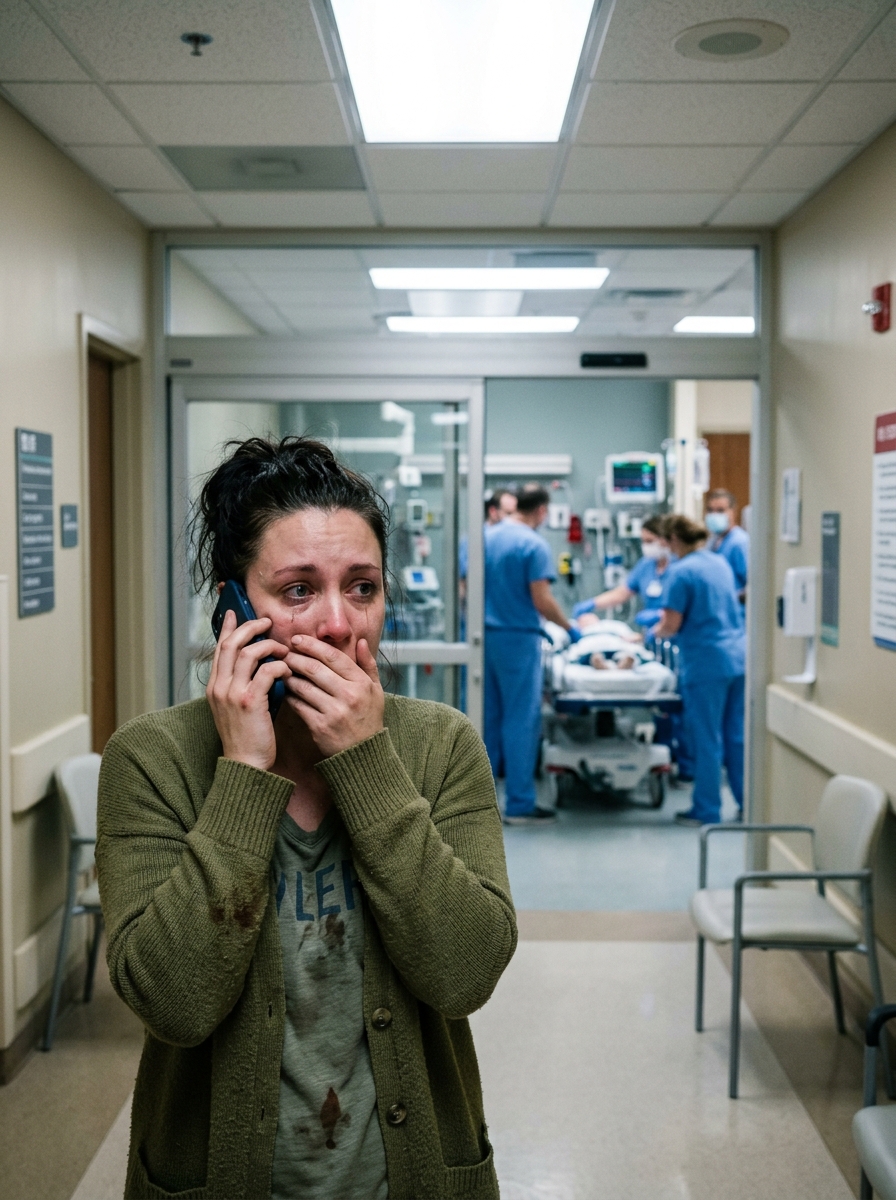
The emergency room was a blur of fluorescent lights, shouting medical staff, and the cold metal of a trauma gurney. The moment I burst through the sliding doors carrying Leo, the triage nurse took one look at his blue-tinged lips and yelled for an emergency resuscitation team.
Within seconds, four doctors and three nurses swarmed around my little boy in Bay Two. They inserted IV lines, hooked up high-flow oxygen, and began pushing intravenous antibiotics to fight what they suspected was a sudden, aggressive blood infection threatening his compromised heart.
I stood pressed against the cold tile wall in the hallway, clutching Leo’s tiny blue stuffed elephant against my chest, hyperventilating as I watched them work through the glass panel.
My hands were shaking so violently I could barely unlock my phone. I needed Marcus. Despite his cruelty three hours ago, he was still Leo’s father. He needed to be here. He needed to sign emergency consent forms if the doctors had to intubate our son.
I dialed Marcus’s cell phone. It went straight to voicemail.
I dialed it again. Voicemail.
Then I remembered that Marcus carried a secondary, high-tier work phone provided by his medical firm—a phone he kept specifically for urgent corporate emergencies. He had left the number written on a sticky note inside his leather planner on the kitchen counter months ago, and I had saved it in my contacts under “Marcus Work Direct.”
I tapped the number and held the phone to my ear, praying he would hear the ring.
It rang once. It rang twice. On the third ring, the line clicked open.
“Marcus!” I cried out, my voice cracking with desperation. “Marcus, thank God! You have to come to Saint Jude right now! Leo is in the ER, they’re trying to stabilize his heart, and—”
“Hello?” a soft, breathless female voice interrupted.
I froze instantly. The noise of the hospital seemed to drop into dead, ringing silence.
“Who is this?” the woman’s voice asked, sounding groggy and slightly irritated. “Why are you calling Marcus’s private line at three in the morning?”
My stomach dropped into a sickening vault. “Who… who are you?” I whispered, my voice barely audible above the hum of the ER monitors. “Where is Marcus?”
There was a sudden, sharp pause on the other end of the line, followed by the faint rustle of silk bedsheets.
“This is Sarah,” the woman replied, her tone turning defensive and cautious. “I’m his partner. Marcus is asleep right now. He’s had a really long week with the new baby, so unless this is an official corporate emergency, please don’t call this line.”
The world tilted on its axis. My breath caught in my throat so hard I choked.
*The new baby?*
“What… what did you just say?” I breathed, gripping the hospital handrail to keep my knees from collapsing. “What new baby?”
“Look, lady, I don’t know who gave you this private number,” Sarah snapped, her voice dropping into an angry whisper. “Marcus and I have been together for two years. Our daughter was born four months ago. He’s sleeping in the nursery with her right now because he took off work this week to help me. Lose this number.”
The call disconnected with a sharp click.
I stood frozen in the middle of the pediatric trauma hallway, the phone pressed against my ear, listening to the hollow dial tone as the terrible, monstrous truth washed over me.
PART 3
The daycare pickups that were “too exhausting.” The endless “out-of-town sales trips” every Thursday through Saturday. The sudden financial tightness despite his six-figure corporate salary. The total emotional detachment from our dying son.
Marcus hadn’t been working eighty hours a week. He hadn’t been traveling for business. For two years—while I was sitting in sterile hospital rooms holding our sick toddler’s hand—my husband had been living a complete, fully funded second life with another woman and a newborn daughter just twenty miles across town.
A doctor stepped out of Bay Two, wiping sweat from his forehead. “Mrs. Miller?”
I forced myself to look at him, pushing the suffocating shock deep down into a dark corner of my mind. My son was still alive. That was the only thing that mattered.
“We’ve managed to bring his fever down and stabilize his oxygen saturation,” the doctor said, offering a tired, reassuring smile. “The sepsis was caught just in time. He’s sleeping now. We’re moving him to the Pediatric Intensive Care Unit for monitoring.”
“Thank you,” I choked out, tears finally spilling over my cheeks. “Thank you, Doctor.”
I sat beside Leo’s ICU bed until six in the morning, holding his warm, small hand while he slept peacefully under the soft hum of the heart monitor. As the sun began to rise over the city skyline, a cold, unyielding strength took root inside me. The weak, desperate, isolated woman who had begged for crumbs of affection from a monster was gone.
At seven AM, I called my father—a retired chief of police—and told him everything. By eight AM, my father and my uncle arrived at the hospital, taking over the shift at Leo’s bedside so I could handle what needed to be done.
I didn’t drive home to cry. I drove straight to the law offices of Vance & Stern, where my former employer, Senior Partner Thomas Vance, met me in his conference room.
Within three hours, Thomas pulled up property records, corporate filings, and bank registry indexes. The evidence was damning and effortless to find. Marcus had forged my digital signature eighteen months ago to take out a $150,000 second mortgage on our family home—using the equity to buy a luxury townhouse in Sarah’s name and fund her lifestyle while claiming to me that our savings were depleted by Leo’s medical bills.
“He committed mortgage fraud, marital conversion of assets, and grand larceny, Hannah,” Thomas said softly, laying the printouts on the glass table. “If we file this affidavit with the county prosecutor, he isn’t just looking at a divorce. He’s looking at federal prison time.”
“File it,” I said, my voice steady, icy, and completely devoid of fear. “File every single page.”
At two o’clock that afternoon, I walked into our house with two uniformed sheriff’s deputies and a court-appointed emergency asset preservation officer.
Marcus was sitting at the kitchen island in his bathrobe, casually drinking coffee and typing on his laptop, having finally woken up from his rested sleep.
He looked up, frowning with annoyance when he saw the officers behind me. “Hannah? Where the hell have you been all day? I woke up and the house was empty. Did you take Leo to the clinic again without telling me?”
I walked up to the island, set my house keys on the granite counter, and looked him dead in the eyes.
“Leo spent the night in the PICU fighting for his life while you slept off your shift at Sarah’s house,” I said smoothly.
Marcus’s face drained of every ounce of color. The coffee cup in his hand trembled, spilling dark liquid onto his white robe. “Hannah… wait… I can explain—”
“You don’t get to explain anything to me ever again, Marcus,” I interrupted. “Deputies, that is the man who forged my signature on the secondary land deed.”
ENDING
The fallout was swift, devastating, and entirely deserved.
Marcus was arrested on the spot for grand fraud and identity theft. When Sarah discovered that the man who claimed to be a wealthy, single medical executive was actually a married father who had stolen from his terminally ill child to fund her apartment, she cooperated fully with the prosecution, turning over every text message, financial record, and luxury gift he had ever given her.
Faced with overwhelming paper evidence and potential ten-year prison sentence, Marcus surrendered every financial asset he possessed in a pre-trial settlement to avoid maximum sentencing.
Through the court order, the second mortgage was fully liquidated from his personal corporate pension fund, the house was restored entirely to my name, and a $300,000 medical trust was legally secured for Leo’s ongoing healthcare needs. Marcus was eventually sentenced to four years in a state correctional facility for financial fraud.
Four months after the divorce was finalized, a miracle occurred.
A donor heart became available for Leo at the Children’s Hospital of Philadelphia. The fourteen-hour transplant surgery was a complete success.
Today, eighteen months later, I stand on the back porch of our sunlit home, watching my four-year-old boy run through the green grass with our golden retriever. His cheeks are bright pink, his laughter echoing across the yard, full of strength, energy, and limitless life.
He is no longer dying. He is thriving.
I sat down on the porch steps, pulling my cardigan around my shoulders, feeling a deep, unshakeable sense of peace.
I used to think I needed Marcus to survive the storm that hit our family. I used to think I was weak because I was fighting alone. But the moment I stopped begging a coward for help was the moment I reclaimed my own power.
True strength isn’t about holding onto a broken marriage to keep up appearances. It’s about having the courage to tear down the lies, protect the innocent, and build a safe, honest world for the people who truly matter.
Leo ran up the steps, his chest moving with a strong, steady, healthy rhythm, and threw his small arms around my neck.
“I love you, Mommy,” he whispered into my ear.
“I love you too, my brave boy,” I smiled, holding him tight against my heart—a heart that was finally whole, peaceful, and completely free.


