
PART 1
My name is Evelyn Vance. I am sixty-eight years old, and for forty-two years, Grace Community Church in Oak Creek, Ohio, has been the backdrop of my entire life.
It was where my late husband, Calvin, and I were married in 1978. It was where we baptized our two children, where we wiped away tears at quiet funeral services, and where we spent virtually every weekend clearing brush, painting Sunday school rooms, and baking casseroles for community potlucks.
Six months ago, our long-serving pastor retired, and the deacon board brought in Pastor Mark Hollings. Mark was thirty-four, sharp-suited, and possessed a charismatic smile that charmed the younger families moving into the new housing developments on the edge of town. Mark was a man full of vision—and he made it very clear from his first week that Grace Community needed a total image overhaul.
“We need modern energy, Evelyn,” Mark had told me casually in his office three weeks ago during our monthly committee review. “The modern church needs to reflect the modern family. People want open spaces, digital displays, and fresh perspectives.”
What he really meant was that he wanted me off the building committee.
I had founded the building committee in 1984. Back then, the church was a small, struggling congregation of forty families meeting under a leaky roof. When the church decided to expand and build a dedicated fellowship hall to host youth groups and community meals, the local bank refused to extend a commercial mortgage line to the church board without personal guarantors.
The congregation was poor. Most members were factory workers or young farm couples raising children on tight budgets. Nobody had the collateral—except Calvin and me. Calvin ran a modest but successful rural plumbing contracting business, and we owned twenty acres of farm equipment and our home free and clear.
Quietly, without fanfare or public recognition, Calvin and I signed our names as personal guarantors on the $145,000 mortgage note for the fellowship hall. When the regional economy hit a brutal recession in 1987 and church tithes dropped by half, the church couldn’t make the monthly bank note. Rather than watch the bank foreclose on the sanctuary, Calvin and I paid the monthly bank notes out of our own business savings account for nearly five years.
The church board signed a formal promissory note back then, promising to reimburse us once the building fund stabilized. But over the decades, as pastors changed and old board members passed away, the debt was swept under the rug.
Calvin never pushed them for it. “It’s God’s work, Evie,” he used to tell me, squeezing my hand. “The money went into the bricks, and the bricks hold up the people.”
Calvin passed away four years ago from heart failure. I never asked for a penny of that money back. I was content simply serving on the committee, making sure the building my husband bled for was maintained with care, dignity, and respect.
Until Pastor Mark decided my presence was an embarrassing relic of the past.
Two weeks ago, during the announcements at the end of the Sunday service, Pastor Mark had stood on the stage, looked directly at me in the second row, and beamed into his wireless headset microphone.
“We want to take a moment today to recognize our dear Evelyn Vance for her decades of faithful service on the building committee,” Mark announced, as the congregation clapped politely. “Evelyn has been a pillar here, but as we launch our multi-million-dollar modern building campaign, Evelyn has graciously agreed that it’s time for fresh faces to take the lead.
We thank her for her service as she steps into a well-deserved retirement from administrative duties.”
My blood ran cold. I had agreed to no such thing. He had orchestrated the public announcement to trap me—knowing that if I disputed it right there, I would look like a bitter, disruptive old woman ruining a sacred moment.
I sat in my pew, smiled politely, and kept my lips pressed tight.
For two weeks, Mark ignored my calls to discuss the upcoming building plans, which included demolishing the original 1984 fellowship hall to build a glass-fronted coffee lounge.
He thought I was just an aging widow who could be managed, patronized, and quietly pushed into the background.
He didn’t know that on Saturday night, I opened Calvin’s old metal filing cabinet in the basement, pulled out the faded blue leather binder labeled *Grace Community Fellowship Hall — 1984 Bank Note*, and read every single notarized page.
PART 2
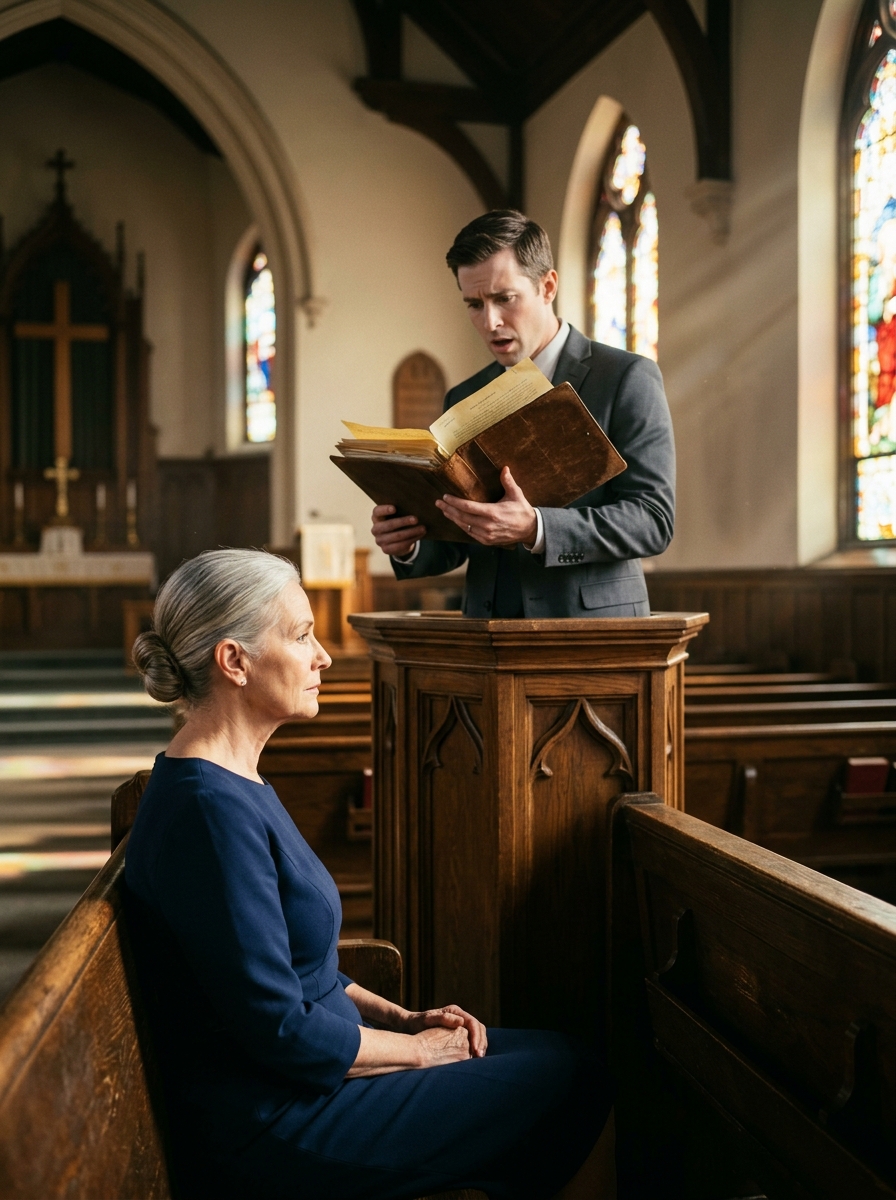
On Sunday morning, the air inside the sanctuary was crisp and heavy with anticipation. The modern worship band finished their final song, and the congregation settled into the pews.
Pastor Mark stepped up to the hand-carved mahogany pulpit—the same pulpit Calvin had refinished with his own hands in 1991. Mark adjusted his iPad on the wooden stand, smoothed his tailored jacket, and prepared to deliver his sermon on “Building a Vision for Tomorrow.”
Before he could begin, I stood up from my usual seat in the second row.
The sanctuary grew completely quiet. A few people gasped softy; rising during the transition to the sermon was strictly outside church protocol.
I walked up the carpeted altar steps, carrying the blue leather binder in my hands. I didn’t look angry, and I didn’t raise my voice. I simply walked directly up to the pulpit, set the heavy folder squarely beside his iPad, right over his sermon outline, and looked Pastor Mark straight in the eyes.
“You’ll want to review the building’s original title encumbrance before you present the expansion vote today, Pastor,” I said softly, my voice clear enough for the first three rows to hear.
Mark’s smile froze. He looked down at the folder, then at me, his eyes narrowing with subtle irritation. He clearly thought I was handing him a list of grievances or an old committee petition.
“Thank you, Evelyn,” he whispered tightly, attempting to brush me off with a polite nod toward the stairs. “We can discuss committee notes in Tuesday’s administrative meeting.”
“Page three has the notarized bank signature,” I replied in the same quiet, unshakeable tone. “I’ll be right down here.”
I turned, walked back down the altar steps, and resumed my seat in the pew, smoothing my skirt over my knees.
The congregation watched in absolute silence. Mark cleared his throat, trying to regain his composure. “Well… before we turn to the Scriptures today, let’s… let’s see what sister Evelyn has brought us.”
He opened the blue leather binder, expecting a handwritten letter.
I watched his eyes as he hit page one.
Page one was the original 1984 commercial mortgage agreement between First National Bank of Oak Creek and Grace Community Church, carrying the signatures of Calvin Vance and Evelyn Vance as primary personal guarantors.
Mark’s brow furrowed. He flipped to page three.
Page three contained the 1987 formal promissory note, legally executed by the church’s board of trustees, acknowledging that Calvin and Evelyn Vance had personally assumed forty-eight consecutive monthly mortgage payments totaling $68,400 during the economic crisis, at a six-percent annual interest rate.
Page six was the most critical page of all. It was the deed restriction rider executed when the fellowship hall was completed. Because the debt was never officially settled or cleared by the church, the deed contained a binding covenants clause: *No structural alterations, demolition, or sale of the Fellowship Hall parcel may occur without the written consent of the primary guarantors or their surviving heir.*
Mark’s face lost every bit of its youthful color. The charismatic confidence he had worn like armor for six months completely evaporated.
He flipped through the remaining pages—the bank receipts, the canceled checks stamped with Calvin’s plumbing business logo, and the notarized county land record index.
The entire sanctuary held its breath. The silence was so profound you could hear the ticking of the wall clock in the back foyer.
Mark looked up from the folder, his hands visibly trembling at the edges of the mahogany pulpit. He looked at the senior deacons sitting in the front row, then at the congregation, and finally down at me.
He opened his mouth, closed it, cleared his throat, and then spoke into the microphone.
PART 3
“Brothers and sisters…” Mark began, his voice lacking its usual boisterous projection, sounding suddenly thin and fragile. “It appears… it appears there are historical legal covenants attached to our church property that require our immediate attention.”
He paused, swallowing hard as he looked down at the paper in front of him.
“In 1984, when this congregation was facing total financial collapse and the loss of its grounds, Calvin and Evelyn Vance personally carried the financial burden of this church,” Mark announced, his words ringing through the silent room like a tolling bell. “They signed their own home and livelihood over as collateral. And for forty years… that debt was carried in silence.”
A murmur rippled through the pews. Old Bob Miller, who had served on the usher team since 1990, leaned forward, his mouth open in shock. Sister Clara, sitting two rows behind me, clutched her prayer book to her chest.
Mark looked directly down at me, his arrogant posture completely humbled.
“The building committee expansion vote scheduled for today is suspended,” Mark said into the microphone. “And before I say another word… I need to publicly apologize to Evelyn Vance. I treated her service as a legacy of the past, without ever understanding that without her and Calvin, there would be no present for this church to stand on.”
After the service concluded, the congregation didn’t rush to the foyer for coffee as they usually did. They gathered in quiet, respectful clusters around my pew.
The older members wept, remembering the lean years of the mid-eighties and realizing for the first time who had quietly kept the heat on and the doors unlocked during those cold winters. The younger families looked at me with a newfound reverence, realizing that the fellowship hall where their children played tag every Sunday was paid for by the sweat of a local plumber and his wife.
An hour later, Pastor Mark and the board of deacons asked me to step into the executive office.
Mark sat across the table from me, the blue leather folder lying open between us. He looked thoroughly shaken, but for the first time since he had arrived at Grace Community, he looked genuinely human.
“Evelyn,” Mark said softly, his hands folded on the table. “I was wrong. I was arrogant, and I was focused on building a kingdom for my own vision rather than honoring the people who built the foundation. The church owes your family over two hundred thousand dollars with accrued interest. If you enforce the deed restriction or demand immediate repayment, we cannot proceed with any building plans.”
I looked at the young pastor, seeing the genuine remorse in his eyes. I hadn’t brought that folder to destroy the church, nor had I brought it to line my pockets with old money.
“Pastor Mark,” I said calmly, resting my hands on my purse. “Calvin and I didn’t give that money to own this church. We gave it because we loved the people inside it. I don’t want two hundred thousand dollars, and I don’t want to stop this church from growing.”
Mark blinked, stunned. “You… you don’t?”
“No,” I replied firmly. “But I will not allow you to tear down the fellowship hall that my husband gave his youth to build just so you can put up a trendy coffee shop. And I will not allow you or anyone else to treat the senior members of this congregation as obsolete relics who have nothing left to offer.”
ENDING
## 8. ENDING
By Monday afternoon, a formal legal agreement was drafted by the church attorney and signed in the presence of the entire deacon board.
In exchange for a formal waiver of the monetary debt, the church established the *Calvin and Evelyn Vance Community Outreach Endowment*—a permanent, protected fund dedicated to helping local families in Oak Creek struggling with mortgage payments, emergency medical bills, and home repairs.
Furthermore, the deed restriction was modified with my full approval: the original 1984 fellowship hall would not be demolished. Instead, the architectural firm was instructed to redesign the expansion project to integrate and restore the original wooden structure, preserving the hand-carved mahogany beams Calvin had helped raise.
I did not step down from the building committee. Instead, Pastor Mark appointed me as the Senior Chair of the Historical and Facilities Oversight Board, ensuring that every future expansion project respects both the financial integrity and the heritage of the founding families.
Yesterday afternoon, I walked through the fellowship hall after Sunday school let out.
The sun was shining through the high arched windows, casting warm amber light across the polished oak floorboards. A dozen children were laughing and running across the hall, while young parents sat at the tables chatting and sharing coffee.
Pastor Mark walked up beside me, carrying two paper cups of tea. He handed one to me with a respectful nod.
“It’s a good room, Evelyn,” he said softly, looking around at the sturdy, honest craftsmanship of the walls. “It has good bones.”
“It has the best bones, Pastor,” I smiled, taking a sip of the warm tea. “Because it was built on sacrifice, not vanity.”
As I watched my grandchildren play near the altar steps where Calvin and I had stood decades ago, I knew that my husband’s legacy was safe. We hadn’t just saved a building—we had preserved the heart of a community, proving that true vision never discards the foundation it was built upon.