
PART 1
My name is Rachel Vance. I am thirty-eight years old, and for as long as I can remember, my Aunt Clara was the steady, quiet anchor of our family.
Growing up in a tight-knit neighborhood in suburban Indiana, Aunt Clara was the relative everyone relied on. If a neighbor was sick, she brought over homemade soup. If my mother needed someone to watch me after school, Aunt Clara’s front door was always open. Yet despite her generosity, there was an invisible wall around her.
She never spoke about her youth, she never married, and she rarely discussed her personal life.
The centerpiece of her modest home was a massive, dark mahogany upright piano that sat in the corner of her front parlor. It was always polished, decorated with a lace runner and framed family photographs. But in all my thirty-eight years, I never once heard Aunt Clara press a single key. When I was a child and asked her to play a song, she would simply smile softly, pat my hand, and say, “That piano has already played its music, sweetheart.”
When Aunt Clara passed away peacefully in her sleep at age eighty-two, her modest estate was divided among her nieces and nephews. To my brother, she left her small savings; to my sister, her silver tea set. To me, she left the old upright piano.
Two days ago, two professional movers arrived at my house to deliver it.
As they hoisted the instrument up my front steps, both men grunted under the weight.
“I’ve moved dozens of these, ma’am,” the lead mover said, wiping sweat from his forehead. “This thing weighs like it’s full of lead bricks. Something inside slid real heavy when we turned the corner.”
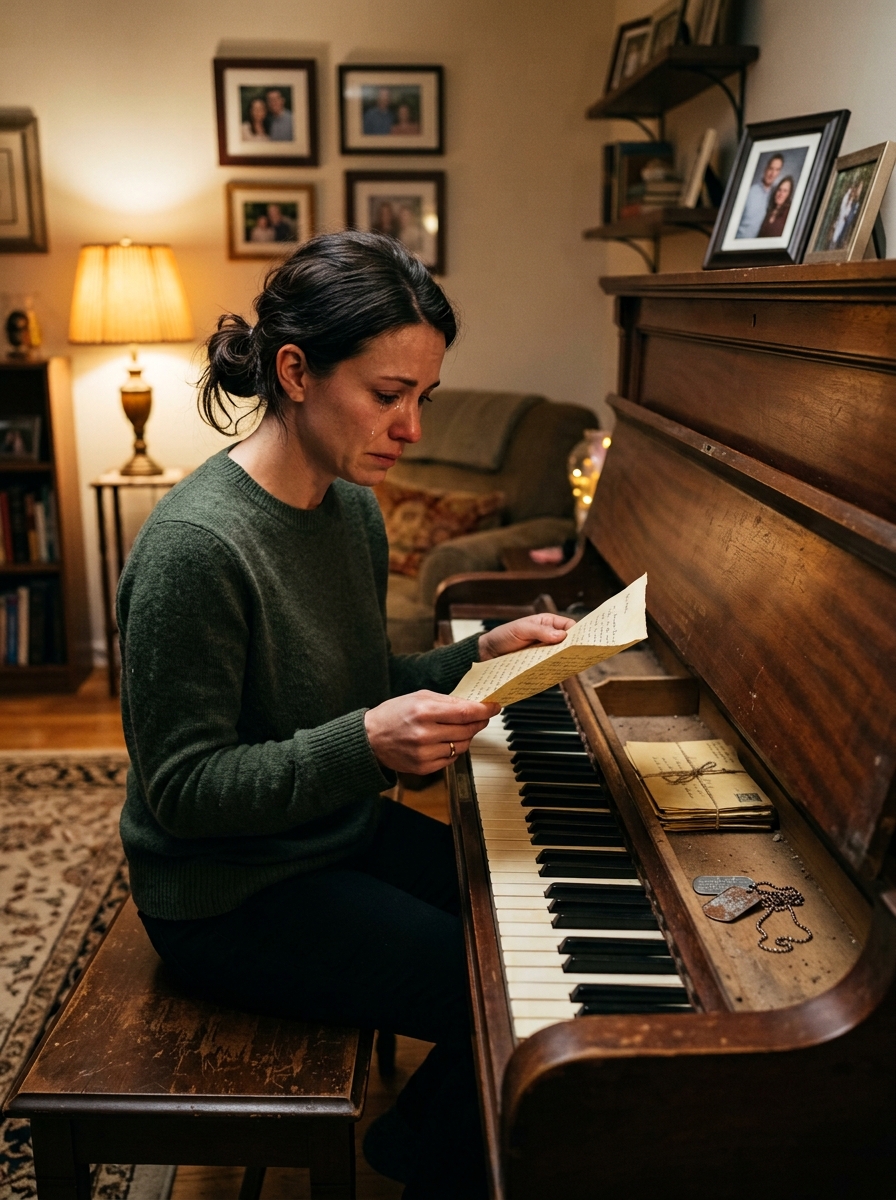
After they left, the curiosity became unbearable. I grabbed a flashlight and a screwdriver from my kitchen drawer and sat down on the piano bench. I unscrewed the upper front wooden panel that covered the internal hammer assembly.
When the wooden face came away, I gasped.
The cast-iron harp and strings were still there, but directly behind the keyboard, where the lower soundboard should have been exposed, someone had carefully built a shallow, custom wooden box fitted flush against the frame. It was painted with matte black lacquer, making it completely invisible unless the entire outer cabinet was removed.
Using a butter knife from my kitchen, I gently popped the small brass latch securing the box.
Inside lay a neat, tightly packed stack of forty thick paper envelopes, each tied with blue ribbon and labeled with a year spanning from 1984 to 2024.
Resting on top of the letters was a tarnished silver military dog tag stamped with the name *Thomas E. Miller*, and a yellowed legal document bearing an official state seal.
My heart hammered in my chest. I picked up the topmost envelope—dated 1984—and carefully unfolded the handwritten letter inside.
The handwriting belonged to Aunt Clara, but the story it told was one our family had never heard.
PART 2
For my entire life, my family believed Aunt Clara had chosen to live a quiet life as a single woman simply because she preferred her independence. My mother had always told us that Clara was “just not the marrying type.”
The letters proved how wrong we were.
In the summer of 1982, when Clara was forty years old, she had fallen deeply in love with Thomas Miller, a soft-spoken carpenter and Vietnam veteran who had moved to our town to work on local restoration projects. Thomas was a widower with a five-year-old son named David.
According to Clara’s detailed journal entries, she and Thomas had planned to marry in the spring of 1984. But just six months before their wedding, Thomas was diagnosed with an aggressive, terminal illness related to his military service.
Knowing his time was short, Thomas was terrified for his young son’s future. David’s maternal relatives were distant and cold, and Thomas wanted Clara to raise the boy. However, under the strict adoption and guardianship laws of the era, an unmarried woman faced immense legal hurdles to gain legal custody of a child who was not biologically hers.
Determined to secure David’s future, Thomas used his remaining strength as a master carpenter to build the hidden compartment inside Clara’s upright piano. Together, they quietly placed $45,000—Thomas’s life savings and military pension settlement—inside the instrument.
Two weeks before Thomas passed away in late 1984, he signed a private, notarized guardianship trust naming Clara as the legal custodian of his funds for David’s upbringing, held in trust until the boy reached adulthood.
When Thomas died, his estranged relatives attempted to claim his estate, but Clara presented the legal guardianship papers Thomas had drawn up. Unable to locate his cash savings—which remained hidden inside the piano—the relatives eventually retreated.
Clara raised David in secret during his early childhood, placing him in a reputable private residential boarding school two hours away to protect him from legal interference from Thomas’s family, paying every dollar of his tuition, medical care, and living expenses directly from the hidden cash reserve inside the piano.
As I read through the envelopes year by year, I saw Clara’s meticulous records: receipts for school clothes, summer camp fees, medical bills, and college application fees, all paid in cash, paired with photos of a young boy growing into a confident, smiling young man.
Aunt Clara had spent forty years living frugally in her small house, sacrificing her own comfort and endure our family’s quiet pity, all to fulfill a sacred promise to the love of her life.
Then I reached the final envelope, labeled 2024. Inside was a recent photograph of a forty-five-year-old man standing beside a young girl at a high school graduation—and a letter written just three weeks before Clara died.
PART 3
The final letter was addressed directly to me.
*My dearest Rachel,* Clara had written in her elegant, slightly shaky script.
*If you are reading this, it means I have finally gone to rejoin Thomas, and you have discovered the secret I kept hidden for forty years. I left this piano to you because out of everyone in our family, you have your mother’s soft heart and your own quiet strength.*
*David is forty-seven now. He is a successful pediatric surgeon living in Chicago, married with two beautiful children. He never knew the full extent of what Thomas and I did to protect his future, only that his father loved him and that I was the guardian who made sure he lacked for nothing.*
*The remaining money in the piano was fully expended on David’s medical school tuition in 2002. But the final gift inside this instrument is not money, Rachel. It is a deed.*
I reached deeper into the wooden compartment and pulled out the legal document resting at the very bottom.
It was a property deed to a fifteen-acre parcel of timberland along the Wabash River—a piece of land Thomas had purchased in 1983 as the planned site for the home he and Clara had hoped to build together.
Clara had kept the land untouched for four decades, paying the modest property taxes each year out of her own meager bakery salary. Attached to the deed was a signed transfer document assigning full ownership of the land jointly to me and to David Miller.
*I want you to call David,* the letter concluded. *His phone number is written on the back of this page. Tell him that the music in the front room has finally come to an end, and it is time for the land to belong to those who remember us.*
Tears fell freely down my cheeks as I held the letter against my chest. All those years I had watched Aunt Clara sit in her parlor beside that silent instrument, thinking she was lonely, thinking her life was simple and small.
She wasn’t lonely. She was living in the quiet, sacred sanctuary of a profound love that had outlasted death itself.
I picked up my phone, dialed the number written on the back of the page, and waited as the line rang.
On the fourth ring, a warm, deep voice answered. “Hello?”
“David?” I asked, my voice trembling with emotion. “My name is Rachel Vance. I’m Clara’s niece… and I’m calling about your father’s piano.”
ENDING
Three weeks later, on a warm, clear Saturday afternoon in May, a tall man with silvering hair at his temples and warm hazel eyes pulled into my driveway.
It was David Miller.
We stood together in my living room, standing quietly beside Aunt Clara’s upright piano. David ran his hand slowly over the dark, polished wood, his eyes shining with unshed tears as I showed him the hidden compartment, the handwritten receipts, and the rusted military dog tag that had belonged to his father.
“She used to visit me every single weekend at the school,” David whispered, his voice thick with gratitude. “She never talked about where the money came from. She just told me my father had made sure I would always be taken care of. I knew she loved me, but I never knew what she sacrificed to keep me safe.”
That afternoon, David and I drove out to the fifteen-acre property along the Wabash River.
The land was breathtaking—a quiet sanctuary of tall oak trees, wildflowers, and a gentle river bluff overlooking the water. As we walked through the grass where Aunt Clara and Thomas had once planned to build their life together, David turned to me with a soft smile.
“My daughter is starting college next year,” David said gently. “She wants to study forestry and environmental conservation. I think Aunt Clara and my father would be happy to know this land will stay in our family forever.”
Together, David and I arranged for the land to be placed into a perpetual private nature trust named the Clara & Thomas Miller Reserve, ensuring it would never be developed or sold.
Last week, I hired a local craftsman to carefully restore Aunt Clara’s piano. He replaced the old felt pads, tuned the strings, and repaired the internal action—while preserving the hidden wooden box behind the keys exactly as Thomas had built it.
Yesterday evening, my eight-year-old daughter sat down on the wooden bench in our living room. She pressed her small fingers against the keys, filling our house with the warm, rich notes of a simple melody.
I stood in the doorway, listening to the beautiful music echoing through the hallway.
Aunt Clara’s piano had kept its quiet secret for forty years. But as I watched my daughter play, I knew that the love, sacrifice, and dignity hidden inside its frame would continue to resonate through our family for generations to come.