
PART 1
My name is Sarah Miller. I am thirty-two years old, and for the past four years, I have worked twelve-hour shifts as an emergency room nurse at a regional hospital in central Indiana.
When my first husband walked out on us when our daughter, Lily, was just fourteen months old, I threw everything I had into building a stable, safe life for her. Lily was my whole world—a bright, vocal, energetic little girl who filled our small rental home with endless laughter, messy art projects, and unbridled joy.
Then, three years ago, I met Marty Vance at a hospital charity drive. Marty was charismatic, handsome, and an account executive for a regional logistics firm. He swept into our lives like a warm summer breeze. He brought Lily small toys, volunteered to assist with her youth soccer team, and always insisted on making sure dinner was waiting when I finished a grueling hospital shift.
When Marty proposed, I thought my prayers had been answered. We had a large church wedding—a day filled with flowers, music, and an eighteen-thousand-dollar price tag that stretched our combined savings to the absolute limit. Marty moved into the modest three-bedroom home I had purchased two years prior, and on paper, we were the picture of a blended, happy American family.
Because my ER schedule required three twelve-hour day shifts a week—usually from seven in the morning until seven at night—Marty agreed to handle Lily’s afternoon pick-ups from school and look after her until I returned home.
“Don’t worry about a thing, babe,” Marty would say, kissing my cheek as I grabbed my scrub top at dawn. “Lily and I have our own little routine. We’re a team.”
For the first year, everything seemed smooth. But over the past six months, a quiet, eerie transformation took hold of my daughter.
Lily, who used to jump on the living room sofa, sing at the top of her lungs, and burst through the front door to show me her school drawings, grew strangely subdued. At first, I attributed it to starting second grade or adjusting to a stricter teacher.
Then came the rigid, robotic politeness.
If she wanted a glass of apple juice, she didn’t just ask; she stood at the kitchen threshold with her hands clasped behind her back, waiting until she was acknowledged. If she needed to use the bathroom during dinner, she would raise her small hand and wait for Marty’s subtle nod before stepping away from the table.
Last night, the tension became unbearable. During dinner, Lily finished her chicken and broccoli, placed her fork horizontally across her paper plate, and looked directly at Marty—not at me.
“Can I please get up now?” she asked softly.
Marty smiled, taking a sip of his iced tea. “May you, Lily?”
“May I please get up now, Marty?” she corrected herself immediately.
“You may go to your room,” Marty replied in a calm, measured voice that sent a sudden, inexplicable chill straight down my spine.
Lily slipped off her chair, carefully pushed it in without making a sound, and walked down the hallway like a soldier marching to barracks.
I stared at my husband across the table. “Marty, why is she acting like she’s in military school? She’s seven years old.”
Marty reached across the table and squeezed my hand reassuringly. “Sarah, you’re just tired from your hospital shifts. You’ve always been a little soft on her because of what happened with her biological dad. I’m just teaching her structure and respect. Kids thrive on clear boundaries.”
His explanation sounded reasonable, almost loving. But my instincts as a mother refused to let it go.
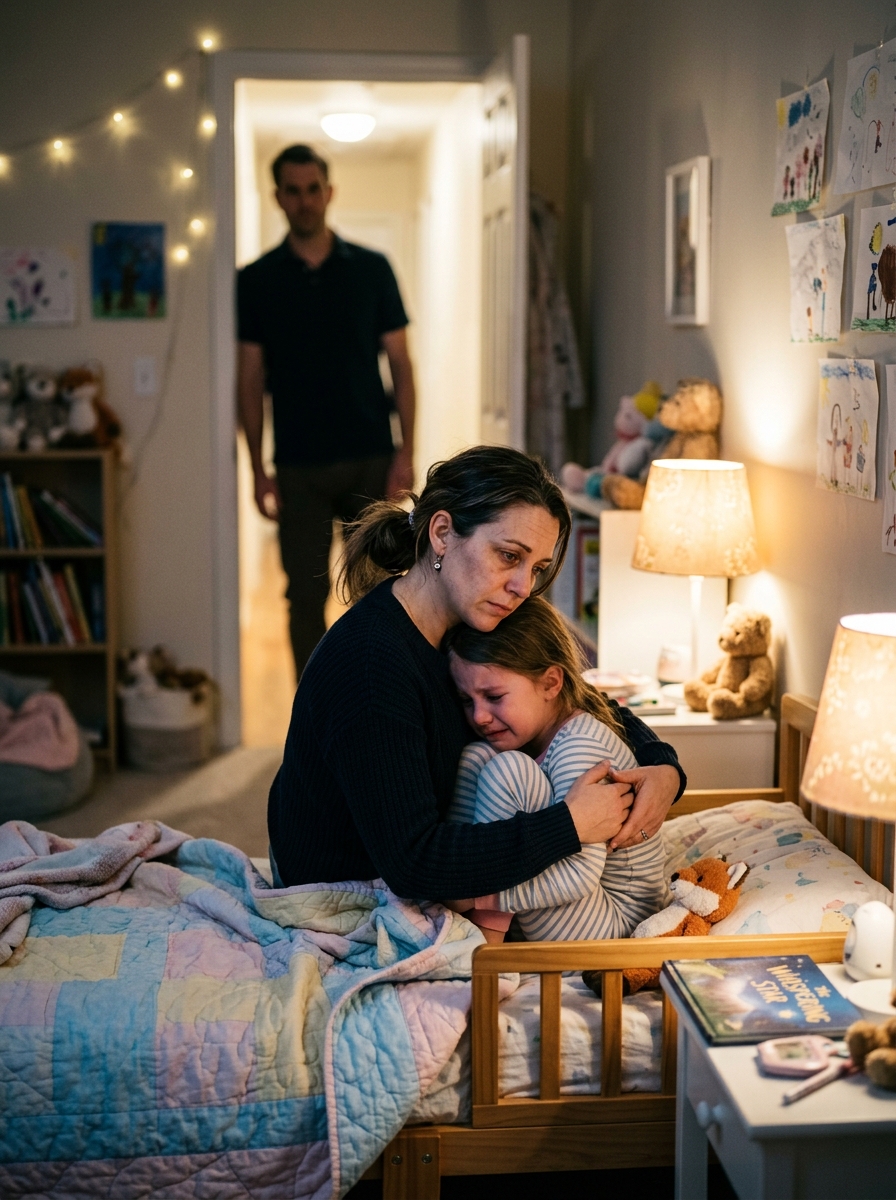
An hour later, after Marty went down to the basement to clean his golf clubs, I walked down the hall and quietly opened Lily’s bedroom door. She was lying in bed under her floral quilt, staring blankly at the ceiling fan.
I sat on the edge of her mattress, brushing a stray lock of dark hair from her forehead. “Lily, sweetie… can we talk?”
She pulled her knees tight against her chest, wrapping her arms around them like a protective shield.
“I noticed you were very quiet at dinner,” I said gently, keeping my voice down to a whisper. “You don’t ever have to ask permission like a stranger in your own house, baby. Why are you acting so scared?”
Lily looked toward her bedroom door, then back at me. Her small body began to shake.
“Marty has rules for when you’re at work, Mommy,” she whispered, her voice cracking under immense emotional pressure.
I held very still, feeling the air leave my lungs. “What rules, baby?”
She picked frantically at a loose thread on her blanket. “I’m not allowed to sit on the living room furniture when you’re gone. He says I’ll ruin the cushions. I have to stand in the laundry room corner until my legs shake. And if I ever tell you…”
Tears spilled over her eyelashes, wetting her cheeks. “He said if I tell you, he’ll leave us, and it will be my fault that we’re alone again.”
PART 2
The room seemed to tilt beneath me. A sickening wave of nausea rushed up my throat, quickly replaced by a scorching, primal rage that burned away every trace of fatigue.
My little girl—my joyful, innocent seven-year-old child—had been subjected to psychological intimidation and physical strain in her own home while I was off saving lives at the hospital. And the man doing it was the same man who hugged me at night and claimed to be her protector.
“Oh, baby… no, no, no,” I breathed, pulling Lily into my arms and holding her against my chest so hard I could feel her rapid, terrified heartbeat. “Listen to me very carefully, Lily. Nothing you ever do will make me leave you. And nobody—*nobody*—is allowed to treat you like that.”
“He checks the couch cushions, Mommy,” Lily sobbed into my shoulder, releasing months of pent-up fear. “If he sees a crease, he puts a timer on his phone. I had to stand on the hard tile for forty-five minutes on Tuesday. My knees hurt so bad…”
I stroked her hair, forcing my voice to remain calm so I wouldn’t terrify her further. “Did he ever hit you, sweetie?”
“No,” she whimpered. “He just stands in the doorway and watches me. He tells me I’m ungrateful, and that you work so hard because I cost too much money.”
Every word was a jagged knife in my heart. Marty hadn’t left physical marks because he was smart—he was systematically breaking her spirit, isolating her, and instilling a deep sense of guilt so she would remain silent. He was using my long shifts and the ghost of her father’s abandonment to control her.
“Lily,” I said, holding her face between my hands and looking directly into her eyes. “You did nothing wrong. You were so brave to tell me. I promise you, on my life, you will never have to stand in that corner again.”
I tucked her in, waited until her breathing evened out into exhausted sleep, and stepped out into the dark hallway.
My first impulse was to run down to the basement, scream at Marty, and throw his belongings into the street. But as an ER nurse, I had seen too many domestic disputes go terribly wrong when handled in a heat of blind rage. Marty was deliberate, calculating, and manipulative. If I confronted him without proof, he would deny everything, accuse me of being an unstable, paranoid mother, and use his standing as a respected professional to complicate any legal separation.
I needed evidence.
The next morning was Thursday—one of my scheduled twelve-hour shifts. I kissed Marty goodbye at six-thirty AM, pretending everything was normal.
“Have a good shift, babe,” Marty said, giving me a smooth, affectionate kiss on the cheek. “I’ll pick Lily up from afternoon care at three.”
“Thanks, Marty,” I forced out, forcing a faint smile.
Instead of driving straight to the hospital, I pulled into a shopping center two miles away. Using my emergency savings, I purchased three compact, motion-activated nanny cameras disguised as ordinary USB wall chargers.
During my lunch break, I took a forty-five-minute personal leave from the hospital, drove back to my neighborhood, parked two streets over, and snuck into my own house using my spare key while Marty was at his corporate office.
I plugged one camera into the laundry room outlet, facing the corner Lily had described. I placed the second near the living room television, and the third in the hallway.
At three-fifteen that afternoon, while sitting in the nurses’ breakroom between patient intakes, I opened the secure application on my smartphone.
The live feed connected immediately.
What I saw on that screen made my hands shake so hard I nearly dropped the phone.
PART 3
On the screen, Marty was standing in the doorway of the laundry room, wearing his casual work clothes. Lily was standing stiffly in the far corner, facing the blank wall, her small hands pressed against her sides.
Marty was holding his phone, looking down at a digital timer.
*”You have twelve minutes left, Lily,”* Marty’s voice came through the crisp audio feed of the hidden camera. *”Because you left your backpack on the entry rug instead of hanging it up immediately. What is the rule about order in this house?”*
*”A place for everything, and everything in its place,”* Lily’s tiny, trembling voice echoed through the speaker.
*”And what happens when you break the rules?”* Marty asked coldly.
*”I waste Mommy’s quiet time,”* Lily recited, her shoulders shaking as tears silently streamed down her face.
*”That’s right,”* Marty said calmly. *”Your mother works twelve hours a day to pay for this house. The least you can do is not be a burden. If you move your feet before the timer hits zero, we add ten minutes.”*
He turned on his heel and walked toward the kitchen, leaving a seven-year-old child standing in isolation on cold tile.
A cold, deadly clarity settled over me. The grief and shock vanished, replaced by an absolute, unwavering resolve.
I recorded the live stream directly to my phone’s secure cloud storage. Then, I called my nurse manager, explained that I had an emergency family crisis, and checked out of my shift.
Instead of driving straight home alone, I drove directly to the local police precinct. I presented the recorded video footage to an officer at the front desk, along with my daughter’s verbal statement transcribed in my own handwriting.
A detective from the Special Victims Unit reviewed the file within twenty minutes. While Marty’s actions fell into the complex legal territory of emotional abuse and child endangerment rather than overt physical assault, the footage provided indisputable grounds for an immediate Emergency Protective Order and an official child welfare investigation.
At five-thirty PM, I arrived at my home, accompanied by two uniformed police officers who parked around the corner.
I unlocked the front door and stepped inside. Marty was sitting comfortably on the living room sofa, watching a college basketball game with a glass of wine in his hand. Lily was sitting at the kitchen table, her head bowed over a coloring book, looking pale and exhausted.
“Hey, babe!” Marty said, looking up in surprise. “You’re home early. Everything okay at the hospital?”
I didn’t answer him. I walked straight to the kitchen table, pulled Lily into my arms, and lifted her off her chair.
“Lily, sweetie, go stand out on the front porch for just a minute,” I whispered gently. “Officer Davis is waiting out there for you.”
Marty stood up from the couch, his brow furrowing in instant irritation. “Sarah, what are you talking about? What officers?”
I looked Marty straight in the eye, pulling my phone from my pocket and holding up the screen. Displayed on the glass was a frozen frame of the video footage from three o’clock—Marty standing over our daughter in the laundry room with his phone timer.
Marty’s face drained of every ounce of color. The smooth, arrogant confidence he had carried for three years dissolved into pure, naked shock.
“Sarah… wait,” Marty stammered, stepping forward, his hands raised in a defensive gesture. “That’s… you’re taking that completely out of context! I was just disciplining her! She needs discipline—”
“Do not step a single foot closer to me,” I said, my voice dropping to a icy, terrifying whisper that stopped him dead in his tracks. “You are done in this house, Marty. You are done with my daughter, and you are done with me.”
ENDING
The two uniformed officers stepped through the front door seconds later. Marty tried to spin his narrative, claiming he was a dedicated stepfather running a structured household, but the objective video evidence left no room for his lies. He was formally served with the Emergency Protective Order on the spot and escorted from the property, allowed to take only his wallet and vehicle keys.
Over the next four months, my legal team moved with aggressive precision.
Using the recorded video evidence, Lily’s formal interview with a state child advocate, and documented bank records showing I was the sole owner of the home prior to our marriage, we filed for an immediate annulment on the grounds of fraud and mental cruelty.
Because of the protective order and the pending child endangerment charges, Marty had no legal leverage to claim alimony or a portion of the house. He was forced to accept a quick, clean dissolution of the marriage, agreeing to pay for Lily’s psychological therapy sessions as part of his court-mandated diversion program.
The financial cost of the divorce and legal proceedings was steep, wiping out what was left of my savings. But every penny spent was a investment in my daughter’s freedom and safety.
I adjusted my work schedule at the hospital, switching from twelve-hour day shifts to a predictable clinic schedule that allowed me to be home every single afternoon when Lily got off the school bus.
Healing did not happen overnight. For the first few weeks, Lily still hovered near doorways, looking at me with uncertain eyes before pulling a chair out or reaching for a glass in the cabinet.
Every single time, I would wrap her in a tight hug and remind her: *”This is your home, Lily. You belong here, and you never have to be afraid again.”*
Yesterday afternoon, six months after that terrible night, I was sitting on the living room sofa reading a book when I heard loud, galloping footsteps coming down the hallway.
Lily burst into the room, wearing a bright yellow cape made from a beach towel. Without asking permission, without hesitation, she leapt straight onto the middle of the couch, landing beside me with a triumphant laugh that shook the room.
“Look, Mommy! I’m a superhero!” she shouted, tossing her head back as her dark hair flew in every direction.
I pulled her onto my lap, burying my face in her soft hair, feeling her wild, unburdened heart beating against mine.
The house was messy. There were toys on the rug, a half-empty juice box on the coffee table, and a crease across the middle sofa cushion. It was chaotic, loud, and imperfect.
And as I held my daughter close, watching her laugh without fear, I knew that our home was finally whole again.