
PART 1
My name is Mark Davies. I am thirty-eight years old, and for the last twelve years, I’ve operated a modest residential remodeling business in a quiet suburb twenty miles west of Columbus, Ohio.
For as long as I could remember, the house next door to mine belonged to Evelyn Vance. Evelyn was eighty-two years old, thin as a willow branch, and moved through her day with a quiet, ghost-like efficiency. She kept her grass neatly trimmed, spent hours kneeling in her yard tending to a sprawling patch of heirloom red roses along our shared wooden fence line, and rarely spoke more than three words at a time to anyone on the block.
When she passed away peacefully in her armchair last autumn, the local news reported that she had no surviving relatives, no living friends, and no official next of kin. The county took control of her property, and six months later, her two-bedroom brick bungalow was put on the probate auction block.
I placed the winning bid at $187,000, using most of my business credit line. My plan was simple: spend three months gutting the outdated interior, update the plumbing, and resell the home to a young family.
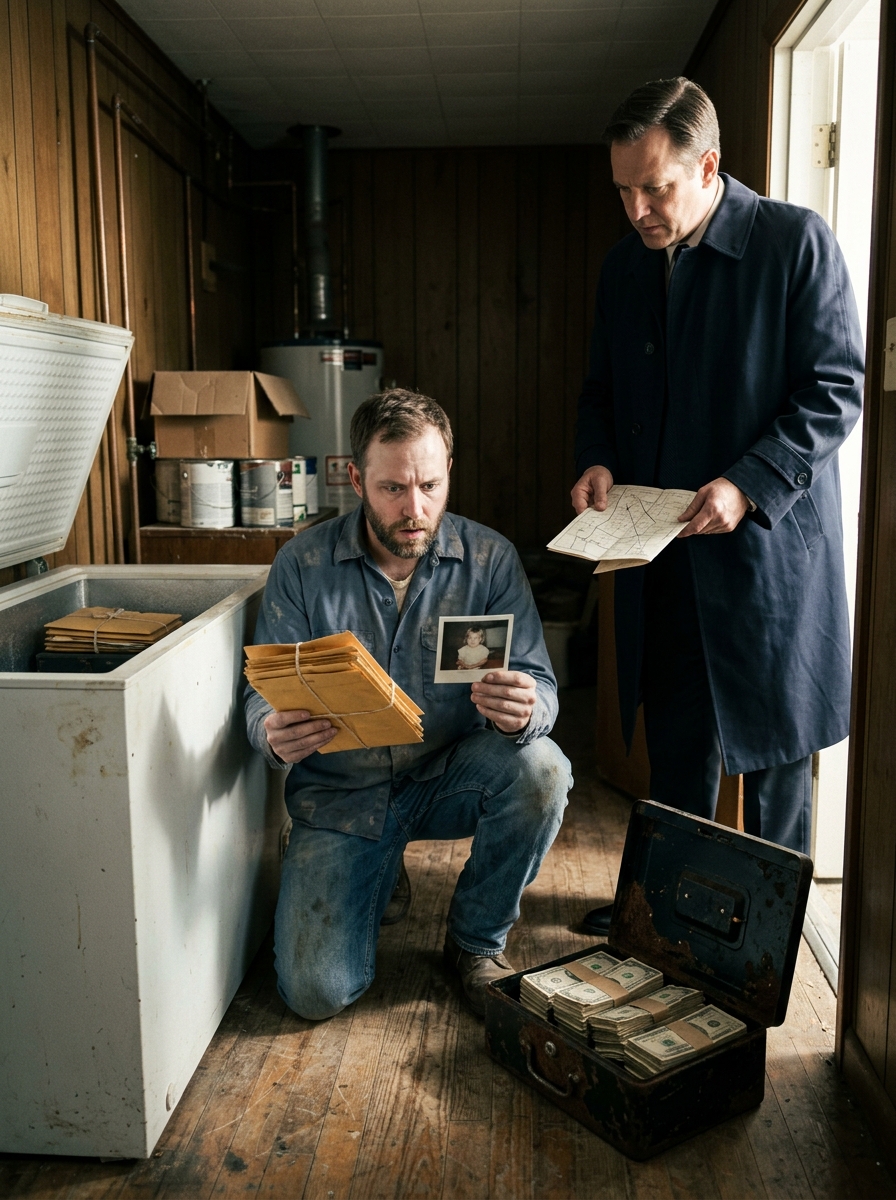
On my second afternoon of clearing out the house, I reached the small utility room behind the kitchen. Against the back wall sat a large, heavy chest freezer—an old white appliance hummed softly, plugged into a dedicated outlet.
I unplugged the unit, lifted the heavy lid, and started clearing out the contents. Beneath three layers of frozen garden vegetables from five years ago, my hand struck something solid and cold.
I pulled out a heavy, rusted steel lockbox, roughly the size of a shoebox. The latch was broken, holding closed only by a thick rubber band wrapped around its center.
I snapped the band and opened the lid.
Inside sat forty-seven identical yellow Manila envelopes, neatly stacked in chronological order. I picked up the top envelope. Across the front, written in a sharp, elegant hand, was a date: *October 14, 2021*.
I unsealed the flap and tipped the contents onto the stainless steel sink counter.
Out tumbled a thick stack of hundred-dollar bills wrapped in a paper bank band—exactly five thousand dollars. And resting right beside the money was a single square Polaroid photograph.
The photo showed a little girl, roughly four years old, sitting on a bench in a bright green park wearing a yellow raincoat. She was looking directly into the camera, not smiling, her eyes wide and solemn.
My brow furrowed. I picked up the second envelope, dated *April 3, 2019*. Inside was another stack of $5,000 cash, and a Polaroid of a little boy in a blue striped shirt sitting in the backseat of a sedan.
Envelope after envelope, the pattern remained unchanged. Forty-seven envelopes, forty-seven stacks of cash totaling over $235,000, and forty-seven different children—boys and girls, ages three to six, each photographed in candid, everyday settings like playgrounds, parking lots, and ice cream stands.
My pulse began to hammer against my throat. A cold, suffocating wave of nausea washed over me as my mind jumped to the dark, horrifying possibilities of what my quiet, elderly neighbor had been involved in for twenty-three years.
My hands shook so violently I could barely tap out the three digits on my phone screen.
“911, what is your emergency?”
“I need an officer at 414 Elm Street,” I stammered, pulling my collar away from my neck. “I… I just bought my deceased neighbor’s house.
I found a box in her freezer. There’s hundreds of thousands in cash and dozens of photos of young children.”
Twelve minutes later, a city patrol car pulled into the driveway. Detective Paul Miller, a veteran investigator in his late fifties with graying hair and an exhausted posture, walked up the porch steps.
I led him straight to the utility room, showing him the open lockbox and the forty-seven scattered Polaroids spread across the counter.
Detective Miller picked up two of the photographs, examining them under the overhead bulb before letting out a slow, dismissive breath. “Look, Mr. Davies, elderly folks who lived through lean times do strange things with their money. She probably didn’t trust banks and kept photos of her grandchildren or great-nieces.”
I shook my head firmly, stepping between him and the counter. “No, Detective. You don’t understand. Evelyn Vance lived next door to me for twelve years. I checked her property records during the probate filing. She was an only child, her husband died in 1991, and she never had children. She had no family.”
Detective Miller’s expression shifted. The dismissive fatigue in his eyes vanished, replaced by a sharp, calculating stare. He pulled a small portable scanner and a tablet from his coat pocket.
“I’m going to run three of these facial captures through the state missing persons and unsolved cold-case registry,” Miller said, his voice dropping into a flat, professional tone. “Stay right here.”
He walked out to his cruiser, leaving me alone in the silent house with forty-seven pairs of young, innocent eyes staring up from the metal counter.
PART 2
Twenty minutes passed in absolute silence. The only sound in the house was the rhythmic ticking of the wall clock in the hallway.
When the screen door finally creaked open, Detective Miller stepped back into the utility room. His face was no longer pale—it was a heavy, chalky gray. His jaw was set so tight the muscle on his cheek twitched.
“Detective?” I asked, taking a step toward him. “Did you find a match?”
“Not one,” Miller said quietly, setting his tablet on the counter. “I found four. The boy in the blue striped shirt was Toby Coleman—disappeared from a park in Akron in 1999. The girl in the yellow raincoat was Clara Vance… missing from a daycare center in Canton in 2004.”
My breath hitched in my chest. “Evelyn… she was kidnapping children?”
“No,” Detective Miller replied, his voice raspy. “Evelyn Vance wasn’t a kidnapper. According to the state database, every single one of those four children was located safe and sound within forty-eight hours of their disappearance twenty years ago. They were returned to their legal guardians after being taken by non-custodial parents, runaway cases, or illegal adoption rings.”
I stared at him, completely lost in the maze of facts. “Then why did she have their pictures? And why the money?”
Detective Miller didn’t answer right away. He reached back down into the empty metal lockbox, feeling around the velvet-lined bottom until his fingers caught on a small secret compartment under the false base.
He pulled out envelope forty-eight.
Unlike the others, this envelope was unsealed, larger, and had no date written on the front. Across the middle, written in bold, dark black ink, was my name: *Mark Davies*.
My throat went bone dry. “She wrote that for me?”
“She knew who bought the property surrounding her house,” Miller said softly, handing me the envelope. “Read it.”
With trembling fingers, I pulled a folded piece of heavy yellowed stationery from inside. The handwriting was neat, precise, and entirely steady.
> *”Dear Mark,”* the letter began.
>
> *”If you are reading this, my heart has finally stopped, and you have purchased the house just as I prayed you would. You are a good man, Mark. I watched you repair Mrs. Gable’s porch for free three winters ago when she couldn’t afford the lumber. I knew you were the only person on this street who would look at my home with care instead of greed.*
>
> *The money in this box does not belong to me. It is the record of forty-seven debts paid by desperate people.*
>
> *For thirty-five years, my late husband Harold worked as a chief investigator for the State Department of Human Services. Before he died in 1991, he discovered a network of wealthy, protected individuals who used private foster agencies to sell vulnerable children into unregistered, off-the-grid domestic placements.*
>
> *When the legal system failed to act, Harold and I built our own system.
We brought those forty-seven children back. Every five thousand dollars in those envelopes was paid by a family who hired Harold—and later, hired me—to find their stolen children and bring them home safely when the police had run out of leads.*
>
> *The photos were my proof that every child reached their real mother.*
>
> *But there were six children we were too late to save. Six children whose locations we found only after their captors had ended their small lives to cover their tracks.*
>
> *I could not leave them in cold, unmarked places. So I brought them home to my garden.*
>
> *Start digging where the roses are. What you’ll find there is the evidence that will finally put the men who built that network behind bars. The key to the floor safe in my bedroom closet is tucked inside this letter. Finish what Harold and I started.”*
The paper trembled in my hands until the ink blurred into a smear of black lines.
Detective Miller stepped closer, looking over my shoulder at the hand-drawn map tucked behind the letter. On it, Evelyn had drawn six precise red X’s placed directly beneath the root lines of the heirloom rose bushes she had tended every afternoon for thirty years.
PART 3
Within two hours, Elm Street was closed off by yellow police tape.
Three forensic vehicles, two unmarked state police cruisers, and a team from the county coroner’s office filled Evelyn’s driveway. Searchlights were erected around the backyard, casting long, sharp shadows across the manicured lawn and the high wooden fence that separated her property from mine.
I sat on the edge of my back porch steps, wrapped in a heavy wool jacket, watching the crime scene technicians in white suits carefully prune away the decades-old rose bushes.
Detective Miller stood near the fence line, overseeing the excavation. Every time a shovel struck the dark Ohio soil, a heavy silence fell over the entire yard.
By 2:00 AM, the forensic team had recovered six small, preserved wooden caskets buried six feet beneath the root systems of the rose garden. Each box was carefully marked with a brass identification plate bearing a child’s name, birthdate, and the date Evelyn had recovered their remains.
Along with the caskets, the floor safe in Evelyn’s master bedroom revealed three leather-bound ledgers detailing names, dates, financial transactions, and bank account numbers belonging to a high-profile adoption agency operating out of Chicago during the late 1980s and 1990s.
The agency had fronted as a legitimate charitable foundation while trafficking children to wealthy clients across three states.
“She wasn’t a criminal,” Detective Miller said, walking over to sit beside me on the porch steps as the sky began to turn a faint gray at the horizon. “She was an underground railroad for forgotten children.”
“Why didn’t she go to the authorities thirty years ago?” I asked, staring at the empty patches of earth where the rose bushes had stood for decades.
“Because the man running that adoption network thirty years ago was the regional deputy director of the state police,” Miller replied, his voice dark with a mixture of disgust and solemn respect. “If Harold or Evelyn had handed these ledgers to the department in 1995, the evidence would have been burned, and they both would have ended up in a ditch.”
Miller looked at me, resting his hands on his knees. “That deputy director retired ten years ago. He’s eighty-one now, living in a gated community in Florida. Thanks to these ledgers and the physical evidence in this yard, state warrants are being issued right now.”
I looked over at the quiet blue bungalow I had bought at auction.
I had thought I was buying a simple fix-and-flip property to boost my business. Instead, I had inherited the final chapter of a woman’s lifelong, secret crusade for justice—a woman who had spent thirty years living in total isolation, carrying the weight of six lost children under her garden while keeping forty-seven others safe in the light.
ENDING
Six months later, the story of Evelyn Vance hit national news headlines.
The evidence recovered from the lockbox and the bedroom safe led to the complete dismantling of a decades-old trafficking syndicate, resulting in fourteen arrests across three states—including the former deputy director, who was formally charged with multiple counts of kidnapping and racketeering before his death in custody.
Every single one of the forty-seven cash stacks found in Evelyn’s freezer was traced back to the families Harold and Evelyn had helped. Not a single family claimed the money; instead, with the court’s approval, the $235,000 was placed into a permanent endowment fund created in Evelyn and Harold Vance’s honor to support cold-case missing children investigations across the Midwest.
As for the house, I never put it back on the market.
I cancelled my plans to gut the building and flip it for profit. Instead, I spent the summer restoring the bungalow to its original 1960s character, maintaining its modest, quiet footprint on Elm Street.
Where the overgrown rose bushes had once stood along the shared fence line, I hired a local stone mason to build a quiet, beautiful memorial garden. In the center sits a simple granite bench surrounded by white hydrangeas, featuring a brass plaque inscribed with the names of the six children Evelyn had brought home to rest.
Every afternoon around 4:00 PM, when I return home from my job sites, I walk over to the garden next door.
I pull the small watering hose from the side of the house, tend to the plants, and sit on the granite bench for a few quiet moments before sunset.
The neighborhood is peaceful now. The dark secrets that haunted the faded blue house for thirty years have finally been brought into the light, and the quiet woman who lived next door is no longer remembered as a lonely, forgotten recluse.
She is remembered as the woman who kept the light burning for forty-seven children who found their way home—and six who finally found their peace.