
PART 1
My name is Elena Vance. I was twenty-eight years old, working as a long-term substitute teacher at Southwest High in Detroit—a school where the radiators hissed incessantly, the hallways echoed with territorial shouts, and half the textbooks in my classroom were missing their back covers.
I had entered the teaching profession with high ideals, but after six months on the line, burnout was slowly creeping in. Every day felt like a battle just to keep forty kids seated and quiet for fifty minutes.
Except for Marcus.
Marcus sat in the back right corner of Room 204, right against the drafty window frame. He was fourteen, slight of build, and wore the same dark blue zip-up hoodie almost every single day. While other students threw paper wads, argued across rows, or checked hidden cell phones, Marcus simply stared straight ahead. He didn’t cause trouble, but he didn’t do work either. When I handed back quizzes, his paper was always turned face down—a blank slate with a zero marked in red ink at the top.
By late November, the Michigan winter was closing in. The sun set early, leaving the classroom shrouded in gray twilight by fourth period.
On a cold Thursday afternoon, after the final bell rang and the room emptied in a chaotic wave of stomping boots, I saw Marcus still sitting at his desk. He was packing his worn backpack with agonizing slowness, his fingers stiff from the cold.
I stacked my lesson plans, walked down the aisle, and crouched in the narrow space beside his desk.
“Marcus,” I said gently, keeping my tone warm and unhurried. “You haven’t turned in the last three history worksheets. I know you’re listening during lectures—I see you watching the board. Why don’t you try?”
Marcus froze. He didn’t pull away, but he kept his head turned toward the dark glass window. His fingers clutched the faded canvas straps of his bag until his knuckles turned pale.
“It doesn’t matter,” he muttered, his voice barely audible over the hum of the radiator.
“It does matter,” I insisted softly. “Education is the one thing no one can take away from you.”
Marcus finally turned his head. His dark eyes were shadowed by deep gray circles—the kind of bone-deep exhaustion you rarely see in a child.
“Miss Vance,” he whispered, his voice cracking slightly. “I sleep in a four-door sedan with my mom and my little sister.
When the streetlights go off at night, it’s just dark. I can’t read in the dark.”
The air left my lungs as if I’d been struck in the chest.
In a busy city school, you hear about hardship in abstract terms—statistics on free lunch programs, housing instability figures on staff bulletins. But sitting across from a fourteen-year-old boy who couldn’t do his history homework because he lacked a single light bulb was a reality that hit with sickening clarity.
I reached into my bag, pulled out a small notepad, and wrote down my address in West Dearborn—a twenty-minute bus ride from the school.
I tore the slip off and held it out to him. “My name is Elena. I live at this address. My porch light stays on every evening. If you ever need a quiet, warm table to sit at and do your schoolwork… you come by. No questions asked.”
Marcus looked at the piece of paper in my hand as if it were written in a foreign language. He hesitated, then reached out with trembling fingers, folded the paper tightly, and tucked it into his sock.
“Thank you, Miss,” he murmured, before pulling his hood up and disappearing down the empty hallway.
PART 2
For the next two days, I caught myself glancing out my front window every time a car drove past or a footstep sounded on the pavement.
I second-guessed myself a dozen times. Was it professional to give a student my address? Should I have called social services immediately? I knew the system in Detroit was stretched past its breaking point, and taking a mother’s children away because she lost her apartment wouldn’t instantly fix their lives. I just wanted the boy to have a safe space to sit.
Sunday night brought a freezing rainstorm that rattled the storm windows of my modest bungalow.
At 7:30 PM, while I was grading essays at my dining table, a faint, rhythmic sound tapped against my front door. It was so soft I thought it was wind blowing a tree branch against the siding.
I stood up, walked into the entryway, and flipped on the porch light.
Standing on the wet wooden deck was Marcus. He was drenched from head to toe. His blue hoodie was soaked through, sticking to his thin shoulders, and he was holding a plastic grocery bag tightly against his chest to protect a torn spiral notebook.
I opened the door wide instantly. “Marcus! Come inside, quick.”
He stepped over the threshold, hovering awkwardly on the rubber doormat as if he were afraid his wet shoes would ruin the hardwood floor. He looked around the small entryway, his eyes wide, taking in the warm yellow light spilling from the living room lamps.
“I’m sorry to bother you, Miss Vance,” he stammered, his teeth visibly chattering. “The car… the battery died tonight. The dome light went out. I couldn’t see the pages.”
“You aren’t bothering me at all,” I said firmly.
I rushed into the bathroom, grabbed two clean bath towels, and brought them to him. I showed him where to hang his wet jacket and led him into the kitchen.
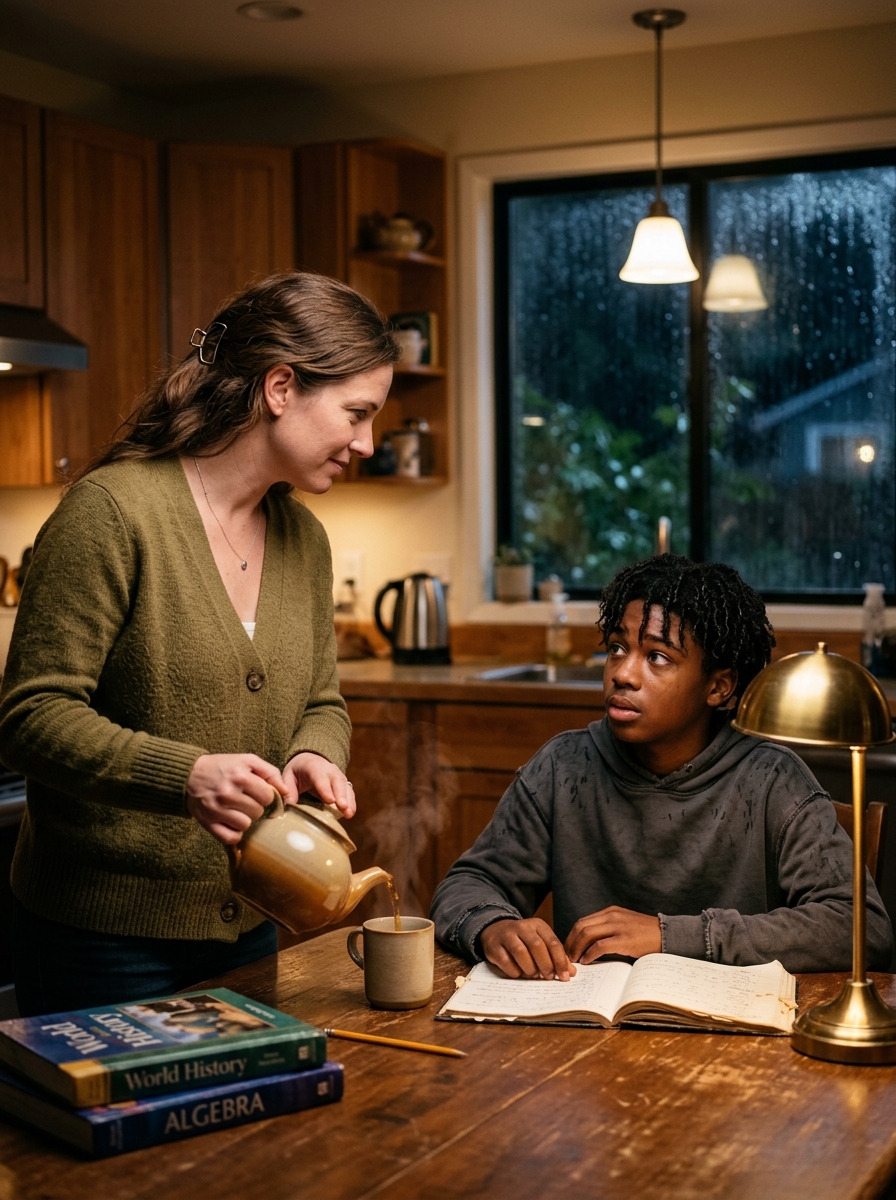
I pulled out a sturdy wooden chair at the kitchen table, right under the bright pendant light that hung from the ceiling. I made him a mug of hot cocoa, set out a plate of warm toast and peanut butter, and pointed to the table.
“This is your spot,” I told him. “Stay as long as you need.”
Marcus sat down slowly on the edge of the wooden chair. He didn’t reach for the food right away. Instead, he lifted his face and stared up at the glass pendant light hanging six inches above his head. He watched the steady, unwavering golden glow with a look of pure reverence—as if a light bulb were a miracle he hadn’t seen in years.
He pulled his damp spiral notebook out of the plastic bag, smoothed the wrinkled pages with his palm, opened his history textbook, and began to write.
He stayed for two hours. He didn’t speak except to say “thank you” when I refilled his cocoa. He worked with a quiet, fierce intensity, his pencil flying across the lined paper.
At 9:30 PM, he carefully closed his book, stacked his papers, and stood up.
“My mom is waiting at the gas station down the street,” he said softly. “She doesn’t like me being out late.”
“I’ll drive you back to her,” I said, grabbing my coat keys from the counter.
When we pulled into the brightly lit gas station lot two miles away, I saw an old gray sedan parked near the vacuum stations, its windows fogged from the inside. A tired-looking woman sat in the driver’s seat, wrapped in a heavy blanket.
Before Marcus got out of my car, I handed him a small flashlight with extra batteries and a spare house key I had made that morning.
“Tuesdays and Thursdays,” I said. “And any other night you need light, Marcus. The door is open.”
PART 3
What began as a single desperate night turned into a steady, unspoken routine that lasted for four years.
Every Tuesday and Thursday afternoon after school, Marcus would take the city bus down Michigan Avenue and walk up my front path.
At first, he would only stay for an hour, do his homework at the kitchen table in absolute silence, and leave. But gradually, as the weeks turned into months, the thick wall of caution he had built around himself began to melt.
My house became his sanctuary.
While Marcus did his homework at the kitchen table, his mother, Sandra, was slowly working two jobs—cleaning offices at night and working a retail shift by day—saving every dime to get them back into a permanent home. By the spring of his freshman year, Sandra had secured a small two-bedroom apartment near the bus line.
Even after they had four walls and working electricity again, Marcus kept coming.
He became a fixture in my life. He helped me carry groceries from the car. I taught him how to cook simple meals like spaghetti and chicken stir-fry. When he struggled with algebra in his sophomore year, we sat at that same kitchen table until midnight, working through quadratic equations until he finally cracked the code.
The change in Marcus wasn’t just reflected in his report card—though his grades climbed from failing marks to straight A’s.
It was in his posture. The boy who used to slide into class with his head down and his hoodie pulled tight now walked down the hallways with his shoulders back and his eyes clear. He joined the track team. He volunteered at the school’s peer tutoring center.
In June 2022, I sat in the fifth row of the Detroit Masonic Temple auditorium during Southwest High’s graduation ceremony.
When Marcus walked across the stage in his navy blue cap and gown to receive his diploma—distinguished with a gold cord for high academic honors—he didn’t just grab his certificate and walk off. He stopped at the podium, looked out into the crowd of hundreds of cheering parents, found me in the fifth row, and gave a quiet, respectful nod.
After the ceremony, amidst the sea of throw caps and crying families, Marcus walked up to me with his mother, Sandra, standing proudly beside him.
“I made it, Miss Vance,” he said, holding out his diploma.
“You made it, Marcus,” I choked out, tears overflowing as I pulled him into a tight embrace. “I never doubted you for a second.”
Two months later, Marcus loaded his bags into a secondhand car and drove off to attend Michigan State University on a full academic scholarship.
For five years, our contact shifted to seasonal calls and occasional texts during midterms. I moved from my long-term substitute position into a permanent history teaching role at the school, continuing to see generations of kids pass through Room 204.
Then, three weeks ago, on a rainy Tuesday afternoon in early July, a white envelope with a East Lansing postmark arrived in my mailbox.
ENDING
#
I sat down at the familiar wooden kitchen table—the same table where a cold, wet fourteen-year-old boy had sat eight years earlier—and opened the letter.
Inside was a formal printed invitation to the grand opening of the *New Dawn Youth Center* in downtown Detroit, a shelter designed specifically to provide after-school housing, tutoring, and emergency care for homeless teenagers.
Pinned to the invitation was a handwritten letter on thick notebook paper.
> *”Dear Miss Vance,”* the letter began in Marcus’s sharp, confident handwriting.
>
> *”Last week, I passed my final exams and officially earned my Master’s Degree in Social Work. Next month, I am stepping into my new role as the Director of Youth Services at the New Dawn Center.*
>
> *When people ask me what inspired me to build a career helping kids who sleep in cars, shelters, and parks, they expect me to tell a story about a grand rescue or a tragic system.*
>
> *I tell them about a substitute teacher who crouched beside a broken desk in 2018 and handed a terrified boy a slip of paper with her address on it.*
>
> *You didn’t judge my mother. You didn’t make me feel small. You just gave me a chair, a warm cup of cocoa, and a table under a bright lamp where I could build a future.*
>
> *I didn’t need saving, Elena. I just needed a place where the light didn’t turn off.*
>
> *Thank you for keeping the porch light on.*
>
> *With all my respect,*
> *Marcus”*
I folded the letter carefully, holding it against my chest as tears of profound gratitude slipped down my cheeks.
I looked over at the glass pendant lamp hanging over my kitchen table. The house was quiet, save for the gentle patter of rain against the windowpane.
That evening, as dusk fell over Dearborn, I walked out onto my front porch. I didn’t flip the light switch off when I went to bed. I left it burning bright—a small, steady beam cutting through the dark, waiting for anyone who might need a place to find their way home.


