
PART 1
My name is Clara Vance. I’m fifty-eight years old, and for the last eight years, my life has been measured out in quiet, predictable rhythms in a small suburban neighborhood just outside of Raleigh, North Carolina.
When my husband, David, died suddenly of a massive heart attack eight years ago, the world felt like it had been stripped of all its sound. David and I had been married for twenty-two years. We didn’t have children, but we had a warm, modest brick house, a small garden behind the garage, and a deep, comfortable rhythm that made the rest of the world feel manageable.
When David passed, the silence in our house was heavy. I kept my grief tucked away inside, returning to my job as a mid-level administrator at the local community college, keeping my lawn trimmed, and rarely speaking to anyone outside of necessary daily pleasantries.
The one anchor in my day was our mailman, Mr. Okafor.
Samuel Okafor was a tall, dignified man in his early sixties with graying hair at his temples and a quiet authority that commanded instant respect. Every afternoon at roughly 1:15, I would hear the distinct *clack-clack* of his boots on my concrete front porch.
Unlike the other delivery drivers who dropped packages and sprinted back to their vans, Mr. Okafor had a rule at my house. He would press the doorbell button twice. *Ring-ring.*
Then he would wait. He wouldn’t leave until I opened the wooden front door. When I did, he would tip his navy blue postal hat, hand me the small stack of envelopes, and say something simple: “Good afternoon, Mrs. Vance.
Looks like rain this evening,” or “The azaleas in the bed look strong today, ma’am.”
I’d smile, thank him, and watch him walk down the driveway. It took less than thirty seconds, but over eight years, those thirty seconds were often the only human contact I had on my hardest days. I assumed he was just a man from an older generation who believed in manners.
That was until last Friday.
At 1:15 PM, the doorbell rang. But it didn’t ring twice. It rang once, long and steady.
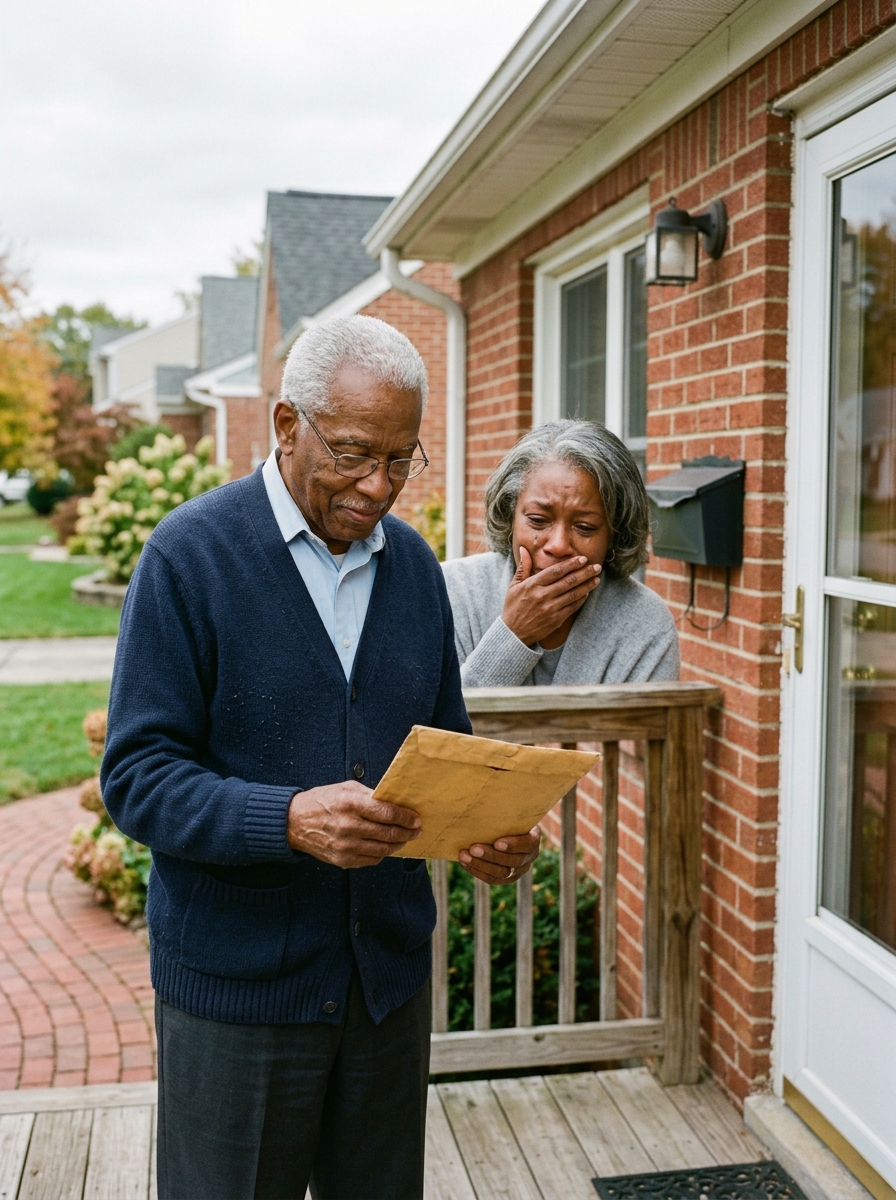
I pulled open the door, expecting to see a substitute driver. Instead, Mr. Okafor was standing on my porch. But he wasn’t wearing his standard blue postal uniform. He was dressed in a dark green button-down shirt, dark trousers, and a neat navy cardigan.
He wasn’t holding a satchel. He was holding a thick, worn brown envelope tied with a faded green ribbon.
“Good afternoon, Mrs. Vance,” he said, his voice softer than usual.
“Mr. Okafor?” I asked, stepping out onto the porch in surprise. “Are you… are you taking the day off?”
“No, ma’am,” he offered a small, gentle smile. “Today is my final official day on the route. I turned in my keys at twelve o’clock. I’m retired now.”
My throat tightened unexpectedly. Tears prickled at the corners of my eyes as eight years of quiet, steady companionship washed over me. “Oh, Mr. Okafor… the street won’t be the same without you. You’ve been such a blessing to me.”
“Thank you, Mrs. Vance,” he said softly. But he didn’t turn to leave. He stood there, looking down at his worn leather shoes, his hands turning the thick brown envelope over and over like a young man trying to find the courage to confess something difficult.
“Is everything all right?” I asked gently.
He looked up, his dark eyes brimming with a solemnity that made my heart give a sudden, nervous thud.
“Ma’am, before I walk off this street for the last time, I need to tell you why I always rang twice and waited for you to answer the door,” Mr. Okafor said quietly. “It wasn’t postal policy.
And it wasn’t just good manners. It was a promise I made eight years ago in a hospital parking lot.”
PART 2
The porch seemed to grow instantly quiet. The distant sound of a lawnmower down the block faded into background hum.
“A hospital parking lot?” I repeated, my brow furrowing in confusion. “Mr. Okafor, David died in the emergency room at WakeMed. Were you there?”
“I was, ma’am,” Mr. Okafor replied, his voice calm and steady. “My sister was in the ICU on the second floor that same night. I was sitting in my truck in the parking deck around eleven o’clock, getting ready to drive home, when I saw a man sitting on the concrete bench near the main entrance. He was sitting completely still, holding an unlit cigarette, staring at the ground.”
Mr. Okafor adjusted the brown envelope in his hands.
“I got out of my truck to see if he needed a lift,” he continued. “When I approached him, I realized it was Thomas Wright.”
My breath caught in my chest, a cold shock running down my spine.
Thomas Wright had been David’s business partner at their small woodworking shop on the edge of town. They had been close friends for fifteen years—until three months before David’s death, when a bitter argument over a failed commercial contract tore them apart. Thomas had walked away from the business, and David had refused to speak his name ever again. When David died, Thomas hadn’t come to the funeral. I had assumed it was out of guilt or anger.
“Thomas?” I whispered. “What was Thomas doing at the hospital?”
“He had been in the waiting room, Mrs. Vance,” Mr. Okafor said softly. “He told me he heard about David’s collapse from a guy at the lumberyard. He rushed to the hospital, but he stayed in the back corner of the lobby because he knew you were in the room with David and he didn’t want to disturb your privacy or cause you distress.”
Mr. Okafor looked directly into my eyes.
“Thomas sat on that bench in the dark and cried like a man who had lost his own brother,” Mr. Okafor recalled. “He told me, ‘Samuel, David’s gone. And Clara is completely alone in that big house on Willow Court. She has no family near here. She’s going to pull inward. She’s going to shut the door and let the world slip away.'”
Tears began to spill over my eyelashes, burning my cheeks.
“Thomas knew I carried the Willow Court route,” Mr. Okafor said. “He reached into his coat, pulled out a small stack of fifty-dollar bills, and tried to hand them to me. He said, ‘I need you to promise me something, Samuel. Every day you deliver her mail, ring her bell twice. Don’t just drop the letters and run. Wait until she opens the door. Make sure she steps out into the light. Make sure she speaks to another human being at least once a day, so she knows the world hasn’t forgotten her.'”
I stood frozen, my hand grasping the porch railing for balance. “He… he paid you?”
“I refused his money, Mrs. Vance,” Mr. Okafor said firmly, his eyes shining with quiet pride. “I told him, ‘Thomas, I don’t take money to check on a neighbor. I’ll do it because it’s the right thing to do.’ But Thomas insisted. He said he needed to feel like he was contributing something to your safety, even if he couldn’t show his face.”
Mr. Okafor held up the thick brown envelope.
“For eight years, every single month on the first Tuesday, Thomas met me at the diner on Route 40 for breakfast. He paid for my coffee, and he handed me twelve dollars—one dollar for every day I rang your bell. He made me promise never to tell you while David’s memory was still fresh, because he didn’t want you to feel obligated or uncomfortable.”
“Is Thomas…” My voice cracked, unable to finish the sentence.
“Thomas moved to a small farm near Sanford five years ago,” Mr. Okafor said gently. “He’s seventy-one now, and his health isn’t great. Before I turned in my postal key today, I drove down to Sanford to see him. I told him I was retiring. And I told him it was time.”
PART 3
Mr. Okafor stepped forward and placed the thick brown envelope into my trembling hands.
“Everything is in here, Mrs. Vance,” he said softly. “Eight years of letters Thomas wrote to David that he never had the courage to send. And a journal of every single project they worked on together, detailing the money Thomas left in the business account that he never claimed after their disagreement.”
I looked down at the package in my hands. The faded green ribbon felt soft under my fingers, heavy with eight years of unspoken grief, secret loyalty, and quiet protection.
“Why today, Mr. Okafor?” I asked, looking up through a haze of tears. “Why tell me now?”
“Because Thomas is in a rehabilitation center in Sanford after a bad hip surgery,” Mr. Okafor replied, his voice filled with a quiet, persistent strength. “He thinks he’s lived out his usefulness. He thinks the world forgot about him the same way he thought you’d want to forget him. But a man who pays a dollar a day for eight years just to make sure his friend’s widow opens her front door to the sunlight isn’t a man who deserves to die alone in a quiet room.”
Mr. Okafor took a step back down the porch stairs, standing on the concrete walkway where he had stood thousands of times before.
“I delivered your mail for eight years, Mrs. Vance,” he said, tipping an imaginary hat with a warm, triumphant smile. “Consider this my final delivery.”
Before I could answer, he turned and walked down the driveway toward his gray sedan parked at the curb. I stood on the porch, watching him drive away until his car disappeared around the bend of Willow Court.
I walked back inside my quiet house, sat down at the kitchen table, and untied the green ribbon.
The envelope contained dozens of handwritten letters. I opened the first one, dated November 12, 2018—the day of David’s funeral.
> *”David,”* Thomas’s rough, familiar handwriting began. *”I sat in the back row of the chapel today behind the wooden pillar. I couldn’t come up to see you because I knew if I saw Clara’s face, I would break in two. I am so sorry for the harsh words I said on the shop floor in August. I was proud, and I was foolish. You were the best partner a man could ever have. I promise you, as long as I have breath in my lungs, Clara will never be invisible. I’ll make sure someone checks on her every afternoon.”*
I spent the next three hours sitting at the table, reading letter after letter.
Thomas hadn’t abandoned our family out of spite. The argument in 2018 had been sparked when Thomas discovered that a commercial buyer was trying to scam David out of our life savings through a fraudulent partnership clause. Thomas had taken the legal heat onto himself, walking away and taking the financial hit so that David’s personal liability remained entirely clean. David had misunderstood his silence as a betrayal, and Thomas had been too proud—and too protective of David’s fragile heart condition—to explain the truth before David passed.
For eight years, Thomas had lived with the weight of being hated by the family he had tried to protect.
At four o’clock that afternoon, I stood up from the kitchen table, folded the letters neatly back into the brown envelope, grabbed my car keys, and walked out the front door.
ENDING
The drive to the rehabilitation facility in Sanford took forty-five minutes.
The building was a quiet, brick facility surrounded by pine trees. When I asked the receptionist for Thomas Wright’s room, she gave me a gentle smile and pointed down the sunlit hallway toward Room 114.
I stood outside the open wooden door for a long moment.
Inside, sitting in a wheelchair near the window overlooking a small garden, was Thomas. He looked so much older than I remembered—his hair entirely silver, his frame thinner, his shoulders slightly hunched as he stared out at a bird feeder hanging from an oak branch. On the small bedside table beside him rested a worn wood-carving tool and an unlit pipe.
I didn’t knock. I simply stepped into the doorway and cleared my throat.
“Thomas,” I said softly.
The old man stiffened. He turned his wheelchair slowly around, his faded blue eyes widening as they rested on my face. A sudden, terrible look of fear and shame crossed his features, and he instinctively gripped the armrests of his chair as if preparing for a blow.
“Clara…” he whispered, his voice trembling violently. “What… what are you doing here?”
I walked slowly across the room, carrying the brown envelope tied with the faded green ribbon. I didn’t yell. I didn’t demand explanations.
I set the brown envelope on his lap, pulled up a wooden chair, and sat down right beside him.
“Mr. Okafor retired today,” I said, my voice warm and steady. “He made his final delivery to my porch at one o’clock.”
Thomas looked down at the envelope on his knees. A heavy, shuddering breath escaped his chest, and he covered his eyes with his weathered, callous-worn hands, his shoulders shaking as silent, heavy tears finally broke through thirty-four years of buried regret.
“I’m sorry, Clara,” he sobbed quietly into his hands. “I’m so sorry. I should have told David… I should have come to the house… I just didn’t want you to suffer.”
I reached out, taking his frail, shaking hands into my own, holding them firmly.
“You spent eight years making sure I stepped out into the sunlight every afternoon, Thomas,” I said, wiping a tear from his cheek with my thumb. “You never let me be invisible. Now it’s my turn to make sure you aren’t invisible either.”
Thomas looked at me through his tears, finding a peace in my eyes that he had been searching for since the night David died.
I didn’t leave Sanford that evening until visiting hours ended at eight o’clock. We talked about David, about the old woodworking shop, about the garden, and about the future.
Two weeks later, when Thomas was discharged from the rehabilitation facility, he didn’t go back to his isolated farm in Sanford. My garage had a spacious, sunlit workshop that David had built decades ago—a room that had remained locked and dark for eight years.
I unlocked the double doors, cleaned off the workbench, and helped Thomas move his carving tools into the shop.
Today, if you walk down Willow Court around one o’clock in the afternoon, you won’t hear Mr. Okafor’s boots on the concrete path. The new mail carrier drops the letters in the box and drives on.
But at 1:15 every afternoon, the side door of the garage opens. Thomas walks out into the sunlight, leaning on his cane, carrying two cups of warm tea. He walks up the porch steps, rings the doorbell twice—*ring-ring*—and waits for me to open the door so we can sit together, talk about the weather, and remember the man we both loved.