
PART 1
The auction notice on the courthouse door in Haskell County had been simple: *Bank Liquidation Sale — Estate of Arthur Vance.*
Arthur Vance had lived alone on eighty sun-bleached acres outside of Sublette, Kansas, for as long as anyone in town could remember. To the local farmers who saw his battered green pickup idling outside the farm supply store on Tuesday mornings, Arthur was a quiet, reclusive ghost. He spoke only when spoken to, kept his fences mended, and lived without air conditioning or a television until he suffered a stroke in early February and died in a county hospital forty miles away at the age of eighty-one.
Because Arthur had no wife, no living children listed in the county registry, and no will on file at the probate office, the local bank seized the property to cover unpaid real estate taxes. They auctioned off the land to a commercial wheat conglomerate and put out a call for local scrappers to clean out the dilapidated machinery sheds.
That was where I came in. My name is Marcus Miller. I run a small two-bay auto repair and welding shop on the edge of town. Scrapping old farm iron on the weekends was how I bought new tools and kept my business out of the red.
I paid four hundred dollars cash for the right to haul away three rusted plow frames, a burnt-out combine engine, and a stack of eight oversized John Deere tractor tires resting against the back of Arthur’s barn. The bank representative didn’t even check my receipt; he just handed me the key to the gate and told me to have the lot cleared by Sunday evening.
Loading those tires was a brute-force job. They were heavy, six-foot-tall rear drive tires, dry-rotted and coated in decades of hard-packed Kansas mud.
By six o’clock on Saturday evening, I had the last tire loaded onto my tandem-axle trailer and hauled back to my shop. The sun was setting over the flat wheat fields when I began rolling them off the wooden deck into the back bay of my barn.
When I grabbed the fourth tire—a heavily weathered 18.4-38 Goodyear Power Torque—I almost threw my back out.
It felt twice as heavy as the others. When I shoved it off the trailer ramp, it didn’t bounce or roll smoothly. It wobbled with an awkward, lopsided weight, and as it made a quarter-turn across the dirt floor, a distinct, metallic *thud-clunk* vibrated from deep inside the rubber casing.
I stopped and let the tire rest against a wooden roof support beam.
I pulled out my pocket flashlight and inspected the wheel. The rubber was cracked from forty years of prairie sun, but the inner steel rim was surprisingly free of heavy rust.
Then I noticed the valve stem: the brass tube had been pinched shut with pliers and completely sealed over with a thick drop of hardened solder.
I knelt down in the dirt and ran my hand along the bead where the tire met the steel wheel rim. Someone had used black industrial roofing tar to glue the bead back onto the steel lip after seating it manually.
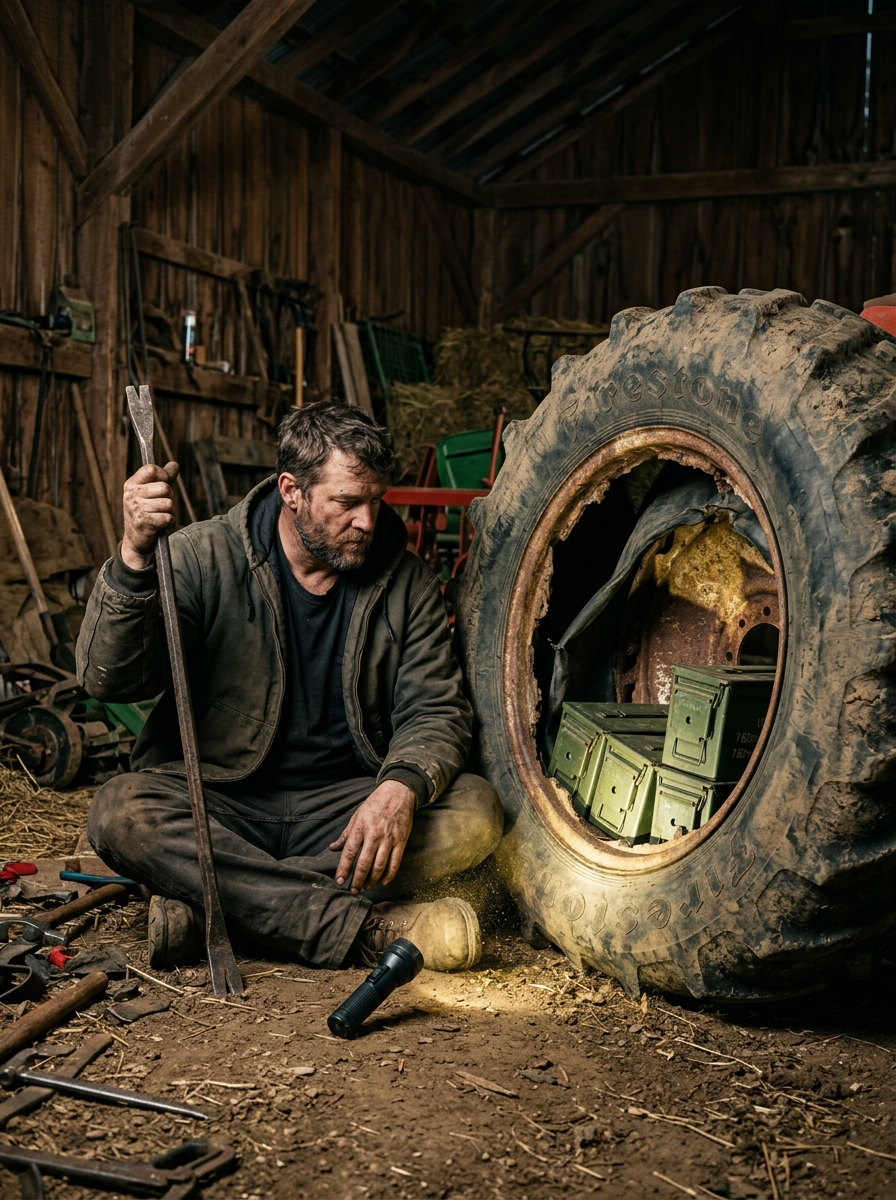
Someone hadn’t just mounted this tire to a tractor wheel. They had turned it into an airtight, rolling vault.
I grabbed a five-foot steel pry bar, a can of penetrating oil, and a pair of heavy bead-breaker clamps from my service truck. For two straight hours, under the harsh glow of an overhead halogen work light, I pounded, levered, and sweat through my shirt, fighting the hardened rubber.
With a loud, resounding *pop* that echoed off the barn rafters, the heavy bead finally gave way, slipping off the steel lip and exposing the hollow interior cavity of the wheel.
I wiped the sweat from my forehead, lifted my flashlight, and shined the beam down into the gap.
Tucked snugly around the deep center channel of the rim were six heavy-gauge steel olive-drab ammunition boxes.
They were clamped tightly to the steel wheel with heavy copper straps, customized so that as the tire rolled, the contents would remain completely motionless inside the hollow rubber wall.
My hands were shaking slightly as I reached down into the dark cavity, unlatched the nearest copper strap, and lifted the first steel box out onto the dirt floor.
PART 2
The ammo can was cool to the touch and completely sealed against moisture with a thick bead of silicone around the rubber gasket.
I popped the heavy metal latch and lifted the lid.
Inside, protected by layers of oiled cotton cloth and silica gel packets, was not a hoard of gold bars or stacks of hundred-dollar bills, as my mind had briefly imagined. Instead, the container held three thick leather-bound journals, a manila envelope sealed with red wax, and a stack of black-and-white photographs wrapped in clear plastic.
I pulled out the manila envelope first. Written across the front in sharp, deliberate cursive was a single name: *For Chloe.*
My breath hitched in my chest.
Chloe Vance—now Chloe Reynolds—was thirty-six years old. She ran the local diner on Main Street in town. Everyone in Haskell County knew Chloe’s story, or at least the version of it that had circulated for thirty years.
Back in 1988, when Chloe was just six years old, her mother, Sarah Vance, had vanished overnight from the farm. The local sheriff’s department had conducted a brief investigation, but Arthur Vance had refused to speak to reporters, refused to offer a reward, and had sent six-year-old Chloe to live with her maternal aunt in Denver just three weeks later.
For three decades, the prevailing town gossip was that Arthur Vance was a cold, bitter man who had either driven his young wife away or done something far worse, eventually abandoning his only daughter to live out his life as a hermit on his deteriorating farm. Chloe had returned to Sublette eight years ago after her aunt passed away, opening the diner, but she had never once been seen visiting her father’s farm on Willow Road.
I set the envelope gently on my workbench and opened the top leather journal. The first page was dated *October 14, 1984*.
> *”If anyone is reading this, it means I am either dead or the bank has finally taken the dirt out from under my feet. I am hiding these records where no search warrant or greedy relative will ever look—inside the drive wheel of the old 4020 tractor parked in the lower shed.”*
I turned the pages slowly, my eyes scanning the tight, precise handwriting of a man writing under immense emotional strain.
> *”Sarah didn’t run away. And I didn’t drive her off. Sarah’s brother, Raymond, was involved with loan sharks out of Kansas City who were using his trucking business to move stolen farm equipment. When Raymond couldn’t pay his debts in the fall of 88, those men came to the farm looking for him while I was in town buying fertilizer. They took Sarah from the kitchen to force Raymond to hand over his titles.”*
My heart hammered against my ribs as I read further.
Arthur had returned home that afternoon in 1988 to find the kitchen door kicked off its hinges and his wife gone. But instead of calling the county sheriff—who, as Arthur documented in explicit detail over twenty pages of bank statements and recorded phone transcripts, was actively receiving monthly payoffs from Raymond’s illicit freight ring—Arthur had taken matters into his own hands.
He had spent six months hunting down the men responsible, quietly collecting names, cancelled checks, and wire transfers that proved a massive network of rural extortion that stretched across three counties. But when he realized how deep the corruption ran, he knew his six-year-old daughter Chloe was in immediate physical danger if he pressed formal charges.
So, Arthur made a devastating, heartbreaking choice.
He deliberately played the villain. He sent Chloe away to her aunt in Colorado, cut off all visible contact to keep her completely invisible to his enemies, and spent the next thirty-five years living in complete isolation, quietly accumulating evidence and paying off every cent of his brother-in-law’s debts in secret to ensure no one would ever hunt down his daughter.
The remaining five ammo cans inside the tractor tire contained complete financial ledgers, original bank receipts showing over $180,000 paid out over thirty years to protect Chloe, and dozens of un-sent birthday cards filled with crisp fifty-dollar bills for every year of her life from 1988 to 2023.
Arthur hadn’t been a monster who abandoned his child. He had spent his entire life living as a pariah in his own town, allowing everyone to hate him, just to keep his daughter breathing.
PART 3
I sat on the dirt floor of my barn until midnight, reading through every single journal, every bank transfer, and every un-mailed birthday card.
The weight of what I was holding was staggering. The bank had declared Arthur’s estate insolvent, the town had remembered him as a cold-hearted miser, and his daughter, Chloe, was currently sitting in her quiet house three miles away, carrying thirty-six years of belief that her father had never loved her.
I didn’t sleep that night. At seven o’clock on Sunday morning, I packed all six steel ammunition boxes into a wooden crate, loaded it into the cab of my pickup truck, and drove into town.
The *Prairie Rose Diner* was just opening its doors for the breakfast crowd. The smell of fresh coffee and bacon filled the air as I pushed open the glass door.
Chloe was behind the counter, dressed in a faded navy apron, tying her dark hair back into a ponytail. She looked tired, the subtle lines around her eyes reflecting a life spent working hard for every dollar.
“Morning, Marcus,” she said with a faint, polite smile as she set a mug on the counter. “You’re early today. Just coffee, or are you hungry?”
“I don’t need coffee today, Chloe,” I said gently, setting the wooden crate down onto the laminate counter between us. “I need you to come sit down in the back booth with me for a minute.”
Chloe frowned, looking at the heavy wooden box and then up at my face. “Marcus, what is this? I’m opening the kitchen—”
“I was scrapping out your father’s farm yesterday,” I said quietly, keeping my voice low so the cook in the back wouldn’t hear. “The bank let me take the old machinery in the lower shed. I found something inside one of the tractor tires.”
At the mention of her father, Chloe’s face instantly hardened, her posture turning stiff and defensive. “I don’t care what was on that farm, Marcus. Arthur Vance was no father to me. He let my mother walk out, he shipped me off to Denver when I was six years old, and he didn’t call me once in thirty years. Whatever junk he left behind, you can throw it in the scrap heap.”
She turned toward the coffee pot, her hands visibly trembling.
“Chloe, please,” I said, leaning closer. “Your mother didn’t walk out on you. And your father didn’t send you away because he didn’t care. He sent you away because he was keeping you alive.”
Chloe froze, her hand hovering over the glass coffee carafe. She turned around slowly, her blue eyes wide with a mix of shock, anger, and deep-seated pain. “What did you say?”
I opened the top lid of the crate, pulled out the manila envelope sealed with red wax, and set it directly in front of her. Beside it, I laid out three un-mailed birthday cards—dated 1989, 1998, and 2012—each bearing her name in Arthur’s sharp, distinctive handwriting.
“He hid six steel boxes inside the rear tire of his 4020 tractor in 1988,” I whispered. “He spent thirty-five years paying off the debts that threatened your life, and he documented every single penny. He lived like a pauper in that house so that when he died, there would be undeniable proof of what really happened to your mother.”
Chloe stared down at the wax-sealed envelope. Her breath came in short, jagged hitches as she recognized her father’s handwriting on the paper.
“Sit down, Chloe,” I said softly, sliding into the booth. “Read the first journal. I’ll stay right here with you.”
ENDING
For two hours, while the morning sun slowly crossed the diner windows and the town outside woke up, Chloe Reynolds sat in the corner booth, reading her father’s words.
I watched her face transform. The cold, defensive wall she had built around her heart for three decades slowly cracked and crumbled with every page she turned. Tears tracked silently down her cheeks, dripping onto the yellowed pages of Arthur’s 1988 journal as she read his desperate, loving accounting of why he had made himself a ghost to save her life.
When she opened the un-mailed birthday cards and found thirty-five years of private, quiet notes—each one detailing how he had watched her from afar, how proud he was when she bought the diner, and how much he missed her every single day—she covered her face with her hands and sobbed with a depth of emotion that echoed through the quiet diner.
“He loved me,” she whispered, looking up at me through a blur of tears, her hand clutching the 1995 card to her chest. “All those years… he wasn’t rejecting me. He was protecting me.”
“He never stopped protecting you, Chloe,” I said softly.
Over the next three months, the truth about Arthur Vance swept through Haskell County like a quiet, cleansing wind.
Chloe took the journals and financial records to the Kansas State Bureau of Investigation in Topeka. The evidence Arthur had painstakingly preserved inside that tractor tire cleared his wife’s memory, exposed the historical corruption of the former county officials, and completely dismantled the old rumors that had tarnished the Vance name for thirty-six years.
Chloe used the contents of the un-mailed birthday cards and the estate restitution funds recovered by the state to buy back eighty acres of her family’s original homestead from the bank.
She didn’t tear down the old barn. Instead, she had the rusted green 4020 John Deere tractor fully restored, placing it prominently in the front yard near the driveway as a monument to her father’s incredible, silent sacrifice.
Last month, Chloe invited me out to the farm for Sunday dinner.
As we sat on the porch drinking sweet tea, looking out over the green wheat fields swaying in the Kansas breeze, she looked over at the newly painted tractor sitting by the oak tree.
“You know, Marcus,” she said softly, a warm, peaceful smile touching her eyes. “People in town used to look at that old farm and see nothing but junk and abandoned lives. But now I look out here and I see the truth.”
She reached over, squeezing my hand with deep gratitude.
“Sometimes,” she whispered, “the greatest love stories aren’t the ones told out loud for everyone to hear. They’re the ones hidden in the quietest, darkest places, waiting for the right moment to finally bring a daughter home.”